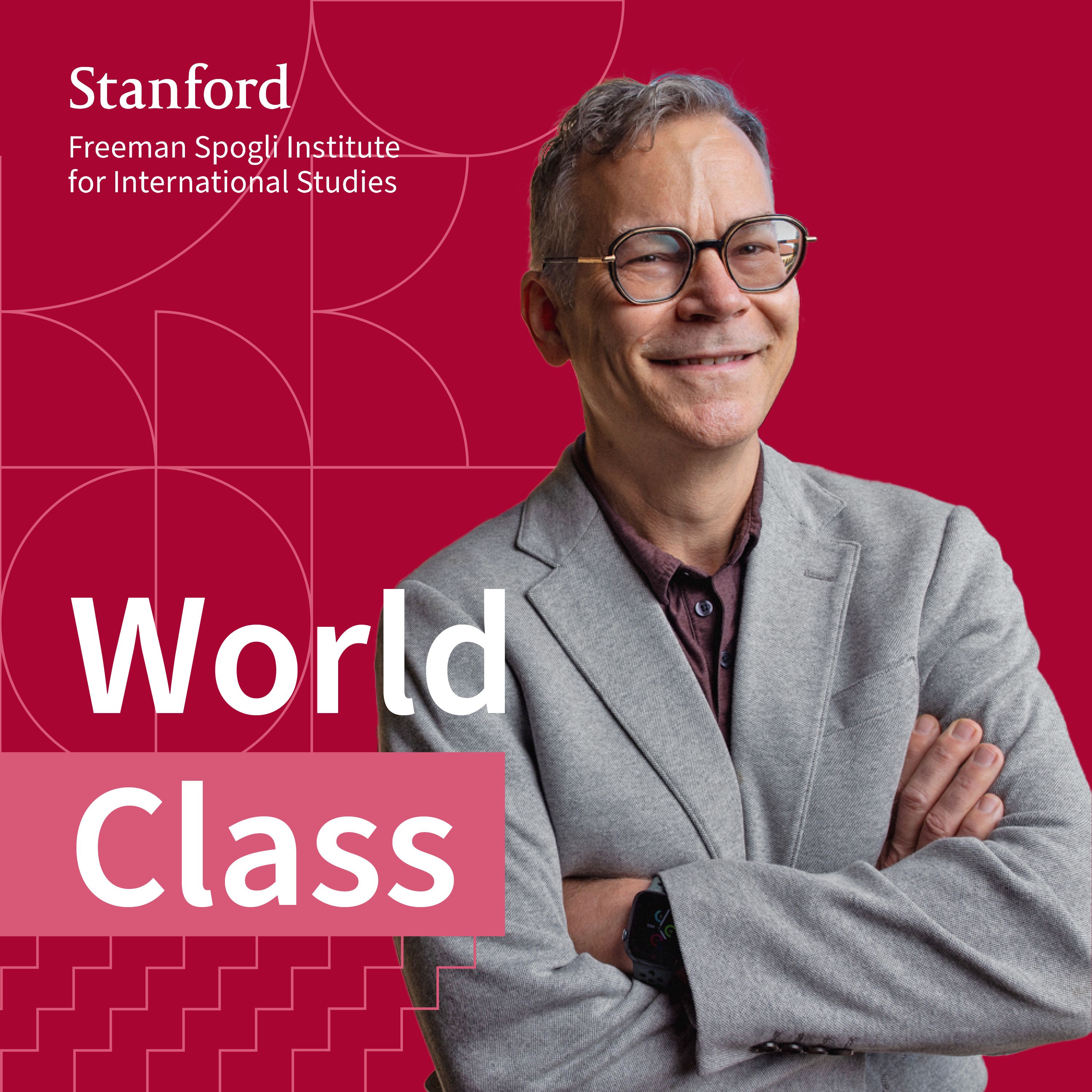
Freeman Spogli Institute for International Studies, Stanford University
World Class
Podcast from the Freeman Spogli Institute for International Studies (FSI) at Stanford University, featuring Director Colin Kahl, former under secretary of defense for policy at the U.S. Department of Defense. Colin and his guests dive into critical international issues, offering insights into the history and context of the biggest stories in the news.
Be sure to visit the podcast's website and support the creator: fsi.stanford.edu
Author
Freeman Spogli Institute for International Studies, Stanford University
Category
Podcast website
Latest episode
May 21, 2026
Where to listen?
Podcasts in the app Replaio Radio Coming soonPodcasts are coming to the app soon. Install now and be the first to see a whole new take on podcasts
 Install for free
Android almost 10M downloads · 4.8 rating
iOS soon
Install for free
Android almost 10M downloads · 4.8 rating
iOS soon
Episodes
What if "the people" are a threat to democracy? 08.06.2018 23:01
What exactly is populism and why is it suddenly everywhere? Are the different movements around the world connected to each other, or are they popping up independently? What are the underlying conditions that give rise to populism, and what risks does it present to democracy? Anna Gryzmala-Busse is a senior fellow at FSI and the new director of our Europe Center. Together with Michael McFaul and Fr...
Larry Diamond with Cambodian Human Rights Activist Mu Sochua 01.06.2018 28:01
Fears are growing that Cambodia is coming under authoritarian rule. Prime Minister Hun Sen, the world’s longest-serving government leader, has dissolved the opposition party and started arresting its leadership in September 2017. Deputy opposition leader and human rights activist Mu Sochua, fearing imprisonment herself, went into exile last October. In this conversation with FSI senior fellow Larr...
From Cold War to Hot Peace: Michael McFaul on his new book 25.05.2018 26:19
Michael McFaul, director of FSI, former US ambassador to Russia, and host of World Class, has a new book out. It's called From Cold War to Hot Peace, and it offers an unparalleled perspective on US–Russia relations. In this conversation with FSI's deputy director Kathryn Stoner, herself a Russia expert who has co-authored two books with Amb. McFaul, he shares the story of how he first became inter...
Sir Nick Clegg on Brexit, with host Gerhard Casper 18.05.2018 36:58
Is it too late to stop Brexit? As the deadline for exiting approaches, what are the pros and cons of trying to halt Brexit at this late juncture? Regardless of what happens, what might we expect for the future relationship between the United Kingdom and the European Union? In this conversation Sir Nick Clegg, former Deputy Prime Minister from 2010-2015, sits down with former Stanford president and...
Armenia's new leadership: How did we get here? 11.05.2018 25:57
Armenia is in a state of transition. Peaceful protests led by Nikol Pashinyan have dislodged Serzh Sargsyan from his seat of power, and suddenly the country looks poised for dramatic change. Is this a grassroots movement, or are outside forces pulling the strings? What's the role of social media in all this? And why now, exactly? To take stock of these fast moving developments, we're joined by FSI...
Turbulence in Taiwan 04.05.2018 23:42
Since the 1980s, Taiwan has been a model of democracy in East Asia, but there are challenges on the horizon. Domestically, Taiwan is experiencing slow economic growth and a polarized electorate. Meanwhile across the region leaders are navigating tensions on the Korean peninsula, disputes in the South China Sea, and the possibility of a US-China trade war. In this conversation, former president of...
Democracy at Risk in Kenya 27.04.2018 35:37
Kenya is in a state of polarization, and its democracy is at risk. Maina Kiai was the United Nations Special Rapporteur on the rights to freedom of peaceful assembly and of association from 2011 – 2017, and in this conversation with FSI's Larry Diamond he discusses Kenya’s 2017 disputed presidential election. The stakes are high. As Kiai wrote last year, "Elections in Kenya are not a civil po...
How do you stop a pandemic in the middle of a war? on "World Class with Michael McFaul" 20.04.2018 20:48
When we think of health in conflict zones, we usually think of the victims of violence. But more people can die due to other healthcare disruptions than they do from combat wounds. War-torn states are vulnerable to malnutrition, contaminated water, and – most terrifying – outbreaks such as Ebola and Zika. If physicians can't do their work, the wrong set of conditions could set off a global pandemi...
Why Can’t We Feed the World? 13.04.2018 59:03
Dealing with world hunger has never been easy, but in recent years the challenge has less to do with natural disasters and much more to do with human conflict. In this lecture, Ertharin Cousin, former director of the World Food Programme and a visiting scholar at FSI’s Center on Food Security and the Environment, reflects on her experiences and identifies key strategies for helping to end world hu...
Doctors in the Crosshairs 06.04.2018 1:12:35
Medical and humanitarian workers are increasingly in the crosshairs as hospitals and aid centers have become part of the battlefield in today's wars. In this panel discussion, the producers of the new documentary, The New Barbarianism, and FSI faculty discuss this crisis, its causes, the limited international response and possible ways forward. They build off the film, a CSIS Global Health Policy...
When the War Next Door Reaches You, on "World Class with Michael McFaul" 30.03.2018 22:45
When jihadists get involved in civil wars, they push the conflict well beyond its original borders. Since 1990, the rate of jihadist involvement in civil conflict has jumped from 5% to 40%. What's changed? FSI senior fellow Martha Crenshaw, a counterterrorism expert, tells FSI director Michael McFaul how jihadism has grown in the last 30 years and how terrorism and civil wars affect each other. Cr...
Why Does My Colonoscopy Cost so Much? 24.03.2018 24:01
Ever wonder how Medicare pricing works? It affects us all more than you might think. Prices for procedures set by Medicare often trickle over to the private sector, so Medicare effectively sets the cost of procedures for the health-care market as a whole. David Chan and Jay Bhattacharya explain how an independent committee gives recommendations on how much each procedure will cost. Because the com...
Can Liberal Democracy Survive Modern Technology? 16.03.2018 44:28
Technology is threatening liberal democracy, say Toomas Hendrik Ilves and Francis Fukuyama. The internet has revolutionized society, but too often it is exploited by authoritarian leaders and populist groups. Fake news breeds more partisanship and disunity. Governments can do more to combat this, but there is a fine line between sensible regulation and encroaching on free speech. For instance, Chi...
Telegrams from Tehran on "World Class with Michael McFaul" 10.03.2018 26:00
The way Iranians interact with their government is changing. With information more readily available through the internet, it is easier for citizens to organize protests but also to make an impact without leaving home. Since the Iranian Green Movement in 2009, the political elite has changed dramatically, but a small, stagnant group at the top still holds the most influence. Mehdi Yahyanejad, a se...
Government Can't Save Us from Cyberattacks, but Facebook Can 02.03.2018 23:50
The 2016 cyber campaign to influence the U.S. election has been well documented, but represents only a fraction of what information technology makes possible. Drawing on extensive experience in both the private and public sectors, Paul Stockton, the managing director of Sonecon, outlines how foreign adversaries might use information operations for an increasing number of alarming purposes, sowing...
The Modern Civil War 24.02.2018 22:37
Civil wars have changed. In the last 20 years, the average duration has increased and organizations like the UN have had a harder time keeping the peace. This has been particularly true in the Middle East and North Africa where most peace-keeping and state-building efforts have failed. James "Jim" Fearon, an FSI senior fellow, tells us why civil wars have changed. Fearon is one of eight...
Revolutionizing Africa's Food Systems 16.02.2018 1:34:01
Ertharin Cousin, the former Executive Director of the United Nation's World Food Programme, leads a panel discussion on the future of African agriculture. African political leaders from the Alliance for a Green Revolution in Africa concur that more private industry and technological advancement is needed for the continent. Given that famine and corruption is still all too common, African governmen...
The Baltics Are Back 09.02.2018 1:18:06
Countries created after the Soviet Union dissolved provide a unique window into state development. The Baltic states — Estonia, Latvia, and Lithuania — have emerged as geopolitical and economic leaders in Eastern Europe. Former President of Estonia and FSI Affiliate Toomas Hendrik Ilves and FSI Director Michael McFaul discuss the reasons for these states’ unlikely success, delve into Estonian hist...
The Facts on Climate Change on "World Class with Michael McFaul" 02.02.2018 23:31
Looking for a reliable source on climate change? Marshall Burke is an assistant professor in the Department of Earth System Science at Stanford University and an FSE fellow. He has studied climate change extensively throughout his career. He tells FSI Director Michael McFaul how the world has already warmed one degree Celsius since pre-industrial times, causing more extreme weather events, a small...
America as a Defender of Democracy with Robert Kagan 26.01.2018 1:20:22
The liberal world order that arose after World War II did not occur because of the intellectual superiority of liberal ideas, argues Dr. Robert Kagan, a senior fellow at the Brookings Institution. Instead, it was the military and geopolitical might of the United States that converted countries like Germany and Japan into Western-style democracies. However, in today's world, Kagan believes the Unit...
Are Protests in Iran Here to Stay? on "World Class with Michael McFaul" 20.01.2018 22:15
With double-digit unemployment, widespread corruption and inequality, and a youth population ready for change, the recent protests in Iran are no surprise, says Abbas Milani, Stanford’s Hamid and Christina Moghadam Director of Iranian Studies. After arresting more than 3,700 protesters, the Iranian regime has quelled the demonstrations for now. Should we expect more, or will the government succeed...
The State of the Constitution on "World Class with Michael McFaul" 12.01.2018 21:04
How has the United States Constitution been holding up during President Trump's first year in office? Pretty well, says constitutional law expert Gerhard Casper. The three branches of government are still operating independently, and President Trump has actually scaled back the power of his branch by overturning some of President Obama’s executive orders. The American people are politically engage...
Terrorism, Refugees and Pandemics 22.12.2017 26:47
Civil wars are getting longer, and their consequences are starting to seep across borders to threaten other countries and, sometimes, the rest of the world. In this first episode of our series on civil wars, Karl Eikenberry and Stephen Krasner talk about how war is changing and why we need to address it. In their project on confronting civil war threats, Eikenberry and Krasner gathered experts fro...
Karl Eikenberry: China's Arrival as a World Power on "World Class with Michael McFaul" 15.12.2017 24:37
For years, people around the world have hailed China as a rising power. Those days are over: China has arrived. At the October 2017 Communist Party Congress, President Xi Jinping was the first Chinese leader to acknowledge China’s strength as a “great” power. What will this mean for the United States and other countries around the world? Former Lieutenant General in the U.S. Army and Ambassador to...
Ambassador Anatoly Antonov: The U.S. and Russia 08.12.2017 1:10:41
U.S.-Russian relations have reached their lowest point since the Cold War. Amidst accusations that the Russian government interfered in the 2016 U.S. presidential election and Russian frustration with NATO, dialogue between the two powers has become increasingly strained. Anatoly Antonov, Russian Ambassador to the United States, talks about what might be done to mend relations between the two coun...
Similar podcasts




Listen to the World Class podcast in Replaio
Radio and podcasts in one app - free, with no sign-up. Install today and do not miss the launch
Replaio is not a podcast publisher; show names, artwork and audio belong to their authors and are distributed through public RSS feeds.