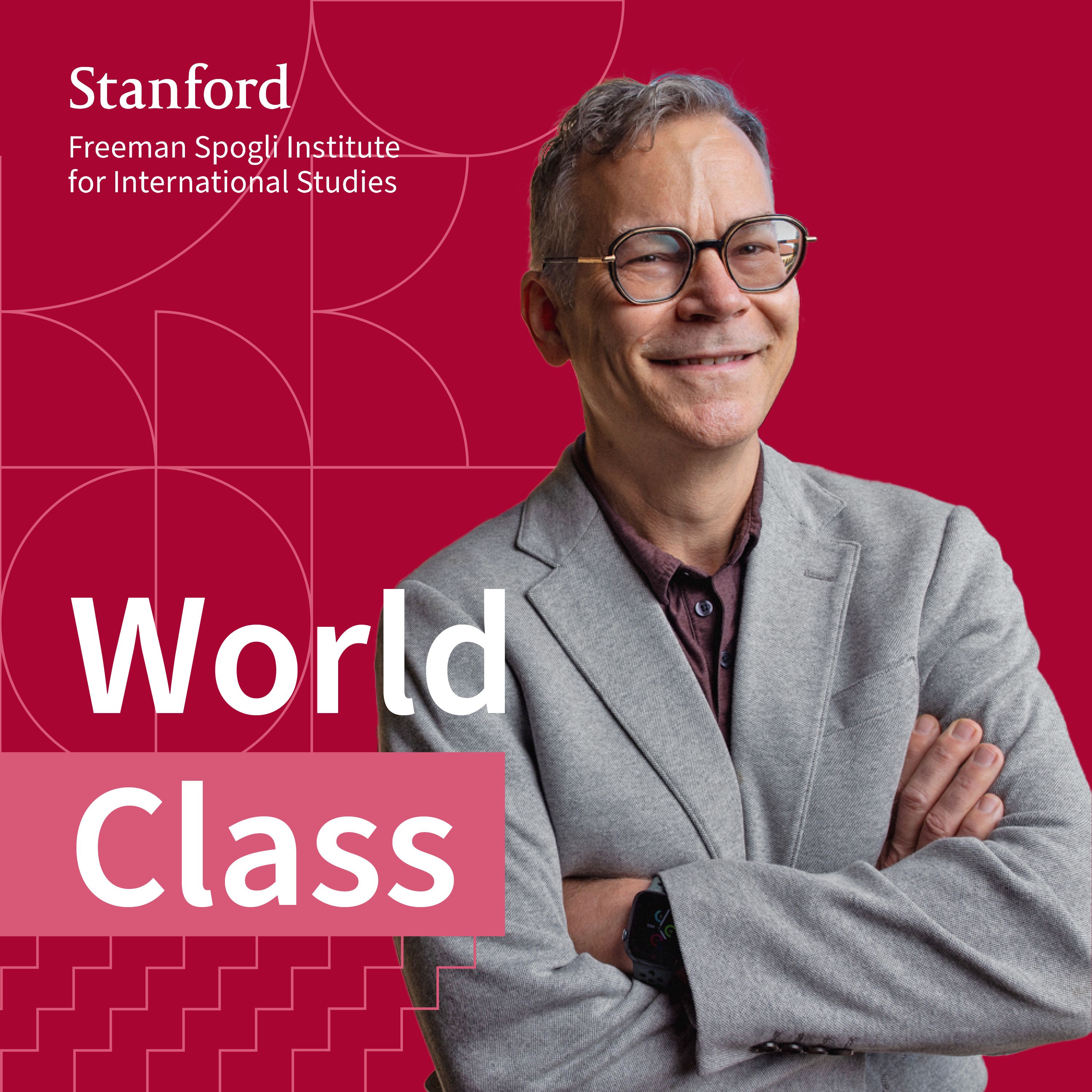
Freeman Spogli Institute for International Studies, Stanford University
World Class
Podcast from the Freeman Spogli Institute for International Studies (FSI) at Stanford University, featuring Director Colin Kahl, former under secretary of defense for policy at the U.S. Department of Defense. Colin and his guests dive into critical international issues, offering insights into the history and context of the biggest stories in the news.
Be sure to visit the podcast's website and support the creator: fsi.stanford.edu
Author
Freeman Spogli Institute for International Studies, Stanford University
Category
Podcast website
Latest episode
May 21, 2026
Where to listen?
Podcasts in the app Replaio Radio Coming soonPodcasts are coming to the app soon. Install now and be the first to see a whole new take on podcasts
 Install for free
Android almost 10M downloads · 4.8 rating
iOS soon
Install for free
Android almost 10M downloads · 4.8 rating
iOS soon
Episodes
A Journalist’s Perspective on the Russia Investigation, with Greg Miller 05.04.2019 21:00
Special Counsel Robert Mueller has submitted his report to the Attorney General, but additional investigations into Russia’s interference in the 2016 U.S. election are now expected. Greg Miller and Mike McFaul discuss the challenges that policymakers and journalists face in investigating Russia, and how democracy in the U.S. has fared since 2016. Greg Miller is a national security correspondent fo...
Demystifying the U.S.-North Korea Relationship, with Scott Sagan 20.03.2019 22:57
The United States-North Korea summit in Hanoi, Vietnam, was cut short and did not produce any agreement between the two countries on denuclearization. What does this outcome mean for the prospect of future diplomacy and the potential for armed conflict? Scott Sagan is a professor of political science at Stanford University, and a senior fellow at FSI and the Center for International Security and C...
The Roots of Political Polarization, with Murat Somer 08.03.2019 24:51
There’s a range of issues dividing voters in America today. As it turns out, though, the current polarization is not limited to the U.S. political system. What is triggering polarization, and what is the relationship between polarization and the populist movements underway globally? What, if anything, can be done to alleviate deepening political divides? Murat Somer is a Professor of Political Sci...
The Science of Gun Safety and Violence, with David Studdert 22.02.2019 20:47
Gun violence is one of the most polarizing topics in America, and the gun debate is about to heat up. The Supreme Court has decided to hear a significant gun rights case, and House Democrats recently unveiled a landmark bill requiring background checks. All of this comes in the wake of the worst year for gun deaths in two decades. Gun violence goes beyond homicides – a large share of deaths are at...
How Southeast Asian Nations Balance China-US Relations, with Don Emmerson 08.02.2019 22:27
The economic and diplomatic tensions between the US and China are creating ripple effects across Southeast Asia. China is pursing an aggressive agenda of economic development throughout the region, and while there is undoubtedly a strong need for infrastructure projects, the Chinese strategy could limit the future autonomy of the Southeast Asian nations. If the US-China trade war were to escalate,...
Religion, Rationality, and Democracy, with Dan Edelstein 25.01.2019 21:12
Ever since the the scientific revolution of the 17th century, there has been tension between the institutions of science and religion. This tension between religion and science has a direct effect on governance. After all, the United States was conceived as a system of democratic institutions that valued reason and deliberation. But are religious beliefs and rationality completely at odds with one...
Former Facebook Chief Security Officer Alex Stamos on Russian Election Interference 11.01.2019 23:55
We are still learning the details about Russia’s disinformation and manipulation campaigns during the US 2016 elections. Tech companies have come under intense scrutiny, and, according to former Facebook’s Chief Security Officer Alex Stamos, much of the spotlight on Big Tech is warranted. However, Stamos also argues that our government, the media, and we as citizens all have a role to play in the...
Marshall Burke on the Surprising Relationship between Suicide Rates and Climate Change 28.12.2018 13:47
Climate change is likely to have far reaching impacts, and some consequences are particularly unexpected. In a provocative study, Marshall Burke and his colleagues demonstrate that suicide rates increase on hot days, regardless of other factors. Burke's findings raise significant questions. Are the underlying drivers of this relationship tied to economic forces, or are there human biological facto...
Casper Klynge, Denmark's Ambassador to Silicon Valley 14.12.2018 26:23
Silicon Valley's role in the world is now so big that some people argue the power of tech firms is similar to the powers of a nation-state. So maybe it's not too surprising to learn that Denmark has taken an unusual step, and has dispatched career diplomat Casper Klynge to serve as the world’s first tech ambassador. Klynge's role is to create avenues for dialogue, to work with firms to establish a...
Ambassador Wendy Sherman on negotiating the Iran Nuclear Deal 30.11.2018 26:33
From 2011 to 2015 Ambassador Wendy Sherman was Under Secretary of State for Political Affairs, the fourth-ranking official in the State Department. She was the lead U.S. negotiator on the Iran nuclear deal, and before that she served as policy coordinator on North Korea for President Clinton. She has a new book, Not for the Faint of Heart: Lessons in Courage, Power and Persistence. In this convers...
How Do We Stop a Man-Made Pandemic? with David Relman and Megan Palmer 16.11.2018 23:37
Biosecurity threats are often overlooked. For years scientists have been saying that the world is overdue for a pandemic, and there's an ongoing risk that terrorists or nation states might weaponize diseases. If that's not worrying enough, the risks of pandemics increase as climate change worsens. What steps are we taking to understand and prepare for the next outbreak? David Relman is a senior fe...
Colin Kahl on Khashoggi and Where the US Stands with Saudi Arabia 06.11.2018 22:06
It is now clear that the murder of Washington Post journalist Jamal Khashoggi at the Saudi embassy in Turkey was a pre-planned execution, likely ordered by people at the very top of the Saudi government. The incident has sparked an international outcry, and raises questions about the US’s relationship with the Saudis. What is the underlying nature of the US-Saudi alliance? How has Trump's strategy...
Ambassador Eileen Donahoe on Digital Threats to the Midterm Elections 02.11.2018 22:17
With the US midterms fast approaching, we are still trying to make sense of everything that happened in the 2016 elections. What do we now know about vulnerabilities in our democratic processes? What risks do we face from foreign adversaries? Beyond the US, how are governments around the world adjusting to threats posed by digital technologies? Eileen Donahoe was the first US Ambassador to the Uni...
Francis Fukuyama Explains Identity Politics 19.10.2018 22:44
“Identity politics" has become a driving force in political conversations in the U.S. and abroad, but what exactly is it? Where did it come from, and how will it shape the future of our society? FSI Olivier Nomellini Senior Fellow and CDDRL Mosbacher Director Francis Fukuyama joins host Michael McFaul to explain how his new book, “Identity: The Demand for Dignity and the Politics of Resentmen...
Improving Black Men's Health in a Single Step 05.10.2018 23:36
African American men have the lowest life expectancy of any major demographic group in the U.S. The reasons for this are many and complex, but new research from FSI's Stanford Health Policy suggests that there may be a straightforward solution: hiring doctors who look like the patients they're treating. Dr. Marcella Alsan, an associate professor of medicine at Stanford Health Policy, and her resea...
Who Won the Trump-Kim Summit? 12.09.2018 1:22:39
President Trump says the nuclear threat is behind us, but do the experts agree? Gi-Wook Shin, Scott Sagan, Kathleen Stephens, and Michael McFaul tell us about the winners and losers from the 2018 U.S.-North Korean Summit, what we should worry about, what denuclearization really means, and the eternal question: what comes next? Kathleen Stephens is the former U.S. ambassador to South Korea and a Wi...
Michael McFaul: When Geopolitics Gets Personal 03.08.2018 21:34
What’s it like to have a dictator after you? In the wake of Vladimir Putin’s “request” to interrogate former ambassador and World Class host Michael McFaul, the US public backlash was swift and strong. It’s extremely unlikely that McFaul will be asked to respond to Russian investigators - but many Americans were unnerved at the Trump administration’s response. Where do US-Russia relations stand in...
How to Make a New Country 27.07.2018 20:02
It's not so easy to create a whole new country, and the world map is much more fixed than it used to be. While there are many secessionist and independence movements around the globe, the truth is that international powers are extremely reluctant to redraw borders. Where are the unrecognized states in the world, and what commonalities do they share? What happens when our normal understanding of &q...
A Democracy Divided: The Roots of our Political Polarization 20.07.2018 22:01
The gulf between right and left in America is widening by the day. How long has this been going on, and what can we learn by studying other Western democracies? Didi Kuo is an expert on democratization and political parties. She's a research scholar at the Center on Democracy, Development, and the Rule of Law at FSI, and she has a new book called, Clientelism, Capitalism, and Democracy: The Rise o...
When Your Government Doesn’t Want to Govern 13.07.2018 24:36
The Venezuelan economy is disintegrating, yet president Nicolas Maduro has thus far been successful in squashing his political opposition. How has Maduro been able to remain in power, and what's the best-case scenario for Venezuela's future? We're joined today by Harold Trinkunas to examine the situation in Venezuela since the death of Hugo Chavez. Later in the conversation we also talk with Trink...
Rebroadcast: Both Sides of The Border 06.07.2018 1:21:55
Today's episode is a rebroadcast. In November of 2016, FSI's Center on Democracy, Development & The Rule of Law co-hosted a panel with Stanford's Center for Latin American studies. At this event, Latin scholars, students, and staff at Stanford explored what Donald Trump's election would mean on the US's southern border. Now, almost two years later the analysis and perspectives of our panelists...
Daniel Ellsberg on the continuing nuclear threat – from the US 29.06.2018 40:03
Daniel Ellsberg is well-known for the Pentagon Papers, but few people realize he also has extensive experience with US nuclear weapons policy dating back to the 1950s and 60s. Last year, Ellsberg published a memoir called "The Doomsday Machine," where he argues that US developed immoral and dangerous policies during the Cold War, and that surprisingly little has changed in the years sinc...
Siegfried Hecker on Denuclearization 25.06.2018 23:43
After the June 12th meeting between Kim Jong-un and Donald Trump, the US is pushing for rapid denuclearization. But, even in a best case scenario, what is a realistic timetable? And now that North Korea has nuclear military capabilities, how might the US encourage the North Koreans to develop nuclear energy for their electrical grid instead? Dr. Siegfried Hecker is the former director of the Los A...
Robin Hood isn’t coming: Why democracies don’t always correct income inequality 22.06.2018 28:23
As income inequality soars, we expect democracies to correct it with higher taxes on the rich. But time and again, the average voter rejects this idea at the ballot box. Why does this happen? In a country founded on the ideal that we are all equal, who gets to decide what’s fair? We talk with Professor Kenneth Scheve, an FSI senior fellow and professor of political science, about our ideas of fair...
Former Ambassadors Kathleen Stephens and Michael McFaul on the North Korea Summit 15.06.2018 26:28
Kim Jong-un and Donald Trump met in Singapore on June 12th, and everyone is still working to make sense of the meeting. What led up to this meeting, what are the key takeaways from the summit itself, and what can we expect going forward? Former South Korean Ambassador Kathleen Stephens, who is also the William J. Perry Fellow at FSI’s Shorenstein Asia-Pacific Research Center at FSI, joins FSI Di...
Similar podcasts





Listen to the World Class podcast in Replaio
Radio and podcasts in one app - free, with no sign-up. Install today and do not miss the launch
Replaio is not a podcast publisher; show names, artwork and audio belong to their authors and are distributed through public RSS feeds.