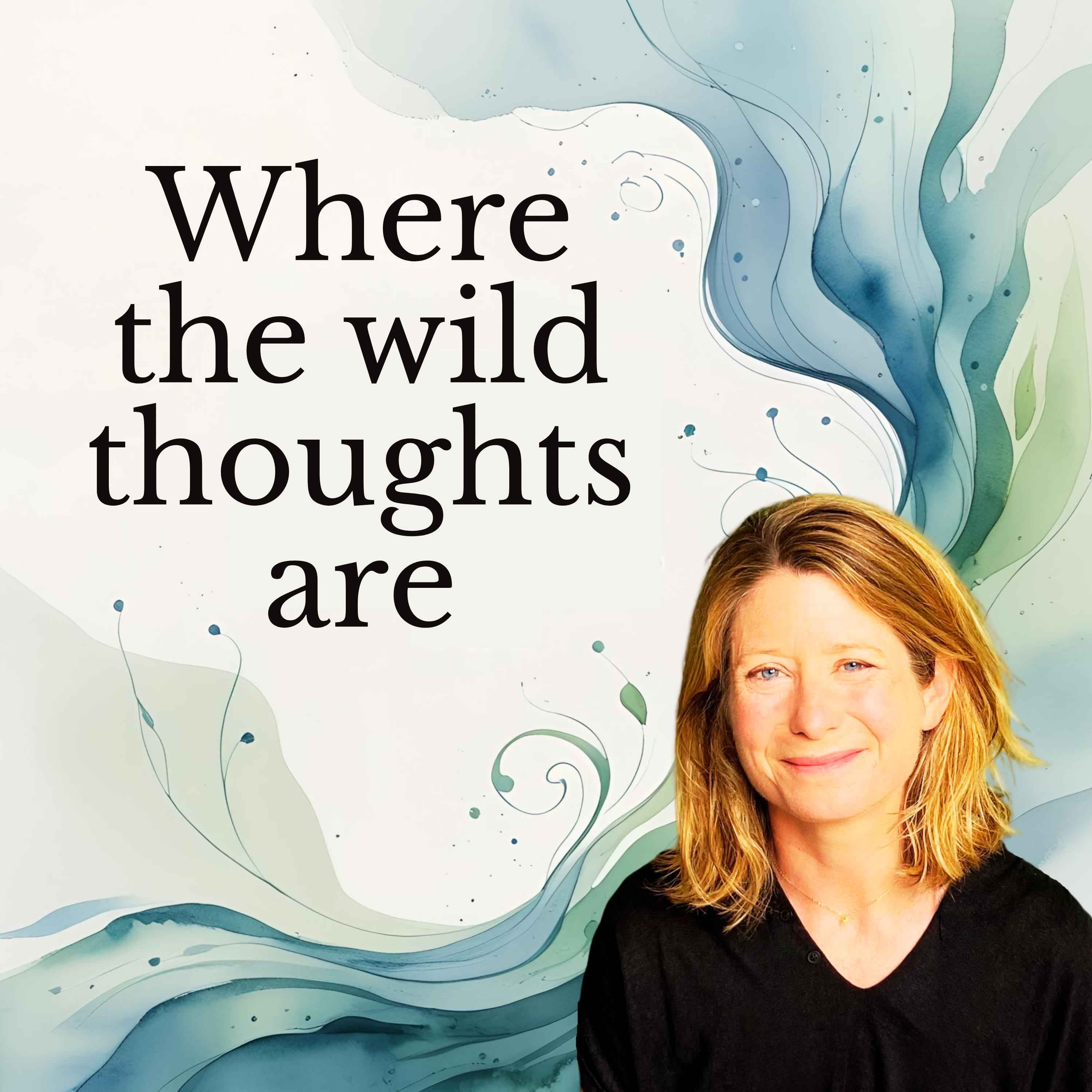
Jo Marchant
Where The Wild Thoughts Are
We’re talking about science. But not just any science... Each episode, journalist Jo Marchant meets researchers who are doing things differently : challenging our assumptions , stretching our minds , and changing how we see the world. We’ll be pushing boundaries from cosmology and quantum physics to neuroscience, archaeology, ecology… Jo’s guests are asking deep questions, chasing outrageous dreams, and exploring the world in completely new ways. As well as learning about their pioneering ideas, we’ll hear their personal stories: what inspires their leaps of imagination; how they keep going de...
Where to listen?
Podcasts in the app Replaio Radio Coming soonPodcasts are coming to the app soon. Install now and be the first to see a whole new take on podcasts
 Install for free
Android 5M+ downloads · 4.8 rating
iOS soon
Install for free
Android 5M+ downloads · 4.8 rating
iOS soon
Episodes
What is 'Now'? 16.02.2026 54:14
Exciting news: I have a new book coming out! It’s called In Search of Now: the science and mystery of the present moment , and I’d love to share some of the ideas in it with you, so here is a one-off special episode to ask: What is Now? The present moment has always fascinated me because on the one hand it’s all around us: everything we do, everything we are. We feel that Now is where we mee...
End of season special 08.12.2025 48:36
Since September we've met 16 scientists, in fields from neuroscience and quantum physics to archaeology and ecology, who are asking wild questions, exploring the world in different ways, wondering what if the world isn't how we thought. They've all been surprising, brilliant and creative in different ways: for me, each chat has been like a glimpse into a fascinating, hidden world. To finish the se...
Can we hear the secret life of ponds? 01.12.2025 36:37
What happens if we let go of our expectations about nature – all the things we think it is, or isn’t, or should be – and just… listen? Our guide into the unknown this week is award-winning sound artist and ecologist David de la Haye. I first met him at this year’s New Scientist Live in London: I was giving a talk about the science of awe and David came up to me afterwards to tell me about the awe...
How does the moon shape biology? 24.11.2025 47:51
People have long told stories about the moon’s power, from werewolves shapeshifting by the moon, to the belief that drinking water soaked with moonlight could help women conceive. And monthly rhythms appear across nature, from corals and cacti to gorillas. But while there's lots of research showing that the daily cycles of the sun are crucial for biology, scientists have largely ignored the r...
Can slow AI make us more human? 17.11.2025 35:38
How does using AI change who we are? Last week on Where the Wild Thoughts Are, we talked about freeing AIs to have their own creative ideas and express their own realities. This week we’re flipping that theme, with philosopher Caterina Moruzzi of Edinburgh College of Art, to explore how people and AIs work together, and what that relationship does to us as humans. There’s evidence that when we use...
Can AI reveal its true self through art? 10.11.2025 41:19
Can an AI have wild thoughts? Are machines capable of true creativity, true art, of going beyond the training and the prompts we give them in order to explore new worlds? My guest this week is Simon Colton of Queen Mary, University of London. He’s a professor of computational creativity who has been working towards this goal for decades, and he thinks the answer is yes… but only if we give AIs the...
What was Einstein's 'cosmic religion'? 03.11.2025 56:50
Thinkers don’t come much wilder than Albert Einstein. His out-of-the-box physics transformed how we think about the universe: with his famous equation E=mc2 he showed that energy and matter are one and the same; through his theory of relativity he joined space and time into one malleable fabric that can morph according to your point of view. But we’re talking about a very different side to Einstei...
What happens when consciousness meets chaos? 27.10.2025 54:02
Standing waves and resonant frequencies appear everywhere in the world around us, from musical notes and swaying bridges to electron orbits and animal coats. This week's guest, neuroscientist Selen Atasoy, wondered if they could also be found in the brain. Her work has led to a new way to understand different states of consciousness -- from anaesthesia through our normal waking state to meditation...
What awakened at Göbekli Tepe? 20.10.2025 52:35
Steady your nerves and light up your torches, because this week we’re clambering into the deep, dark Neolithic underworld with archaeologist Jens Notroff. Jens, of the German Archaeological Institute, has spent years excavating one of the world’s most fascinating and mysterious prehistoric sites – Göbekli Tepe in southeastern Turkey. This is a series of circular stone enclosures, featuring giant T...
Can life transcend physics? 13.10.2025 51:14
We’re talking about life, the universe and everything – literally! My guest is cosmologist Marina Cortês of the University of Lisbon. Marina trained as a dancer before helping to shake up cosmology with some revolutionary ideas about the nature of time. As if that wasn’t enough – she’s now using the tools of theoretical physics to investigate the significance of life in the universe, in a n...
Why do placebos work? 06.10.2025 46:01
Placebo effects are not about expectation, or positive thinking, and you don’t have to believe you’re taking a real drug to feel better. In fact, they are not in your mind at all, but your body . This is what self-confessed ‘deviant’ Ted Kaptchuk wants you to know, after conducting decades of research that has shocked the medical establishment and turned upside down conventional thinking abou...
Can we talk to whales? 29.09.2025 53:26
We're diving into the world of whales - as well as dolphins and other cetaceans - with biologist and filmmaker Tom Mustill, author of the fascinating book How to Speak Whale . I first learned about Tom’s work in 2023 when I attended a talk he gave at the British Library, and he began with the story of how on a kayaking trip he was almost crushed by a breaching humpback whale. After that exp...
Can we sense magnetic fields? 22.09.2025 41:33
We're digging into how living creatures – including us – sense and respond to magnetic fields with quantum biologist Margaret Ahmad of the University of Sorbonne in Paris. For decades, biologists knew about striking examples of species apparently navigating by Earth’s magnetic field, from monarch butterflies to loggerhead turtles to racing pigeons. Yet for years, many physicists said any ‘m...
How do you read a library turned to ash? 15.09.2025 54:11
We're delving into one of the ancient world's biggest mysteries: the Herculaneum scrolls. Computer scientist Brent Seales of the University of Kentucky talks about a journey that has taken him from Mars to Beowulf to the Dead Sea and beyond. AI has been key to finally reading what's inside the scrolls -- but this is a story about human ingenuity, and what it takes to make an impossible dream come...
Can epilepsy reveal the secrets of perception? 08.09.2025 34:31
We’re exploring the secrets of bliss – with neurologist and epilepsy specialist Fabienne Picard of the Medical School of Geneva. Fabienne became fascinated by a rare condition called “ecstatic seizure” after reading the work of 19th century Russian novelist Fyodor Dostoevsky. He used his own experiences with epilepsy as inspiration, in particular a profound and intriguing feeling that...
Is there life on Venus? 01.09.2025 41:12
In the search for alien life, we don’t always hear much about Venus. There’s a lot of effort going into detecting possible signs of life on Mars, and looking for potentially habitable planets beyond our solar system. Venus seems a crazy place to look for aliens: its surface is burning hot, hot enough to melt lead; and it has clouds made of concentrated acid. But could a very different kind of life...
What if there are no laws of physics? 01.09.2025 57:32
When physicists investigate the very smallest components of reality – atoms and subatomic particles – they famously find all sorts of things that make no sense. Particles can apparently be in different places at once, and they have different properties depending on how we measure them. Spooky effects seem to act instantaneously, across vast distances. The decisions we make can even alter journeys...
Can plants think? 01.09.2025 47:01
In this first episode of Where the Wild Thoughts Are, I chat to Paco Calvo, prof of cognitive science from the University of Murcia in Spain. He’s author of the fascinating Planta sapiens: Unmasking Plant Intelligence , and he researches the neurobiology of plants . From bean plants searching out supports to climb up, to parasitic vines chasing down prey, to slow-growing oak trees, Paco is convinc...
Where The Wild Thoughts Are - Coming soon 01.08.2025 3:21
Listen to some clips from Jo Marchant's new science podcast in which she interviews scientists who are asking deep questions, chasing outrageous dreams, and exploring the world in completely new ways. Hosted on Acast. See acast.com/privacy for more information.
Similar podcasts







Listen to the Where The Wild Thoughts Are podcast in Replaio
Radio and podcasts in one app - free, with no sign-up. Install today and do not miss the launch
Replaio is not a podcast publisher; show names, artwork and audio belong to their authors and are distributed through public RSS feeds.