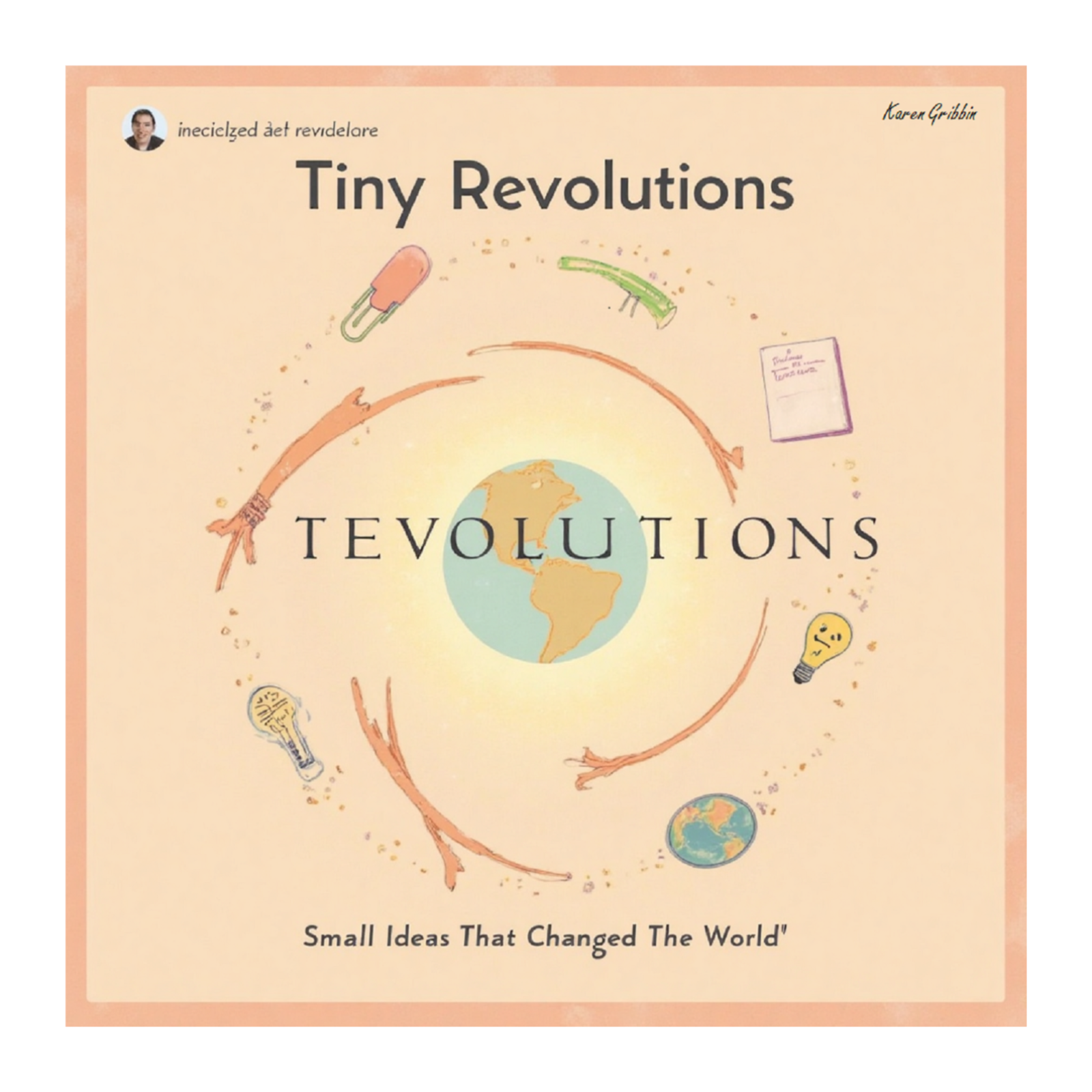
Karen Gribbin
Tiny Revolutions: Small Ideas That Changed the World
Sometimes, the smallest ideas spark the biggest changes. Tiny Revolutions is a podcast about the humble inventions, unnoticed habits, and small flashes of creativity that quietly transformed the way we live — from the paperclip to the emoji, from the safety pin to the coffee filter. Each episode reveals the story behind a seemingly simple idea: who created it, how it spread, and why it changed the world in ways no one expected. Blending history, creativity, and everyday life , this series celebrates the inventors, thinkers, and even accidents that made our daily world what it is today.
Be sure to visit the podcast's website and support the creator: rss.com
Where to listen?
Podcasts in the app Replaio Radio Coming soonPodcasts are coming to the app soon. Install now and be the first to see a whole new take on podcasts
 Install for free
Android almost 10M downloads · 4.8 rating
iOS soon
Install for free
Android almost 10M downloads · 4.8 rating
iOS soon
Episodes
The Umbrella — Shelter in Style 29.03.2026 6:39
This episode explores how the umbrella evolved from a symbol of power into an everyday tool of protection. In ancient civilizations like Egypt and China, early umbrellas were parasols used to block sunlight and signify status, often carried by servants for royalty. They were decorative and symbolic rather than practical. The transformation began when Chinese craftsmen developed waterproof versions...
The Wheelbarrow — Labor in Motion 21.03.2026 6:50
This episode explores how the wheelbarrow transformed human labor by allowing one person to move heavy loads efficiently. Before its invention, most work depended on physical strength — people carried materials by hand, limiting how much could be transported and slowing construction and agriculture. Even with carts, movement required animals and open space. The wheelbarrow, first developed in anci...
The Compass — Guiding the World 15.03.2026 7:24
This episode explores how the compass transformed human exploration by giving travelers a reliable sense of direction. Before its invention, sailors and travelers relied on natural cues such as the sun, stars, coastlines, and landmarks. These methods worked only under clear conditions, making long-distance journeys risky and limiting exploration beyond familiar territories. The compass originated...
The Candle — Flame of Civilization 08.03.2026 8:03
This episode explores how the candle transformed human life by turning nighttime into usable time. Before portable lighting, darkness ended most daily activities. While fire existed in hearths and torches, it was large, smoky, and difficult to move, limiting what people could do after sunset. The invention of the candle — a simple combination of solid fuel and wick — created the first reliable por...
The Wheel - The First Revolution 02.03.2026 8:08
This episode explores how the invention of the wheel transformed human civilization by overcoming the physical limits of carrying and dragging heavy objects. Before the wheel, progress depended on strength — transporting goods, building structures, and traveling long distances required enormous human or animal effort, keeping communities small and isolated. The earliest wheel appeared as a potter’...
The Queue - The Invisible Line That Created Fairness 23.02.2026 6:06
This episode explores how the simple act of standing in line transformed social behavior by introducing fairness among strangers. Before queues existed, access to services was chaotic — the strongest, fastest, or highest-status individuals were served first, while others were ignored. Order depended on power rather than equality. As cities and commerce grew in early modern Europe, especially with...
The Calendar - Organizing Time Itself 16.02.2026 6:01
This episode explores how the calendar transformed human society by allowing people to share and coordinate time. Before calendars, humans lived by natural cycles — daylight, seasons, and weather — but these varied by location and made large-scale planning impossible. Communities could not reliably schedule travel, trade, agriculture, or gatherings. Early societies first used the moon to measure m...
The Mirror - Seeing Ourselves for the First Time 09.02.2026 6:30
This episode explores how the mirror transformed human self-awareness, identity, and culture. For most of history, people had no clear way to see their own faces. Reflections in water or polished metal were rare, distorted, and unreliable. Only wealthy individuals in ancient civilizations could access crude metal mirrors, leaving most people unaware of their true appearance. The major breakthrough...
The Eraser - Permission to Fail 02.02.2026 6:34
This episode explores how the eraser quietly transformed learning, creativity, and human confidence by making mistakes reversible. For most of history, errors in writing, carving, and drawing were permanent and costly, discouraging experimentation and risk-taking. Being wrong often meant embarrassment or failure. Before modern erasers, people removed pencil marks using bread crumbs, an unreliable...
The Pencil - The Quiet Power of Impermanence 26.01.2026 7:05
This episode explores how the pencil transformed human thinking by making mistakes acceptable and creativity flexible. For much of history, writing was permanent — carved in stone or fixed in ink — making errors costly and discouraging experimentation. The pencil changed this by allowing ideas to be written lightly, erased, and revised. The story begins in 16th-century Borrowdale, England , where...
Paper – The Silent Engine of Civilization 18.01.2026 6:06
This episode explores how paper, a fragile and unassuming material, became one of the most powerful forces in human history. Before paper, knowledge was heavy, rare, and difficult to preserve, recorded on stone, clay, parchment, or papyrus — materials accessible only to elites. Ideas moved slowly, and literacy was limited. Everything changed around 105 CE in China, when Cai Lun refined papermaking...
Toilet Paper - A Soft Revolution 12.01.2026 6:01
This episode explores how one of the most ordinary objects in modern life — toilet paper — quietly reshaped hygiene, comfort, and human dignity. For most of history, people relied on whatever was available: grass, leaves, cloth scraps, snow, corn cobs, seashells, or even communal sponges. A clean, disposable product simply did not exist. While China experimented with paper for cleansing as early a...
The Matchstick - A Spark That Changed Everything 05.01.2026 6:02
This episode explores how the humble matchstick transformed humanity’s relationship with fire. For most of history, creating fire required skill, time, and effort using flint, steel, or preserved embers. Fire was precious and often difficult to replace once lost. In 1826, English chemist John Walker accidentally invented the first practical friction match after a chemical-coated stick ignited when...
The Safety Pin – Fastening More Than Fabric 29.12.2025 5:28
This episode explores the remarkable story of the safety pin, a tiny invention that quietly made everyday life safer and more resilient. Before its invention, fastening fabric relied on exposed straight pins that easily slipped, tore clothes, and injured skin. In 1849, American mechanic Walter Hunt , while trying to pay off debt, twisted a piece of wire into a loop with a clasp, creating a pin tha...
The Shopping Cart – Rolling into Modern Life 21.12.2025 6:56
This episode explores how the shopping cart quietly transformed modern consumer culture. Before its invention, grocery shopping was limited by what people could physically carry in hand baskets. No matter how large stores became, customers simply couldn’t buy more than their arms allowed. In 1937, grocery store owner Sylvan Goldman noticed this problem and created the first shopping cart by attach...
The Coffee Filter - Clean Brew, Clear Mind 14.12.2025 6:18
This episode explores how a simple paper filter transformed the way the world drinks coffee. In the early 20th century, coffee was often bitter and cloudy, filled with grounds that settled at the bottom of the cup. Dissatisfied with this, a German housewife named Melitta Bentz searched for a better way to brew coffee at home. In 1908, she experimented by placing blotting paper from her son’s noteb...
Bubble Wrap – From Failed Wallpaper to Global Comfort 07.12.2025 5:36
This episode tells the surprising journey of Bubble Wrap, an invention that began as a failure and ended as a global necessity. In 1957, inventors Alfred Fielding and Marc Chavannes tried to create a futuristic textured wallpaper by sealing two shower curtains together and trapping air bubbles between them. The idea completely failed. Attempts to sell it as home insulation failed too. But instead...
The Ballpoint Pen – The Writing Revolution 01.12.2025 6:16
This episode follows the journey of the ballpoint pen, a tiny everyday object that quietly transformed how the world writes. It begins with Hungarian journalist László Bíró , who grew frustrated with leaky, smudging fountain pens in the 1930s. Inspired by fast-drying printer ink, he imagined a pen that used a tiny rolling ball to spread ink smoothly onto paper. With help from his brother György ,...
Velcro - The Power of Observation 25.11.2025 6:01
This episode tells the remarkable story of how a simple walk in the Swiss countryside led to one of the most useful inventions of the modern age. In 1941, Swiss engineer George de Mestral noticed burrs clinging stubbornly to his pants and his dog’s fur. Instead of brushing them off, he examined them under a microscope and discovered that each burr was covered in tiny hooks that naturally latched o...
The Fork – A Revolution at the Table 19.11.2025 5:43
This episode reveals the surprising history of the fork — a dining tool so ordinary today, yet once considered shocking, sinful, and unnecessary. For most of human history, people ate with hands, spoons, and knives. Early forks existed only as cooking tools , not utensils. The fork’s first appearance at the dinner table came in the 11th century , when Byzantine princess Theodora Anna Doukaina intr...
The Birth of Emoji - Faces That Speak Without Words 15.11.2025 6:08
This episode explores how a tiny set of pixelated images transformed human communication. In the late 1990s, Japanese designer Shigetaka Kurita at NTT DoCoMo wanted to make digital messages feel more human. Working with limited space on mobile screens, he created the first 176 emojis , inspired by weather icons, comic symbols, and street signs. Each 12-by-12 pixel drawing — a heart, a smile, a sun...
The Zipper That Changed Fashion – Closing the Gap 11.11.2025 6:07
This episode unzips the fascinating journey of one of the most overlooked inventions in daily life — the zipper. It begins with Whitcomb Judson , an American inventor in the 1890s who tried to replace shoelaces with his “clasp locker.” The idea was brilliant but flawed; the device jammed and failed to gain traction. Years later, Gideon Sundback , a Swedish engineer, refined the mechanism, replacin...
Post-it Notes – The Mistake That Stuck 08.11.2025 6:19
This episode tells the remarkable story of how one of the world’s most recognizable office tools was born — not from success, but from failure. In 1968, Dr. Spencer Silver at 3M set out to invent a super-strong adhesive. Instead, he accidentally created a weak glue that could stick lightly and be reused over and over again. For years, no one saw its purpose — until Art Fry , another 3M scientist a...
The Paperclip Revolution – The Shape of Simplicity 06.11.2025 6:41
The first episode of Tiny Revolutions explores the extraordinary story behind one of the simplest tools in history — the paperclip. It traces its origins to Norwegian inventor Johan Vaaler , who in 1899 envisioned a bent wire to hold papers together. Though his prototype wasn’t perfect, his idea inspired the version we use today, the Gem paperclip , created in Britain. Beyond its practicality, the...
Similar podcasts






Listen to the Tiny Revolutions: Small Ideas That Changed the World podcast in Replaio
Radio and podcasts in one app - free, with no sign-up. Install today and do not miss the launch
Replaio is not a podcast publisher; show names, artwork and audio belong to their authors and are distributed through public RSS feeds.