Wide Awake Media
The Wide Awake Parenting Podcast
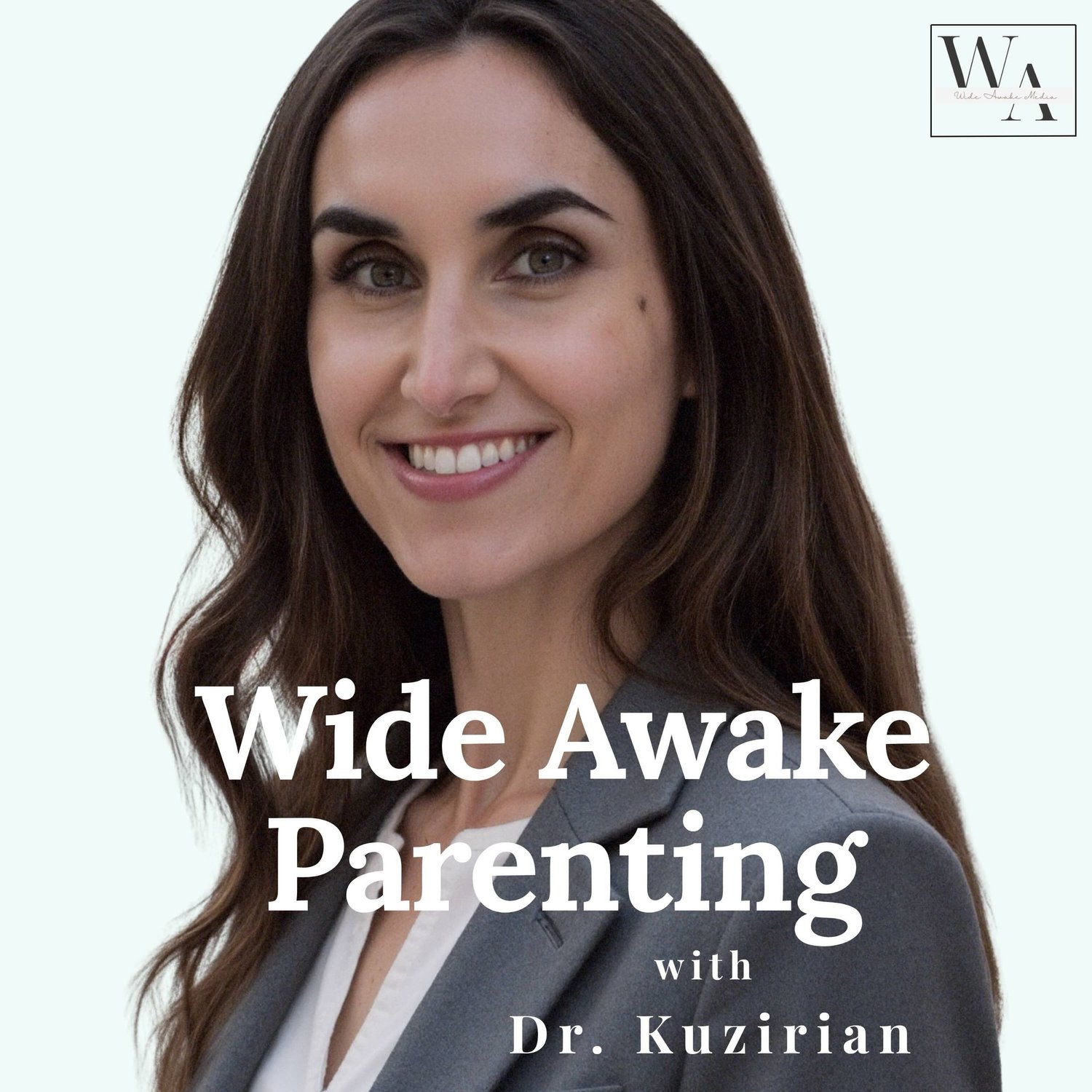
Join psychologist Dr. Kirsten Kuzirian for research-backed insights that help you understand what's really happening in those challenging parenting moments—and respond from wisdom rather than worry. Every other week, we explore child development, brain science, and practical strategies through a neurodiversity-affirming lens. From tantrums to teen struggles, from ADHD to anxiety, we dive into the real stuff with warmth, honesty, and zero judgment. This isn't about perfect parenting scripts or one-size-fits-all solutions. 20 minutes of insight that honors your instincts and the science. For par...
Author
Wide Awake Media
Category
Podcast website
Latest episode
Jun 30, 2026
Where to listen?
Podcasts in the app Replaio Radio Coming soonPodcasts are coming to the app soon. Install now and be the first to see a whole new take on podcasts
 Install for free
Android 5M+ downloads · 4.8 rating
iOS soon
Install for free
Android 5M+ downloads · 4.8 rating
iOS soon
Episodes
Anxiety and Dopamine: The Safety Teacher 30.06.2026 20:35
Your child can tell you the dog is friendly. They can tell you the presentation will be fine. They know — and they still can't feel it. If you've watched your child understand that something is safe while their body insists otherwise, this episode is for you. In the final episode of the Dopamine series, child psychologist Dr. Kirsten Kuzirian looks at dopamine's least expected job: teaching the br...
Autism, Dopamine, and Motivation: Why Social Praise Isn't the Driver 16.06.2026 32:19
The birthday party you worried about for two weeks. The cake, the noise, the other children running through the living room — and your child is in the corner, watching the ceiling fan turn, or reading the volcano book they brought from home. Their reward system hasn't gone dim. It's lit up — just by something else. In this episode, child psychologist Dr. Kirsten Kuzirian walks through what the lat...
The Motivation Molecule — What Dopamine Actually Does in Your Child's ADHD Brain 02.06.2026 31:30
What if the thing everyone calls laziness is actually about fuel? Dopamine gets called the brain's pleasure chemical. It's closer to a motivation signal — the thing that quietly decides what's worth showing up for. In the ADHD brain it runs differently, and the 2024–2025 research has moved that picture somewhere more nuanced, and more hopeful, than the old "low dopamine" headline. It's less that t...
Emotional Awareness in ADHD and Autism: Why Your Child Says "I Don't Know" 19.05.2026 13:15
"What are you feeling?" Your child screams "I don't know!" — and they're telling the truth. Dr. Kirsten Kuzirian explains interoception and alexithymia: why some children genuinely can't identify or describe their emotions, especially under stress. This is particularly common in autistic and ADHD kids. Learn body-based approaches that work when emotion words don't.
ADHD, Anxiety, and Autism Sleep Problems: Why Standard Advice Doesn't Work 05.05.2026 13:15
You've tried the calm bedtime routine, the dim lights, the no screens before bed. It doesn't work. Dr. Kirsten Kuzirian explains why standard sleep advice fails for neurodivergent children — from the delayed circadian rhythms common in ADHD to the sensory sensitivities in autism to the racing thoughts of anxious kids. Different brains need different sleep solutions.
How AI Is Using Attachment to Reach Our Kids (And What We Can Do About It) 21.04.2026 29:14
64% of American teenagers use AI chatbots. Almost a third use them every day. And according to Common Sense Media, 31% say their conversations with AI are as satisfying — or more satisfying — than talking with a real friend. T hat's not a technology statistic. It's an attachment statistic. In this episode, child psychologis...
The Stuck Brain: Adapted Mindfulness for Neurodivergent Children 07.04.2026 10:10
Standard mindfulness doesn't work for every brain. "Sit still and notice your breath" can actually make things worse for kids with ADHD, autism, or anxiety. Dr. Kirsten Kuzirian explains how mindfulness can change brain networks involved in rigid thinking — but only when adapted for how your child's brain actually works. Includes specific examples for different neurotypes.
Why Your ADHD Child Takes Everything Personally: Understanding RSD 24.03.2026 10:24
A sideways glance from a classmate ruins the whole day. Being picked last devastates them for weeks. Dr. Kirsten Kuzirian explores rejection sensitive dysphoria (RSD) — what's actually happening in the brain when social pain hits harder than it should. Learn why "don't take it personally" doesn't work and what neuroscience tells us about protecting your child's emotional wellbeing.
When Your Child Can't "Just Be Flexible": Understanding Cognitive Rigidity 10.03.2026 9:23
"Just be more flexible" doesn't work for kids whose brains are wired for predictability. Dr. Kirsten Kuzirian explains why traditional flexibility training often backfires for neurodivergent children — and what the research says actually helps. Learn why rigidity is often a stress response, not a character flaw, and how to reduce it without forcing your child through distressing exposures.
The Rule-Following Brain: Why Your Neurodivergent Child Isn't Being Defiant 24.02.2026 10:12
Your child follows some rules religiously but ignores others completely. They can recite the classroom expectations but break them daily. Dr. Kirsten Kuzirian explains the neuroscience behind this confusing pattern — why predictable rules are easy but social rules are hard, and what this means for neurodivergent kids. This isn't defiance. It's a brain processing rules in a fundamentally different...
Separation Anxiety in ADHD and Autistic Kids: What's Really Happening 10.02.2026 9:29
When your child clings, cries, or panics at drop-off, it's easy to wonder if you're doing something wrong. Dr. Kirsten Kuzirian explains what's actually happening in your child's nervous system during separation — and why this isn't manipulation or misbehavior. Learn why standard separation anxiety approaches often fail for neurodivergent children and what actually helps their brain feel safe.
What Actually “Spoils” Children 02.12.2025 18:01
Your calm voice doesn't spoil children - giving in to emotional escalation does. What creates "spoiled" behavior is teaching children's brains that intensity gets results. You can be incredibly kind AND incredibly firm, using calm co-regulation to build emotional resilience while maintaining consistent boundaries. The Four Approaches Analysis: 1. Harsh + Giving In: Creates confusing neural pattern...
The Neurobiology of Temperament 18.11.2025 12:29
Your child's temperamental reactions aren't about your parenting failure - they're influenced by 700+ genes that create their unique way of experiencing the world. When you understand and work with their neurobiological wiring instead of against it, you build Trust Fund deposits and teach them valuable metacognition about their own patterns. Key Research: - Over 700 genes may influence how childre...
Screen Time and the ADHD Brain 04.11.2025 17:39
ADHD brains are magnetically drawn to screens because they provide immediate feedback, clear progression, predictable rewards, and high stimulation - elements that ADHD brains need to feel engaged. Instead of fighting this, parents can work WITH their child's neurology by incorporating these same elements into homework, social situations, and family life.
Why Every Child Deserves a Trust Fund (And It's Not About Money) 15.10.2025 15:57
Resources Mentioned: Download the free Trust Fund Field Guide at wideawakeparenting.com/freebies to recognize the deposits you're already making and discover practical tools for building your child's emotional foundation. About Dr. Kirsten Kuzirian: Licensed clinical psychologist and founder of Wide Awake Parenting, specializing in helping parents recognize their natural wisdo...
The Foundation: What Your Child's Brain Is Actually Looking For 30.09.2025 29:41
The moments you keep showing up — the same morning routine, the same "I love you, have a good day," the same coming back after a hard moment — are doing more developmental work than you probably realize. Child psychologist Dr. Kirsten Kuzirian walks through the research on what your child's brain is actually built to receive from your presence — and why the pattern of it, not the perfection of it,...
Similar podcasts







Listen to the The Wide Awake Parenting Podcast podcast in Replaio
Radio and podcasts in one app - free, with no sign-up. Install today and do not miss the launch
Replaio is not a podcast publisher; show names, artwork and audio belong to their authors and are distributed through public RSS feeds.