James Edward Mills
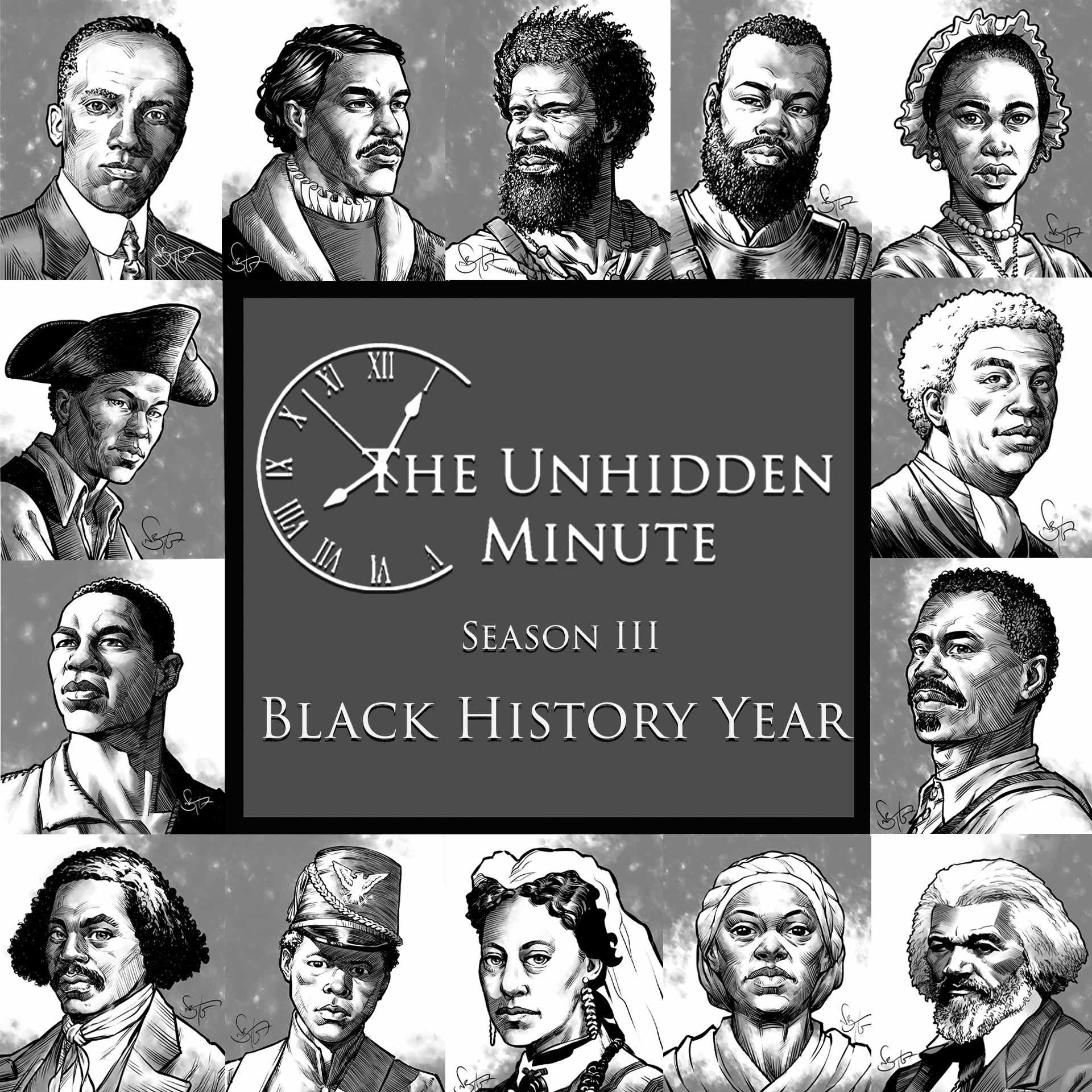
The Unhidden Minute
The Unhidden Minute is part of the Unhidden Podcast Project supported through a National Geographic Explorer Grant from the National Geographic Society. This series celebrates the untold stories of Black American history. jamesedwardmills.substack.com
Author
James Edward Mills
Category
Podcast website
Latest episode
Jul 7, 2026
Where to listen?
Podcasts in the app Replaio Radio Coming soonPodcasts are coming to the app soon. Install now and be the first to see a whole new take on podcasts
 Install for free
Android 5M+ downloads · 4.8 rating
iOS soon
Install for free
Android 5M+ downloads · 4.8 rating
iOS soon
Episodes
Claudette Colvin 13.01.2026 1:20
Claudette Colvin was just 15 years old when she made history in Montgomery, Alabama. On March 2, 1955—nine months before Rosa Parks —Colvin refused to give up her seat on a segregated city bus. Inspired by lessons on Black American history and the Constitution, she later said she felt Harriet Tubman and Sojourner Truth “pushing down” on her shoulders, telling her to stay seated. She was arrested,...
Black History Year 06.01.2026 1:21
Did you know that 2026 is the 100th anniversary of Black History Month ? This annual observance is a necessary correction in a nation that too often erased or ignored the full story of Black American life. In 1926, historian Carter G. Woodson launched Negro History Week so the contributions of Black Americans could no longer be dismissed as footnotes. What began as a week became a month. Now, in t...
Jo Ann Allen Boyce 30.12.2025 1:20
At just fourteen years of age, Jo Ann Allen Boyce walked into history. In 1956, two years after the Brown v. Board of Education Supreme Court Decision that ended legal segregation, she became one of the Clinton 12. Boyce was among the first Black Americans to integrate a public high school in the South, when she entered Clinton High School in Tennessee. Her daily walk to class required extraordina...
Barbara Rose Johns 23.12.2025 1:20
Barbara Rose Johns (1935–1991) was a sixteen-year-old Black American student whose courage helped ignite one of the most important legal battles of the twentieth century. In 1951, while attending the segregated Robert Russa Moton High School in Farmville, Virginia, Johns organized and led a student strike to protest overcrowded classrooms, crumbling facilities, and the gross inequities of Jim Crow...
Sarah Rector 16.12.2025 1:20
Sarah Rector (1902–1967) was once known as “the richest Black girl in America.” Born in Indian Territory—now Oklahoma—to formerly enslaved Muscogee (Creek) Nation citizens, she and her family were among thousands of Black tribal members who received land allotments under the Dawes Act of 1887, which aimed to divide Native American land. In 1913, oil was discovered on her 160-acre parcel, and befor...
The Montgomery Bus Boycott 09.12.2025 1:20
The Montgomery Bus Boycott of 1955 was a landmark moment in the struggle for civil rights and a defining example of collective, nonviolent resistance. Sparked by the arrest of Rosa Parks , a Black American seamstress who refused to surrender her seat to a white passenger, the boycott began on December 5, 1955, in Montgomery, Alabama. For 381 days, Black residents refused to ride city buses. In def...
Bill Pickett 25.11.2025 1:20
Bill Pickett (1870–1932) was a pioneering Black cowboy, rodeo performer, and Wild West showman whose innovations left an indelible mark on American ranching culture. Born in Texas to formerly enslaved parents, Pickett developed extraordinary skills in horsemanship and cattle handling. He became famous for inventing “bulldogging,” a daring rodeo technique in which he would leap from his horse, grab...
The Double Victory Campaign 13.11.2025 1:20
The Double Victory Campaign was a powerful movement launched by Black Americans during World War II. This national initiative symbolized the fight for two forms of victory: one over fascism abroad and another over racism at home. Sparked by a 1942 letter to the Pittsburgh Courier , one of the nation’s leading Black newspapers, the campaign gained national momentum as Black citizens demanded that t...
George Meléndez Wright 04.11.2025 1:20
George Meléndez Wright was a pioneering biologist and one of the earliest advocates for the scientific management of wildlife in the U.S. National Park System . Born in San Francisco Wright earned a zoology degree from UC Berkeley and joined the National Park Service in the 1920s. At a time when wildlife policies focused primarily on controlling “nuisance” animals and enhancing visitor experiences...
Tie Sing 28.10.2025 1:20
A Chinese American chef named Tie Sing worked for the U.S. Geological Survey (USGS) in California through the early 20th century. As head cook on major mapping expeditions, his role was far more critical than it might seem. His creative meals nourished surveyors while on grueling journeys through the rugged terrain of the American West. Sing became a legend within the USGS for his ingenuity, using...
The Wereth 11 21.10.2025 1:20
The Wereth 11 were a group of Black American soldiers who were captured, tortured, and executed by Nazi troops near Wereth, Belgium, on December 17, 1944 . Part of the 333rd Field Artillery Battalion during the Battle of the Bulge these men had sought refuge in the home of a Belgian farmer after their unit was overrun. Betrayed to the Germans by a local collaborator, they were taken outside the vi...
William Monroe Trotter 14.10.2025 1:20
William Monroe Trotter was a pioneering Black journalist, activist, and civil rights leader. His uncompromising demand for racial equality helped to shape Black political thought in the early 20th-century. Born in Boston, Massachusetts, and educated at Harvard University, where he graduated magna cum laude, Trotter became one of the most outspoken critics of racial accommodation and segregation. A...
Lt. Col George E. Hardy 07.10.2025 1:20
Lieutenant Colonel George E. Hardy (1925–2025) was one of the last surviving members of the famed Tuskegee Airmen, the pioneering group of Black aviators who shattered racial barriers during World War II. Born in Philadelphia, Hardy enlisted in the U.S. Army Air Corps in 1943 and trained at the Tuskegee Army Airfield in Alabama, earning his wings in 1944. As a member of the 332nd Fighter Group , h...
Fannie Lou Hamer 30.09.2025 1:20
Fannie Lou Hamer (October 6, 1917 – March 14, 1977) was a powerful voice in the Civil Rights Movement, renowned for her fight for voting rights and economic justice. Born into a sharecropping family of 20 children in Mississippi, she began laboring in cotton fields at age six and left school by age twelve. In 1962, at age 45, she joined the Student Nonviolent Coordinating Committee (SNCC) and was...
Ranger Robert Stanton 22.09.2025 1:20
Robert Stanton (1940– ) was the 15th Director of the National Park Service (NPS) and the first Black American to hold the position, serving from 1997 to 2001 under President Bill Clinton. Born in Fort Worth, Texas, Stanton earned a degree in recreation and park administration from Huston–Tillotson University. His NPS career began in 1962 as a seasonal ranger at Grand Teton National Park . Over nea...
Ranger Betty Reid Soskin 22.09.2025 1:20
Betty Reid Soskin (1921– ) is a trailblazing figure who was the oldest active U.S. National Park Ranger until her retirement at age 100. Born in Detroit and raised in Oakland, Soskin lived through nearly a century of American history, experiencing segregation, the Great Depression, and the civil rights movement firsthand. During World War II, she worked as a file clerk in a segregated shipyard uni...
Lt. Colonel Lee Archer 16.09.2025 1:20
Lieutenant Colonel Lee Archer was a decorated Tuskegee Airman and one of the few Black American fighter pilots to achieve ace status during World War II. Born on September 6, 1919, in Yonkers, New York, Archer joined the U.S. Army Air Corps in 1941 and trained at Tuskegee Army Airfield. As a member of the 332nd Fighter Group , he flew 169 combat missions in the European theater, escorting bombers...
The Yorktown Battlefield 08.09.2025 1:20
The Yorktown Battlefield in Virginia is known for its pivotal role as the site of the decisive victory of the Continental Army over the British in 1781that ended the American Revolutionary War. However, during the Civil War, it became a critical site for Black Americans seeking freedom. In 1862, as Union forces advanced, thousands of enslaved people fled to Union lines from the South, forming what...
Gordon Parks 02.09.2025 1:20
Gordon Parks (1912–2006) was a groundbreaking Black American photographer, filmmaker, and writer whose work forever shaped American culture. Born in Fort Scott, Kansas, Parks grew up in poverty and experienced the harsh realities of segregation. Despite these challenges, he taught himself photography and used the camera as a tool for social change. His early photo essays revealed systemic racism a...
Fazendeville 19.08.2025 1:19
Fazendeville , Louisiana, was a historic Black community founded in the 1860s by freedman Jean Pierre Fazende, not long after the Civil War. The land near Chalmette, just outside of New Orleans was subdivided to sell to formerly enslaved people. For nearly a century, Fazendeville thrived as a tight-knit settlement, with many homes, a school, a church, and cemetery. Generations of Black families li...
Mary Jane Richards 12.08.2025 1:19
Mary Jane Richards, also known as Mary Bowser, was a formerly enslaved Black woman who became a Union spy during the American Civil War. Born in Richmond, Virginia, around 1840, she was freed by her owner , Elizabeth Van Lew , a wealthy white abolitionist. Van Lew arranged for Richards to be educated in the North before returning her back to the South to gather intelligence. Under the alias Mary B...
James Baldwin 05.08.2025 1:20
James Baldwin ( 1924–1987) was a groundbreaking Black American writer and social critic whose work explored the intersections of race, sexuality, and identity. Born in Harlem, he rose from poverty to become one of the 20th century’s most influential voices. His essays, such as those in Notes of a Native Son (1955), and novels like Go Tell It on the Mountain and Giovanni’s Room, boldly addressed bo...
The Chicago Race Riot of 1919 29.07.2025 1:18
The Chicago Race Riot of 1919 erupted on July 27 in the Bronzeville neighborhood along the shores of Lake Michigan. A Black teenager, Eugene Williams , drowned when white beachgoers threw rocks at him for drifting into a whites-only swimming area. When police refused to arrest the white perpetrator, long-simmering racial tensions exploded into violence. For eight days, white and Black residents cl...
Lincoln Hills 22.07.2025 1:20
Lincoln Hills, Colorado, established in 1922, was the only Black-owned mountain resort west of the Mississippi River during the Jim Crow era. Founded by entrepreneurs E.C. Regnier, Robert Ewalt, and Edmund J. McMahon, this site provided a refuge for Black Americans barred from other vacation destinations due to segregation. Over 600 lots were sold to middle-class Black families, creating a vibrant...
The Victory Monument 15.07.2025 1:20
The Victory Monument in Chicago’s Bronzeville neighborhood honors the all-Black Eighth Regiment of the Illinois National Guard. Later known as the 370th Infantry , these soldiers fought valiantly under French command in World War I. Erected in 1927 and later enhanced with a bronze “doughboy” statue in 1936, the monument features granite reliefs depicting battles, symbols of victory, and a Black in...
Similar podcasts







Listen to the The Unhidden Minute podcast in Replaio
Radio and podcasts in one app - free, with no sign-up. Install today and do not miss the launch
Replaio is not a podcast publisher; show names, artwork and audio belong to their authors and are distributed through public RSS feeds.