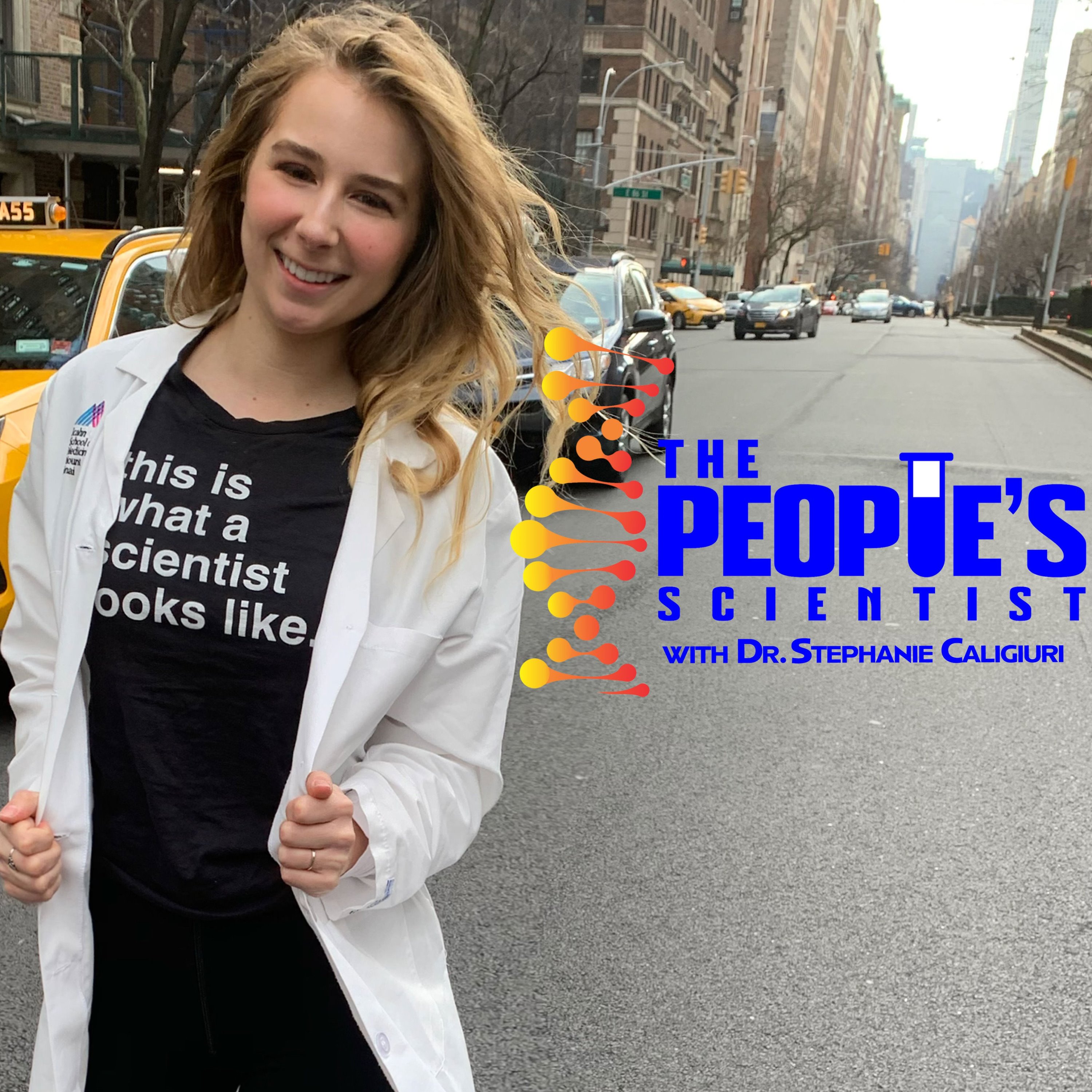
Dr. Stephanie Caligiuri
The People's Scientist
The People's Scientist is a weekly podcast covering the latest scientific findings on Neuroscience, Physiology, and Nutrition. I, your host, Dr. Stephanie Caligiuri, hold a Bachelor and Master degree in Nutritional Science, a PhD in Physiology, and Fellowship in Behavioral Neuroscience. I am currently a Scientist (Research Fellow) at Mount Sinai Hospital in NYC. Every week, I will provide you scientific evidence on important topics pertaining to our brain, body, and nutrition. In the past I have covered intermittent fasting, CRISPR gene editing for cancer therapy, using our own neurobiology to...
Author
Dr. Stephanie Caligiuri
Category
Podcast website
Latest episode
Feb 25, 2024
Where to listen?
Podcasts in the app Replaio Radio Coming soonPodcasts are coming to the app soon. Install now and be the first to see a whole new take on podcasts
 Install for free
Android almost 10M downloads · 4.8 rating
iOS soon
Install for free
Android almost 10M downloads · 4.8 rating
iOS soon
Episodes
Stephanie's Theory of Modern Motivation 25.09.2022 31:27
In Episode 133, I discuss my own theory on the modern motivations of humans today. With the onset of technology, I believe that our motivations have adapted and changed. At the root, we all crave to be seen. That is it. I go on to explain 3 other levels to human motivation. I expound upon how we can use this information to our advantage to benefit our everyday interactions and relationships. Tune...
Is it Social Anxiety or Introversion? 11.09.2022 33:58
In Episode 132 of The People's Scientist podcast, I talk about how Scientists speculate that the prevalence of social anxiety has increased in the last several years. I offer an alternative, that in part, these observations may be explained by us having the opportunity to be more introverted over the pandemic. So is it introversion or social anxiety? I talk about the neuroscience, diagnostic crite...
What Are We So Afraid Of? The Neuroscience of Rejection 07.08.2022 31:17
In Episode 131 of The People's Scientist podcast, I dive into the Neuroscience and Psychology of Rejection. Social rejection is believed to recruit brain regions involved in feeling social pain. As a result, many of us may have missed opportunities because of the fear of this pain. But guess what? When people were surveyed about their missed opportunities and moments of rejection, missed opportuni...
An Exercise Metabolite That Can Reduce Food Intake and Induce Fat Loss 24.07.2022 31:35
In Episode 130 I dive into a recent publication by Li et al. published this year in Nature that identified an exercise metabolite, lac-phe, that reduces food intake and induces fat loss. The scientists conducted a series of experiments to illustrate that certain types of exercise increase circulating lac-phe in the blood which is likely the mechanism behind reduced appetite, food intake, and enhan...
How to Enhance Our Attention Control 10.07.2022 53:42
In Episode 129 of The People's Scientist podcast, I dive into a ton of scientific evidence on this highly requested topic. Attention control is our ability to regulate to what we give our attention. The opposite would be being distracted, ruminating on negative things, and having intrusive thoughts. Attention control is incredibly important for high productivity and mental well-being. In this epis...
How To Make Lasting Friendships As An Adult 19.06.2022 33:03
In Episode 128 I change it up and do a bit of a different episode based less on empirical evidence and moreso on philosophy, sociology, and my own personal experiences. As of late, I have heard many people say they find it difficult to make new friends as an adult, especially with the onset of working from home. So in today's episode I talk about the different types of friendship, emotional intell...
The Pursuit of Happiness Lies in Juxtaposition 05.06.2022 37:21
In Episode 127 of The People's Scientist podcast, I discuss some recent Psychology and Neuroscience findings on the Pursuit of Happiness. Dating back to the time of Aristotle, a happy life was thought to consist of 1. hedonism (pleasure and security) and 2. eudaimonism (purpose and meaning). However, recent data suggests a third component: psychological richness. Happiness may not always be about...
Let's Learn From Athletes & Sports Psychology Tactics 15.05.2022 32:57
In episode 126, I dive into the scientific evidence on the resilience, psychology techniques, and neurobiology of top athletes. Even the top teams in their league fail on average 40% of the time. Failures and setbacks should not surprise us. We don't not lose, we either win or we learn. What sets apart the winner from the rest is how they respond to the failures. Tune in to learn how the brains of...
The Neuroscience of Intuitive Eating 01.05.2022 39:34
In Episode 125, I discuss the neuroscience of intuitive eating. Intuitive eating is associated with a healthier BMI, less symptoms of depression, less probability for disordered eating, higher self-esteem, and more positive body image. Intuitive eating is a form of adaptive eating that relies on our skill of interoception: being able to observe our internal sensations like hunger. Intuitive eating...
The Neuroscience of Self-Confidence 17.04.2022 35:47
In Episode 124 I share scientific evidence on The Neuroscience of Self-Confidence. I discuss science to answer the following questions: What part of our brain regulates our self-confidence? How does the brain respond differently in people with high vs low self esteem? What difference does it make to our life we have or lack self-confidence? Can we have too much self-confidence? Can we use neurosci...
There Is Power In Understanding The Science Behind Why We Feel The Way We Do 03.04.2022 41:48
In Episode 123, I provide some scientific evidence on how increasing our self-awareness, our knowledge of our physiology, and actionable goals to modify our behavior can induce benefits to our health and well-being. My goal with every episode of this podcast is to empower us through understanding the science behind why we feel the way we do. I give examples on how understanding the neuroscience of...
The Importance of Magnesium in Coping with Stress 20.03.2022 32:43
In episode 122 on The People's Scientist podcast, I dive into some scientific evidence on how physical and psychological stressors increase the need for Magnesium. Magnesium helps to buffer the stress response by promoting the production of ATP, Serotonin, GABA, and antagonizing the excitatory NDMA receptor. However, chronic stress can deplete Magnesium and reduce the ability to buffer the stress...
Genetic History: How The Lifestyle Choices of Previous Generations May Influence Us Today 06.03.2022 31:52
Today in episode 121, I discuss some scientific evidence of genetic history, how the lifestyle choices and experiences of past generations may induce genetic and epigenetic changes which may be passed along to us. For example, were our parents of a healthy weight, did they drink a lot of alcohol, did they exercise regularly, what was their diet like at the time of conceiving us? It appears that th...
Recent Clinical Evidence on Blueberries & Our Health 20.02.2022 28:06
My oat blueberry muffins inspired today's episode! I pondered as I baked this week, I wonder what the recent clinical evidence says about blueberries? Jump into today's episode with me as I cover recent clinical trials from the last 2-3 years that investigated the impact of 1/3 to 1 cup of blueberries daily on inflammation, arthritis, antioxidant status, heart health, metabolic syndrome, cognition...
What Do Neuroscientists & Psychologists Suggest For Happy & Lasting Romantic Relationships? 06.02.2022 35:50
In Episode 119, I do a timely episode as Valentine's Day is upon us. I discuss the studies and theories that scientists have in regard to why we gravitate toward particular people for romantic relationships and what characteristics are associated with long-term happy relationships. Certain factors I discuss include our genetics, social history, physical affection, affect labelling, emotional intel...
Can Indoor Plants Improve Our Air Quality and Mood? 23.01.2022 25:39
In Episode 118 of The People's Scientist podcast, I share some scientific evidence on indoor plants and whether or not they improve air quality and measures of mental health and work productivity. In the segment foregone facts, I discuss how in 1907 it took scientists 30 years to prove that a plague of Pellagra in the South Eastern United States was due to a deficiency in vitamin B3 niacin, not du...
Do Horror Films Make Us More Resilient? 09.01.2022 26:25
In Episode 117 of The People's Scientist podcast, the first episode of 2022, I add in a new section called "Forgeone Facts" and start off with some Neuroscience based strategies to help form new habits and to help break old habits as the new year begins. I continue on in the episode discussing a study published a few months ago that concludes individuals who are fans of horror movies, ranked bette...
The Brilliant Capability of Dogs in Silent Cancer Detection 05.12.2021 25:28
In Episode 116 of The People's Scientist podcast, I share some case reports and studies in which dogs accurately detect the presence of several types of cancer based on urine, breath, and body odor samples from humans. Dogs are brilliant animals with advanced olfactory systems. It appears that cancer cells may emit organic volatile compounds that are undetectable to humans but detectable to dogs....
Using Neuroscience to Our Advantage for Self-Defense 21.11.2021 28:10
In Episode 115 of The People's Scientist podcast, I dive into the neuroscience and psychology of self-defense in order to deter violence or to avoid being accosted. 1. We may be able to use uncertainty to our advantage as instinctually, we humans tend to feel uneasy and want to avoid unpredictable situations 2. The likelihood of being caught is a far greater deterrant than the severity of punishme...
Physical Convergence - Do We Look More Like Our Partner Over Time? 26.09.2021 29:19
In this fun interest piece for Episode 114 on The People's Scientist podcast, I talk about if we become physically more similar to our partners over time. As we share a home with people over a long period of time, we may develop similarities in our immune system, gut microbiome, facial expressions, mannerisms, and we may therefore become more biologically similar over time. There is also a theory...
How to Raise our Metabolic Rate to Maintain a Healthy Body Weight 19.09.2021 32:17
Today in Episode 113 of The People's Scientist podcast, I talk about the importance of our metabolic rate. Our resting energy expenditure is an incredibly important factor in determining our weight regain after weight loss and our ability to maintain a healthy body weight. Unfortunately, when reducing calories and losing weight, our metabolic rate declines. This is often why some of us regain weig...
The Neuroscience of Anxiety 12.09.2021 35:31
There is power in understanding the science behind why we feel the way we do. In Episode 112 I talk about the Neuroscience of Anxiety. Anxiety may be a result of an imbalance in the activity of our emotional brain regions like the hypothalamus, amygdala, and bed of the stria terminalis. Think of an overflowing sink without a safety drain port. Chronic anxiety may be a result of our stress signal n...
The Security Guard of Our Mitochondria - L-Carnitine 15.08.2021 33:39
Today in Episode 111, I cover a listener requested topic, all about Carnitine. We make Carnitine in our body; it is essential for our ability to turn fat into energy. As such, orally supplementing with Carnitine has been studied in the context of fat loss, exercise performance, mental functioning, cognition, and overall health in chronic disease. Deficiencies in Carnitine can occur in some individ...
The Nose Knows - How Our Emotions Have a Smell 08.08.2021 20:15
In today's episode I dive down the science rabbit hole of how humans can communicate with one another via our body odor and sense of smell. For decades we thought that humans communicated via our sense of vision and sound, because through evolution of visual cortex became more developed and our olfactory system regressed. However, recent data suggests that humans can emit certain molecules while f...
The Neuroscience of Anger 01.08.2021 28:56
Today in Episode 109, I dive into the neuroscience and psychology of anger. Trait anger, or commonly called, having a temper, may be in part influenced by our genetics and past life experiences. But our genetics and past are not our destiny, let's take that information, and let it empower us. We can to a certain extent, change our outcomes and I help give some neuroscience based suggestions on how...
Similar podcasts




Listen to the The People's Scientist podcast in Replaio
Radio and podcasts in one app - free, with no sign-up. Install today and do not miss the launch
Replaio is not a podcast publisher; show names, artwork and audio belong to their authors and are distributed through public RSS feeds.