Maria
The Partially Examined Life Philosophy Podcast
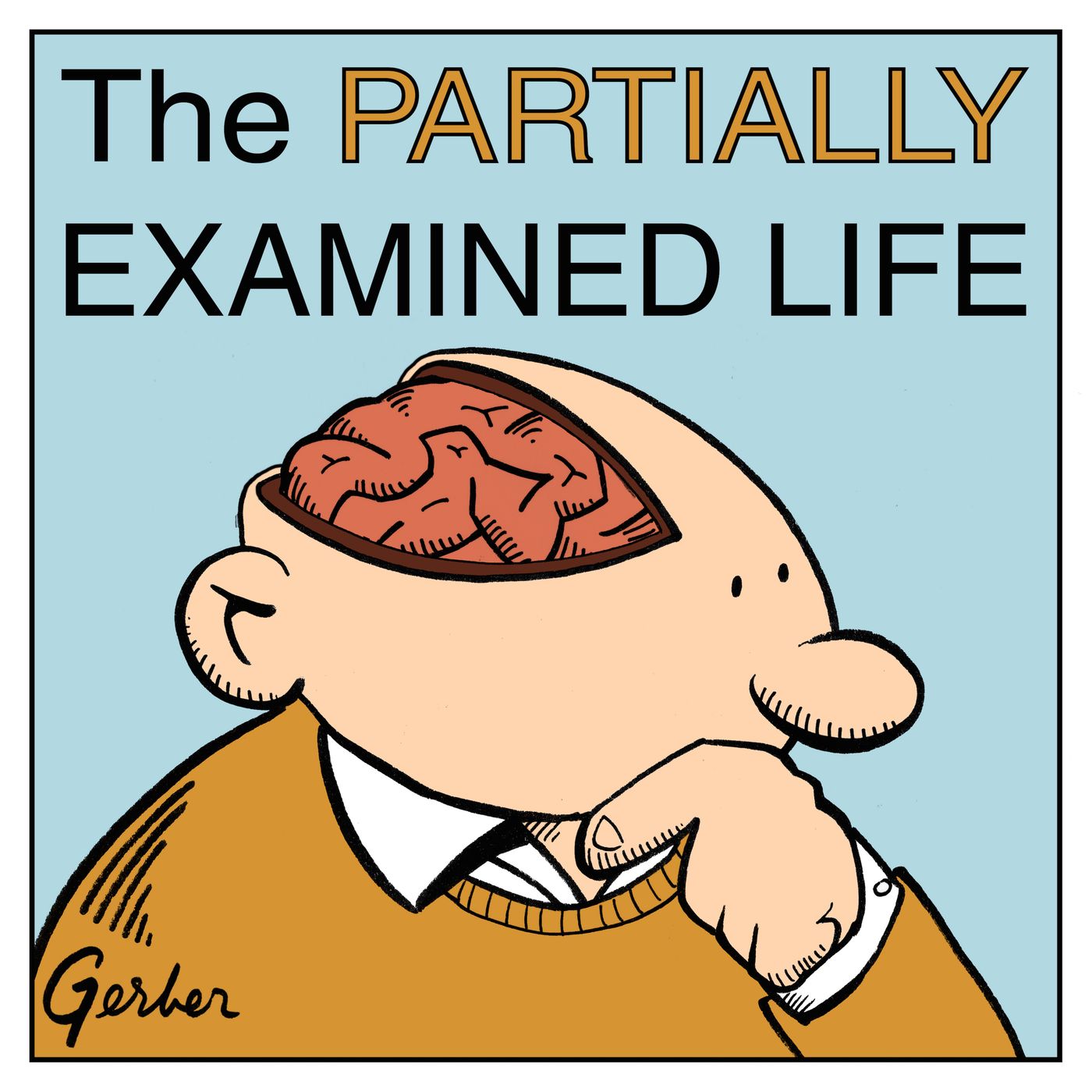
The Partially Examined Life is a podcast by some guys who were at one point set on doing philosophy for a living but then thought better of it. Each episode, we pick a short text and chat about it with some balance between insight and flippancy. You don't have to know any philosophy, or even to have read the text we're talking about to (mostly) follow and (hopefully) enjoy the discussion. For links to the texts we discuss and other info, check out www.partiallyexaminedlife.com. We also feature episodes from other podcasts by our hosts to round out your partially examined life, including Pretty...
Where to listen?
Podcasts in the app Replaio Radio Coming soonPodcasts are coming to the app soon. Install now and be the first to see a whole new take on podcasts
 Install for free
Android 5M+ downloads · 4.8 rating
iOS soon
Install for free
Android 5M+ downloads · 4.8 rating
iOS soon
Episodes
Episode 184: Pascal on Human Nature (Part Two) 25.02.2018 1:08:44
Continuing on Pascal's Pensées. More on our human desire and how God is supposed to address that, plus Pascal's views on political philosophy, the relation between faith, reason, and custom... and finally the wager! Why not just be a skeptic? Is Pascal right that people suck? Listen to part 1 first or get the unbroken, ad-free, Citizen Edition now. Please support PEL ! End song: "44 Days" by Dutch...
Episode 184: Pascal on Human Nature (Part One) 19.02.2018 50:59
On Blaise Pascal's Pensées (1670). Is it rational to have religious faith? You're likely familiar with "Pascal's Wager," but our wretchedness is such that we can't simply choose to believe and won't be argued into it. Pascal thinks Christianity is the only religion to accurately describe the human condition. Please support PEL!
Episode 183: Mill on Liberty (Part Two) 12.02.2018 1:03:58
Continuing on John Stuart Mill's On Liberty. For Wes Alwan's summary of this book, go here ). We discuss "partial truths," whether "truth will out," whether we can discard some "experiments in living" as established failures, how Mill compares to Nietzsche, education, "barbarians," and more. Listen to part 1 first, or get the unbroken, ad-free Citizen Edition . Please support PEL! End song: "Flavo...
Episode 183: Mill on Liberty (Part One) 04.02.2018 57:10
Discussing John Stewart Mill's On Liberty (1859). For Wes Alwan's summary of this book, go here ). If we disapprove of certain behaviors, when is it okay to prohibit them legally? What about just shaming people? Mill's "harm principle" says that we should permit anything (legally and socially) unless it harms other people. But what constitutes "harm"? And how can we discourage someone from, e.g.,...
PREMIUM-Episode 182: Reflections on PEL 2017 (Part Two) 04.02.2018 4:39
The PEL guys get personal and political and tell you in brief about things like Planet of the Apes, The Killing of a Sacred Deer , and Vine Deloria Jr. in the second half of our year-in-review discussion. Here you get a taste. You can only hear the meat with the full, ad-free episode, posted for PEL Citizens ( see partiallyexaminedlife.com/support !) or at patreon.com/partiallyexaminedlife .
Episode 182: Reflections on PEL 2017 (Part One) 29.01.2018 52:26
To what extent has our podcast changed in reaction to current politics? Mark, Seth, Wes, and Dylan reflect back on our year, discuss how we select texts, and give some thumbnail sketches of potential topics. Also, does authorial intent matter, and how to talk philosophically about works that aren't philosophical texts. Attention: Only the first 45 min of this discussion will be posted on the blog...
Episode 181: Hannah Arendt on the Banality of Evil (Part Two) 22.01.2018 1:20:23
Continuing on Eichmann in Jerusalem, on how ordinary people can do--or acquiesce to--horrific things. How do people rationalize this? What can we apply from this to ourselves? Also, how was genocide a new type of crime, and what's the best rationale for punishing it? We talk justice, revenge, and ways that we too might be morally mass-confused. Listen to part one first or get the unbroken, ad-free...
Episode 181: Hannah Arendt on the Banality of Evil (Part One) 15.01.2018 47:18
On Eichmann in Jerusalem: A Report on the Banality of Evil (1963). Are we still morally culpable if our entire society is corrupt? Arendt definitely thinks so, but has a number of criticisms of the handling of the 1961 trial of Nazi war criminal Adolf Eichmann. The Israelis were committed to the view that Eichmann was a monster, when the reality, says Arendt, is more frightening. Please support PE...
Episode 180: More James's Psychology: Self and Will (Part Two) 08.01.2018 1:15:47
Concluding on William James's Psychology, the Briefer Course (1892). We briefly cover emotions and spend the bulk of our time on will. James's introspective method allows us to distinguish reflex or coerced actions from voluntary, free-seeming ones, and gives us the vocabulary to attribute moral virtue to those who have enough willpower to keep those inconvenient truths in mind (if you eat this, y...
Episode 180: More James's Psychology: Self and Will (Part One) 01.01.2018 1:00:24
On Psychology, the Briefer Course (1892), chapters on "The Self," "Will," and "Emotions." Continuing from ep. 179 , we talk about the "Me" (the part of me that I know) vs. the "I" (the part of me that knows), including personal identity. James thinks that emotions are just our experience of our own physiology. Finally, we tackle will, veering into ethics, free will, and more. Please support PEL!
Episode 179: William James's Psychology (Part Two) 25.12.2017 1:00:00
Continuing on Psychology, the Briefer Course (1892), completing "The Stream of Thought" and covering the chapter on "Habit." James thinks that psychologists focus too much on those parts of consciousness that get picked out by substantive words. He describes habit as part of a general natural pattern that things that happen once tend to create pathways for themselves in surrounding material to all...
Episode 179: William James's Introspective Psychology (Part One) 18.12.2017 52:56
On The Principles of Psychology (1890) chapters 1 & 7, and Psychology, the Briefer Course (1892), the chapters on "The Stream of Thought," "Habit," and some of "The Self." Can we talk about the mind in a way that is both scientific and also does justice to our everyday experiences? James thought his method, which involved both introspection and physiology, yielded more accurate descriptions of...
Episode 178: Nietzsche as Social Critic: Twilight of the Idols (Part Two) 10.12.2017 1:07:45
Continuing on Nietzsche's 1888 book. (For Wes Alwan's summary of this book, go here ). Is there any ground from which we could judge life as a whole to be good or bad? Is N. more about saying "yes" to life or saying "no" to all the numerous things that piss him off? We also talk Becoming, whether producing great art is more important than being nice to everyone, and whether Nietzsche is ultimately...
Episode 178: Nietzsche as Social Critic: "Twilight of the Idols" (Part One) 04.12.2017 51:42
On Friedrich Nieztsche's 1888 book summarizing his thought and critiquing the founding myths of his society. (For Wes Alwan's summary of this book, go here ). He defends "spiritualized" instinct and frenzied creativity, but also Napoleon and war. We try to figure out what kind of social critic he'd be today. Would we actually like him? Please support PEL!
Episode 177: Guest Russ Roberts on Adam Smith and Libertarian Economics (Part Two) 27.11.2017 1:13:49
Continuing with the Econtalk host on the moral aspects of economics, focused by Adam Smith's The Wealth of Nations and Theory of Moral Sentiments. Should we sacrifice ourselves to the machine of the economy? How does Smith's idea of virtue and talk of the "impartial spectator" line up with economic growth? Listen to part 1 first or get the unbroken, ad-free Citizen Edition . Please support PEL! L...
Episode 177: Guest Russ Roberts on Adam Smith and Libertarian Economics (Part One) 20.11.2017 50:42
The host of Econtalk provides his take on our ep. 174 on The Wealth of Nations, and explores with us the idea of emergent economic order. Is the economy more like a machine or a garden or what? Please support PEL!
Episode 176: Situationism in Psych: Milgram & Stanford Prison Experiments (Part Two) 13.11.2017 58:18
Continuing with Dave Pizarro on articles by Stanley Milgram, Philip Zimbardo, and John Doris about situationism, which entails that people's level of morality will vary by situation, as opposed to virtue ethics, which posits that how people will act in a novel situation will be determined by the quality of their character. Listen to part 1 first or get the ad-free Citizen Edition . Please support...
Episode 176: Situationism in Psych: Milgram & Stanford Prison Experiments (Very Bad Wizards Crossover) (Part One) 06.11.2017 44:12
On Stanley Milgram's "Behavioral Study of Obedience" (1963), Philip Zimbardo's "Interpersonal Dynamics in a Simulated Prison" (1973), and John Doris's "Persons, Situations, and Virtue Ethics" (1998). Do difficult situations make good people act badly? Are there really "good" and "bad" people, or are we all about the same, but put in different situations? With guest David Pizarro from the Very Bad...
PREMIUM-Episode 175: Blade Runner (Part Two) 06.11.2017 3:42
Do you want the WHOLE discussion on the new Blade Runner 2049, the original 1982 film, and the idea packed Do Androids Dream of Electric Sheep? (1967) by Philip K. Dick? If you do, show your love to the podcast by signing up to be a supporter at the $1-or-higher level at patreon.com/partiallyexaminedlife , or better yet become a PEL Citizen and get every podcast we've ever recorded plus bonus disc...
Episode 175: Blade Runner: Androids and Humanity (Part One) 30.10.2017 46:22
On Philip K. Dick's Do Androids Dream of Electric Sheep? (1967) and the films Blade Runner 2049 (2017) and Blade Runner (1982). What makes us human? Dick's story about androids emphasized their lack of empathy, while the movie adaptations portrayed the "replicants" as plenty capable of emotion, but unjustly treated as servants or targets. Attention: This second half of this special bonus episode i...
Episode 174: Adam Smith's "Wealth of Nations" (Part Two) 22.10.2017 1:05:33
Continuing on the foundational text of economics. We talk "invisible hand," "greed is good," tariffs, unproductive labor, city vs. country, and the education racket. Listen to part 1 first or get the ad-free Citizen Edition . Please support PEL! End song: "With My Looks and Your Brains" by The Mr. T Experience. Hear about the singer/songwriter on Nakedly Examined Music #56 .
Episode 174: Adam Smith's "Wealth of Nations" (Part One) 16.10.2017 55:23
On the foundational, 1776 text of modern economics. How does the division of labor and our instinct to exchange lead to the growth of wealth? Is the economy sufficiently machine-like to enable us to manipulate its output, or at least to tell us how not to screw it up? Please support PEL!
Episode 173: Relating to American Indian Philosophy (Part Two) 09.10.2017 1:00:34
We go further into "Philosophy of Native Science" by Gregory Cajete and "What Coyote and Thales Can Teach Us: An Outline of American Indian Epistemology" by Brian Yazzie Burkhart, plus process philosophy, propositional vs. procedural knowledge, and what we owe to nature. With guest Jim Marunich. Listen to part 1 first or get the ad-free Citizen Edition . Please support PEL! End song: "Circle's Got...
Episode 173: Relating to American Indian Philosophy (Part One) 02.10.2017 49:50
What is wisdom? We discuss articles by Brian Burkhart, Gregory Cajete, and Anne Waters, plus Black Elk Speaks by John Neihardt (1932) and some traditional stories. With guest Jim Marunich; we read his master's thesis, "Process Metaphysics in the Far West: American Indian Ontologies." Please support PEL!
Episode 172: Mind, Self, and Affect with Guest Dr. Drew (Part Two) 25.09.2017 58:49
Continuing with Drew Pinsky on "Attachment and Reflective Function: Their Role in Self-organization" by Peter Fonagy and two articles by Allan Schore. Fonagy claims we gain the ability to emotionally self-regulate as a result of achieving secure attachment with a caregiver as infants. Schore claims that if this fails, we can end up fundamentally disengaged. So what are the philosophical implicatio...
Similar podcasts








Listen to the The Partially Examined Life Philosophy Podcast podcast in Replaio
Radio and podcasts in one app - free, with no sign-up. Install today and do not miss the launch
Replaio is not a podcast publisher; show names, artwork and audio belong to their authors and are distributed through public RSS feeds.