Maria
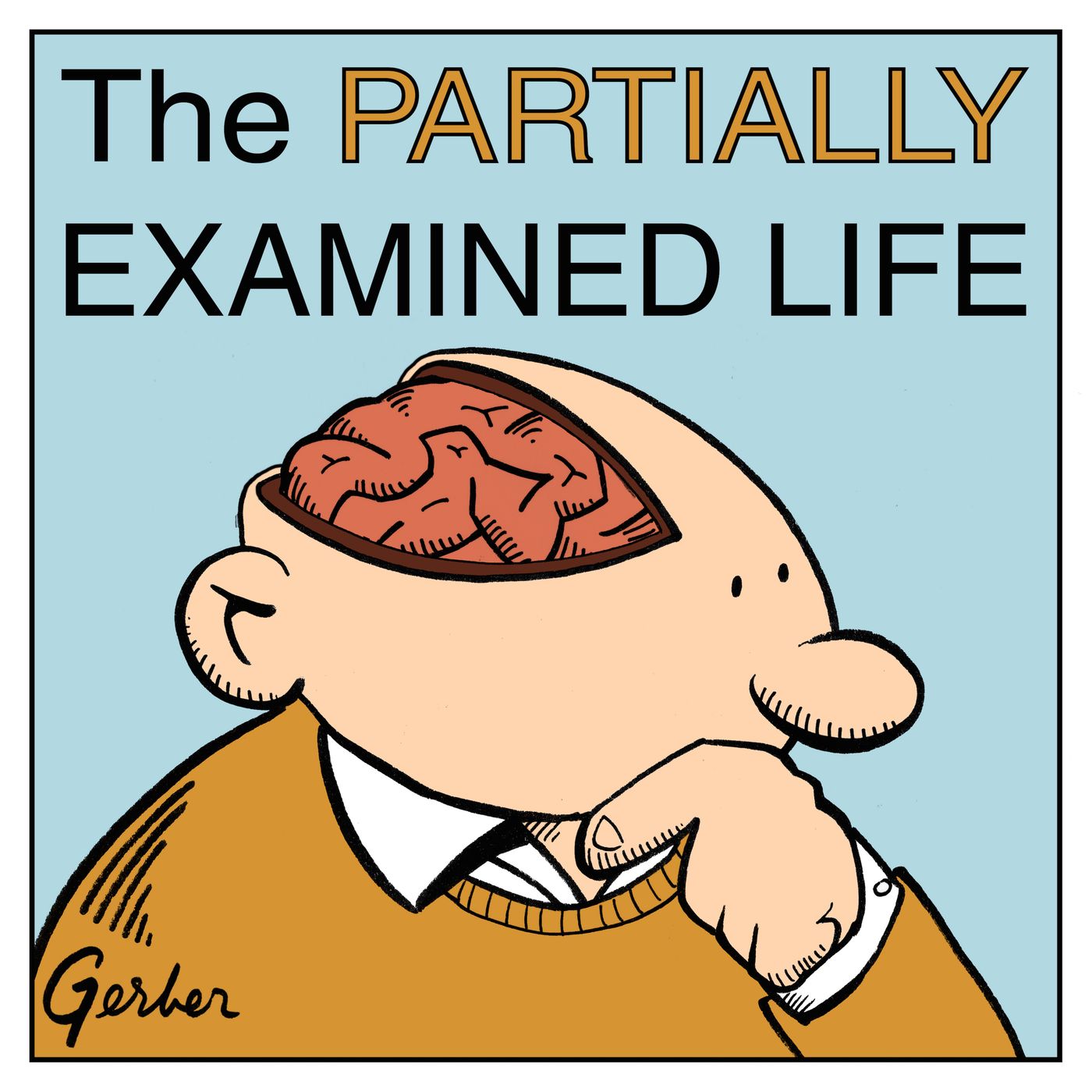
The Partially Examined Life Philosophy Podcast
The Partially Examined Life is a podcast by some guys who were at one point set on doing philosophy for a living but then thought better of it. Each episode, we pick a short text and chat about it with some balance between insight and flippancy. You don't have to know any philosophy, or even to have read the text we're talking about to (mostly) follow and (hopefully) enjoy the discussion. For links to the texts we discuss and other info, check out www.partiallyexaminedlife.com. We also feature episodes from other podcasts by our hosts to round out your partially examined life, including Pretty...
Where to listen?
Podcasts in the app Replaio Radio Coming soonPodcasts are coming to the app soon. Install now and be the first to see a whole new take on podcasts
 Install for free
Android 5M+ downloads · 4.8 rating
iOS soon
Install for free
Android 5M+ downloads · 4.8 rating
iOS soon
Episodes
Episode 195: Truth-The Austin/Strawson Debate (Part Two) 30.07.2018 1:00:49
Continuing on "Truth" by J.L. Austin and "Truth" by P.F. Strawson both from 1950. We proceed to the Strawson article, which critiques the notion of a "fact" as explaining why a sentence might be true. A "fact" is not a thing in the world! So what do we add when we change "The cat is on the mat" to "'The cat is on the mat' is true?" Listen to Part One first, or get the unbroken, ad-free Citizen Edi...
Episode 195: Truth-The Austin/Strawson Debate (Part One) 23.07.2018 1:00:39
On two articles in the "ordinary language" tradition of philosophy called "Truth" from 1950 by J.L. Austin and P.F. Strawson. Is truth a property of particular speech acts, or of the propositions expressed through speech acts? Does truth mean correspondence with the facts, or does the word "fact" make this definition totally uninformative? Does saying "is true" add any information content to a sen...
Episode 194: Alfred Tarski on Truth (Part Two) 16.07.2018 1:11:13
Continuing on Tarski's "The Semantic Conception of Truth and the Foundations of Semantics" (1944), Hartry Field's "Tarski's Theory of Truth" (1972), and Donald Davidson's "The Folly of Trying to Define Truth" (1977). What was Tarski really doing? What are the implications of his project? Does it even make sense to define "truth," and what should a definition look like? Listen to part one first, or...
Episode 194: Alfred Tarski on Truth (Part One) 09.07.2018 55:22
On Tarski's "The Semantic Conception of Truth and the Foundations of Semantics" (1944), Hartry Field's "Tarski's Theory of Truth" (1972), and Donald Davidson's "The Folly of Trying to Define Truth" (1977). What is truth? Tarski gives a technical, metaphysically neutral definition for truth within a particular, well-defined language. So how does that apply to real languages? He thought he was defin...
PREMIUM-Eps 192-193 Allan Bloom & Liberal Education Follow-Ups 07.07.2018 17:19
Hear highlights from two supporter-only discussions: Allan Bloom on Nietzsche/Freud/etc. and Leo Strauss vs. Richard Rorty on liberal education and democracy .
Episode 193: The Theory and Practice of Liberal Education (Part Two) 02.07.2018 52:48
Continuing with Pano Kanelos on articles on liberal education by Jacob Klein, Sidney Hook, and Martha Nussbaum. What's the practical application of a liberal education? Is it really liberating or indoctrinating? We continue discussion of the Great Books model. Listen to part 1 first or get the ad-free Citizen Edition along with the follow-up discussion . Please support PEL! End song: "Preservation...
Episode 193: The Theory and Practice of Liberal Education (Part One) 25.06.2018 48:56
Pano Kanelos, the president of St. John's College, Annapolis joins us to discuss Jacob Klein's "The Idea of a Liberal Education" (1960) and "On Liberal Education" (1965), plus Sidney Hook's "A Critical Appraisal of the St. John's College Curriculum" (1946) and Martha Nussbaum's "Undemocratic Vistas" (1987). What constitutes a liberal education? Should we all read the Western canon? Klein (and our...
Episode 192: "The Closing of the American Mind": Allan Bloom on Education (Part Two) 18.06.2018 1:05:28
Continuing on Allan Bloom's 1987 book critiquing the current fragmented structure of the university that promotes technical and professional education over the ability to think philosophically. Does Bloom's vision require aristocracy, or can a Great Books education be available for all? Listen to part 1 first, or get the unbroken, ad-free Citizen Edition . Your Citizenship will also get you access...
Episode 192: "The Closing of the American Mind": Allan Bloom on Education (Part One) 11.06.2018 52:06
On Allan Bloom's 1987 best-selleing polemic. What is the role of the university in our democracy? Bloom thinks that today's students are conformist, relativistic, and nihilistic, and that great books and thinking for thinking's sake are the cure. Continued on part 2 , or get the unbroken, ad-free Citizen Edition plus an exclusive follow-up discussion . Please support PEL!
Episode 191: Conceptual Schemes: Donald Davidson & Rudolf Carnap (Part Two) 04.06.2018 1:07:04
Finishing Davidson's "On the Very Idea of a Conceptual Scheme" (1974) and moving on to Carnap's "Empiricism, Semantics, and Ontology" (1950). Carnap claims that we talk about mathematical objects or subatomic particles or whatever, we're not really (contra Quine) making metaphysical claims. Ontological questions like "Are there really numbers?" are just pretentious nonsense. With guest Dusty Dallm...
Episode 191: Conceptual Schemes: Donald Davidson & Rudolf Carnap (Part One) 28.05.2018 54:59
On Davidson's "On the Very Idea of a Conceptual Scheme" (1974) and Carnap's "Empiricism, Semantics and Ontology" (1950). What does it mean to say that we grasp the world through a conceptual scheme? Are schemes different between cultures or even individuals, such that we can't really understand each other? Davidson thinks that this doesn't make sense. Please support PEL!
PREMIUM-Ep 189: Authorial Intent (Part Three) 26.05.2018 17:35
Listen here to a few highlights from a recent discussion between Mark and Wes: We chase down some issues from ep. 189 , relating authorial intent to philosophy of language more generally. Get the full discussions by becoming a PEL Citizen or $5/month Patreon supporter .
Episode 190: Film Analysis: "mother!" 21.05.2018 1:25:33
On Darren Aronofsky's philosophical 2017 film about humanity's relationship to nature. We discuss the philosophical content of the film (Gnosticism, anyone?) and explore the relation between meaning and the sensuous aspects of an artwork. Can a work be both allegorical and yet have fully fleshed out characters and the other elements that make a film feel real? This was a very polarizing film; how...
Episode 189: Authorial Intent (Barthes, Foucault, Beardsley, et al) (Part Two) 14.05.2018 1:19:03
Continuing on "The Death of the Author" by Roland Barthes (1967) and "What Is an Author?" by Michel Foucault (1969), and finally getting to "Against Theory" by Steven Knapp and Walter Benn Michaels (1982). What could it mean to say that a text, once written, speaks itself? We get into Foucault's critique of the cult of the author and the reader-centric types of analysis he proposes in its place. P...
Episode 189: Authorial Intent (Barthes, Foucault, Beardsley, et al) (Part One) 07.05.2018 52:01
On four essays about how to interpret artworks: "The Intentional Fallacy" by W. K. Wimsatt and Monroe Beardsley (1946), "The Death of the Author" by Roland Barthes (1967), "What is an Author?" by Michel Foucault (1969), and "Against Theory" by Steven Knapp and Walter Benn Michaels (1982). When you're trying to figure out what, say, a poem means, isn't the best way to do that to just ask the author...
Episode 188: Discussing "Lysistrata" and Politics with Lucy and Emily (Part Two) 30.04.2018 1:00:25
Concluding our discussion of Aristophanes's play with Lucy Lawless and Emily Perkins. We focus on trying to connect its lessons to the here and now: Is Lysistrata's victory properly described as the ascension of some kind of "feminine spirit" over warlike values, and how does that actually relate to women's struggles now to attain positions of power? Listen to our performance and then part one of...
Episode 188: Discussing "Lysistrata" and Politics with Lucy and Emily (Part One) 23.04.2018 49:27
We are rejoined by actresses Lucy Lawless and Emily Perkins to discuss Aristophanes's bawdy play. Listen to us perform it first . Supplementary readings included Jeffery Henderson's introduction to his 1988 translation of the play; "Sexual Humor and Harmony in Lysistrata" by Jay M. Semel (1981); and "The 'Female Intruder' Reconsidered: Women in Aristophanes' Lysistrata and Ecclesiazusae" by Helene...
"Lysistrata" w/ Lucy Lawless, Emily Perkins, Erica Spyres, Bill Youmans & Aaron Gleason 16.04.2018 1:23:14
The PEL Players return to perform a "cold read" of Aristophanes's play about using a sex strike to end war, first performed in 411 BCE. Jeffrey Henderson's translation makes this very accessible, and it's still really damn funny. Your hosts are joined by five real actors from TV, film, and Broadway. We will be following this up in ep. 188 with a full discussion of the play and the issues it raises...
PREMIUM-Episode 187: The Limits of Free Speech (Part Three) 14.04.2018 14:50
Three substantial chunks of a follow-up conversation to our free speech episode . Mark and Wes discuss Jordan Peterson on speech, organizations' promoting certain speech (as opposed to restricting), insults vs. arguments, offense vs. harm, "incoherence" arguments like Fish's, fundamental principles in ethics, and more. Get the full discussion by becoming a PEL Citizen or Patreon supporter .
Episode 187: The Limits of Free Speech (Part Two) 09.04.2018 1:01:19
Continuing our free form discussion, trying to make sense of Stanley Fish's " There's No Such Thing as Free Speech, and It's a Good Thing, Too " (1994) and other potential rationales for prohibiting hate speech. How might the same sentence or idea be used in different speech acts, some of which might be legitimately censured but others not? Listen to part one first, or get the Citizen Edition , al...
Episode 187: The Limits of Free Speech (Part One) 29.03.2018 59:35
A free-form discussion drawing on Stanley Fish's "There's No Such Thing as Free Speech, and It's a Good Thing, Too" (1994), Joel Feinberg's "Limits to the Free Expression of Opinion" (1975), and other sources. What are the legitimate limits on free speech? Feinberg delves into the harm and offense principles. Fish argues that every claim to free speech has ideological assumptions actually favoring...
Episode 186: J.L. Austin on Doing Things with Words (Part Two) 26.03.2018 1:10:13
Continuing on How to Do Things with Words (lectures from 1955), covering lectures 5-9. Austin tries and fails to come up with a way to grammatically distinguish performatives from other utterances, and so turns to his more complicated system of aspects of a single act: locutionary, illocutionary, perlocutionary. In doing so, he perlocutionarily blows our minds. Listen to part one first, or get the...
Episode 186: J.L. Austin on Doing Things with Words (Part One) 19.03.2018 47:01
On How to Do Things with Words (lectures from 1955). What's the relationship between language and the world? Austin says it's not all about descriptive true-or-false statements, but also includes "performatives" like "I promise…" and "I do" (spoken in a wedding) that are actions unto themselves. They can't be true or false, but they can be "unhappy" if social conventions aren't fulfilled (e.g., yo...
Episode 185: Ethics in Homer's "Odyssey" Feat. Translator Emily Wilson (Part Two) 12.03.2018 1:08:55
Continuing with Emily Wilson on her translation of the Greek epic poem. We discuss the "oikos" or estate, built on violence, and its connection to "xenia," or hospitality, which serves to forge military alliances. Also: status distinctions and the role of the gods in the text. Listen to part one first, or get the ad-free, unbroken Citizen Edition . Please support PEL! End song: "Tiny Broken Boats"...
Episode 185: Ethics in Homer's "Odyssey" Feat. Translator Emily Wilson (Part One) 05.03.2018 46:52
On the classic Greek epic poem, written ca. 750 BC and translated by our guest Emily Wilson in 2018. Does this story of "heroes" have anything to teach us about ethics? Wilson wrote an 80-page introduction to her new translation laying out the issues, including "hospitality" as a political tool, the value for status and identity of one's home (including your family and slaves), and the tension bet...
Similar podcasts




Listen to the The Partially Examined Life Philosophy Podcast podcast in Replaio
Radio and podcasts in one app - free, with no sign-up. Install today and do not miss the launch
Replaio is not a podcast publisher; show names, artwork and audio belong to their authors and are distributed through public RSS feeds.