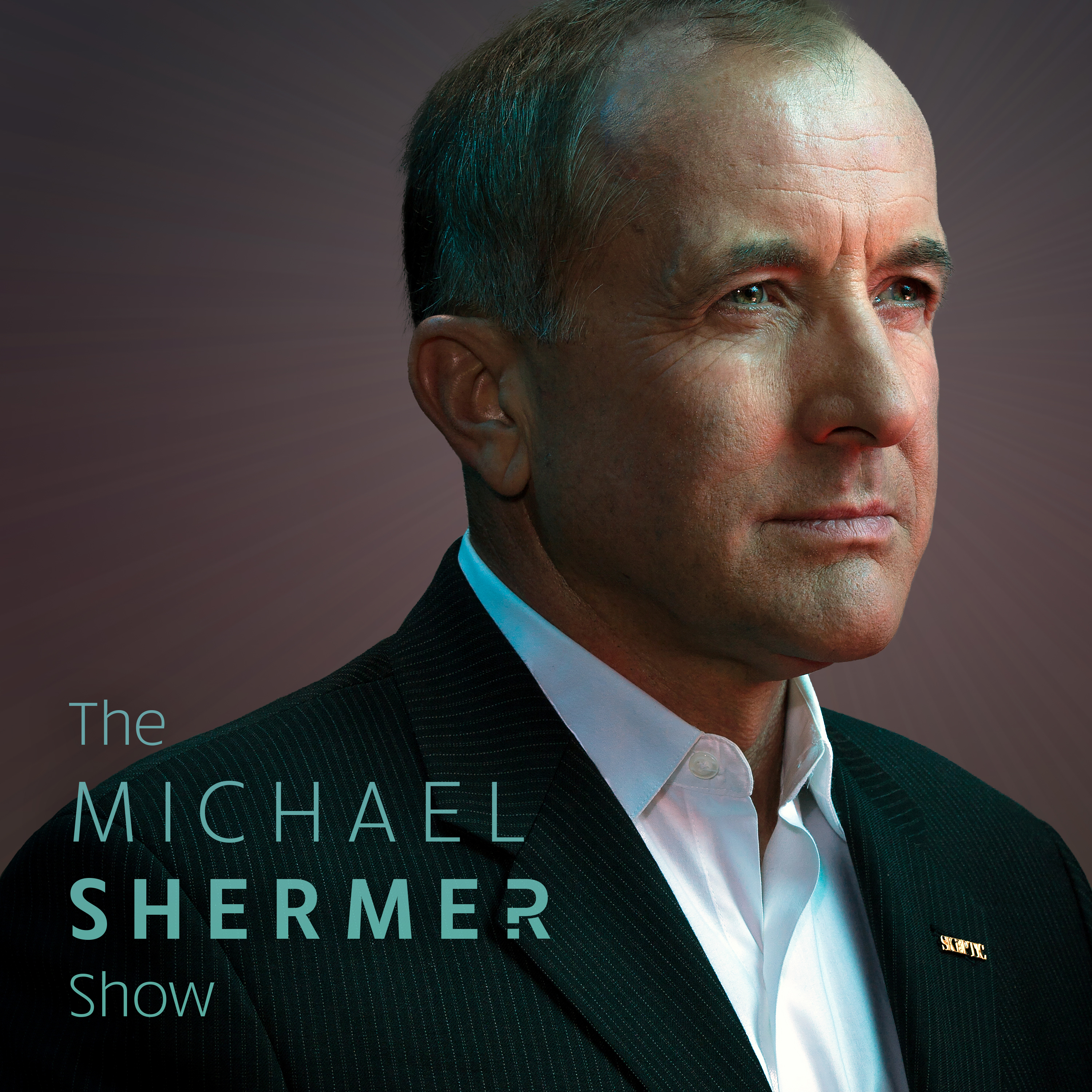
Michael Shermer
The Michael Shermer Show
The Michael Shermer Show is a series of long-form conversations between Dr. Michael Shermer and leading scientists, philosophers, historians, scholars, writers and thinkers about the most important issues of our time.
Be sure to visit the podcast's website and support the creator: www.skeptic.com
Where to listen?
Podcasts in the app Replaio Radio Coming soonPodcasts are coming to the app soon. Install now and be the first to see a whole new take on podcasts
 Install for free
Android almost 10M downloads · 4.8 rating
iOS soon
Install for free
Android almost 10M downloads · 4.8 rating
iOS soon
Episodes
The Collapse of Open Inquiry: Sacred Victims and Forbidden Questions 28.12.2025 1:30:00
Open inquiry depends on the ability to ask uncomfortable questions and follow evidence wherever it leads. Eric Kaufmann argues that this norm is now under strain. Drawing on history, survey data, and political theory, Kaufmann outlines how certain identity categories came to be treated as morally sacred—and how that shift has reshaped debates about equality, free speech, and academic inquiry. The...
The Future of Brain Implants: Restoring Speech, Regaining Mobility, Treating Pain 23.12.2025 1:00:21
Brain-computer interfaces are moving out of the lab and into real medical use. In this episode of The Michael Shermer Show , Michael Shermer talks with Dr. Matt Angle, founder and CEO of Paradromics, a neurotechnology company developing one of the most advanced high-data-rate brain implants in the world, similar to Neuralink. These devices record activity from individual neurons, making it possibl...
The Original Alien Craze: When People Believed in Martians 20.12.2025 1:26:06
At the turn of the 20th century, millions of Americans, including elite scientists, major newspapers, and cultural icons, were convinced that Mars was home to an advanced civilization. In this episode, Michael Shermer speaks with award-winning science journalist David Baron about one of the most astonishing episodes in scientific-cultural history. Blurry telescopes, mistranslated words, and persua...
How AI Sees Science Differently Than We Do 16.12.2025 2:07:33
What if the great discoveries of science came in the "wrong" order? The Laws of Thermodynamics were discovered well after the creation of algebra, classical physics, and chemistry, but are perhaps much more important to our basic understanding of the universe. Chris Edwards argues that AI will be able to understand science outside of the traditional chronological developments of the sciences, unlo...
Can You Spot a Killer? The Dangerous Fantasy of Criminal Profiling 13.12.2025 1:14:10
Criminal profiling promises certainty in the face of horror: this is what a killer looks like, this is how they think, this is how we stop them. But what if that promise is mostly an illusion? In this episode, Michael Shermer is joined by journalist and author Rachel Corbett to dismantle the myths behind criminal profiling, from the FBI's Behavioral Science Unit to our obsession with serial killer...
Why Wars Last Longer Than Experts Predict 08.12.2025 1:01:39
For nearly two centuries, international relations have been premised on the idea of the "Great Powers." As the thinking went, these mighty states—the European empires of the nineteenth century, the United States and the USSR during the Cold War—were uniquely able to exert their influence on the world stage because of their overwhelming military capabilities. But this conception of power fails to c...
The Emergent Mind: From Ant Colonies to Human Thought to Artificial Intelligence 06.12.2025 1:44:30
In this episode of The Michael Shermer Show , Michael sits down with two giants of mind and machine science: Jay McClelland, one of the founders of modern neural networks, and Gaurav Suri, computational neuroscientist and director of the RAD Lab. Drawing from decades of research, they walk us through the revolution from behaviorism to cognitive psychology to modern neuroscience, and why simple int...
Are We Meant to Leave Earth? Why Humanity May Have No Choice but to Go to Space 02.12.2025 1:33:34
Astrobiologist Caleb Scharf joins Michael Shermer for a wide-ranging conversation about the past, present, and future of our relationship with space. Drawing on his new book The Giant Leap , Scharf explains why human expansion beyond Earth may be less a choice than an evolutionary development, and he walks through the physics, history, and personalities that shaped our journey off the planet. Scha...
Cosmology, Creation, and the Evidence for God 29.11.2025 1:16:23
In this episode, Michel-Yves Bolloré lays out his case for why modern cosmology, fine-tuning, and the limits of materialism point toward a creator. Drawing on physics, thermodynamics, probability, and philosophy, he argues that the Big Bang, the apparent beginning of the universe, and the complexity of life collectively form a compelling body of evidence for God's existence. Bolloré explains why h...
Why Eastbound Flights Are Faster, and Other Strange Things About Wind (Simon Winchester) 22.11.2025 1:20:41
Have you ever thought about the science and history of … wind? In this episode, Simon Winchester explains why eastbound flights are usually faster than flying west, and how the discovery of the jet stream was almost missed because the original research was published in Esperanto. He also talks about the debate over the Great Terrestrial Stilling—the idea that global wind speeds may be decreasing—a...
Logic, Creativity, and the Limits of AI: How Humans Think in Ways Machines Never Will 18.11.2025 1:49:41
In this episode, Angus Fletcher explains why the human brain doesn't work like a computer and why our deepest strengths come not from logic or data processing but from imagination, emotion, and the ability to invent new futures. Drawing on neuroscience, Shakespeare, evolutionary biology, and his work with U.S. Army Special Operations, Fletcher shows how storytelling is the brain's oldest "technolo...
The Psychology of War: Could YOU Make a Moral Choice in Wartime? 16.11.2025 1:26:34
War begins in the human mind long before it unfolds on the battlefield. In this episode, Michael Shermer sits down with Nicholas Wright, a neurologist, neuroscientist, security strategist, and advisor to the Pentagon, to explore one of the biggest questions of our time: why do humans fight, and how does the brain shape violence, leadership, and geopolitical decision-making? Nicholas Wright is a me...
Tribes, Teams, and Cults: How Groups Shape What We Believe 11.11.2025 1:35:52
Why do smart people join dangerous cults, follow bad leaders, or stay silent when they know something's wrong? In this episode, Michael Shermer talks with organizational psychologist Colin Fisher about the science of group dynamics and conformity. From jazz bands to political mobs, Fisher explains how our evolutionary need to belong both unites and blinds us. He discusses the psychology of revenge...
Shermer Says 3: Weird Experiences, the Meaning of Dreams, and What Mark Twain Knew About Reality 08.11.2025 31:50
In this episode, Michael Shermer explores anomalous experiences through personal anecdotes and historical examples. He reflects on how to balance healthy skepticism with open-mindedness, and how to reckon with the very real emotional significance of such experiences—regardless of the scientific explanations behind them.
A Former Spy Explains How AI is Changing Espionage 04.11.2025 1:07:41
A former senior intelligence officer explains how espionage is evolving in the age of AI and amid rising global tensions with China, and why the mass harvesting of data affects not just nation-states, but all of us. The discussion also explores the history of spying, what life is really like for intelligence officers, and major intelligence failures and scandals, including 9/11 and Edward Snowden'...
Did Lost Civilizations Really Exist? An Archaeologist Explains 02.11.2025 1:39:19
Archaeologist Ken Feder sheds light on how archaeology separates evidence from wishful thinking and entertaining storytelling. He explains what rock art, radiocarbon dating, and DNA can really tell us about the first peoples of the Americas, and talks about the different theories about ancient human migration and the impact of European contact on Native American populations. He also shares what we...
Charles Murray: Why I'm Taking Religion Seriously 25.10.2025 1:43:55
Michael Shermer sits down with Charles Murray (author of The Bell Curve , Coming Apart , and now Taking Religion Seriously ) for a riveting 100-minute conversation about Murray's late-life turn from Harvard-bred agnosticism ("Smart people don't believe that stuff anymore") to Bayesian theism ("I put the afterlife at just over 50%"). This wide-ranging discussion explores the evidence for the existe...
The Myth of Human Exceptionalism: Why Humans Aren't as Special as We Think 21.10.2025 1:03:27
In this episode, Harvard primatologist Christine Webb challenges one of our deepest beliefs: that humans stand apart from the rest of nature. She traces the roots of human exceptionalism from Aristotle and Descartes to modern science, and explains why we still cling to hierarchies of intelligence. While most critiques of human exceptionalism focus on our moral obligation toward other species, Webb...
Shermer Says: Why Secularists Are Turning to Religion, The Substitution Hypothesis, Sleep Paralysis 18.10.2025 42:54
Are we entering a Fifth Great Awakening—a cultural swing back toward religion? An increasing number of books and articles are calling for a religious revival. "We need religion to keep our society functioning." "People need meaning." Michael Shermer responds to and revisits the historical waves of religious fervor that shaped American life. He also asks what today's renewed interest in faith, spir...
The Serial Killer Era of the 70s/80s: Lore, Patterns, and Plausible Explanations 15.10.2025 1:35:46
Pulitzer-winner Caroline Fraser maps the lives and crimes of Ted Bundy and his infamous peers—the Green River Killer, the I-5 Killer, the Night Stalker, the Hillside Strangler, and even Charles Manson—and explores an intriguing hypothesis: might environmental factors have played a role in the rise of serial killers in the 1970s and '80s? Caroline Fraser is the author of Prairie Fires: The American...
Shermer Says: Debate Skills, 2025 Nobel Peace Prize, Autism, Vaccines, ANTIFA, Bari Weiss & CBS News 13.10.2025 29:28
First installment of our new series Shermer Says . Topics covered: Debate Skills Nobel Peace Prize 2025 Autism & Tylenol COVID Vaccines & Myocarditis ANTIFA Bari Weiss & CBS News New Skeptic Research Center Study
When Rationality Becomes Irrational 11.10.2025 1:27:46
For many decision scientists, their starting point—drawn from economics—is a quantitative formula called Rational Choice Theory, allowing people to calculate and choose the best options. The problem is that this framework assumes an overly simplistic picture of the world, in which different types of values can be quantified and compared, leading to the "most rational" choice. Behavioral economics...
The Science of Revenge: Why Getting Even Feels So Good 07.10.2025 1:29:06
Why do we crave revenge? And why can't we stop? In this episode, James Kimmel explains the neuroscience behind one of our most destructive urges. Drawing from his new book, The Science of Revenge: Understanding the World's Deadliest Addiction , Kimmel reveals how revenge activates the same brain circuits as drugs like cocaine—and why even imagining payback can feel euphoric. If you've ever fantasi...
Why No One Thinks They're in a Cult 05.10.2025 1:13:42
What really defines a cult—and why do smart, well-intentioned people get caught up in them? In this episode, Michael Shermer sits down with cult intervention specialist Ashlen Hilliard to explore the psychology of high-control groups and the people drawn into them. Her work has been featured in prominent media outlets like Hulu, NewsNation, HuffPost, and BET+. In 2022, Ashlen founded People Leave...
Was Benjamin Franklin America's First Scientist? 30.09.2025 1:29:22
Michael Shermer sits down with economist and Franklin descendant Dr. Mark Skousen to explore the wit, wisdom, and modern relevance of Benjamin Franklin, the man who bridged science, politics, and philosophy like no other. Shermer and Skousen discuss Franklin's contributions to science, moral philosophy, economics, and religious thought, while asking: What would Franklin make of today's America—its...
Similar podcasts







Listen to the The Michael Shermer Show podcast in Replaio
Radio and podcasts in one app - free, with no sign-up. Install today and do not miss the launch
Replaio is not a podcast publisher; show names, artwork and audio belong to their authors and are distributed through public RSS feeds.