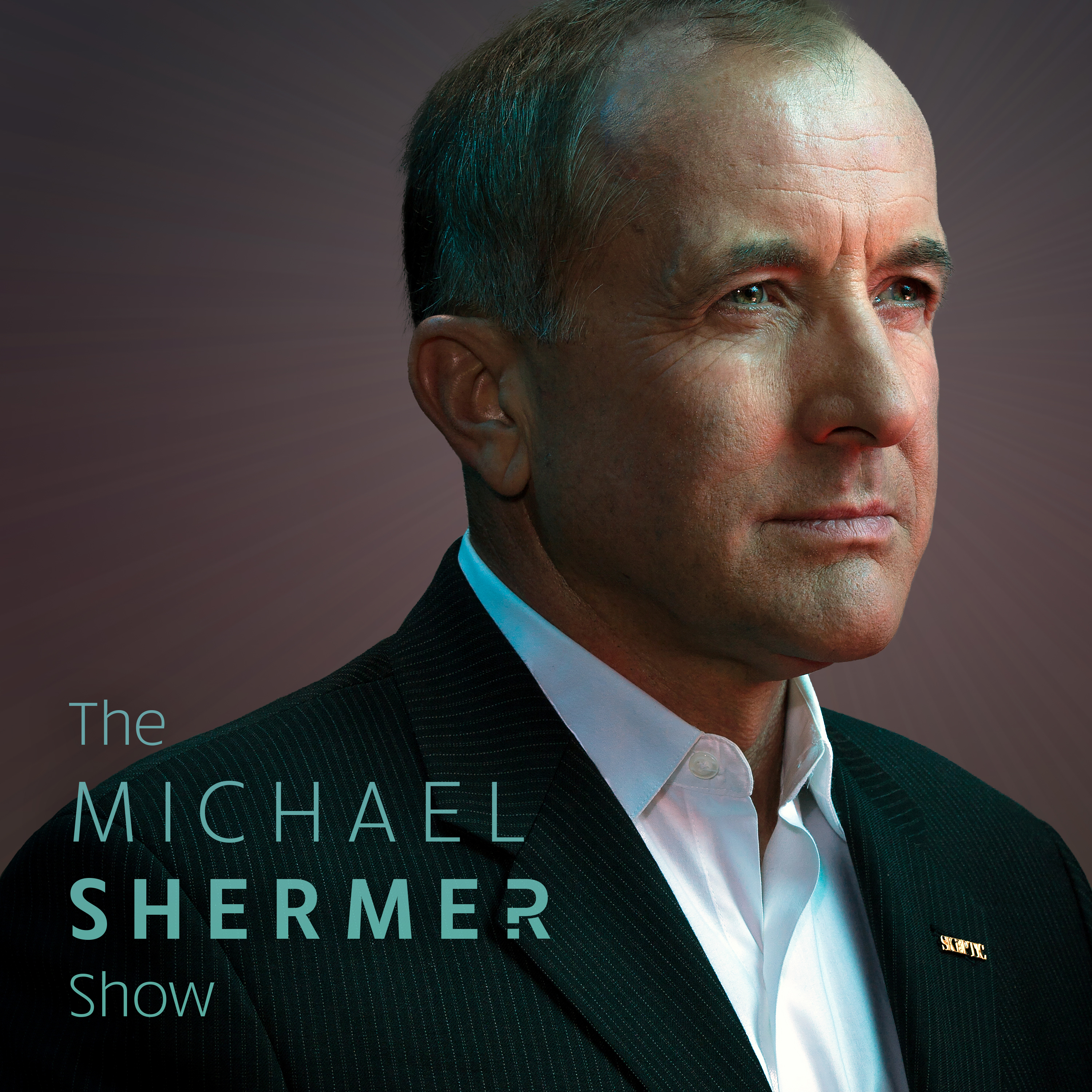
Michael Shermer
The Michael Shermer Show
The Michael Shermer Show is a series of long-form conversations between Dr. Michael Shermer and leading scientists, philosophers, historians, scholars, writers and thinkers about the most important issues of our time.
Be sure to visit the podcast's website and support the creator: www.skeptic.com
Where to listen?
Podcasts in the app Replaio Radio Coming soonPodcasts are coming to the app soon. Install now and be the first to see a whole new take on podcasts
 Install for free
Android almost 10M downloads · 4.8 rating
iOS soon
Install for free
Android almost 10M downloads · 4.8 rating
iOS soon
Episodes
Racism and White Guilt: Has America Changed More Than We Admit? | Shelby Steele & Eli Steele 11.10.2026 41:37
Can fighting racism end up reinforcing it? Shelby Steele grew up under segregation and became a Black militant in the 1960s. Today, he argues that White guilt has created a different racial problem: treating Black Americans as permanent victims who cannot succeed without White help. Shelby and his son, filmmaker Eli Steele, join Michael Shermer to discuss White Guilt , their new documentary abou...
Would You Want to Know If You Were Wrong? 28.09.2026 1:38:27
What do you make of an experience you can't explain? A strange light in the sky, a book flying off a desk, a coincidence that feels too improbable to be chance? Social psychologist Barry Markovsky joins Michael Shermer to discuss his new book Everyday Extraordinary and the experiences that have kept him studying paranormal beliefs for decades—including his own childhood UFO sighting and a supposed...
Does Consciousness Break the Laws of Physics? 22.09.2026 46:07
If we could explain everything happening in your brain, would there still be something left to explain about you? Physicist Avshalom Elitzur thinks so—and argues that accounting for consciousness may require changing the laws of physics. In this lively conversation, Michael Shermer challenges Elitzur on why subjective experience should be anything more than a product of the brain, whether an AI co...
Jared Diamond: How Much Can One Person Change History? 15.09.2026 1:29:25
Would World War II have happened without Hitler? Would someone else have built Apple without Steve Jobs? Jared Diamond joins Michael Shermer to ask how much history depends on particular people. From Darwin's discoveries to the rise of Christianity, Diamond considers when someone is truly irreplaceable, when someone else would have done much the same thing, and how we can tell the difference. Jare...
Why America Failed to Stop 9/11 | Gerald Posner & Michael Shermer 11.09.2026 42:49
How did 19 hijackers evade the world's most advanced intelligence apparatus despite years of warnings? Twenty-five years after 9/11, journalist Gerald Posner joins Michael Shermer to explain the security failures that left America vulnerable. Those failures, compounded by government secrecy, have helped sustain suspicions that officials orchestrated the attacks or deliberately allowed them to happ...
Why Be Honest When Cheating Pays? 09.09.2026 1:45:08
Most of us think of ourselves as honest. But would we still tell the truth if lying got us what we wanted—and nobody would ever find out? Philosopher Christian Miller joins Michael Shermer to discuss his new book The Honesty Crisis and the uncomfortable gap between having a reputation for honesty and actually being honest. Christian B. Miller is the A.C. Reid Professor of Philosophy at Wake Fores...
Is the Future Unknowable? Uncertainty, Free Will, and the Limits of Science 01.09.2026 1:23:41
What if uncertainty isn't a temporary problem science will eventually solve, but a fundamental feature of reality? Neuroscientist Stuart Firestein joins Michael Shermer to make the case that the universe may be far less deterministic—and the future far less predictable—than we like to imagine. Firestein and Shermer discuss chaos and complexity, Darwin and randomness, free will, scientific progress...
Why We Want to Believe in Aliens and Why We Still Haven't Found Them 25.08.2026 1:13:53
UFOs were once the stuff of tabloids and conspiracy theories. Today they're the subject of congressional hearings, Pentagon investigations, mainstream news coverage, and a new wave of claims about government cover-ups and alien technology. Adam Kirsch, senior editor at The Atlantic and author of We Want to Believe: How Aliens Went Mainstream and Why It Matters , joins Michael Shermer to ask what c...
Is There a Second Arrow of Time? A New Law of Evolution, Information, and Complexity 18.08.2026 1:18:04
Why does the universe produce ever more elaborate forms, from atoms and minerals to cells, organisms, brains, technology, and civilization? The familiar laws of physics can explain much of what happens in nature, but Robert Hazen and Michael Wong argue that something important has been missing: a law describing how evolving systems generate and select new forms over time. Michael Shermer speaks wi...
Why Good People Disagree About Right and Wrong 11.08.2026 1:57:21
Why do reasonable people disagree so strongly about right and wrong? And why are we so quick to assume that people on the other side of a moral or political issue are irrational, selfish, ignorant, or simply bad? Michael Shermer speaks with Cornell psychologist Audun Dahl, author of Between Fixed and Fickle: Why Our Moral Views Keep Changing , about how human morality develops and why many familia...
Are We Building a God? AI, Superintelligence, and the Coming Singularity 05.08.2026 1:22:49
Robert Wright joins Michael Shermer to discuss his new book, The God Test: Artificial Intelligence and Our Coming Cosmic Reckoning , and why he thinks the AI revolution may be moving much faster than most people realize. Wright argues that deep learning is not just a new way of programming computers. In an important sense, it resembles evolution: neural networks discover solutions for themselves,...
Can You Trust Wikipedia? Co-Founder Larry Sanger on Wikipedia's Bias and Why He Was Banned 30.07.2026 2:03:46
Michael Shermer speaks with Wikipedia co-founder Larry Sanger shortly after Sanger was permanently banned from editing the site he helped create. Sanger tells the story of Wikipedia's founding, how its ideal of open collaboration hardened into a system dominated by a relatively small group of powerful editors, and why he believes its rules on sourcing and "consensus" now produce political and reli...
How to Think Clearly About a World in Crisis: Iran, China, Russia, and the West's Economic Pessimism 18.07.2026 1:04:04
Michael Shermer speaks with political scientist Marlene Laruelle about Russia's turbulent transformation during the 1990s and the rise of Vladimir Putin, why the Kremlin so badly misjudged Ukraine, China's rise and its ambitions regarding Taiwan, why killing Iran's Supreme Leader and much of its senior leadership did not bring down the regime, the limits of foreign aid and sanctions, mass surveill...
The Truth About Sex Differences (Steve Stewart-Williams) 11.07.2026 55:03
How do men and women differ? Where do the differences come from? And how do they shape modern life? Drawing on a century of research and a billion years of evolution, Steve Stewart-Williams explains why many sex differences appear despite socialization, not because of it; why in our mating and parenting patterns, humans are more like the average bird than the average mammal; and why sex difference...
America at 250: What Did the Founders Get Right? 06.07.2026 17:17
Michael Shermer makes the case that the U.S. Founding Fathers were not only steeped in Enlightenment values on which the Declaration of Independence was based, but they were also scientists searching to discover moral truths and values on which to base a rational society, which they succeeded in doing in this document along with the Constitution.
When History Goes on Trial: Demjanjuk, Eichmann, and Justice After Atrocity 27.06.2026 1:32:24
John Demjanjuk lived for decades as a retired autoworker in suburban Cleveland. Then investigators accused him of being "Ivan the Terrible," one of the most notorious guards at Treblinka. What followed was one of the strangest and most troubling Nazi war-crimes cases of the postwar era: extradition, eyewitness testimony, a death sentence, a reversal, and a final prosecution many years later. In th...
Why I Joined the Government UAP Science Advisory Council 23.06.2026 29:08
Michael Shermer has been appointed to the newly formed UAP Science Advisory Council, formed at the request of the White House and in coordination with the All-domain Anomaly Resolution Office (AARO), the Office of the Director of National Intelligence (ODNI), the FBI, and other agencies. The council brings together experts from a wide range of disciplines—including astrophysics, oceanography, mole...
Massimo Pigliucci on Doubt, Moral Courage, and Living Without Illusions 20.06.2026 1:33:55
What does it mean to live well when certainty is unavailable? Michael Shermer speaks with Massimo Pigliucci about moral character, ancient philosophy, and the difficult art of making decisions without easy answers. The conversation moves from Cicero and Stoicism to the legacy of the New Atheism, asking why rejecting religion is not the same as having a philosophy of life. They discuss virtue ethic...
Cathy Young: Why Free Societies Need Free Speech 16.06.2026 1:30:24
Cathy Young returns to the show for a wide-ranging conversation about free speech, institutional trust, and the strange incentives shaping public debate today. What happens when universities, media outlets, political movements, and online personalities trade careful thinking for moral certainty, tribal loyalty, or attention? Michael and Cathy discuss the pressure to excuse bad ideas when they come...
The Zodiac Killer Wasn't Real 13.06.2026 1:39:14
The Zodiac Killer has been treated for decades as America's ultimate unsolved true crime mystery: one mysterious killer, taunting letters, cryptic ciphers, a strange costume, and a trail of victims across Northern California. Eddie McNamara thinks that story is wrong. The victims were real, the crimes were real, but the single mastermind may have been a media-made myth. Eddie McNamara is the autho...
How Algorithms Use Your Data to Control You 09.06.2026 1:34:18
Michael Shermer speaks with Oxford philosopher Carissa Véliz about the long human desire to know the future—from ancient oracles and astrology to AI, surveillance capitalism, predictive policing, and "data-driven" decision-making. Véliz argues that prediction is rarely neutral: the same machinery that collects personal data also tries to forecast behavior, and once institutions start treating pred...
Batya Ungar-Sargon: Why the Left Sees Jews Differently Now 06.06.2026 54:35
Batya Ungar-Sargon joins Michael Shermer for a wide-ranging conversation about the historical relationship between Jews and the American left, and why that relationship has become increasingly strained in recent years. The discussion begins with the reaction to October 7 and the political language that quickly emerged around Israel, Palestine, power, oppression, and resistance. From there, Ungar-S...
From Equality to Equity: How Social Justice Becomes Ideology 03.06.2026 58:45
Jon Mills, a philosopher, psychoanalyst, and clinical psychologist, joins Michael Shermer to discuss how social justice ideology has moved from a concern with fairness and equal treatment into a rigid moral framework built around oppressors and victims, privilege and disadvantage, good and evil. Their conversation focuses on the tension between compassion and truth: how to take injustice seriously...
Can Science Fix Criminal Justice? 29.05.2026 1:06:35
America's criminal justice debate usually gets reduced to two options: abolish the system or lock everyone up forever. Economist Jennifer Doleac thinks the data point somewhere else entirely. In this episode, Michael Shermer speaks with Doleac about what rigorous research can tell us about crime, punishment, deterrence, prison reform, and public safety. Doleac argues that America has built much of...
Gad Saad: When Empathy Becomes Dangerous 26.05.2026 1:30:02
Gad Saad returns to discuss his new book Suicidal Empathy: Dying to Be Kind , a provocative argument that empathy is not a moral trump card. Empathy can illuminate suffering, but it can also distort judgment when it is treated as an unquestionable virtue, applied selectively, or insulated from consequences. Saad's central claim is that many Western institutions have learned to treat compassion as...
Similar podcasts








Listen to the The Michael Shermer Show podcast in Replaio
Radio and podcasts in one app - free, with no sign-up. Install today and do not miss the launch
Replaio is not a podcast publisher; show names, artwork and audio belong to their authors and are distributed through public RSS feeds.