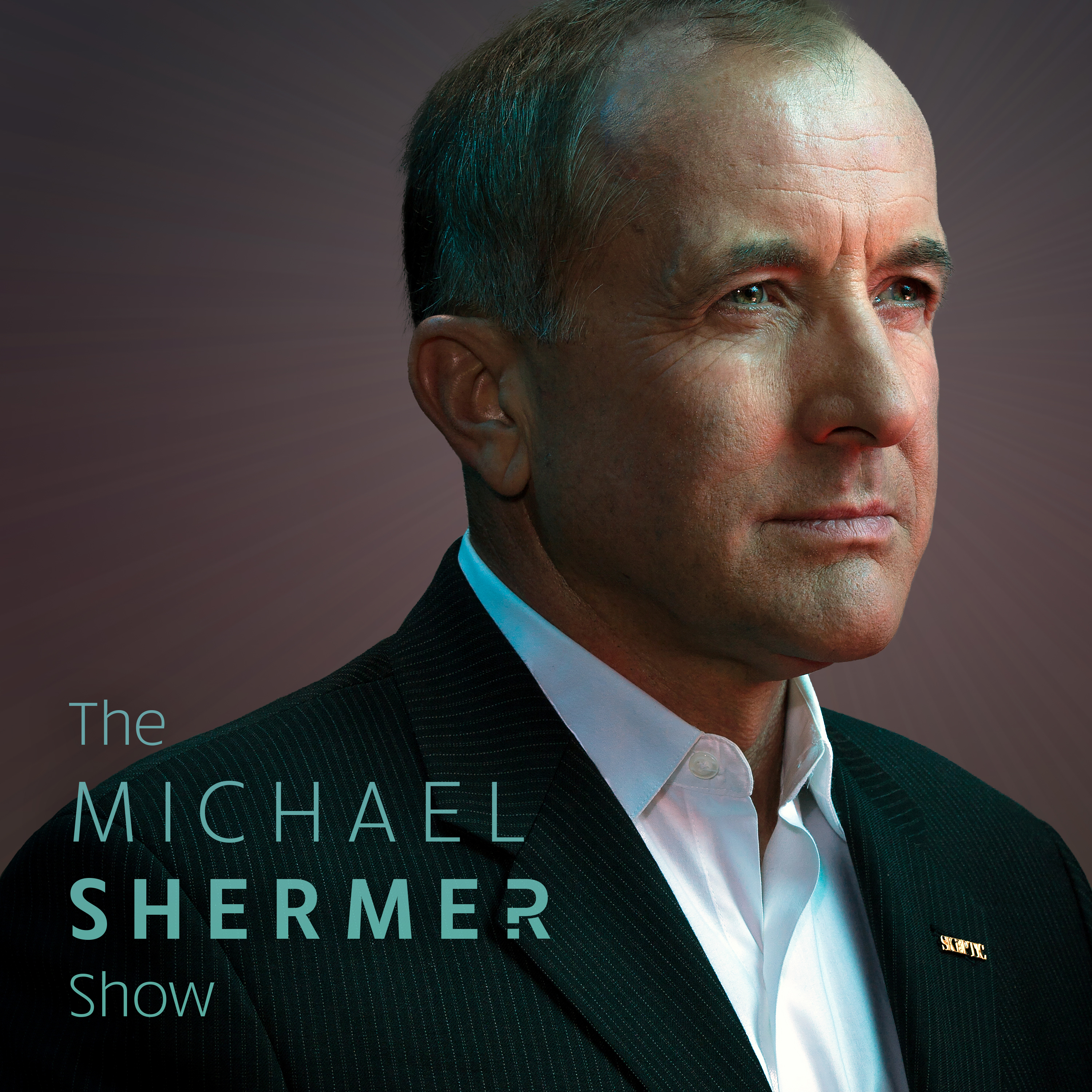
Michael Shermer
The Michael Shermer Show
The Michael Shermer Show is a series of long-form conversations between Dr. Michael Shermer and leading scientists, philosophers, historians, scholars, writers and thinkers about the most important issues of our time.
Where to listen?
Podcasts in the app Replaio Radio Coming soonPodcasts are coming to the app soon. Install now and be the first to see a whole new take on podcasts
 Install for free
Android 5M+ downloads · 4.8 rating
iOS soon
Install for free
Android 5M+ downloads · 4.8 rating
iOS soon
Episodes
101. Hugo Mercier — Not Born Yesterday: The Science of Who We Trust and What We Believe 28.01.2020 1:59:16
Not Born Yesterday explains how we decide who we can trust and what we should believe — and argues that we're pretty good at making these decisions. Hugo Mercier demonstrates how virtually all attempts at mass persuasion — whether by religious leaders, politicians, or advertisers — fail miserably. Drawing on recent findings from political science and other fields ranging from history to anthropolo...
100. Episode Special: Ask Me Almost Anything 21.01.2020 1:01:46
In this 100 th episode of the Science Salon podcast Dr. Shermer gives a brief overview and history of the salon and how it evolved from the Distinguished Science Lecture Series at Caltech, which began in 1992, along with the founding of the Skeptics Society, a 501(c)(3) nonprofit science education organization, and it's publication Skeptic magazine. Following this brief history Dr. Shermer answers...
99. Bobby Duffy — Why We’re Wrong About Nearly Everything: A Theory of Human Misunderstanding 14.01.2020 1:33:33
What percentage of the population are immigrants? How bad is unemployment? How much sex do people have? These questions are important and interesting, but most of us get the answers wrong. Research shows that people often wildly misunderstand the state of the world, regardless of age, sex, or education. And though the internet brings us unprecedented access to information, there's little evidence...
98. Robert Pennock — An Instinct for Truth: Curiosity and the Moral Character of Science 07.01.2020 1:59:34
An exploration of the scientific mindset — such character virtues as curiosity, veracity, attentiveness, and humility to evidence — and its importance for science, democracy, and human flourishing. Exemplary scientists have a characteristic way of viewing the world and their work: their mindset and methods all aim at discovering truths about nature. In An Instinct for Truth , Robert Pennock explor...
97. Amber Scorah — Leaving the Witness: Exiting a Religion and Finding a Life 31.12.2019 1:35:32
In this revealing conversation Amber Scorah opens the box into the psychology of religious belief to show how, exactly, religions and cults convince members that theirs is the one true religion, to the point, she admits, that she would have gladly died for her faith. As a third-generation Jehovah's Witness, Amber Scorah had devoted her life to sounding God's warning of impending Armageddon. She vo...
96. Catherine Wilson — How to Be an Epicurean: The Ancient Art of Living Well 24.12.2019 1:11:52
In this wide-ranging conversation the philosopher Catherine Wilson makes the case that if the pursuit of happiness is the question, Epicureanism is the answer. Not the mythic Epicureanism that calls to mind gluttons with gout or an admonition to eat, drink, and be merry. Instead, in her new book How to Be an Epicurean , Wilson shows that Epicureanism isn't an excuse for having a good time: it's a...
95. John Martin Fischer — Death, Immortality and Meaning in Life 17.12.2019 1:34:40
John Martin Fischer's Death, Immortality, and Meaning in Life offers a brief yet in-depth introduction to the key philosophical issues and problems concerning death and immortality. In this wide-ranging and thoughtful conversation, Shermer and Fisher discuss: meaning in life meaning in death the badness of death different philosophical, religious, and scientific ideas on immortality near-death exp...
94. David Leiser — How We Misunderstand Economics and Why it Matters 10.12.2019 1:22:39
This is the first book to explain why people misunderstand economics. From the cognitive shortcuts we use to make sense of complex information, to the metaphors we rely on and their effect on our thinking, this important book lays bare not only the psychological traits that distort our ability to understand such a vital topic, but also what this means for policy makers and civil society more widel...
93. Geoffrey Miller — Virtue Signaling: Essays on Darwinian Politics & Free Speech 02.12.2019 2:04:20
Michael Shermer talks with the polymathic polyamorous sapiosexual classically liberal evolutionary psychologist Geoffrey Miller about: virtue signaling and why we all do it how the phrase "virtue signaling" became a derogatory political meme how virtue signaling really works and why it is not a bad thing why evolutionary psychology is not based on "just so" story telling how multiple traits can be...
92. Tim Samuels — Future Man: How to Evolve and Thrive in the Age of Trump, Mansplaining, and #MeToo 19.11.2019 1:47:12
If ever there was an urgent need for a frank understanding of what's going on with men, it is now. Male rage and frustration have driven resurgent populism, mass shootings, and epidemics of addiction and violence. Powerful men who have abused their positions for decades have been and are being #MeToo-outed and dismissed. The patriarchy, that solid bedrock of male power for thousands of years, seem...
91. James Traub — What Was Liberalism? The Past, Present, and Promise of a Noble Idea 12.11.2019 1:21:30
In this wide-ranging conversation James Traub and Michael Shermer discuss: the changing meaning of "liberalism" over the centuries and decades why the first liberals were deeply skeptical of majority rule how, by the second half of the 20 th century, liberalism become the national creed of the most powerful country in the world why this consensus did not last the giants of liberalism: James Madiso...
90. Melvin Konner — Believers: Faith in Human Nature 05.11.2019 1:39:18
World renowned biological anthropologist Mel Konner examines the nature of human nature, including and especially in his new book the nature of religiosity. In Believers , Konner, who was raised in an orthodox Jewish home but has been an atheist his entire adult life, responds to attacks on faith by some well-meaning scientists and philosophers, most notably the "new atheists" Richard Dawkins, Dan...
89. Richard Dawkins — Outgrowing God: A Beginner's Guide 29.10.2019 40:09
In 12 fiercely funny, mind-expanding chapters, Richard Dawkins explains how the natural world arose without a designer — the improbability and beauty of the "bottom-up programming" that engineers an embryo or a flock of starlings — and challenges head-on some of the most basic assumptions made by the world's religions. In this wide-ranging conversation Shermer and Dawkins discuss: how Outgrowing...
88. Daniel Oberhaus — Extraterrestrial Languages 22.10.2019 1:21:26
The endlessly fascinating question of whether we are alone in the universe has always been accompanied by another, more complicated one: if there is extraterrestrial life, how would we communicate with it? In his book Extraterrestrial Languages , Daniel Oberhaus leads readers on a quest for extraterrestrial communication. Exploring Earthlings' various attempts to reach out to non-Earthlings over t...
87. Douglas Murray — The Madness of Crowds: Gender, Race, and Identity 15.10.2019 1:10:45
In his devastating new book The Madness of Crowds , Douglas Murray examines the 21 st century's most divisive issues: sexuality, gender, technology and race. He reveals the astonishing new culture wars playing out in our workplaces, universities, schools and homes in the names of social justice, identity politics and intersectionality. We are living through a postmodern era in which the grand narr...
86. Neil deGrasse Tyson — Letters from an Astrophysicist 08.10.2019 1:08:29
Astrophysicist Neil deGrasse Tyson has attracted one of the world's largest online followings with his fascinating, widely accessible insights into science and our universe. Now, Tyson invites us to go behind the scenes of his public fame by revealing his correspondence with people across the globe who have sought him out in search of answers. In this hand-picked collection of 101 letters, Tyson d...
85. Deepak Chopra — Metahuman: Unleashing Your Infinite Potential 01.10.2019 55:12
In this conversation long-time adversaries and now friends Michael Shermer and Deepak Chopra make an attempt at mutual understanding through the careful unpacking of what Deepak means when he talks about the subject-object split, the impermanence of the self, nondualism, the mind-body problem, the nature of consciousness, and the nature of reality. Shermer also pushes Deepak to translate these dee...
84. Christof Koch — The Feeling of Life Itself: Why Consciousness is Widespread but Can't Be Computed 24.09.2019 1:33:22
In this fascinating discussion of one of the hardest problems in all of science — the hard problem of consciousness, that is, explaining how the feeling or experience of something can arise from neural activity — one of the world's leading neuroscientists Christof Koch argues that consciousness, more widespread than previously assumed, is the feeling of being alive, not a type of computation or a...
83. Peter Boghossian — How to Have Impossible Conversations: A Very Practical Guide 17.09.2019 1:15:27
In our current political climate, it seems impossible to have a reasonable conversation with anyone who has a different opinion. Whether you're online, in a classroom, an office, a town hall — or just hoping to get through a family dinner with a stubborn relative — dialogue shuts down when perspectives clash. Heated debates often lead to insults and shaming, blocking any possibility of productive...
82. Phil Zuckerman — What it Means to be Moral: Why Religion is Not Necessary for Living an Ethical Life 10.09.2019 1:17:15
In What It Means to Be Moral: Why Religion Is Not Necessary for Living an Ethical Life , Phil Zuckerman argues that morality does not come from God. Rather, it comes from us: our brains, our evolutionary past, our ongoing cultural development, our social experiences, and our ability to reason, reflect, and be sensitive to the suffering of others. By deconstructing religious arguments for God-based...
81. Bruce Hood — Possessed: Why We Want More Than We Need 03.09.2019 1:39:45
You may not believe it, but there is a link between our current political instability and your childhood attachment to teddy bears. There's also a reason why children in Asia are more likely to share than their western counterparts and why the poor spend more of their income on luxury goods than the rich. Or why your mother is more likely to leave her money to you than your father. What connects t...
80. Bryan Walsh — End Times: A Brief Guide to the End of the World 27.08.2019 1:03:35
End Times: A Brief Guide to the End of the World is a compelling work of skilled reportage that peels back the layers of complexity around the unthinkable—and inevitable—end of humankind. From asteroids and artificial intelligence to volcanic supereruption to nuclear war, 15-year veteran science reporter and TIME editor Bryan Walsh provides a stunning panoramic view of the most catastrophic threat...
79. Anthony Kronman — The Assault on American Excellence 20.08.2019 1:21:07
The former dean of Yale Law School argues that the feverish egalitarianism gripping college campuses today is out of place at institutions whose job is to prepare citizens to live in a vibrant democracy. In his tenure at Yale, Anthony Kronman has watched students march across campus to protest the names of buildings and seen colleagues resign over emails about Halloween costumes. He is no stranger...
78. Dr. Donald Hoffman — The Case Against Reality: Why Evolution Hid the Truth From Our Eyes 13.08.2019 1:44:11
In his new book, The Case Against Reality: Why Evolution Hid the Truth From Our Eyes , the U.C. Irvine cognitive scientist Dr. Donald Hoffman challenges the leading scientific theories that claim that our senses report back objective reality. How can it be possible that the world we see is not objective reality? And how can our senses be useful if they are not communicating the truth? Hoffman argu...
77. Dr. Lee McIntyre — The Scientific Attitude: Defending Science from Denial, Fraud, and Pseudoscience 30.07.2019 1:54:05
In this engaging conversation on the nature of science, Dr. McIntyre and Dr. Shermer get deep into the weeds of where to draw the line between science and pseudoscience. It may seem obvious when you see it (like Justice Potter's definition of pornography — "I know it when I see it"), from a philosophical perspective it isn't at all easy to articulate a formula for science that perfectly weeds out...
Similar podcasts







Listen to the The Michael Shermer Show podcast in Replaio
Radio and podcasts in one app - free, with no sign-up. Install today and do not miss the launch
Replaio is not a podcast publisher; show names, artwork and audio belong to their authors and are distributed through public RSS feeds.