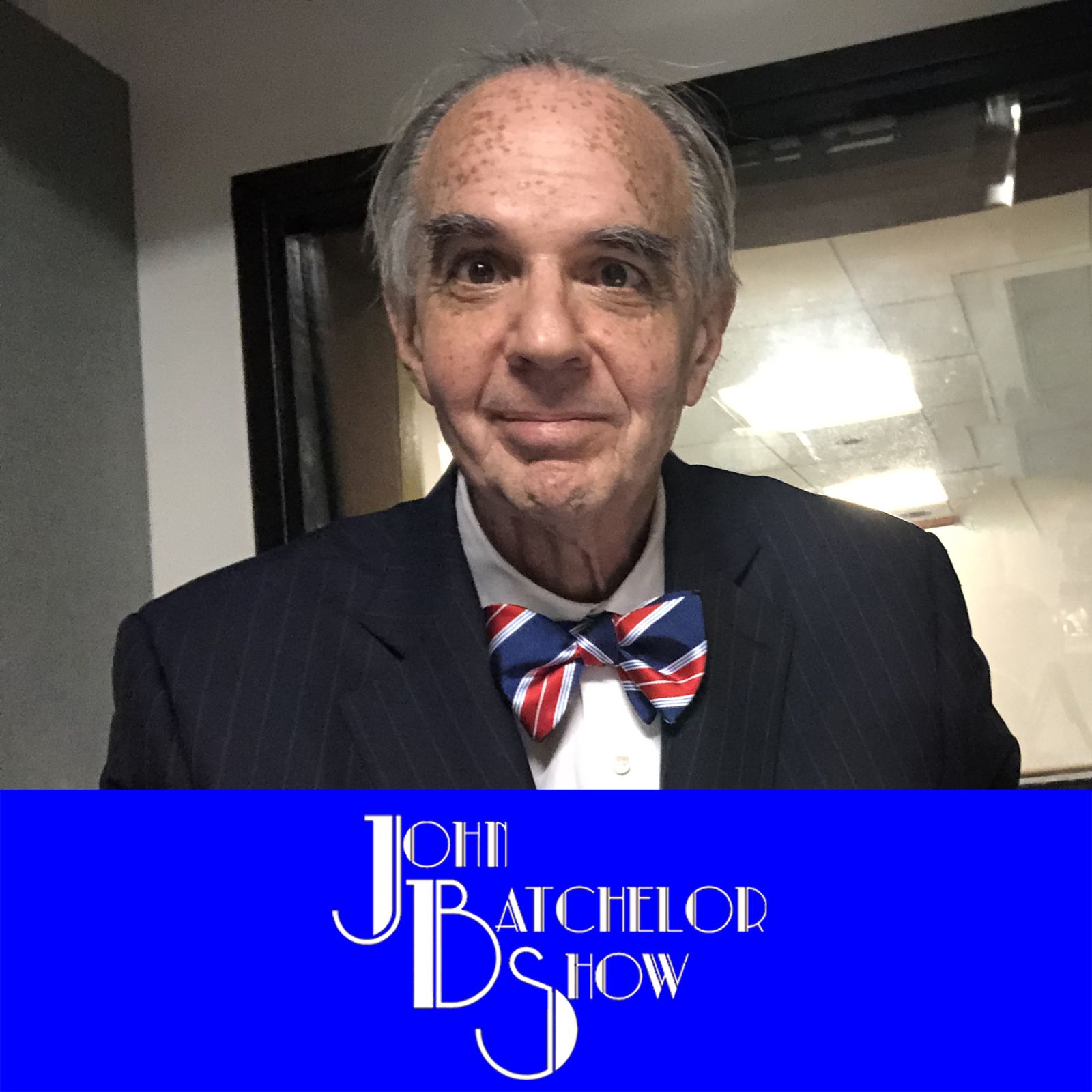
John Batchelor
The John Batchelor Show
The John Batchelor Show is a hard news-analysis radio program on current events, world history, global politics and natural sciences. Based in New York City for two decades, the show has travelled widely to report, from the Middle East to the South Caucasus to the Arabian Peninsula and East Asia.
Be sure to visit the podcast's website and support the creator: substack.com
Where to listen?
Podcasts in the app Replaio Radio Coming soonPodcasts are coming to the app soon. Install now and be the first to see a whole new take on podcasts
 Install for free
Android almost 10M downloads · 4.8 rating
iOS soon
Install for free
Android almost 10M downloads · 4.8 rating
iOS soon
Episodes
S8 Ep1089: Robert Cwiklik, guest author, recounts how, in the wake of the 1874 White League coup, President Grant felt compelled to take decisive action, despite the 1874 midterm elections flipping the House of Representatives to Democratic control. Grant 05.07.2026 9:24
Robert Cwiklik , guest author, recounts how, in the wake of the 1874 White League coup, President Grant felt compelled to take decisive action, despite the 1874 midterm elections flipping the House of Representatives to Democratic control. Grant initially used massive military force—including warships and infantry—to restore Governor Kellogg , but he realized a permanent solution was needed as whi...
S8 Ep1089: Robert Cwiklik, guest author, describes how, by 1874, the Crescent City White League, an armed vigilante group, emerged to violently intimidate Republican officials and Black voters in Louisiana. Their aggression was fueled by a circuit judge's 05.07.2026 6:25
Robert Cwiklik , guest author, describes how, by 1874, the Crescent City White League , an armed vigilante group, emerged to violently intimidate Republican officials and Black voters in Louisiana . Their aggression was fueled by a circuit judge's opinion suggesting that federal Enforcement Acts might be unconstitutional, which white Southerners interpreted as a "green light" for resistance. In Se...
S8 Ep1089: Robert Cwiklik, guest author, explains that following the 1866 massacres, Congress passed the Reconstruction Act of 1867, imposing military rule and requiring new state constitutions that enfranchised Black men. This era saw the rise of "carpet 05.07.2026 13:15
Robert Cwiklik , guest author, explains that following the 1866 massacres, Congress passed the Reconstruction Act of 1867 , imposing military rule and requiring new state constitutions that enfranchised Black men. This era saw the rise of "carpetbaggers"—Northern Republicans who moved south and were elected by newly empowered Black voters—and the implementation of progressive policies like public...
S8 Ep1089: Robert Cwiklik, guest author, recounts how, in July 1866, New Orleans became the site of a brutal police-led riot against a constitutional convention aimed at securing Black voting rights. Following Lincoln's death, President Andrew Johnson's l 05.07.2026 7:24
Robert Cwiklik , guest author, recounts how, in July 1866, New Orleans became the site of a brutal police-led riot against a constitutional convention aimed at securing Black voting rights. Following Lincoln's death, President Andrew Johnson's lenient Reconstruction policy empowered former Confederates , who enacted "Black Codes" to essentially re-enslave African-Americans through vagrancy laws an...
S8 Ep1089: Robert Cwiklik, guest author, discusses the pivotal moments following Lee's surrender on April 9, 1865. President Lincoln, addressing a jubilant crowd, tentatively endorsed voting rights for African-Americans, specifically those who served in t 05.07.2026 10:25
Robert Cwiklik , guest author, discusses the pivotal moments following Lee's surrender on April 9, 1865. President Lincoln , addressing a jubilant crowd, tentatively endorsed voting rights for African-Americans, specifically those who served in the Union Army or demonstrated "intelligence." This stance was influenced by his 1864 meeting with New Orleans intellectuals John Baptist Roudanez and Arno...
S8 Ep1088: Ronald White, guest author, describes how, in his final decades, Chamberlain served as the surveyor of the port in Portland, a position that allowed him to continue writing and speaking while undergoing repeated surgeries for his Petersburg wou 04.07.2026 8:02
Ronald White , guest author, describes how, in his final decades, Chamberlain served as the surveyor of the port in Portland , a position that allowed him to continue writing and speaking while undergoing repeated surgeries for his Petersburg wound. Even in his 80s, his intellectual curiosity remained boundless; he traveled to Egypt and the Holy Land , reading the Bible in Greek and the Quran in A...
S8 Ep1088: Ronald White, guest author, recounts how, in 1880, Maine faced an armed insurrection following a disputed election known as the "Great Count-out," where the Democratic governor manipulated ballot results. Chamberlain was summoned to Augusta to 04.07.2026 11:42
Ronald White , guest author, recounts how, in 1880, Maine faced an armed insurrection following a disputed election known as the "Great Count-out," where the Democratic governor manipulated ballot results. Chamberlain was summoned to Augusta to maintain order and famously faced down an enraged mob at the state house, opening his coat and daring them to kill him. This 12-day stand preserved the pea...
S8 Ep1088: Ronald White, guest author, explains that after his governorship, Chamberlain returned to Bowdoin College as its president, determined to modernize the institution. He introduced progressive reforms, including science, a medical school, and co- 04.07.2026 6:52
Ronald White , guest author, explains that after his governorship, Chamberlain returned to Bowdoin College as its president, determined to modernize the institution. He introduced progressive reforms, including science, a medical school, and co-education, though these changes faced significant resistance from traditional alumni and faculty. His tenure was further complicated by religious tensions...
S8 Ep1088: Ronald White, guest author, describes how, returning home as a hero, Chamberlain overcame a stutter to become one of the nation's most eloquent orators, focusing on the themes of national reconciliation. He was drafted by the Republican Party a 04.07.2026 11:02
Ronald White , guest author, describes how, returning home as a hero, Chamberlain overcame a stutter to become one of the nation's most eloquent orators, focusing on the themes of national reconciliation. He was drafted by the Republican Party and served four one-year terms as Governor of Maine , where he championed economic reconstruction, railroads, and the founding of an agricultural college. H...
S8 Ep1088: Ronald White, guest author, recounts how, in June 1864, Chamberlain led a perilous frontal assault at Petersburg, where he was struck by a minié ball that traveled through his hips, shattering internal blood vessels and his bladder. Surgeons ga 04.07.2026 8:02
Ronald White , guest author, recounts how, in June 1864, Chamberlain led a perilous frontal assault at Petersburg , where he was struck by a minié ball that traveled through his hips, shattering internal blood vessels and his bladder. Surgeons gave him only a 10% chance of survival, and he wrote a heart-wrenching final farewell to Fanny from his hospital bed. Defying medical expectations, he survi...
S8 Ep1088: Ronald White, guest author, explains that the 20th Maine's early service was defined by the grim realities of warfare, from the massacre at Fredericksburg to a debilitating smallpox outbreak caused by defective vaccination serum within the camp 04.07.2026 11:42
Ronald White , guest author, explains that the 20th Maine's early service was defined by the grim realities of warfare, from the massacre at Fredericksburg to a debilitating smallpox outbreak caused by defective vaccination serum within the camp. By June 1863, the regiment was forced on grueling 30-mile marches toward Gettysburg under oppressive summer heat. On the second day of the battle, Chambe...
S8 Ep1088: Ronald White, guest author, describes how Chamberlain began his academic career at Bowdoin College in 1855, seeking to instill critical thinking in his pupils rather than treating them as mere boys to be regimented. His tenure was marked by enc 04.07.2026 7:08
Ronald White , guest author, describes how Chamberlain began his academic career at Bowdoin College in 1855, seeking to instill critical thinking in his pupils rather than treating them as mere boys to be regimented. His tenure was marked by encounters with significant historical figures, including visiting senator Jefferson Davis and neighbor Harriet Beecher Stowe , whose readings of Uncle Tom's...
S8 Ep1088: Ronald White, guest author, recounts how, in 1848, Joshua Lawrence Chamberlain, known as Lawrence, entered Bowdoin College after years of intensive home preparation in classics and Greek. Raised in Brewer, Maine, by parents who valued the "life 04.07.2026 10:46
Ronald White , guest author, recounts how, in 1848, Joshua Lawrence Chamberlain , known as Lawrence, entered Bowdoin College after years of intensive home preparation in classics and Greek. Raised in Brewer , Maine , by parents who valued the "life of the mind," he grew up with a deep Christian faith and intellectual curiosity. His youth balanced physical activities like sailing and riding barebac...
S8 Ep1087: SCHEDULE JBS, 7-3-2026. 04.07.2026 3:25
SCHEDULE JBS, 7-3-2026. 1880 LIMERICK Fitzhugh Brundage , author of A Fate Worse Than Hell , discusses the capture of three black sailors from the Isaac Smith in 1863, which forced the Confederacy to decide if black men in uniform were POWs or runaway slaves. While white sailors were quickly exchanged, the Confederacy refused to trade black captives, viewing them as participants in a servile insur...
S8 Ep1086: Daniel Rood, author of In the Shadow of the Great House, reveals that the University of Georgia's Baldwin Hall was built over an unacknowledged burial ground for enslaved people. Although the university initially claimed the remains were Eu 04.07.2026 5:02
Daniel Rood , author of In the Shadow of the Great House , reveals that the University of Georgia's Baldwin Hall was built over an unacknowledged burial ground for enslaved people. Although the university initially claimed the remains were European, DNA analysis and archival research proved they were of African descent. This attempt to "re-bury the history" illustrates the ongoing need to escape t...
S8 Ep1086: Daniel Rood, author of In the Shadow of the Great House, traces how the plantation system evolved globally, with Cuba becoming a sugar powerhouse using industrial steam technology after the Haitian Revolution. In modern Brazil, multinational co 04.07.2026 14:37
Daniel Rood , author of In the Shadow of the Great House , traces how the plantation system evolved globally, with Cuba becoming a sugar powerhouse using industrial steam technology after the Haitian Revolution . In modern Brazil , multinational corporations like BP and Cargill run "mammoth sugar farms" using unfree contract labor for ethanol production. Similarly, California's agricultural boom r...
S8 Ep1086: Daniel Rood, author of In the Shadow of the Great House, recounts how, during the Civil War, General Sherman targeted "great houses" like that of Confederate politician Howell Cobb for destruction to cripple the planter class. Field Order 15 in 04.07.2026 5:26
Daniel Rood , author of In the Shadow of the Great House , recounts how, during the Civil War, General Sherman targeted "great houses" like that of Confederate politician Howell Cobb for destruction to cripple the planter class. Field Order 15 initially provided a path for land reform by settling refugees on abandoned plantations, but the policy was reversed by Andrew Johnson after Lincoln's assas...
S8 Ep1086: Daniel Rood, author of In the Shadow of the Great House, explains that enslaved people like Suki provided the essential "intellectual labor" and agricultural expertise required for successful plantations. Despite this, the domestic slave trade 04.07.2026 12:23
Daniel Rood , author of In the Shadow of the Great House , explains that enslaved people like Suki provided the essential "intellectual labor" and agricultural expertise required for successful plantations. Despite this, the domestic slave trade treated two million people as speculative property between 1820 and 1860. Charles Dickens famously witnessed the heartbreak of families being separated on...
S8 Ep1086: Daniel Rood, author of In the Shadow of the Great House, describes how, during the Siege of Yorktown, Cornwallis prioritized British sugar profits in Jamaica over the lives of thousands of black refugees, pushing them out to starve or face reca 04.07.2026 7:58
Daniel Rood , author of In the Shadow of the Great House , describes how, during the Siege of Yorktown , Cornwallis prioritized British sugar profits in Jamaica over the lives of thousands of black refugees, pushing them out to starve or face recapture. In contrast, the American "patriots" used human property as a military recruitment tool, offering poor white soldiers land and "one healthy sound...
S8 Ep1086: Daniel Rood, author of In the Shadow of the Great House, explains that American founders like Thomas Jefferson lived in a state of "incoherence," advocating for liberty while fearing a genocide of white people if slaves were freed. Early Virgin 04.07.2026 11:42
Daniel Rood , author of In the Shadow of the Great House , explains that American founders like Thomas Jefferson lived in a state of "incoherence," advocating for liberty while fearing a genocide of white people if slaves were freed. Early Virginia history shows a decline in freedom, as African-born men like Anthony Johnson initially owned land before legal opportunities were narrowed. Nathaniel B...
S8 Ep1086: Daniel Rood, author of In the Shadow of the Great House, argues that the modern link between race and slavery was a conscious creation by planters to secure a lifelong, reproductive workforce. Philosopher John Locke codified this in Carolina's 04.07.2026 6:14
Daniel Rood , author of In the Shadow of the Great House , argues that the modern link between race and slavery was a conscious creation by planters to secure a lifelong, reproductive workforce. Philosopher John Locke codified this in Carolina's founding documents, granting freemen absolute authority over black slaves regardless of their religion. This prevented enslaved people from using Christia...
S8 Ep1086: Daniel Rood, author of In the Shadow of the Great House, recounts how, in 1933, agronomist Wofford Camp led the Associated Farmers of California to violently suppress cotton worker strikes in the Central Valley. This conflict represented the "c 04.07.2026 11:35
Daniel Rood , author of In the Shadow of the Great House , recounts how, in 1933, agronomist Wofford Camp led the Associated Farmers of California to violently suppress cotton worker strikes in the Central Valley . This conflict represented the "cutting edge" of plantation capitalism, which Rood traces back to 17th-century Barbados . Figures like John Yeamans established the model of using manufac...
S8 Ep1086: Fitzhugh Brundage, author of A Fate Worse Than Hell, reflects on how the remains of prisoners became symbols of uneasy national memory, with many sites like Camp Douglas in Chicago resulting in unmarked mass graves. At Andersonville, nearly 14, 04.07.2026 4:48
Fitzhugh Brundage , author of A Fate Worse Than Hell , reflects on how the remains of prisoners became symbols of uneasy national memory, with many sites like Camp Douglas in Chicago resulting in unmarked mass graves. At Andersonville , nearly 14,000 Union soldiers perished, a death toll exceeding the Union losses at Gettysburg . Thanks to a secret list kept by a prisoner, Clara Barton and others...
S8 Ep1086: Fitzhugh Brundage, author of A Fate Worse Than Hell, describes how Andersonville became a death camp where 35,000 men were crammed into a space with no shelter and polluted water. Commander Henry Wirz oversaw a site where over 100 men died dail 04.07.2026 14:51
Fitzhugh Brundage , author of A Fate Worse Than Hell , describes how Andersonville became a death camp where 35,000 men were crammed into a space with no shelter and polluted water. Commander Henry Wirz oversaw a site where over 100 men died daily from starvation and disease. After the war, Wirz was prosecuted for war crimes, arguing unsuccessfully that he was only following orders from superiors...
S8 Ep1086: Fitzhugh Brundage, author of A Fate Worse Than Hell, describes how Andersonville became a death camp where 35,000 men were crammed into a space with no shelter and polluted water. Commander Henry Wirz oversaw a site where over 100 men died dail 04.07.2026 7:26
Fitzhugh Brundage , author of A Fate Worse Than Hell , describes how Andersonville became a death camp where 35,000 men were crammed into a space with no shelter and polluted water. Commander Henry Wirz oversaw a site where over 100 men died daily from starvation and disease. After the war, Wirz was prosecuted for war crimes, arguing unsuccessfully that he was only following orders from superiors...
Similar podcasts






Listen to the The John Batchelor Show podcast in Replaio
Radio and podcasts in one app - free, with no sign-up. Install today and do not miss the launch
Replaio is not a podcast publisher; show names, artwork and audio belong to their authors and are distributed through public RSS feeds.