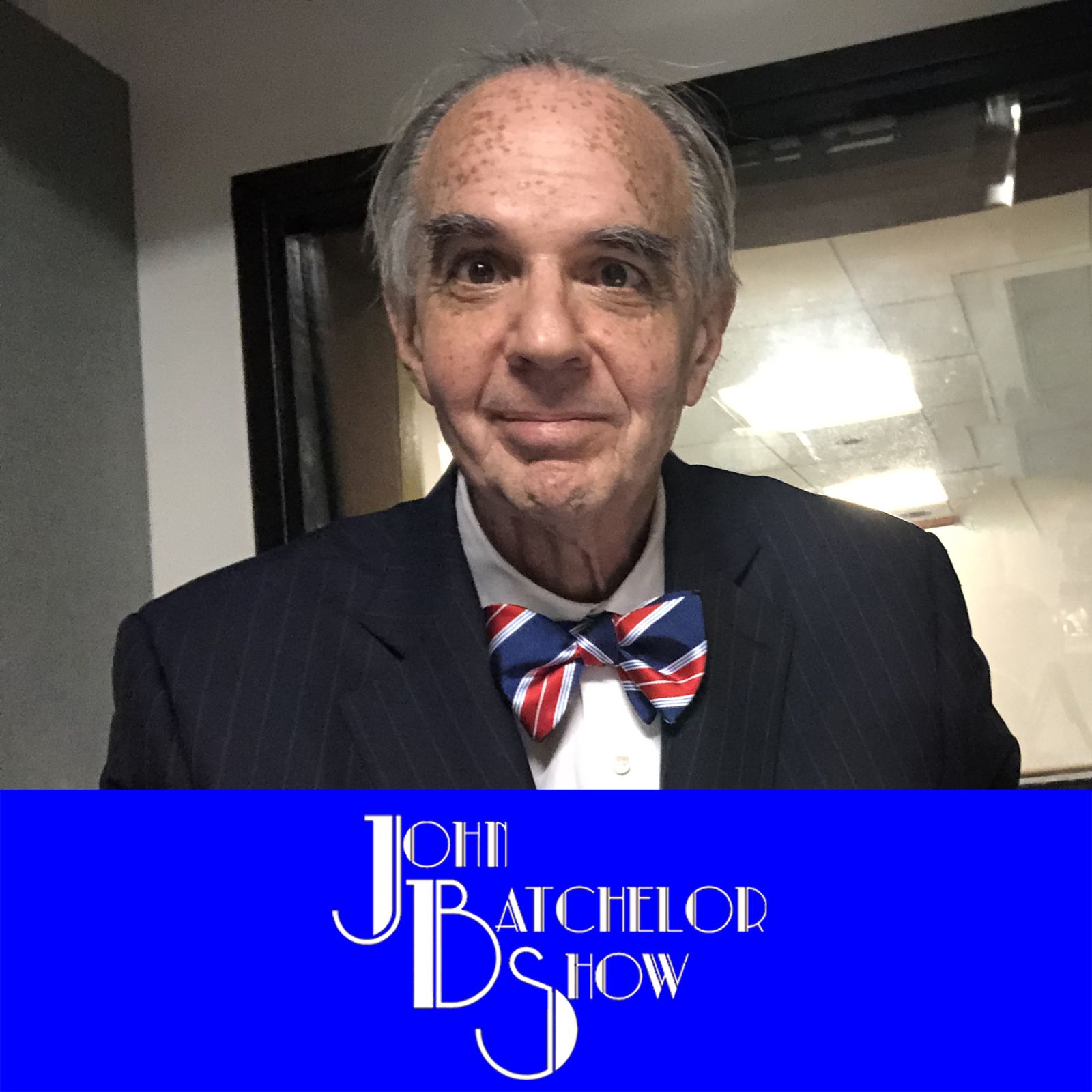
John Batchelor
The John Batchelor Show
The John Batchelor Show is a hard news-analysis radio program on current events, world history, global politics and natural sciences. Based in New York City for two decades, the show has travelled widely to report, from the Middle East to the South Caucasus to the Arabian Peninsula and East Asia.
Be sure to visit the podcast's website and support the creator: substack.com
Where to listen?
Podcasts in the app Replaio Radio Coming soonPodcasts are coming to the app soon. Install now and be the first to see a whole new take on podcasts
 Install for free
Android almost 10M downloads · 4.8 rating
iOS soon
Install for free
Android almost 10M downloads · 4.8 rating
iOS soon
Episodes
S8 Ep1093: George Black, guest author, explains that by 1965, the United States escalated the conflict by deploying Marines to Da Nang to protect the airfield. This period marked the expansion of Operation Ranch Hand, a campaign focused on using technolog 06.07.2026 6:55
George Black , guest author, explains that by 1965, the United States escalated the conflict by deploying Marines to Da Nang to protect the airfield. This period marked the expansion of Operation Ranch Hand , a campaign focused on using technology to defeat the natural advantages of the Vietnamese terrain. The American military utilized herbicides to defoliate the dense triple-canopy jungles and d...
S8 Ep1093: George Black, guest author, recounts how, in May 1959, the North Vietnamese leadership held a critical meeting in Hanoi to determine the future of their revolutionary struggle. While figures like Ho Chi Minh and Vo Nguyen Giap were cautious abo 06.07.2026 10:55
George Black , guest author, recounts how, in May 1959, the North Vietnamese leadership held a critical meeting in Hanoi to determine the future of their revolutionary struggle. While figures like Ho Chi Minh and Vo Nguyen Giap were cautious about provoking the United States, Le Duan , the rigorous head of the Vietnamese Communist Party , pushed for a more militant approach to liberate the South....
S8 Ep1092: Geoffrey Wawro, guest author, concludes that after the 1973 peace deal, the NVA rebuilt their forces, confident that a distracted US government—weakened by Watergate and the oil crisis—would not intervene again. When the final 1975 offensive b 06.07.2026 8:44
Geoffrey Wawro , guest author, concludes that after the 1973 peace deal, the NVA rebuilt their forces, confident that a distracted US government—weakened by Watergate and the oil crisis—would not intervene again. When the final 1975 offensive began, President Ford did not react, and the ARVN , suffering from slashed funding and ammunition shortages, rapidly collapsed. President Thieu's decision to...
S8 Ep1092: Geoffrey Wawro, guest author, describes how Nixon's "Vietnamization" policy aimed to prepare the South Vietnamese army (ARVN) to fight independently through massive equipment transfers. However, the 1971 invasion of Laos (Lam Son 719) proved a 06.07.2026 11:01
Geoffrey Wawro , guest author, describes how Nixon's "Vietnamization" policy aimed to prepare the South Vietnamese army ( ARVN ) to fight independently through massive equipment transfers. However, the 1971 invasion of Laos ( Lam Son 719 ) proved a disaster, revealing that the ARVN lacked the leadership and staff work to execute complex operations without American ground support. In 1972, Nixon re...
S8 Ep1092: Geoffrey Wawro, guest author, explains that in 1970, Nixon ordered an incursion into Cambodia to destroy NVA supply dumps and the Ho Chi Minh Trail extensions. While US forces captured significant materiel, the NVA simply withdrew deeper into t 06.07.2026 6:56
Geoffrey Wawro , guest author, explains that in 1970, Nixon ordered an incursion into Cambodia to destroy NVA supply dumps and the Ho Chi Minh Trail extensions. While US forces captured significant materiel, the NVA simply withdrew deeper into the interior and rebuilt their supply lines shortly after the Americans left. This widening of the war triggered unprecedented domestic protests, most notab...
S8 Ep1092: Geoffrey Wawro, guest author, details how Richard Nixon derailed peace talks in 1968 through Anna Chennault, promising South Vietnamese President Thieu a "better deal" to prevent a "November surprise" for Hubert Humphrey. This move resulted in 06.07.2026 10:59
Geoffrey Wawro , guest author, details how Richard Nixon derailed peace talks in 1968 through Anna Chennault , promising South Vietnamese President Thieu a "better deal" to prevent a "November surprise" for Hubert Humphrey . This move resulted in the war continuing for four more years, costing 28,000 additional American lives for essentially the same peace terms available in 1968. Under Nixon , th...
S8 Ep1092: Geoffrey Wawro, guest author, recounts how, in January 1968, the Tet Offensive was launched by the NVA and Viet Cong to deliver a knockout blow to the South Vietnamese government. While the communists suffered massive tactical losses, they achi 06.07.2026 9:16
Geoffrey Wawro , guest author, recounts how, in January 1968, the Tet Offensive was launched by the NVA and Viet Cong to deliver a knockout blow to the South Vietnamese government. While the communists suffered massive tactical losses, they achieved a strategic victory in information warfare by shattering the American public's illusion of progress. This shift was cemented by Walter Cronkite's broa...
S8 Ep1092: Geoffrey Wawro, guest author, describes how Westmoreland's strategy consisted of three phases: a massive logistical buildup, crushing search-and-destroy operations, and eventually handing the war over to a capable South Vietnamese army. However 06.07.2026 10:24
Geoffrey Wawro , guest author, describes how Westmoreland's strategy consisted of three phases: a massive logistical buildup, crushing search-and-destroy operations, and eventually handing the war over to a capable South Vietnamese army. However, the plan faltered because the vast majority of operations never made contact with the enemy, who chose to protract the war to exhaust American patience....
S8 Ep1092: Geoffrey Wawro, guest author, explains that General Westmoreland introduced the "search and destroy" concept, aiming to use superior US mobility and technology to annihilate North Vietnamese Army (NVA) forces. The Battle of Ia Drang in November 06.07.2026 7:58
Geoffrey Wawro , guest author, explains that General Westmoreland introduced the "search and destroy" concept, aiming to use superior US mobility and technology to annihilate North Vietnamese Army ( NVA ) forces. The Battle of Ia Drang in November 1965 became a pivotal test for this strategy, featuring Hal Moore's 7th Cavalry . As US troops deployed, the NVA responded by escalating to regular regi...
S8 Ep1092: Geoffrey Wawro, guest author, explores the Gulf of Tonkin incident in August 1964, which served as a political catalyst for the Vietnam War. Lyndon Johnson and Robert McNamara sought an incident to galvanize domestic support against conservativ 06.07.2026 9:52
Geoffrey Wawro , guest author, explores the Gulf of Tonkin incident in August 1964, which served as a political catalyst for the Vietnam War. Lyndon Johnson and Robert McNamara sought an incident to galvanize domestic support against conservative critics accusing them of a "no-win" policy. Though the attack was largely concocted or provoked by covert CIA operations, it provided the "blank check" n...
S8 Ep1091: Colonel Jeff McCausland reflects on how, following the battle, the war's brutality is mirrored by civil unrest, specifically the deadly 1863 draft riots in New York City, highlighting deep internal divisions within the North. While General 05.07.2026 9:01
Colonel Jeff McCausland reflects on how, following the battle, the war's brutality is mirrored by civil unrest, specifically the deadly 1863 draft riots in New York City , highlighting deep internal divisions within the North. While General Meade celebrates his victory, President Lincoln remains despondent over the missed opportunity to end the war by failing to capture Lee's army. In November 186...
S8 Ep1091: Colonel Jeff McCausland recounts how, on July 3, Robert E. Lee initiates a bold assault aimed at the Union center on Cemetery Ridge, though faulty assumptions regarding troop strength and coordination plague the plan. A massive two-hour artille 05.07.2026 11:41
Colonel Jeff McCausland recounts how, on July 3, Robert E. Lee initiates a bold assault aimed at the Union center on Cemetery Ridge , though faulty assumptions regarding troop strength and coordination plague the plan. A massive two-hour artillery barrage—the largest in North American history—precedes the infantry advance but proves largely ineffective due to defective fuses and heavy smoke obscur...
S8 Ep1091: Colonel Jeff McCausland explains that by July 2, the Union Army establishes a formidable "fishhook" defensive formation from Culp's Hill to the Round Tops, benefiting from interior lines that allow General Meade to reposition forces much faster 05.07.2026 9:55
Colonel Jeff McCausland explains that by July 2, the Union Army establishes a formidable "fishhook" defensive formation from Culp's Hill to the Round Tops , benefiting from interior lines that allow General Meade to reposition forces much faster than General Lee . Lee seeks to break this line, but delays in General Longstreet's advance push the primary assault into late afternoon. A significant ta...
S8 Ep1091: Colonel Jeff McCausland describes how, on the morning of July 1, 1863, Union General John Buford's cavalry identifies Confederate infantry advancing from the west toward the vital crossroads of Gettysburg. Recognizing the critical nature of the 05.07.2026 8:40
Colonel Jeff McCausland describes how, on the morning of July 1, 1863, Union General John Buford's cavalry identifies Confederate infantry advancing from the west toward the vital crossroads of Gettysburg . Recognizing the critical nature of the terrain, Buford deploys his men on McPherson's Ridge and Oak Hill to delay the advance, sending an urgent request to General John Reynolds for infantry su...
S8 Ep1090: Patrick K. O'Donnell, guest author, describes how, in the war's final hours, Robert E. Lee faced a monumental decision: follow Jefferson Davis's orders to scatter his army into the mountains to conduct guerrilla warfare, or surrender. Lee cho 05.07.2026 6:00
Patrick K. O'Donnell , guest author, describes how, in the war's final hours, Robert E. Lee faced a monumental decision: follow Jefferson Davis's orders to scatter his army into the mountains to conduct guerrilla warfare, or surrender. Lee chose to put "America first," rejecting the insurgency path to avoid subjecting the South to generations of further destruction. This act of statesmanship led t...
S8 Ep1090: Patrick K. O'Donnell, guest author, explains that following Blazer's capture, Harry Harrison Young took command of the Union's special forces assets under Phil Sheridan. Only 5'5" but "absolutely fearless," Young transformed the Jesse Scouts in 05.07.2026 13:40
Patrick K. O'Donnell , guest author, explains that following Blazer's capture, Harry Harrison Young took command of the Union's special forces assets under Phil Sheridan . Only 5'5" but "absolutely fearless," Young transformed the Jesse Scouts into a vital strategic asset. These scouts, often operating in Confederate uniforms, conducted suicide missions and used elaborate disguises—such as peddler...
S8 Ep1090: Patrick K. O'Donnell, guest author, details the final confrontation between Richard Blazer and Mosby's Rangers at Cabletown (or Meyerstown). After Blazer's scouts had embarrassed the Rangers twice, Mosby orchestrated a massive 300-man ambush. D 05.07.2026 4:05
Patrick K. O'Donnell , guest author, details the final confrontation between Richard Blazer and Mosby's Rangers at Cabletown (or Meyerstown ). After Blazer's scouts had embarrassed the Rangers twice, Mosby orchestrated a massive 300-man ambush. During a running gun battle across farmland, Lewis Powell , a Ranger known as "Terrible Powell," personally captured Blazer . The significance of Powell's...
S8 Ep1090: Patrick K. O'Donnell, guest author, recounts how, by August 1864, General Ulysses S. Grant had grown enraged by the disruption caused by irregular partisans and ordered Phil Sheridan to initiate "total war" in the Shenandoah Valley. Grant's ins 05.07.2026 13:45
Patrick K. O'Donnell , guest author, recounts how, by August 1864, General Ulysses S. Grant had grown enraged by the disruption caused by irregular partisans and ordered Phil Sheridan to initiate "total war" in the Shenandoah Valley . Grant's instructions were severe: hang captured Rangers without trial, destroy all crops and livestock, and take all men under 50 as prisoners. While Sheridan did no...
S8 Ep1090: Patrick K. O'Donnell, guest author, explains that in the summer of 1864, Confederate General Jubal Early, known as Lee's "mean old dog," launched a bold campaign that brought the war to the gates of the nation's capital. After repelling Union f 05.07.2026 9:50
Patrick K. O'Donnell , guest author, explains that in the summer of 1864, Confederate General Jubal Early , known as Lee's "mean old dog," launched a bold campaign that brought the war to the gates of the nation's capital. After repelling Union forces at Lynchburg , Early marched through the Shenandoah Valley and into Maryland , winning a time-consuming victory at Monocacy against Lew Wallace . Th...
S8 Ep1090: Patrick K. O'Donnell, guest author, describes how, in early 1864, the Union launched the Dahlgren Raid, a daring "decapitation raid" aimed at infiltrating Richmond to burn the city and kill or capture Jefferson Davis. Led by Ulric Dahlgren and 05.07.2026 9:50
Patrick K. O'Donnell , guest author, describes how, in early 1864, the Union launched the Dahlgren Raid , a daring "decapitation raid" aimed at infiltrating Richmond to burn the city and kill or capture Jefferson Davis . Led by Ulric Dahlgren and General Kilpatrick , the mission disintegrated in the Richmond suburbs, and Dahlgren was killed. Orders found on his body—initially dismissed as a Sou...
S8 Ep1090: Patrick K. O'Donnell, guest author, recounts how, in 1863, Richard Blazer emerged as an unlikely Union hero, leading "Blazer's Scouts," also known as the Legion of Honor. A former barge driver who was often disheveled on the parade ground, Blaz 05.07.2026 6:45
Patrick K. O'Donnell , guest author, recounts how, in 1863, Richard Blazer emerged as an unlikely Union hero, leading "Blazer's Scouts," also known as the Legion of Honor . A former barge driver who was often disheveled on the parade ground, Blazer possessed a unique talent for "hunting people." His unit functioned as the first modern hunter-killer team in the U.S. Army, specifically tasked with n...
S8 Ep1090: Patrick K. O'Donnell, guest author, introduces Captain John Charles Carpenter and the origins of the Jesse Scouts, a Union special operations group formed in Missouri in 1861. Named after Jesse Fremont, wife of General John C. Fremont, these sc 05.07.2026 11:05
Patrick K. O'Donnell , guest author, introduces Captain John Charles Carpenter and the origins of the Jesse Scouts , a Union special operations group formed in Missouri in 1861. Named after Jesse Fremont , wife of General John C. Fremont , these scouts utilized 21st-century tradecraft, such as wearing Confederate uniforms to infiltrate enemy lines and conduct daring reconnaissance missions at site...
S8 Ep1089: Robert Cwiklik, guest author, explains that the ultimate turning point came when Grant decided to back down from Sheridan's aggressive mission. As the news reached New Orleans, telegraph operators shouted, "Grant backs down," a moment celebrate 05.07.2026 6:45
Robert Cwiklik , guest author, explains that the ultimate turning point came when Grant decided to back down from Sheridan's aggressive mission. As the news reached New Orleans , telegraph operators shouted, "Grant backs down," a moment celebrated by the White League as a definitive victory. Although Republicans attempted to pass new enforcement legislation, the effort was stalled by Democrats who...
S8 Ep1089: Robert Cwiklik, guest author, describes how, following the legislative intervention, Sheridan sent his infamous "Banditti" telegrams to Secretary of War William Belknap. He proposed that Congress declare the White League ringleaders "Banditti" 05.07.2026 12:55
Robert Cwiklik , guest author, describes how, following the legislative intervention, Sheridan sent his infamous "Banditti" telegrams to Secretary of War William Belknap . He proposed that Congress declare the White League ringleaders "Banditti" so they could be tried by military commissions and executed. Sheridan's blunt call for military justice against "respectable" white citizens sparked natio...
S8 Ep1089: Robert Cwiklik, guest author, explains that Sheridan arrived in New Orleans in late 1874, but his presence immediately sparked suspicion and sarcasm from the local white press. On January 4, 1875, the situation reached a breaking point during t 05.07.2026 8:25
Robert Cwiklik , guest author, explains that Sheridan arrived in New Orleans in late 1874, but his presence immediately sparked suspicion and sarcasm from the local white press. On January 4, 1875, the situation reached a breaking point during the organization of the Louisiana legislature at the St. Louis Hotel . Democrats staged a violent takeover of the House floor, installing their own speaker...
Similar podcasts



Listen to the The John Batchelor Show podcast in Replaio
Radio and podcasts in one app - free, with no sign-up. Install today and do not miss the launch
Replaio is not a podcast publisher; show names, artwork and audio belong to their authors and are distributed through public RSS feeds.