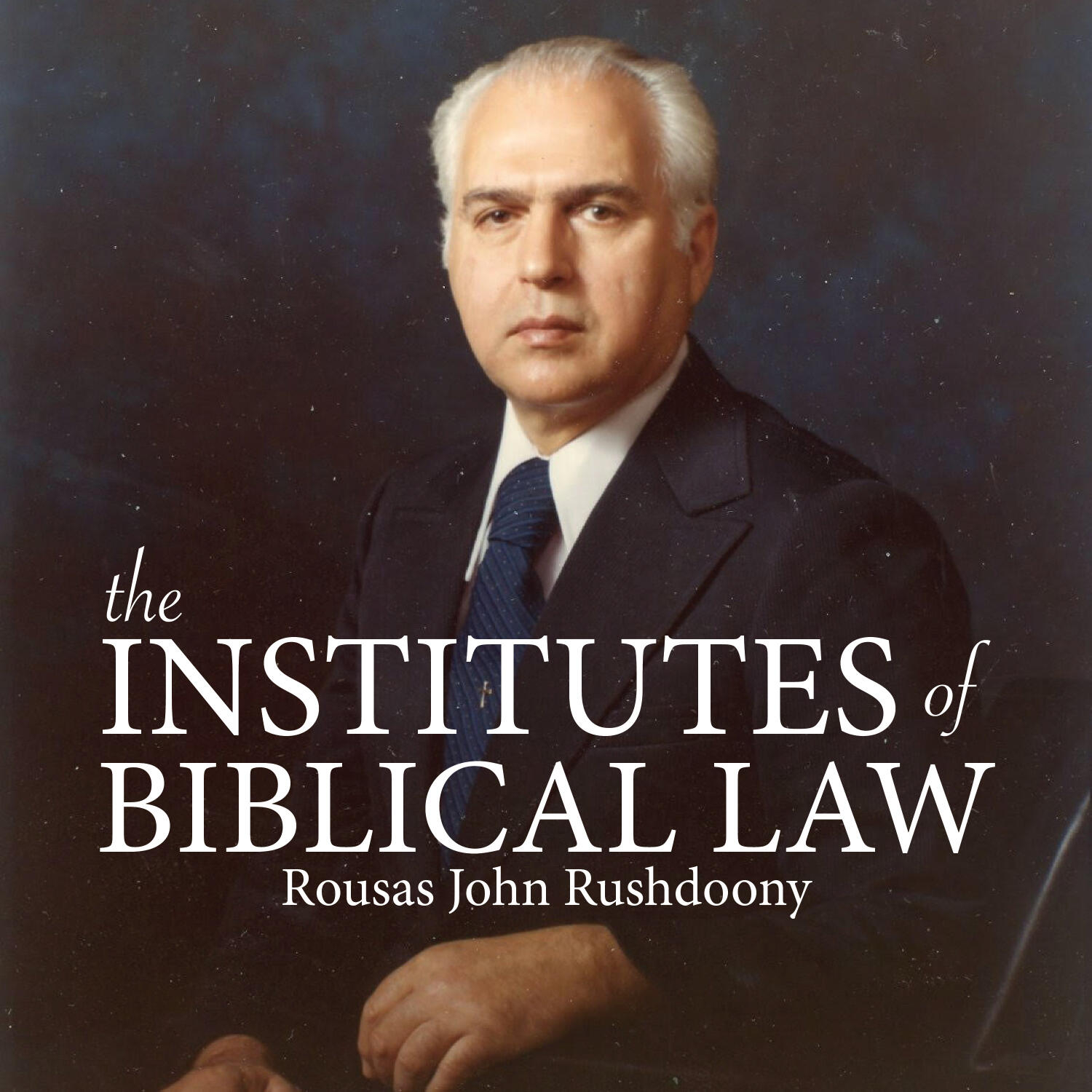
R. J. Rushdoony
The Institutes of Biblical Law
To attempt to study Scripture without studying its law is to deny it. Join Rousas John Rushdoony as he explains the importance of Biblical law and how it is to be used to guide the lives of men and nations.
Where to listen?
Podcasts in the app Replaio Radio Coming soonPodcasts are coming to the app soon. Install now and be the first to see a whole new take on podcasts
 Install for free
Android 5M+ downloads · 4.8 rating
iOS soon
Install for free
Android 5M+ downloads · 4.8 rating
iOS soon
Episodes
Appendix: Law in Western Society (Remastered) 21.06.2026 57:39
Notes on the Law in Western Society – The early church regarded biblical law as binding on believers, applying Levitical regulations to clergy, observing sabbath and moral law, and enforcing discipline, penance, and restitution (Ancyra, Basil, Gregory Thaumaturgus). Canon law reflected Scripture even while navigating Roman law, bureaucracy, and societal decay. The Theodosian Code and later Justini...
Peace (Remastered) 14.06.2026 52:34
Peace in the biblical sense is the wholeness, prosperity, and well-being that flow from reconciliation with God and restoration under His order. It is more than the absence of conflict; it encompasses peace with God, with oneself, with others, and with creation, reflecting the Edenic harmony lost in the Fall and progressively restored through Christ. Messianic prophecies, such as living under one’...
Power and Authority (Remastered) 07.06.2026 56:01
Power and authority are inseparable from God’s law: power is mere force, but authority is the lawful right to rule, and only where both are grounded in God’s word can true order exist. Scripture teaches that the saints are called to govern the world not through humanistic coercion, miracles designed to compel belief, or institutional dominance but through obedience to Christ’s law and faithful sel...
Rebuke and Excommunication (Remastered) 31.05.2026 46:45
Biblical rebukes and excommunication are not institutional tools to protect the church’s prestige but covenantal acts aimed at restoring God’s order in faith, morals, and authority under His law. Rebuke is the first step of correction, grounded in Scripture and applied relationally, while persistent rebellion whether false doctrine, immorality, or refusal to fulfill basic covenant duties like fami...
Discipline (Remastered) 24.05.2026 48:34
True discipline is not punishment but systematic training under God’s authority, producing learning, growth, and submission to His law-word; chastisement is only a corrective tool when discipline has failed. Churches often confuse the two, boasting of “strict discipline” while neglecting faithful teaching of Scripture, which alone empowered by the Holy Spirit creates real discipleship. Matthew 18...
The Priesthood of All Believers (Remastered) 17.05.2026 41:51
The priesthood of all believers is not a New Testament novelty but an Old Testament doctrine rooted in God’s covenant declaration that His people are a kingdom of priests (Ex. 19:5–6), a royal calling conditioned on obedience to His law and directed toward the establishment of His Kingdom. This priesthood is not sacerdotal or sacrificial in the atoning sense Christ alone fulfills that but royal an...
Circumcision and Baptism (Remastered) 10.05.2026 45:44
Baptism succeeds circumcision as the covenant sign, preserving the same covenantal meaning while unfolding it in Christ: both testify that fallen human nature cannot save itself, that salvation comes only through death and regeneration, and that covenant membership brings both blessing and judgment. Circumcision symbolized the cutting off of the old nature and pointed forward to Christ’s atoning b...
The Christian Passover (Remastered) 03.05.2026 53:15
The Lord’s Supper is the Christian Passover, deliberately instituted within the Jewish Passover to proclaim the continuity of God’s covenant and to declare salvation as victory: just as Israel celebrated deliverance from Egypt and the death of the firstborn, so the church celebrates Christ, God’s Firstborn, who bears the covenant death-sentence to deliver His people and inaugurate the new creation...
Office of Elder in the Church 26.04.2026 53:58
This section contends that the biblical office of elder has been hollowed out reduced from an active, pastoral arm of Christ’s kingship into a largely passive, managerial, or judicial role whereas in Scripture and the early church elders functioned as extensions of the pastor/bishop, advancing the gospel, caring for souls, and governing Christ’s people under His authority. Drawing on Ignatius, Pol...
The Eldership (Remastered) 19.04.2026 40:43
This section argues that eldership is an older, covenantal office that the church inherits rather than invents rooted in Israel’s family-and-tribal order, where “elders” governed household, synagogue, and civil life under the one standard of God’s law. In the New Testament, elders (presbyters) become the governing-teaching officers of the “new Israel,” marked by ordination/laying on of hands (1 Ti...
Law in Acts and Epistles (Remastered) 12.04.2026 52:23
This section argues that the New Testament never buries God’s law but repositions it: the Decalogue and moral demands are reaffirmed and intensified (especially inwardly, as Watson notes), while the church rejects only the misuse of law as a means of justification. Acts 15 is framed not as abolishing the law, but as refusing circumcision and rabbinic “law of Moses” as a saving yoke, while still pr...
The Cultural Mandate (Remastered) 05.04.2026 55:19
The cultural mandate isn’t a distraction from the gospel it’s the outworking of Christ’s victory in the world. From Genesis to the Great Commission, God calls His covenant people to subdue the earth under His law, not surrender it to chaos, empire, or fate. To deny this calling is to hand culture, law, education, and nations over to humanism and statism and then to wonder why disorder follows. In...
The Tribute Money (Remastered) 29.03.2026 45:39
They thought they had Jesus trapped with a political “gotcha”: Is it lawful to pay Caesar’s tax or not? Say no, and Rome arrests Him. Say yes, and the crowd calls Him a fraud. But Jesus flips the trap back on them with one coin. Whose image is on it? Caesar’s. Then His answer lands like a thunderclap: Give back to Caesar what’s owed and give back to God what’s owed. In other words: yes, pay the ta...
The Kingdom of God (Remastered) 22.03.2026 50:53
The Kingdom of God teaches that Christ’s proclamation of the Kingdom does not abolish the law but confirms it in its fullest authority, revealing the law as the rule of the reigning King. When Jesus declared that “the law and the prophets were until John,” He marked not their expiration but the transition from promise to presence the Kingdom is now preached because the King Himself has come, summo...
The Transfiguration (Remastered) 15.03.2026 32:47
The Transfiguration reveals the unbreakable unity of Christ with the law and the prophets, identifying Jesus unmistakably as the Greater Moses and the incarnate Lawgiver. On the mountain echoing Sinai Jesus is transfigured in glory alongside Moses and Elijah, showing that the law and the prophets do not stand apart from Him but bear witness to Him in perfect harmony. Their conversation about His c...
Antinomianism Attacked (Remastered) 08.03.2026 1:00:58
Antinomianism Attacked shows that Jesus’ conflict with the religious leaders centered on their substitution of human tradition for God’s law, a move that He identified not as faithfulness but as lawlessness. By exposing ceremonial washings and practices like Corban as man-made commandments that nullified God’s Word, Jesus declared that only laws planted by the Father have authority, and that both...
The Woman Taken in Adultery (Remastered) 01.03.2026 53:42
The Woman Taken in Adultery demonstrates not the setting aside of God’s law but its decisive confirmation by Christ, who exposes the hypocrisy and antinomianism of the scribes and Pharisees while upholding the law’s full authority. By invoking the requirements of Numbers 5 and demanding honest witnesses, Jesus placed the accusers themselves on trial, affirming the death penalty in principle while...
Christ and the Law (Remastered) 22.02.2026 45:33
Christ and the Law explains that Jesus did not come to abolish the law but to fill it full to establish it in its true force and carry it forward as the abiding standard of God’s kingdom (Matt. 5:17–18). In the Sermon on the Mount, Christ speaks not as a commentator but as the King and Lawgiver “I say unto you” reinforcing that even the “least commandments” matter, and that kingdom citizenship is...
The Law and the Covenant (Remastered) 15.02.2026 53:38
The Law and the Covenant presents Scripture’s unified testimony that God’s law and covenant are inseparable and universally binding on all men and nations, whether in blessing or judgment. From Isaiah to Malachi, from Jeremiah and Ezekiel to Hebrews, God indicts individuals and empires alike not merely for immorality but for covenant-breaking rejecting His law and attempting to live as though mean...
Law as Direction and Life (Remastered) 08.02.2026 46:47
God’s law isn’t a list of cold rules it’s direction, light, and life itself. Scripture teaches that torah means a God-given path to walk, not just commands to obey. When men and societies abandon that direction, they don’t become “free” they become lost, blind, and eventually ungovernable. Proverbs makes it clear: God’s law is a lamp for the path, a fountain of life, and the only true source of wi...
Natural and Supernatural Law (Remastered) 01.02.2026 52:26
According to Scripture, the result isn’t neutrality it’s chaos. When man’s reason, experience, or majority opinion becomes the source of law, God is quietly dethroned, the state takes His place, and truth is reduced to compromise and expediency. This episode exposes how even well-meaning theologians traded Moses for Plato, revelation for rationalism, and ended up empowering statism, relativism, an...
God the King (Remastered) 25.01.2026 51:39
From the beginning, God’s kingship has meant authoritative direction—torah—for all who stand in relationship to Him, making law inseparable from faith, covenant, and life itself; Israel’s history, especially in Joshua and Judges, shows that blessing, strength, and victory flowed from obedience to God the King, while lawlessness—“every man doing what was right in his own eyes”—brought defeat, capti...
The Unlimited Liability Universe (Remastered) 18.01.2026 42:41
Scripture reveals that reality is not a limited-liability system but a universe of inescapable moral consequence, where blessings and curses relentlessly “overtake” men according to their obedience or rebellion against God’s law (Deut. 28), exposing the false hope behind atheism, socialism, pietism, and lawless “grace,” all of which seek to escape responsibility by denying God’s sovereignty; bibli...
Curses and Blessings (Remastered) 11.01.2026 55:26
Deuteronomy 27–28 declares that God’s law brings with it inescapable consequences—blessing for obedience and curse for rebellion—revealing a moral order in which covenant faithfulness leads to life, prosperity, and the inheritance of the earth, while lawlessness results in judgment, defeat, and exile; the ban or anathema is not abolished in history but merely redirected by societies that reject Go...
The Law and the Ban (Remastered) 04.01.2026 48:39
God’s covenant law, grounded in His faithfulness and sovereignty, applies to all men without exception, declaring blessings for obedience and curses for rebellion (Deut. 7:9–15), with Christ Himself standing as the covenant Lord who brings both salvation and judgment to all humanity; the “ban” reveals the ultimate consequence of covenant-breaking—the end of communion and the placing of individuals...
Similar podcasts







Listen to the The Institutes of Biblical Law podcast in Replaio
Radio and podcasts in one app - free, with no sign-up. Install today and do not miss the launch
Replaio is not a podcast publisher; show names, artwork and audio belong to their authors and are distributed through public RSS feeds.