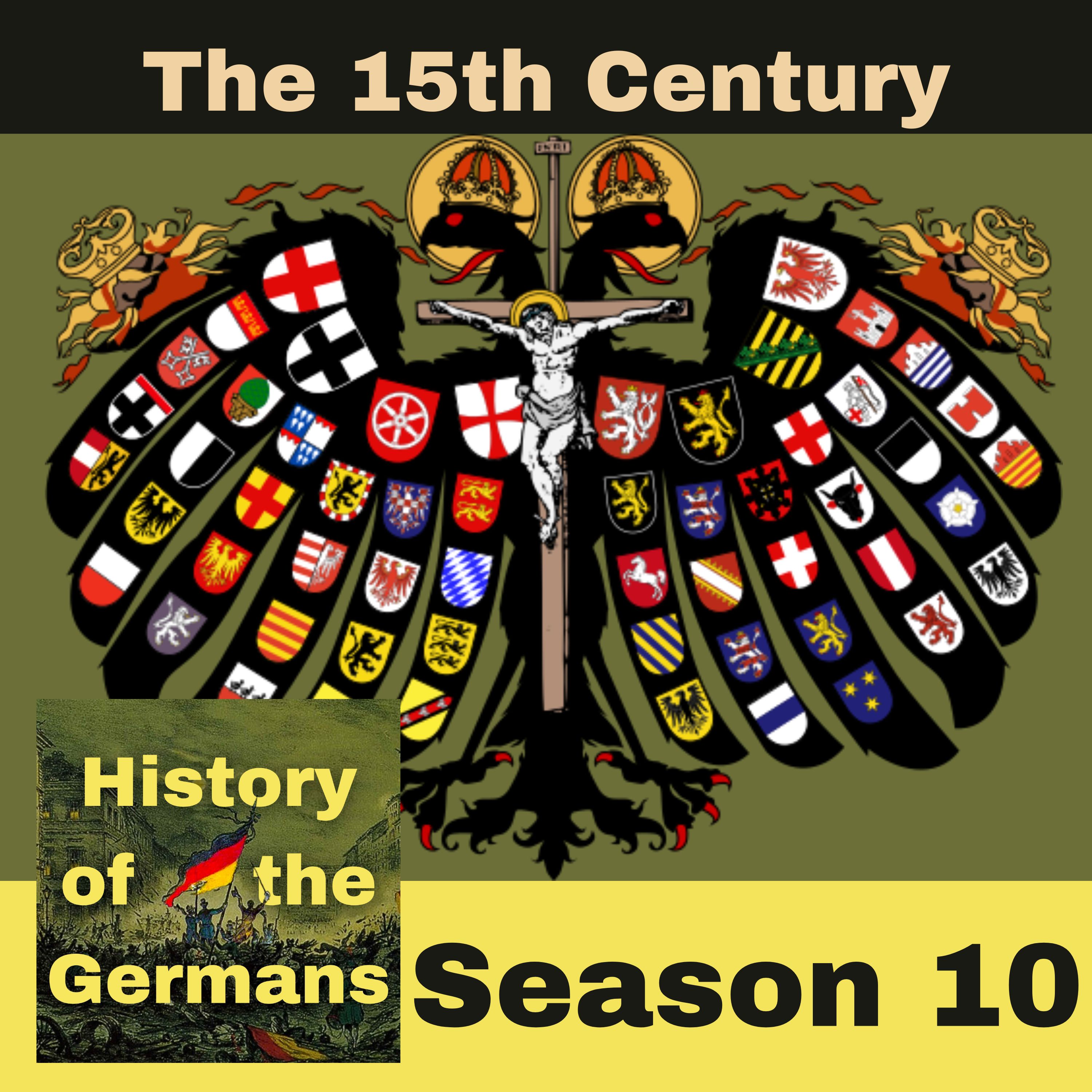
History of the Germans
The Empire in the 15th Century
This is the time when the empire reaches its most challenging phase. This is not the difficult second album, this is more Tina Turner in 1982 when her cover of shame, shame, shame reached #47 in the Netherlands charts. This is where we see the beginnings of actual states and state bureaucracies developing in Germany. But these states were extremely fragile, likely to be overrun by enemies, divided amongst multiple sons or incorporated into larger entties. War was almost constant, as were dramas of love and pride. Despite all this strife and feuding, this is also a time of great innovation. Gut...
Author
History of the Germans
Category
Podcast website
Latest episode
Jan 16, 2026
Where to listen?
Podcasts in the app Replaio Radio Coming soonPodcasts are coming to the app soon. Install now and be the first to see a whole new take on podcasts
 Install for free
Android 5M+ downloads · 4.8 rating
iOS soon
Install for free
Android 5M+ downloads · 4.8 rating
iOS soon
Episodes
Mapping the World, or how Germans invented America 16.01.2026 48:37
When you enter the great hall of the Thomas Jefferson building at the Library of Congress in Washington, the first exhibit you will be facing is their Gutenberg Bible. And it is one of the finest Gutenberg bibles around, one of only three surviving pristine copies on vellum. This was the kind of bible that was so expensive to produce, it bankrupted Gutenberg. When the Library of Congress bought it...
Divide and Lose, the Leipziger Teilung 09.01.2026 28:31
When two brothers, Ernst and Albrecht of Saxony divided up their enormous inheritance that comprised Thuringia, Meissen and the electorate of Sachsen-Wittenberg, they not only undermined their power base as the de facto #2 amongst the imperial principalities and planted the seed for a conflict that would play a key role in the Reformation but they also laid the foundations for the modern Länder of...
Arms and Armour 02.01.2026 35:50
In 1550 Spanish court records show that the Augsburg armorer Kolman Helmschmied was paid an advance of 2,000 ducats for a full armour for king Philipp II. The final price for this piece was 3,000 ducats. At the same time Raphael could charge at max 170 ducats for an altarpiece. Even the Renaissances’ best paid artist, Michelangelo received just 3,000 gold florins for the painting of the ceiling of...
How Holland was Lost to the Holy Roman Empire (Part 2 - the Economy) 26.12.2025 35:36
So, why did Holland really leave the empire? Was it because the valiant and tragic countess Jacqueline was “hunted down from one land to the other, all of them mine”. Was it a story of misogyny, betrayal, incompetence and ruthless power politics. Yes, it was. But it was a also a story of economic and climate change and one that links into the herring trade of the Hanseatic League, the decline of T...
How Holland was Lost to the Holy Roman Empire (Part 1 - the Politics) 19.12.2025 42:33
Today begins a two part series about how the Low countries modern day Belgium, Netherlands and Luxemburg shifted out of the Holy Empire. These lands, with the exception of Flanders, had been part of the empire for hundreds of years, ever since Henry the Fowler acquired Lothringia for east Francia in 925 – not by conquest but through diplomacy – as was his way. There are two ways to tell the story...
The Landshuter Hochzeit – Love and War in Bavaria (Part 2) 12.12.2025 43:50
On November 14th and 15th 1475 one of the grandest events in the history of the Holy Roman Empire took place, the Landshuter Hochzeit, the nuptials of Georg, the Rich, son of Ludwig, the Rich and grandson of Heinrich, the Rich, all of them dukes of Bayern-Landshut, and Hedwig, the daughter of king Kasimir IV of Poland and Lithuania. The event attracted 10,000 guests, amongst them the Counts Palati...
Agnes Bernauer - Love and War in Bavaria – (Part 1) 05.12.2025 31:25
When I first recorded this episode, my nose was so bunged up, I could barely speak. So I cloned my voice and produced a whole episode using an Ai generated version of me. That was a cool experiment, but ultimately, a canned voice is not the same thing. Fortunately, I am now fully recovered, and I have now re-recorded the same episode again, and this time the names of towns and cities will bear a b...
Engraving the German Renaissance 28.11.2025 35:51
Last year I went to an exhibition at the Städel museum in Frankfurt that was entitled Holbein and the Renaissance in the North. That is the elder Holbein, the father of the Holbein who came to England. This exhibition has now ended, but there is still a great summary available on the Städel website ( https://holbein.staedelmuseum.de/en ) . Though obviously not present at the exhibition, one key fo...
The Fuggers of Augsburg 21.11.2025 50:52
Jakob Fugger had been dubbed the Richest Man Who Ever Lived, but there are many more contenders, my favorite being an African, Mansa Musa, the ninth Mansa of the Mali empire whose generous gifts during a visit to Mecca in 1324 triggered a currency crisis. That is something Jakob Fugger would never have done. He never was a flamboyant banker who impressed his contemporaries with lavish displays of...
The Trade and Tribulations of the Free Imperial Cities 14.11.2025 37:51
Ravensburg, and you are very much forgiven if you cannot place it on the map, is today a town of 50,000 in the far south eastern corner of Baden-Württemberg between Friedrichshafen, home of the Zeppelins, and the city of Ulm and its majestic church tower. If you have heard of it, it may be because of Ravensburger, the publisher of puzzles and boardgames, but you would not have associated it with a...
Württemberg, or How to Build a Success 07.11.2025 47:23
The counts, dukes and ultimately kings of Württemberg had risen to the top by winning the genetic lottery. Their eldest sons tended to be competent, some even extremely so, their wives brought in dowries and sometimes entire counties, and they ruled for long enough that the next generation took over when they were ready. But all that falls apart in the 15th century. They are suddenly afflicted wit...
The Margraviate of Baden 21.10.2025 42:17
What is it like to be a prince? Well, not quite what it is set out to be, in particular when you are a smaller prince, not in stature, but in land. The margraves of Baden are such princes. In the 15th century their main territory, a slither of South-West Germany, just 60km long was too small to play on the European, even on the German stage, but too big to escape the need of massive palaces and wa...
A (very) brief History of the German Universities 14.10.2025 47:04
Between the time the first Nobel Prize was awarded in 1901 and 1933, a total of 31 were awarded to German scientists and politicians. To name just a few, Wilhelm Röntgen (1901), Max Planck (1918), Albert Einstein (1921) and Werner Heisenberg (1932) for Physics, Emil Fischer (1902), Fritz Haber (1918), Walther Nernst (1920) and Hans Fischer (1930) for chemistry, Emil von Behring (1901), Robert Koch...
The Count Palatine on the Rhine 07.10.2025 36:53
This week it is back to the political landscape of the empire. We will travel upriver from Mainz via Worms and the not yet existent cities of Mannheim and Ludwigshafen to Heidelberg, my old hometown. And there we will meet the man who held one of the empire’s most confusing titles, the count Palatinate of the Rhine, Elector and High Steward of the Empire. His name is Friedrich, Friedrich der Siegr...
Origin Stories - Mainz and Hessen 30.09.2025 41:16
This week we are setting off on our tour of the empire for real. And where better to start than with the most senior, most august of the seven prince Electors, the archbishop of Mainz, archchancellor of the empire, and holder of the decisive vote in imperial elections. We have already encountered a number of archbishops of Mainz in this podcast, from the treacherous Frederick who tried to overthro...
What Has Printing Ever Done For Us? 23.09.2025 37:10
“We should note the force, effect, and consequences of inventions which are nowhere more conspicuous than in those three which were unknown to the ancients, namely printing, gunpowder and the compass. For these three have changed the appearance and the state of the world.” wrote Francis Bacon in 1620. And almost everybody agreed. Printing changed everything, but how exactly did it change everythin...
Johannes Gutenberg’s Pressing Matters 16.09.2025 44:10
It is the invention of the printing press we discuss here, nothing more and nothing less. How did it come about, how did it work and why? he music for the show is Flute Sonata in E-flat major, H.545 by Carl Phillip Emmanuel Bach (or some claim it as BWV 1031 Johann Sebastian Bach) performed and arranged by Michel Rondeau under Common Creative Licence 3.0 . As always: Homepage wit...
The Empire in the 15th Century - Season Opener 09.09.2025 12:00
Many German histories skip over this period in order to get to the Reformation, which is a shame. Because the 15th century did not just shape the physical appearance of the country, but much of its geographical and mental make-up. he music for the show is Flute Sonata in E-flat major, H.545 by Carl Phillip Emmanuel Bach (or some claim it as BWV 1031 Johann Sebastian Bach) performed and arranged by...
Similar podcasts








Listen to the The Empire in the 15th Century podcast in Replaio
Radio and podcasts in one app - free, with no sign-up. Install today and do not miss the launch
Replaio is not a podcast publisher; show names, artwork and audio belong to their authors and are distributed through public RSS feeds.