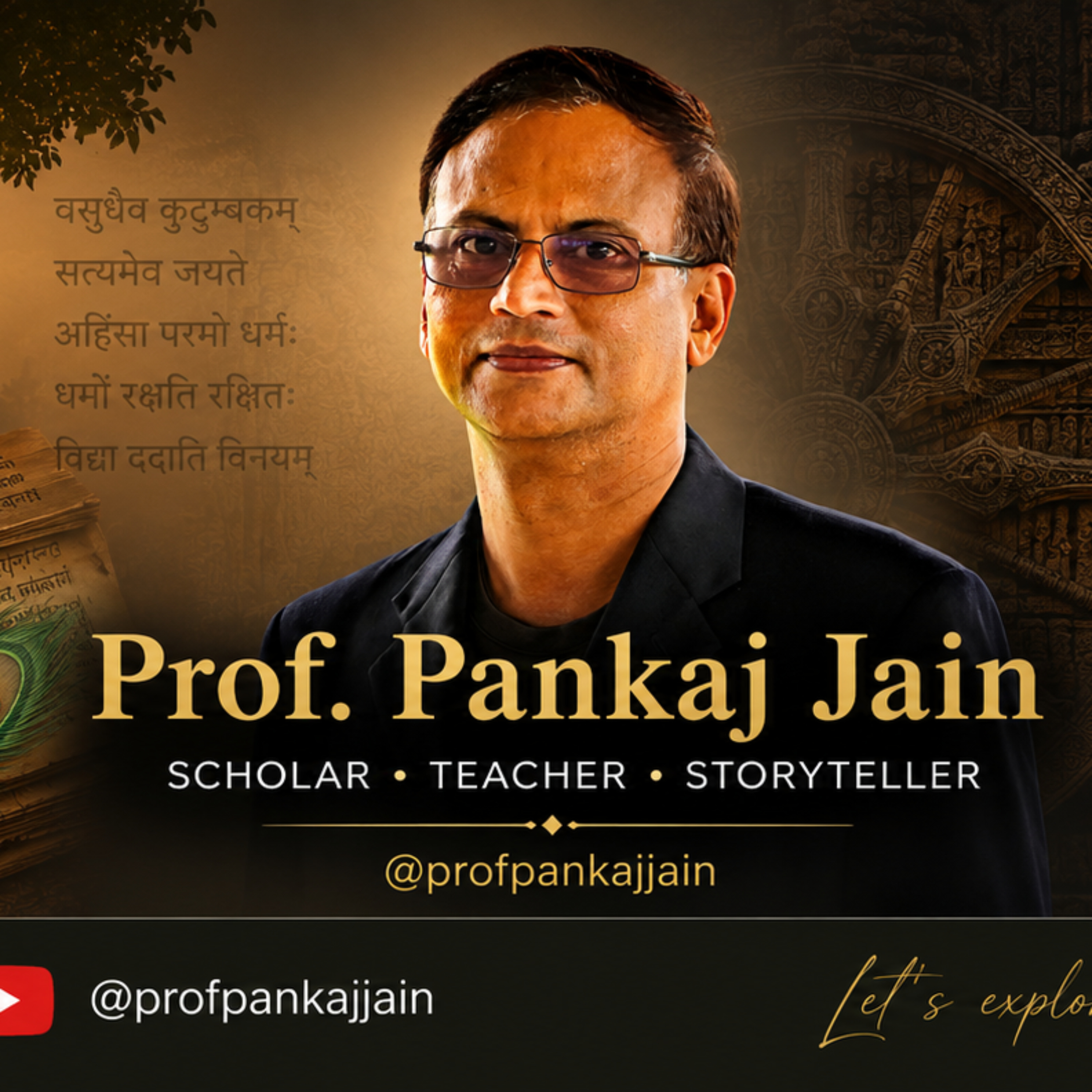
Prof Pankaj Jain
The Discover India Podcast by Professor Pankaj Jain: Bhārat Darśan
Bhārat Darśan: The Discover India Podcast is about Indian Culture, Indian classical music, Sustainability, Hindu/Buddhist/Jain Studies, Film Studies, and Diaspora Studies. Episodes also include presentations at various conferences and webinars. Dr. Pankaj Jain is the Director of The India Centre and the Head of the Department of Humanities and Language at FLAME University.#India #Indology #IndianClassicalMusic #IndianCulture #IndianTraditions #India #Hinduism #Jainism #Buddhism #Dharma #Jainology #ReligionAndEcology #FilmStudies #Bollywood #IndianDiaspora #Dharmic #ManojGovindraj
Be sure to visit the podcast's website and support the creator: en.wikipedia.org
Author
Prof Pankaj Jain
Category
Podcast website
Latest episode
Oct 10, 2026
Where to listen?
Podcasts in the app Replaio Radio Coming soonPodcasts are coming to the app soon. Install now and be the first to see a whole new take on podcasts
 Install for free
Android almost 10M downloads · 4.8 rating
iOS soon
Install for free
Android almost 10M downloads · 4.8 rating
iOS soon
Episodes
Inception and Turīya: Four States of the Self in the Māṇḍūkya Upaniṣad 10.10.2026 1:41
In Christopher Nolan’s Inception (2010), Dom Cobb goes down: dream inside dream inside dream. Then he has to scramble back up, never sure which layer is real. The Māṇḍūkya Upaniṣad, the shortest of the principal Upaniṣads at just 12 verses, maps the same territory differently. It counts four quarters of the self: जाग्रत् · jāgrat: waking स्वप्न · svapna: dreaming सुषुप्ति · suṣupti: deep sleep तुर...
Yantra & Yama: The Sanskrit Root That Ties Machines to Morality 07.10.2026 1:52
AI labs have been meeting religious leaders to ask how a machine can learn right from wrong. Sanskrit tied those two ideas together long ago, in a single root: √yam, "to hold, to restrain." From it come yantra (machine, instrument, literally "a tool for holding"), and yama, niyama and saṃyama, the graded restraints of Patañjali's Yoga Sūtras. Even Jantar Mantar, the 18th-century stone observatorie...
The Ragas Behind Bollywood's Greatest Songs — Best of the Raag Series 03.10.2026 23:19
Before this channel decoded Sanskrit words hiding in English, it spent two years decoding the classical ragas hiding inside Bollywood's biggest songs — a 63-episode webinar series with tabla and sitar scholar Shri Manoj Govindraj. This is the best of it: eight ragas, eight unforgettable film songs, and the 500-year-old music theory neither soundtrack ever credited. Every song in this episode is su...
The Matrix ← Māyā: Reality Isn't What You Think 01.10.2026 0:32
The Matrix ← Māyā. The highest-grossing sci-fi film of its era asks "what is real?" — a question Sanskrit philosophy put at its center 2,500 years earlier. The word is माया · māyā: not "nothing is real," but the creative power by which infinite consciousness appears as a finite world. The film's answer is the red pill — wake up to a different reality. The Upaniṣadic answer runs the other way: the...
Pitru Paksha: A Pause for Where You Came From (Shraddh, Explained) 29.09.2026 1:44
If you grew up in an Indian home, you probably touch a book to your forehead when your foot brushes it. Nobody taught you that. And yet, somebody did. In this short episode, Prof. Pankaj Jain reflects on Pitṛ Pakṣa (Pitru Paksha), the fortnight of the ancestors. It falls between Bhagwan Gaṇeśa's visarjan and Maa Durgā's arrival, when many Hindu families pause to remember those who came before them...
The Sixth Sense ← Sākshi: Who Is the "I" That Sees? 26.09.2026 1:22
The Sixth Sense ← Sākshi. Cole Sear sees what others can't — but the film never asks what the "I" that sees actually is. Sanskrit philosophy names it: साक्षी · sākshi, the witness — the awareness that observes thought, emotion, and the body without being affected by any of them. Cole is burdened by what he sees; the Upaniṣads point the other way: what if you are the seeing itself? A scholar's quic...
Hanuman Is a "Forest-Being" — What the Title Hanuman Ansh Really Says (Vānara, Decoded) 22.09.2026 1:34
You saw Hanuman Ansh. The boy talking to a tree, the pot that never runs dry — both are explained by the title. Ansh, aṃśa, is a fragment. Hanuman is a vānara: vana + nara, forest + person — a forest-being. Greek andr- means "person" too; android is "person-shaped." Cousins from one ancestor, not a borrowing. The pot, read as a way to live rather than a miracle: nothing stored, nothing withheld, p...
Volkswagen Is Half a Sanskrit Word — But Not the Half You Think 19.09.2026 1:56
Volkswagen means "the people's car," and one half of that name is cousin to a Sanskrit word — just not the half most people guess. Wagen and वाहन (vāhana) descend from the same ancestral root meaning "to carry," which also gave Latin vehere and English vehicle. Volks and Sanskrit लोक (loka), on the other hand, mean nearly the same thing and sound nearly the same, and are completely unrelated. A so...
Gaṇeśa and ‘Republic’ Share the Same Sanskrit Word 14.09.2026 1:44
Gaṇeśa’s name doesn’t mean “remover of obstacles” — that title came later. Gaṇa + īśa: lord of the many. The samelittle word gave India gaṇita (mathematics), the ancient gaṇa-saṅgha assemblies, and gaṇatantra — the modern word for republic, honored every Gaṇatantra Divas. On the one day that is both Ganesh Chaturthi and Hindi Diwas, a scholar’s quick decode of the word that runs from the Veda to t...
The Highest-Grossing Film in History Has a Sanskrit Title 13.09.2026 1:54
The biggest film franchise on earth carries a Sanskrit name, and its director himself said so back in 2007, calling it an incarnation of one of the Hindu gods taking flesh. Notice the vocabulary: incarnation, flesh. That is Christian language, borrowed because English had nothing closer. But avatāra never meant a picture, or a face, or a blue alien. It breaks into ava, "down," and the ro...
The Complete Life of Mahavira: Prince to Tirthankara — Full Documentary 08.09.2026 53:24
He was born a prince — and walked away from everything. This is the complete life of Mahāvīra, the 24th Tīrthaṅkara of Jain dharma: his birth and renunciation, the twelve years of austerity that led to kevala jñāna, the philosophy of anekāntavāda and ahiṃsā, his nirvāṇa — and the 2,500-year story that followed, from the Jain councils and the Digambara–Śvetāmbara divide to temple art, the global di...
Krishna's Name Literally Means "The Dark One" — Here's Why That Matters 04.09.2026 1:22
Kṛṣṇa is not a title or a metaphor — in Sanskrit it is simply the word for dark. Born at midnight, in the dark fortnight, on its eighth night: the name is the birth chart. And instead of softening that name, the tradition multiplied it — Śyāma, Ghanaśyāma, dark as the monsoon that ends the heat. This Janmashtami, a scholar's quick decode of the god whose name made darkness beautiful. Which name fo...
Arise, Walk, Arrive: Three Sanskrit Lines That Map a Whole Life 30.08.2026 8:46
Three lines of Sanskrit, from three different texts written centuries apart: "Arise, awake" (Kaṭha Upaniṣad), "keep walking — caraiveti" (Aitareya Brāhmaṇa), and "you alone are my refuge — gatistvam" (Bhavānī Aṣṭakam). Read together, in order, they stop being scattered quotes and become a single map of a life: wake, walk, arrive. I trace all three back to their sources — including what Vivekananda...
Raksha Bandhan and Sanskrit Day Are the SAME Day — That’s Not a Coincidence 28.08.2026 1:35
Raksha Bandhan and World Sanskrit Day fall on the same day this year — and it's not a coincidence. Rakṣā-bandhana literally means "the bond of protection" (rakṣ, to guard + bandhana, to bind) — and the same full moon, Śrāvaṇa Pūrṇimā, is the day the old Sanskrit schools began their study year, which is why it's now World Sanskrit Day. The thread that protects a person and the day that protects a l...
Onam: “Kerala’s Biggest Festival Celebrates a ‘Demon’ King — Here’s Why” 26.08.2026 1:35
Kerala’s biggest festival honors Mahābali — a king the texts call an asura, whom the people call their greatest ruler. Vāmana’s three steps, a kingdom surrendered, and one wish granted: to come home once a year. Onam — whose very name descends from the star Śrāvaṇa — is that homecoming. A scholar’s quick decode.#Onam2026 #Thiruvonam #Onam #Mahabali #Maveli #Kerala #Vamana #avatarthreesteps #Trivik...
Why India Has Two Official Names — in One Sentence of the Constitution 15.08.2026 1:35
“India, that is Bharat, shall be a Union of States.” The Constitution’s very first sentence carries two names — one born from a river seen from outside (Sindhu → Hindu → Indos → India), one from a lineage remembered from within (Bharata, from the root bhṛ: to bear, to carry). This Independence Day, a scholar’s quick decode of what each name actually says.#IndiathatisBharat#Bharatmeaning#Indianameo...
Homer and the Rigveda Use the Same Word for Fame — Kléos & Śravas 06.08.2026 1:52
English took one word from Homer's Odyssey — odyssey , "the long journey out." But the word that poem is really about has a Sanskrit twin. Greek kléos and Sanskrit श्रवस् (śravas) are the same inherited word, from a root meaning "to hear": fame was never what you achieved, it was what was said about you. Homer's kléos áphthiton and the Rigveda's श्रवः अक्षितम् (śrávaḥ ákṣitam) both reach for "impe...
Friendship Day & the Gita: What Krishna Teaches Us About True Friends 02.08.2026 1:28
On Friendship Day, we turn to the oldest wisdom on what real friendship means — the Bhagavad Gita. Krishna didn't rescue Arjuna from the battlefield or hand him easy answers. He stayed beside him in the chaos and helped him find his own clarity. And Sudama, the poor Brahmin who arrived with nothing but a fistful of rice, left with everything — because true friendship keeps no ledger. In this episo...
The Hymn That Takes Away Everything You Depend On | Gatistvam, Decoded 31.07.2026 1:24
Not your father. Not your mother. Not your wealth. Not even your knowledge. The Bhavani Ashtakam — traditionally attributed to Adi Shankaracharya — opens by stripping away everything we lean on, and ends every single verse the same way: gatistvam gatistvam tvameka Bhavani. You alone are my refuge. The real surprise sits inside one word. "Gati" comes from the Sanskrit root for "to go" — and it hold...
"Guru" Doesn't Mean Teacher. It Means Heavy. | Guru Purnima, Decoded 28.07.2026 5:50
You say it constantly — tech guru, business guru — but the Sanskrit word guru doesn't mean teacher. It means HEAVY, and it shares an ancient root with the English word gravity. This Guru Purnima, a scholar's decode of the word, the day, and the guru–śiṣya paramparā: how India transmitted entire libraries mouth-to-ear for a thousand years before printing, why the archetypal guru is a compiler named...
Why a 500-Year-Old Hindu Sect Sent Salman Khan to Jail 25.07.2026 6:02
539 years ago, a guru in the Rajasthan desert gave his followers a code: never cut a living tree, never kill an animal. In 1730, 363 Bishnois were beheaded rather than let a king's men fell their sacred khejri trees. That same vow is why Bollywood's biggest star, Salman Khan, has spent 25 years fighting a case he can't defeat. This episode decodes the Bishnois — India's original environmentalists...
The Ride Home — Bahuḍā Yātrā & Suna Beṣa 24.07.2026 1:28
English kept one word from India's biggest chariot festival — "juggernaut," the unstoppable chariot rolling out. But it only kept half the story. Today is Bahuḍā Yātrā, the return journey: Jagannath rides home, pausing at his aunt's temple for a humble fire-scorched rice cake. And the next evening comes Suna Beṣa — from Sanskrit suvarṇa (gold) + veṣa (attire) — the golden attire that temple tradit...
Aagaman: Why India Named a Rocket Launch "The Arrival" 22.07.2026 1:14
A rocket is built to leave the Earth — and Skyroot named its mission Aagaman: "the arrival." On July 18, 2026, Vikram-1 became the first privately developed Indian rocket to reach orbit, lifting off from the First Launch Pad at Sriharikota and reaching a 450 km orbit about 15 minutes later. India became the third country — after the US and China — where a private company has achieved orbital launc...
Why Chess Is Actually Indian | World Chess Day 20.07.2026 1:22
Chess was born in India, not as a metaphor, literally. The game began as chaturanga (चतुरङ्ग): chatur, “four,” anga, “limbs” — the four divisions of an ancient Indian army: elephants,chariots, cavalry, and infantry. The earliest secure reference is in Bāṇa’s Harṣacarita, around 625 CE. From Gupta-era India, the game traveledto Persia as shatranj, then to the Arab world and Europe. And the journey...
A billion people, zero FIFA World Cup? 18.07.2026 1:09
A billion people. Zero World Cup appearances. And the reason we all repeat — that FIFA banned India for playing barefoot — isn't the one historians accept. In 1950, India qualified for the World Cup in Brazil, but withdrew due to the cost of the trip, insufficient preparation, and a federation that valued the Olympics more. And the myth gets one thing backward: India DID play barefoot, brilliantly...
Similar podcasts








Listen to the The Discover India Podcast by Professor Pankaj Jain: Bhārat Darśan podcast in Replaio
Radio and podcasts in one app - free, with no sign-up. Install today and do not miss the launch
Replaio is not a podcast publisher; show names, artwork and audio belong to their authors and are distributed through public RSS feeds.