Nemone AIM
The Civilization of Taste
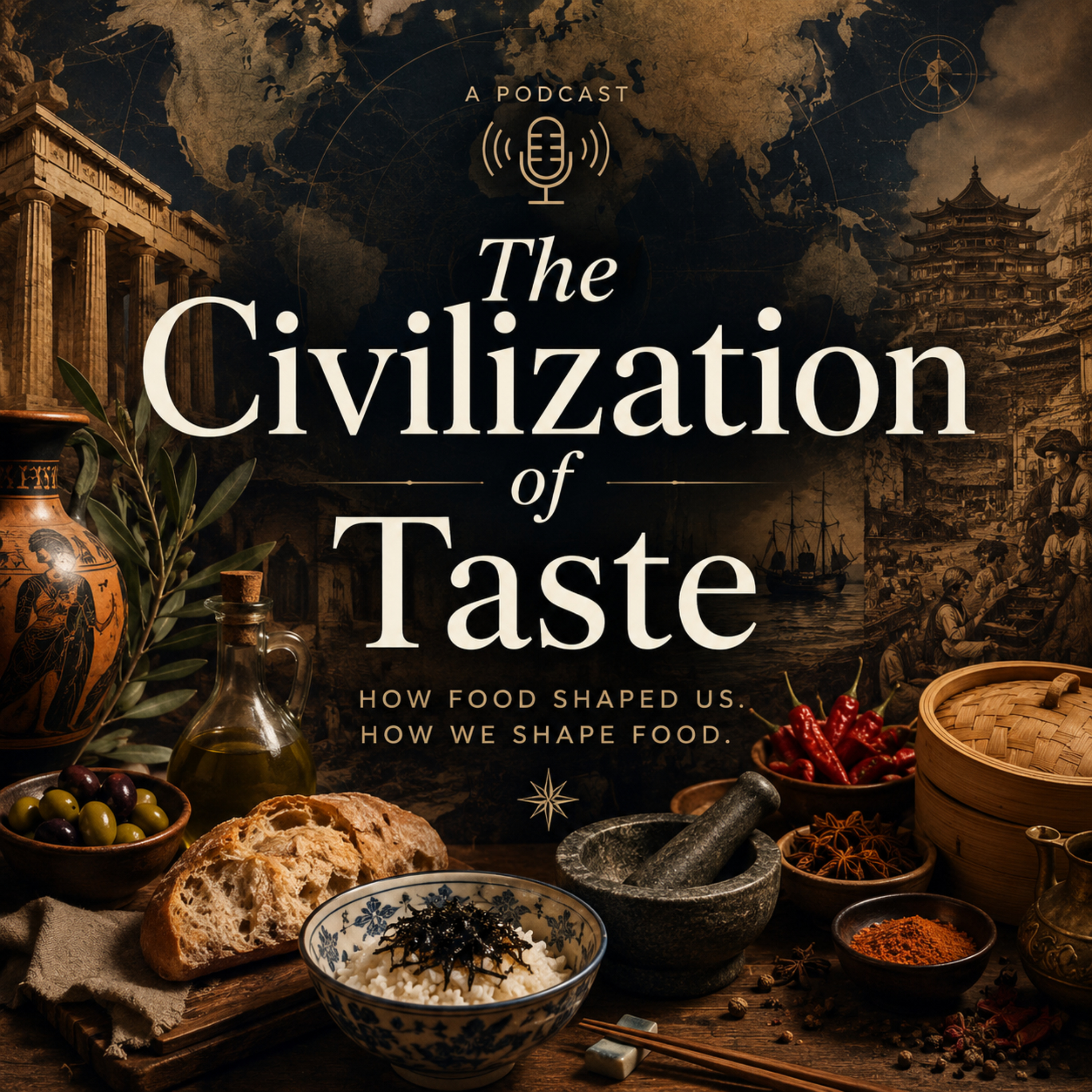
The Civilization of Taste explores the intersection of food, culture, technology, and human civilization. Through stories of coffee, beer, bread, spices, sugar, fermentation, and global trade, we uncover how food has shaped societies, economies, and the human experience throughout history. A podcast for anyone interested in food history, gastronomy, cultural history, and the evolution of taste.https://www.youtube.com/@MatMatch | https://nemoneai.com | A fruitful use of your time
Author
Nemone AIM
Category
Podcast website
Latest episode
Jul 5, 2026
Where to listen?
Podcasts in the app Replaio Radio Coming soonPodcasts are coming to the app soon. Install now and be the first to see a whole new take on podcasts
 Install for free
Android 5M+ downloads · 4.8 rating
iOS soon
Install for free
Android 5M+ downloads · 4.8 rating
iOS soon
Episodes
24. The One-Minute Ritual: Why Lisbon Drinks Coffee Standing Up 05.07.2026 16:51
In Lisbon, coffee isn't just a drink—it’s the rhythm of the city. People don't just "drink" coffee; they "do" coffee. But why do they drink it standing at a bar in less than a minute? In this episode, we dive into the soul of Portuguese coffee culture. We’ll explain the secret meaning behind the word "Bica", why it’s always served with sugar, and how a short c...
23. 7 Days to Live: The Rebel Brewery Defying the Global Beer Giants 02.07.2026 44:05
"What if the most authentic dining experience in China has no sign, no menu, and is impossible to export?" In this episode, we travel to Qufu , the ancient birthplace of Confucius, to find a hidden gem that locals call 'Lamb Skewer Omakase.' With no sign on the door and no way to order, the host reads your eyes to decide what you eat next. It's a world where data and efficien...
22. The Great Bread Evolution: From Parisian Crusts to the K-Bakery Explosion 28.06.2026 23:40
"Same ingredients, different souls." In this episode of The Civilization of Taste , we embark on a culinary journey from the crisp mornings of Paris to the precise bakeries of Tokyo and the vibrant, trend-setting streets of Seoul. While bread began as a Western staple, its journey through East Asia has transformed it into something entirely new. Join us as we explore: France’s Minimalism...
21. The Architecture of the Table: Why Some Societies Still Eat Together 22.06.2026 47:05
Imagine a sunset in Turin, Italy. People gather in the piazza for Aperitivo —not just for the wine, but to reaffirm their place in the community. Now, cut to a highway in America, where a driver finishes a burger alone behind the wheel. Why does one society treat the table as a stage for connection while another reshapes it for efficiency? In the premiere episode of The Architecture of the Table ,...
20. The Great Illusion: Why Parmesan is 'Luxury' and MSG is 'Chemical' 17.06.2026 18:34
Did you know that the MSG in your favorite soup and the premium Parmesan cheese in an Italian restaurant are essentially the same substance? In today's first episode of 《Civilization of Taste: East Asia vs. Europe》, we dive deep into the heart of a century-old culinary debate: the "uncomfortable" truth about MSG (Monosodium Glutamate). In 1908, Japanese chemist Kikunae Ikeda discov...
19. The Secret Map of Meat: How Kebab Conquered the World 16.06.2026 23:34
Imagine a simple skewer of meat traveling thousands of miles, crossing imperial borders, and reinventing itself in every city it touches. In this episode of The History of Taste , we trace the fascinating 500-year journey of the Kebab—a dish that is much more than just grilled meat; it is a living map of human migration. We dive into how the Ottoman expansion spread this nomadic staple across cont...
18. A Universe in a Bowl: Why Jeonju is the World's Ultimate Gastronomy Capital 11.06.2026 17:26
While San Sebastian turned gastronomy into a "lifestyle" and Bologna perfected it through "time," Jeonju, South Korea, speaks of "community" and "balance" through its food. Jeonju is more than just a city with delicious food. it is the place that defines the very standard of how Korean food should be prepared and enjoyed. Experience a city where the dignity...
17. Why the Japanese retreat into narrow alleys after work: Shedding 'Tatemae' to find 'Honne' 10.06.2026 19:01
[Intro] Imagine 9 PM on a Friday in Tokyo. A wave of grey and black suits pours out of Shinjuku Station. Tens of thousands of people move like a giant machine, but soon, this flow is sucked into narrow alleys lit by red lanterns. You smell charcoal and soy sauce. Inside, people sit alone at the counter, not talking to one another. Why has Japan developed such a sophisticated culture of drinking al...
16. The Secret Language of History’s Most Influential Tables 06.06.2026 19:59
What if your dinner plate wasn't just about hunger, but about dominion? In this series, we explore how the world’s most powerful figures used food as a weapon of political theater. From Louis XIV , whose 'Grand Couvert' turned every meal into a public performance of absolute power, to Roman Emperors who signaled their control over the globe by dining on flamingo tongues and peacock bra...
15. The Manhattan Trade: Why the Dutch Swapped New York for Nutmeg 🗽🌰 05.06.2026 20:14
Imagine being offered a choice between a desolate, underdeveloped island and the exclusive rights to the world’s most expensive spice—a commodity worth its weight in gold. In the 17th century, the Dutch made their choice, and they didn’t choose the island we now call Manhattan . [Context] In this episode of The Flavor Thieves , we dive into the high-stakes world of the 17th-century spice trade. We...
14. Why We Crave: The Evolution and Empire of Sugar 04.06.2026 20:30
Ever wondered why there’s always room for dessert, even after a heavy meal? It’s not just a lack of willpower—it’s a survival signal from our ancestors roaming the savannah. In this episode of The Civilization of Taste , we dive into the epic and often dark history of sugar, the "white gold" that reshaped the world. [Key Highlights] The Power of Display: Discover why King Louis XIV used...
13. Choose K-Diet Over Mediterranean": Why Global Nutritionists are Eyeing the Korean Table (The Miracle of K-Diet) 03.06.2026 22:19
For decades, the Mediterranean diet has reigned supreme as the world's healthiest way of eating. But recently, a powerful challenger has emerged to threaten its throne: the 'K-Diet' (Korean Diet) . This isn't just about cultural pride—it's backed by rigorous science. Discover the incredible power of Korean food as proven by the prestigious journal Nutrients and international re...
12. The Art of Controlled Decay: Why Time is the Secret Ingredient in Jamón Ibérico 01.06.2026 21:56
What makes a single slice of ham worth hundreds of dollars? It’s not just meat; it’s a masterpiece sculpted by time, nature, and human history. In this episode, we journey into the heart of the Spanish Dehesa to uncover the secrets of Jamón Ibérico de Bellota . We explore the fascinating biochemistry of how a diet of acorns transforms pig fat into heart-healthy oleic acid , allowing it to literall...
11. The "Real" Reason Southeast Asian Food is So Spicy and Intense (It's Not Just a Preference) 🌶️🍋 31.05.2026 22:38
From your first bite of Pad Thai in Bangkok, Pho in Hanoi, or Laksa in Kuala Lumpur, the flavors are undeniably intense—a powerful strike of spicy, sour, and salty notes followed by pungent herbs. While we often assume this is simply a matter of "taste," the truth is far more fascinating: it was a matter of survival . With average temperatures between 25-30°C and humidity reaching 70-90%...
10. From Survival Fermentation to Global Gourmet | The Civilization of Taste: Eastern Europe 30.05.2026 21:26
Winter in Eastern Europe is a brutal, frozen season lasting from November until as late as April—five long months of ice. In the days before refrigerators, failing to preserve the autumn harvest meant facing the very real threat of famine. In this audio, we dive into the secrets of "preservation" that allowed Eastern Europeans to survive extreme cold. We explore the fascinating science b...
9. Sliced in the Kitchen (East) vs. Cut at the Table (West) 29.05.2026 12:12
Have you ever wondered why Western restaurants always set the table with a knife, while our tables only have spoons and chopsticks? In East Asia, meat is sliced into bite-sized pieces in the kitchen before it ever reaches the table. In contrast, European dining often features large cuts of meat served whole, requiring the diner to slice it themselves., This simple difference in "where the kni...
8. The Mystery of British Cuisine: How Fish and Chips Ruined (and Saved) British Food 28.05.2026 21:19
The Betrayal of Fish and Chips: Iconic Symbol or Gastronomic Disaster? " The British Empire was created as a result of looking for better food than what was available in Britain. "Have you heard this painful joke? It perfectly summarizes the global reputation of British cuisine. While Britain is a cultural powerhouse that produced Shakespeare and the Beatles, why does its food face such...
7. The Breath of the Wok and the Soul of the Oven: A Tale of Two Fires 28.05.2026 20:40
"Why does East Asia explode with heat while Europe waits for the simmer?" Join us in this episode of The Civilization of Taste as we explore how the simple act of controlling fire created two entirely different culinary worlds. We dive deep into the concept of "Open Fire" in East Asia—represented by the high-velocity, 300-degree heat of the Chinese wok and the elusive "Wok...
6. A Masterpiece Crafted by Wind and Soil: Why You Must Experience Jeju Black Pork on the Island 27.05.2026 20:59
"Why does Jeju Black Pork taste so exceptionally savory and deep?" It’s not just a feeling. The island of Jeju itself created this difference. The unique volcanic soil formed 1.8 million years ago, the sea breezes that never stop blowing, and the centuries-old traditional farming philosophy known as 'Tongsi' have all shaped the genetic blueprint of this pig. In this audio, we exp...
5. Butter for the West, Oil for the East? The Millennia-old Secret in Your Kitchen 25.05.2026 22:29
When you turn on your stove, do you reach for the cooking oil or grab a stick of butter from the fridge? This simple, everyday choice actually hides the history of land, climate, and agriculture that each continent has experienced over thousands of years. In a Cantonese kitchen, chefs pour vegetable oil with a high smoke point into a wok heated to over 200°C, creating an explosive Maillard reactio...
4. You thought it was just Turkish? The shocking reason why Kebabs are found everywhere in the world 🥙 24.05.2026 21:23
From the narrow alleys of Istanbul and late-night stalls in Berlin to riverside spots in Cairo and food trucks in the heart of Seoul—wherever you go, you can smell the irresistible scent of meat roasting over fire. While many associate kebabs solely with Türkiye, they exist in diverse forms across continents: 'Koobideh' in Iran, 'Cevapi' in the Balkans, and even 'Chicken Tikka...
3. The Hidden Philosophy of Greek Food: Why "Balance" Beats "Flavor" 24.05.2026 19:58
The "Mediterranean Diet" is prescribed by doctors and praised by nutritionists worldwide. But when you look at the heart of it—Greek food—it’s surprisingly humble, even "plain." While Italian food is intense and Turkish food is rich, Greek food remains rustic and simple. Why did one of the world's oldest civilizations leave behind such a modest table? In this audio, we go b...
2. From "Trash" to "Truffle": How Animal Intestines Became the World's Finest Delicacies (feat. Gopchang, Tacos, Andouillette) 23.05.2026 21:03
Imagine the savory aroma of Gopchang in Seoul, the pungent scent of Andouillette in Paris, and the crispy Tacos de Tripa in Mexico City. Though these three dishes seem worlds apart, they share a single historical starting point: "We ate them because we couldn't afford to waste them." Intestines are one of the most difficult ingredients to handle—they spoil rapidly and possess an over...
1. Why Humans Started Eating Pain — Civilizational History of Taste: The Spiciness Edition 23.05.2026 21:44
Why do we seek out spicy food despite the sweat and tears? We even pay extra to make our dishes even hotter. In fact, spiciness is not a flavor that the human tongue can perceive . Capsaicin in chili peppers binds to pain receptors (TRPV1) in the mouth, tricking the brain into receiving signals akin to being on fire. Yet, the reason we crave it is that the brain releases endorphins—natural painkil...
Similar podcasts








Listen to the The Civilization of Taste podcast in Replaio
Radio and podcasts in one app - free, with no sign-up. Install today and do not miss the launch
Replaio is not a podcast publisher; show names, artwork and audio belong to their authors and are distributed through public RSS feeds.