The Ephesus School
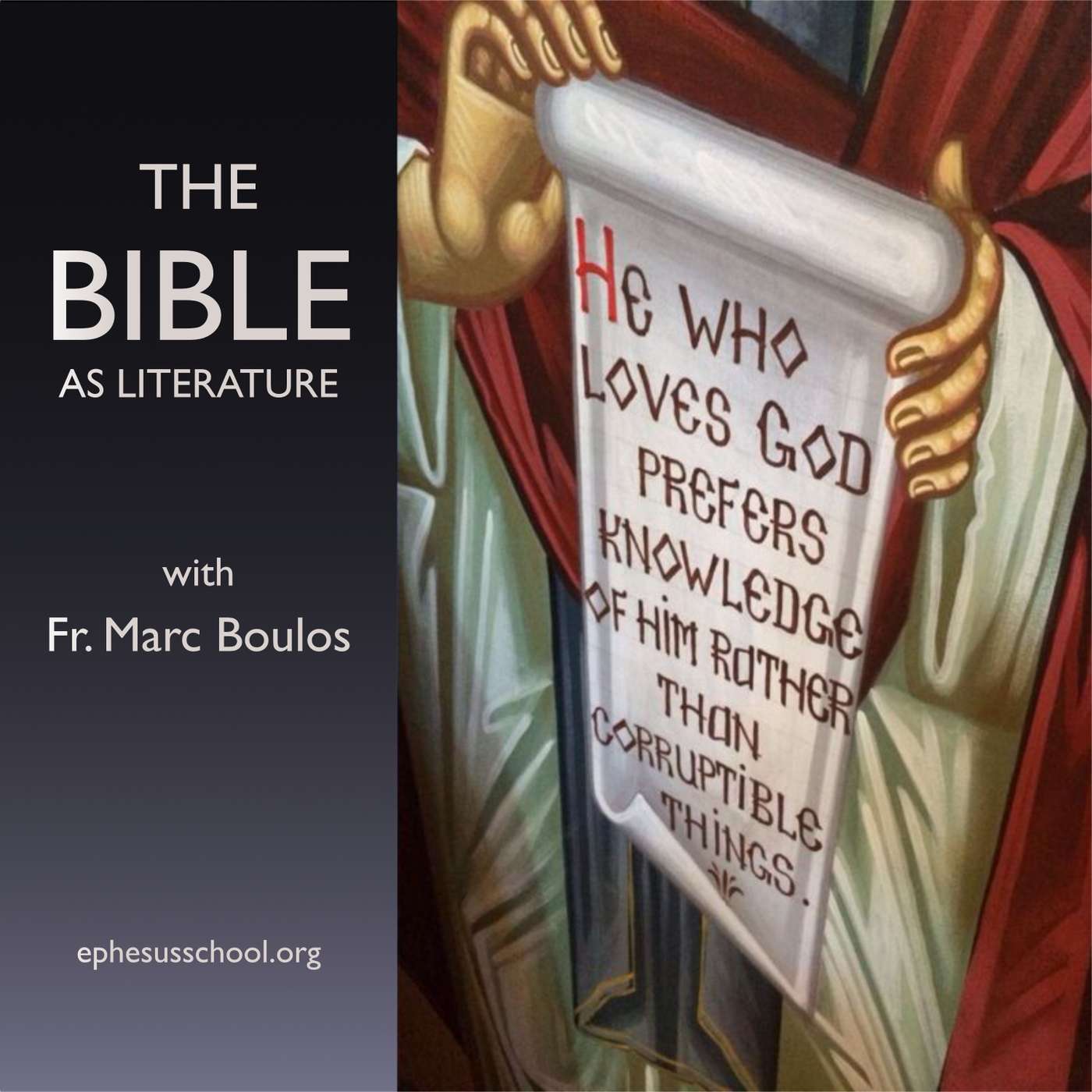
The Bible as Literature
Each week, Fr. Marc Boulos discusses the content of the Bible as literature. On Tuesdays, Fr. Paul Tarazi presents an in-depth analysis of the biblical text in the original languages.
Author
The Ephesus School
Category
Podcast website
Latest episode
Jun 29, 2026
Where to listen?
Podcasts in the app Replaio Radio Coming soonPodcasts are coming to the app soon. Install now and be the first to see a whole new take on podcasts
 Install for free
Android 5M+ downloads · 4.8 rating
iOS soon
Install for free
Android 5M+ downloads · 4.8 rating
iOS soon
Episodes
There is No New Humanity 10.09.2019 19:15
Following his discussion of the Toledot of Adam in Genesis 5, Fr. Paul explains how God manages to continue his plan and salvage humanity despite the people’s disobedience. (Episode 83) ★ Support this podcast on Patreon ★
Binding the Strong Man 05.09.2019 22:14
When the Pharisees accuse Jesus of being in league with Beelzebul, Jesus slams them by exposing a fatal contradiction in their logic: if the only way I am able to’ cast out demons is by Beelzebul, how are your sons able to do it? I’ll tell you how. If you are right and I am in league with Satan, then so are your sons; but if I am in league with God, then the Kingdom of this God is upon you, and yo...
Son of Man 03.09.2019 15:05
This week, Richard and Fr. Marc had the chance to follow-up Fr. Paul’s discussion of Genesis 5 with questions, leading to an important discussion of the anti-kingly tradition of the Bible and it’s connection with the phrase, ‘son of man.’ (Episode 82) ★ Support this podcast on Patreon ★
Teach and Move 29.08.2019 21:22
Internet comment culture invites useless and emotionally charged conflict that accomplishes nothing, except to inflame everyone’s self-serving sentiments. That’s why, in Matthew, Jesus refuses to engage in any argument with the Pharisees. To do so, Matthew teaches, is to squander what is holy. In keeping with the teaching of Isaiah, Jesus refuses to quarrel with anyone so that nothing and no one...
Ha Adam 27.08.2019 17:23
This week, Fr. Paul uses his own family tree to help explain the tree of Adam in Genesis 5. Following verse 2, in which God “created them male and female, and he blessed them and named them man,” whether directly, as Seth or indirectly, as the followers of Seth, the main actor, Fr. explains, is Adam, through his tenth son Noah. (Episode 81) ★ Support this podcast on Patreon ★
The Lord of the Sabbath 22.08.2019 27:04
“Remember the sabbath day, to keep it holy. Six days you shall labor and do all your work, but the seventh day is a sabbath of the Lord your God; in it you shall not do any work, you or your son or your daughter, your male or your female slave or your cattle or your immigrant who stays with you.” (Exodus 20:8-10) This commandment, which joins the needs of the vulnerable—of the immigrant and the lo...
Ha Adam or Adam? 20.08.2019 18:13
This week Fr. Paul touches on the importance of the author’s purposeful use of the word Adam in some places and the words Ha Adam elsewhere. The various connections between biblical words, he explains, hinge not on philosophical premises, but the author’s use of these terms within the flow of the narrative. (Episode 80) ★ Support this podcast on Patreon ★
God Doesn’t Need Our Bread 15.08.2019 15:29
When the Pharisees complain about the disciples picking and eating grain on the sabbath, they betray both their ignorance of Torah, and their desire to control the consecrated bread of God’s instruction to consolidate their power. But God, Matthew teaches, does not need our bread. After-all, whatever we offer him already belongs to him. What he desires is knowledge of and obedience to his Law: tha...
When Men Begin 13.08.2019 15:24
Dismantling the mistranslation found in Genesis 4:26, “at that time men began,” Fr. Paul explains that in the Hebrew, in the passive God merely allows—literally, it was allowed—to call on the name of the Lord. The action is initiated by God, without even mentioning human beings. This distinction is critical, since throughout Scripture, whenever men begin something, it is always negative. (Episode...
The Father 08.08.2019 19:17
In a society that consumerizes rebellion against parents both as entertainment and an axiom of pop-psychology, the basic premise of the New Testament—that the Son is disempowered because all glory and all power belong to his Father—is practically impossible to accept. In Matthew, when Jesus praises his Father, in the very content of his prayer, he underscores that his God is the Lord both of the...
In Spite of Cain 06.08.2019 15:45
This week, Fr. Paul continues to unpack the story of the new seed given to replace Abel, in spite of his murderous brother, Cain. Pointing to the Hebrew, where an ish posits an ish, Fr. Paul notes the actualization of God’s blessing in Genesis 1. The human being produces another human being, and another, remaining alive throughout time and history. (Episode 78) ★ Support this podcast on Patreon ★
It’s Worse for Us 01.08.2019 21:33
One of the strangest characteristics of religious psychology is the commonly held belief that those who have received instruction are better than those left untaught. We don’t phrase it that way, but the implication of consumerized evangelism is that others need what we have so that they can become like us. It is precisely this arrogant mentality that is condemend in Matthew’s gospel. What the oth...
A New Seed 30.07.2019 16:47
This week, Fr. Paul continues his discussion of Genesis 4, explaining how the RSV’s mistranslation of the Hebrew not only misleads but betrays and deconstructs the biblical text. Unlike the birth of Cain, the subject of Eve’s action, Seth is received by the wife of Adam as the gift of the Lord. Notably, Fr. Paul explain’s, Eve’s name disappears from the text with Cain’s in Genesis 4:1 and is not m...
Ideology is Idolatry 25.07.2019 25:47
When we choose an ideological framework, we employ a system of ideas and ideals to bolster our self-styled morality. We want so desperately to have power over others that we create a false reality in which we are always right, always the victim, always justified, and always able to find the culprit. Instead of child abuse at the border, we see criminals getting what they deserve; if a lie suits us...
What He Undertakes 23.07.2019 18:17
In today’s program, Fr. Paul explores the functionality of biblical names in the genealogy presented in Genesis 4. (Episode 76) ★ Support this podcast on Patreon ★
More Than a Prophet 18.07.2019 19:18
When we look at the world, intuitively, we betray Matthew’s admonition against judgment, assessing and interpreting people and texts based on our presuppositions. Instead of seeing everything through the lens of God’s teaching, we trust the lamp of our human eyes, which presents the world to us in darkness. Thankfully, the preaching of John the Baptist—made up entirely of God’s words—can’t be see...
Name and Function 16.07.2019 18:46
This week, Fr. Paul notes the significance of Cain’s construction and subsequent naming of a city after his son, Enoch, the significance of the name Lamech as a metathesis of Melek, and the problem of civilization connected with the city as the production of man. (Episode 75) ★ Support this podcast on Patreon ★
Immigration Letter 13.07.2019 7:18
“The line separating good and evil passes not through states, nor between classes, nor between political parties either—but right through every human heart.” —Alexander Solzhenitsyn The letter read in today’s program quotes the following article in the last paragraph: Sonia Nazario, “How to Secure the Border,” Los Angeles Times, April 23, 2017. Music performed by the West Side Riverview Choir, St....
The Kingdom of the Heavens 11.07.2019 29:13
In Matthew 11, we discover that John the Baptist, who earlier preached the Kingdom of God in the wilderness, is now imprisoned. At this point in story, we do not know how John ended up in prison. All we know is that he preached the Kingdom. Looking a few verses ahead, we learn from Jesus that this very Kingdom “suffers violence” at the hands of violent men. (Matthew 11:12) It is Caesar, the antic...
The Only Avenger 09.07.2019 13:36
This week Fr. Paul explains that in murdering Abel, Cain is responsible for his own sin and may not blame his forefather. Individual responsibility for sin, Fr. Paul explains, is a main feature of the chapter. The fact that Cain ends up in the same situation as Adam (ha adam) cannot obscure this point, which is unmissable in the original Hebrew. (Episode 74) ★ Support this podcast on Patreon ★
To These Little Ones 04.07.2019 22:35
Today is July 4, a holiday in the United States. As is the custom of our church, over the centuries, many such holidays have been coopted to serve the Gospel of Jesus Christ. In this spirit, on this day, we at The Bible as Literature remember all those in peril—the many refugees fleeing poverty and violence and their fallen brothers and sisters. We implore God on their behalf to grant them shelter...
Cain and Abel 02.07.2019 18:26
In today’s program, Fr. Paul begins his discussion of Cain and Abel, explaining the famous phrase, “sin is couching at the door.” He also reiterates the importance of the Hebrew word, yalad, noting that it can only be used in conjunction with the woman—an important point lost in translation. (Episode 73) ★ Support this podcast on Patreon ★
Bringer of the Sword 27.06.2019 28:04
Bewitched by the lie of acquisition and consumerism, we have become of society of people whose actions proclaim the vulgar creed, “me first.” With supposed possessions in hand, we emerge as a nation of cowards, so terrified of losing what we think we have that we elevate our cravenness with ugly platitudes: family first, religion first, and nation first. But in our cowardice, we run afoul of the L...
East of the Garden 25.06.2019 20:00
This week Fr. Paul concludes his discussion of Genesis 3 with the expulsion of Adam from the garden, away from the Tree of Life. As always, he highlights critical connections in the Hebrew, in this case, technical terms that pertain to the keeping of God’s Law. (Episode 72) ★ Support this podcast on Patreon ★
Fear Wisdom 20.06.2019 35:34
People claim to be members of God’s household—to be followers of his teaching—but in the Roman Empire, your master determines your household, and in the Bible, your fears reveal your true master. Insofar as our fears control us, the Matthean metaphor of the Roman household contextualizes this dynamic perfectly, as a kind of slavery. If human beings are controlled by their fears, why not transfer...
Similar podcasts







Listen to the The Bible as Literature podcast in Replaio
Radio and podcasts in one app - free, with no sign-up. Install today and do not miss the launch
Replaio is not a podcast publisher; show names, artwork and audio belong to their authors and are distributed through public RSS feeds.