The Ephesus School
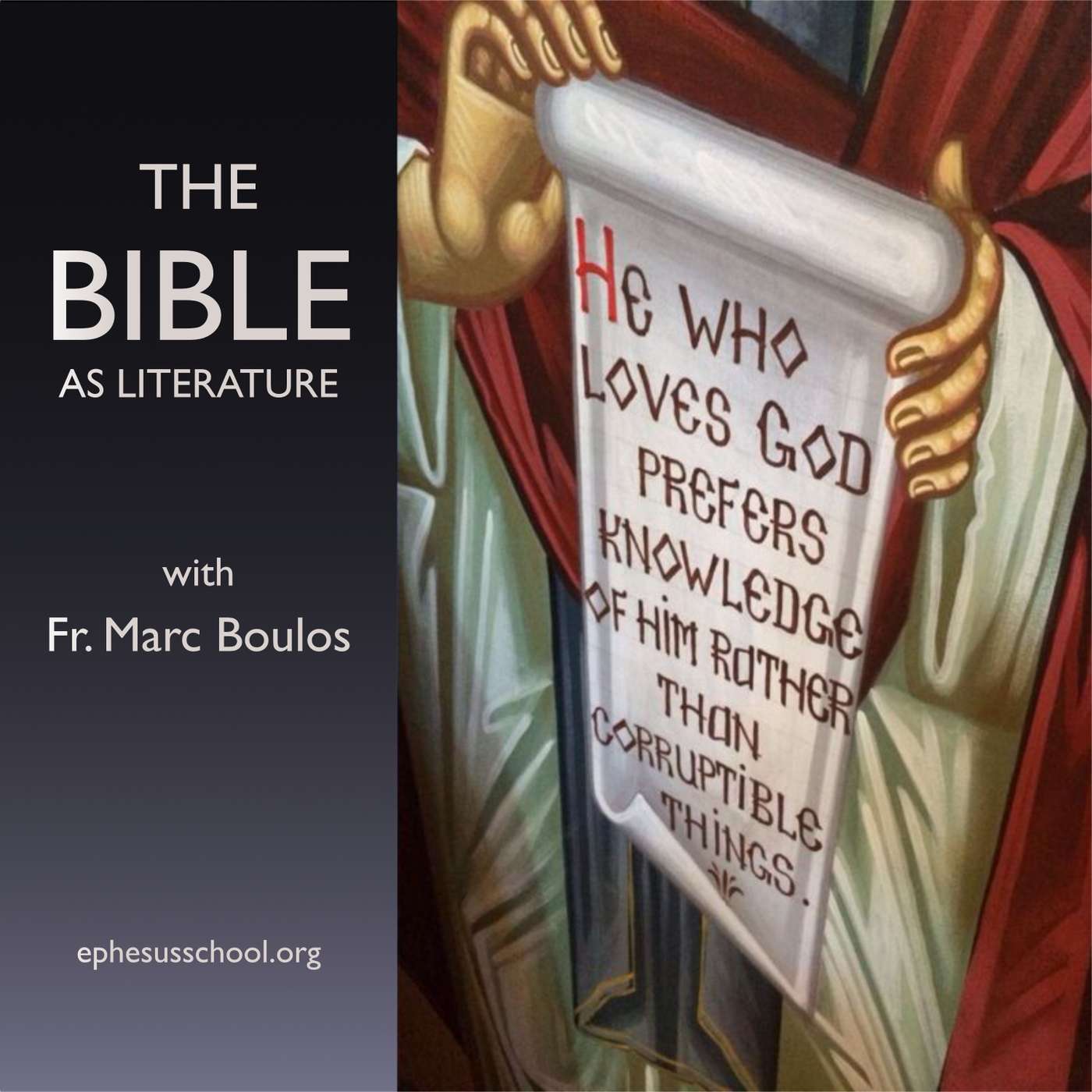
The Bible as Literature
Each week, Fr. Marc Boulos discusses the content of the Bible as literature. On Tuesdays, Fr. Paul Tarazi presents an in-depth analysis of the biblical text in the original languages.
Besuch unbedingt die Website des Podcasts und unterstütze die Macher: ephesusschool.org
Autor
The Ephesus School
Kategorie
Podcast-Website
Neueste Folge
8. Okt 2026
Wo hören?
Podcasts in der App Replaio Radio Bald verfügbarPodcasts kommen bald in die App. Installiere sie jetzt und erlebe als Erster einen ganz neuen Blick auf Podcasts
 Kostenlos installieren
Android fast 10 Mio. Downloads · Bewertung 4,8
iOS bald
Kostenlos installieren
Android fast 10 Mio. Downloads · Bewertung 4,8
iOS bald
Folgen
Crossing into Judgment 08.10.2026 58:42
Fr. Marc Boulos presents "Crossing into Judgment: The ʿIbri, the ʿArabah, and the Philological Manufacture of an Ethnos" at the 2026 OCABS Symposium, held October 2–3, 2026, at St. Elizabeth Orthodox Church in St. Paul, Minnesota. Drawn from his forthcoming book Man of Letters, the sequel to The Eucharist: A Grammar of Thanksgiving, the talk hears the Abrahamic text on its own terms: as a scriptur...
The Scriptural Canon 06.10.2026 1:35:23
Fr. Paul Nadim Tarazi's final public presentation, "The Scriptural Canon," delivered as the keynote address at the 2026 OCABS Symposium, held Saturday, October 3, 2026, at St. Elizabeth Orthodox Church in St. Paul, MN. ★ Support this podcast on Patreon ★
You Are Not the Subject 07.09.2026 51:39
In Episode 590, Father Marc Boulos examines Luke 9:39 through Ezekiel, 3 Maccabees, and the linguistic connections between Greek, Hebrew, and Arabic. He challenges modern ideas of choice, agency, and the “pursuit of happiness,” showing how Scripture presents God—not the human being—as the true subject and actor. ★ Support this podcast on Patreon ★
Look Upon My Son 22.08.2026 1:08:38
غ ن ي Academic institutions, like religious institutions, are metropolitan in nature, gathering where the Scriptural God scatters. They are the elephant whose snout hoards knowledge for the tyrants of the earth like the Egyptian scribes (Genesis 41:8), inscribing their will with an iron stylus on the foreskins of human hearts, concealing them from God ( The Eucharist , 270). The psychē (ψυχή) figh...
Light upon Light 10.08.2026 43:35
In episode 588, Fr. Marc hears the mashal of the Transfiguration as a warning against attempting to control what God gives freely. The Arabic root ش-ي-ع (shīn–yāʾ–ʿayn) spreads light naturally shedding itself without the inevitable fracture it finds in human hands. Peter's ploy to "make" tents for the prophets is a poor attempt to turn the gift of light into property. But the light, like rain, is...
Carried by Night 29.07.2026 29:31
In Episode 587, Fr. Marc Boulos hears the names Lyla and Elijah as rasm , unpointed traces, skeletons of consonants standing like the dry bones in Ezekiel's valley, waiting for a breath that is not their own. His baptism homily, dated July 25, 2026, follows the Arab grammarians, for whom the vowels are ḥarakāt , movements supplied by the one who formed the bones, into the night of Genesis 1, where...
The Bundle of the Living 19.07.2026 28:25
In Episode 586, Fr. Marc Boulos asks what it truly means to welcome someone in Scripture. In Luke's account of the feeding of the five thousand, the answer is far richer than simple hospitality. Examining the Greek verb ἀποδέχομαι (apodechomai) alongside the Hebrew root צ-ר-ר (ṣ-r-r) and the Arabic ص-ر-ر (ṣ-r-r), Fr. Marc demonstrates that biblical welcome is not merely greeting a stranger—it is b...
The Declining Day 29.06.2026 46:50
In episode 585, Fr. Marc Boulos explores the profound linguistic and scriptural connections between Luke 9:10–13 and Sūrat al-ʿAṣr, showing how both texts speak a common Semitic grammar of time, need, loss, and divine provision. As the day declines in Luke, the disciples conclude that the crowd must be sent away. They see the wilderness, the fading light, and their five loaves as proof that there...
What Did You Go Out to See? 14.06.2026 32:08
In Episode 584 of the Bible as Literature Podcast, Fr. Marc Boulos explores Luke 9:10 through the Semitic root ס־פ־ר / س־ف־ر (samek-fe-reš / sīn-fāʾ-rāʾ), uncovering a rich biblical ecology of sending, hearing, obeying, recounting, and carrying the word of God. Beginning with a sharp critique of Greek epistemology and the modern assumption that knowledge originates in the human mind, Fr. Marc argu...
The Khalīfa, the Slave, and the Adversary 31.05.2026 30:46
In this episode, Fr. Marc Boulos explores the profound connection between the Qurʾanic account of Adam as khalīfa (خليفة), Paul’s teaching on κοινωνία (koinonia), the biblical function of stewardship, and Luke 9:7–9, where Herod is troubled by reports concerning Jesus. Why is Herod perplexed? Why does Scripture repeatedly shift attention away from the identity of the messenger and back toward the...
The the Cure Waits for the Kingdom 20.05.2026 55:58
In this episode of The Bible as Literature, Fr. Marc Boulos delivers a powerful Mother’s Day homily and biblical reflection on the meaning of Baal, husbandry, empire, and the anti-imperial function of scripture. Beginning with the Semitic root ב־ע־ל / ب־ع־ل (b-ʿ-l), Fr. Marc explains how the biblical attack is not against the husband or father, but against the corruption of husbandry into dominati...
Isaiah in the Streets 27.04.2026 1:00:53
I call out to Isaiah: اخرج من الكتب القديمة ( ukhruj min al-kutub al-qadīmah ), come out of the old books as they came out. The world needs you now. Mahmoud Darwish said it under the siege of Beirut, in 1982, watching human flesh hung from the walls over the openings of the Old Testament. He knew what most of us still do not: that the scroll does not stay on the shelf. The prophet steps off the pa...
The Hidden Pillar 29.03.2026 44:58
The Greek ὑπομονή ( hypomone ) is a compound: ὑπό ( hypo , under) and μονή ( mone , a remaining, from μένω, meno ). Literally: remaining under. The one who endures is the one who remains standing under the pressure of weight. This is not a second concept grafted onto μένω ( meno ); it is the same root with the load made explicit. The one who stands is the one upon whom weight is placed. This is wh...
God is Not Mocked 08.03.2026 1:11:51
When Luke records Jesus commanding the Twelve to take nothing for the journey, neither staff, nor bag, nor bread, nor money, he activates a deliberate stripping that recalls the scriptural logic of exile as exposure. The Hebrew root ג-ל-ה (gimel-lamed-heh) can function as “to uncover” or, by extension, “to go into exile,” linking displacement with nakedness in the prophetic texts themselves. There...
Seen, and Sent 16.02.2026 58:16
Homily: The Prodigal Son, The Lost Sheep, and the Raven Fr. Marc Boulos Sunday, February 8, 2026 In the name of the Father and of the Son and of the Holy Spirit. Amen. Today’s Gospel (Luke 15:11-32) forms a diptych with the parable of the Lost Sheep (Luke 15:3-7), which unfortunately is used systematically by the followers of Epstein, or, more accurately, by those captivated by the mentality of Ep...
Reconciling Insufficiency 27.01.2026 57:51
My mother was born in Bethlehem, Palestine, a land where hospitality is not sentiment, not a virtue to be cultivated, but obedience. It is not taught, debated, or defended. It is enacted. The land itself bears witness to a scriptural way of life that precedes institutions, borders, and claims of authority. The earth remembers what human beings forget. It remembers what it means to live under decre...
A Word Against the Witnesses 11.01.2026 1:02:12
Human beings move as a flock. What feels like freedom is motion inside a herd. People act the way they do because of pressure, habit, fear, desire, reward, or past experience. When we make decisions, we are responding to systemic forces already acting on us, even when theologians insist on calling this a free choice, the so-called “free will.” Long before a choice is named, the path is worn. Gover...
The Sound of God 24.12.2025 1:05:13
Jairus appears as an administrator. He was named, titled, and located inside a functioning system. He knew how things worked, when to ask, when to stop, when a situation was resolved. When he knelt before Jesus, it was already a breach of role, but the text does not stop there. It presses him. While he was still on the way, while the instruction was still unfolding, a message arrived from his own...
God Sees All 29.11.2025 50:03
Most assume that the difference between Greek literature and the Semitic Scrolls, written in Biblical Hebrew, Aramaic, and Qurʾanic Arabic, lies in narrative. It does not. Narrative is the veil, a carrier wave for what remains unseen. Everything hinges on lexicography. The decisive divide is grammatical. Greek “meaning” is a conceptually “built” construct, grounded in philosophical abstraction and...
By God's Command 09.11.2025 59:00
Human beings have always prided themselves on the advantage gained from possessing knowledge that others lack. We boast of being smarter, more informed, more enlightened—as if we were the elite guardians of some secret insight reserved for our sect, our institution, or our circle. Whether the advantage lies in religious doctrine, education, status, political ideology, or modern technology, it alwa...
Crowd of Thorns 20.10.2025 47:19
The thorns in Luke press and threaten. They are the self-referential swarm posing as a flock: the so-called “community” that gathers to its own voice, circling death, mistaking its stench for sweetness, even as it strangles the one bearing the seed. These are the thorns. But the roots are of another kind. They spring up from the seed itself. A daughter of Israel, fruit of the Master’s vine, afflic...
One is the Only Number 02.10.2025 47:58
The functional path of oneness is not an abstract unity but a lived encounter of utter dependence. Western thought, enslaved by the grammar of the Anglo-Saxons, treats the human as an individual: a self-contained atom, an object unto itself. It imagines freedom as isolation, and isolation as freedom. But this supposed independence becomes sterility: the atomized person, cut off from the Shepherd’s...
Unsettled Settlement 18.09.2025 55:07
The obsession of Western spirituality with forgiveness—therapeutic forgiveness—is an obsession with the self. With control. With the usurpation of God’s throne by human power. It domesticates God, it drags wisdom into abstraction, it ties it down, it entangles it in comfort for the self, and multiplies suffering for others. But Scripture cuts the knot. Forgiveness from the cross is not therapy. It...
Despair and Light 04.09.2025 46:25
Every dynasty insists on its permanence. Every people clings to the hollow echo of its own voice. Every generation invents its own despair and dares to call it light. Yet Scripture unmasks the fragility of these human building projects. The voices of despair rise in the camp, soothing themselves with stories of morality, while kings and judges build false legacies and nations carve idols in the li...
Lift Up Your Gates 21.08.2025 42:37
All of Scripture comes to this: hope and trust. Not in the work of our hands, but in the righteousness of God. He alone vindicates the poor, he alone tends the needy. He is the Good Shepherd, the breath in the night, the voice that calms the storm, the hand that keeps the wolf at bay. Will we close the gates? Will we bind ourselves in chains? Will we send him away? To wait is to hope. Yet waiting...
Ähnliche Podcasts







Höre den Podcast The Bible as Literature in Replaio
Radio und Podcasts in einer App - kostenlos und ohne Anmeldung. Installiere sie noch heute und verpasse den Start nicht
Replaio ist kein Herausgeber von Podcasts; die Namen der Sendungen, Cover und Audioinhalte gehören ihren Autoren und werden über öffentliche RSS-Feeds verbreitet