I & A Publishing
Talks by Zen Roshi, Lola McDowell Lee
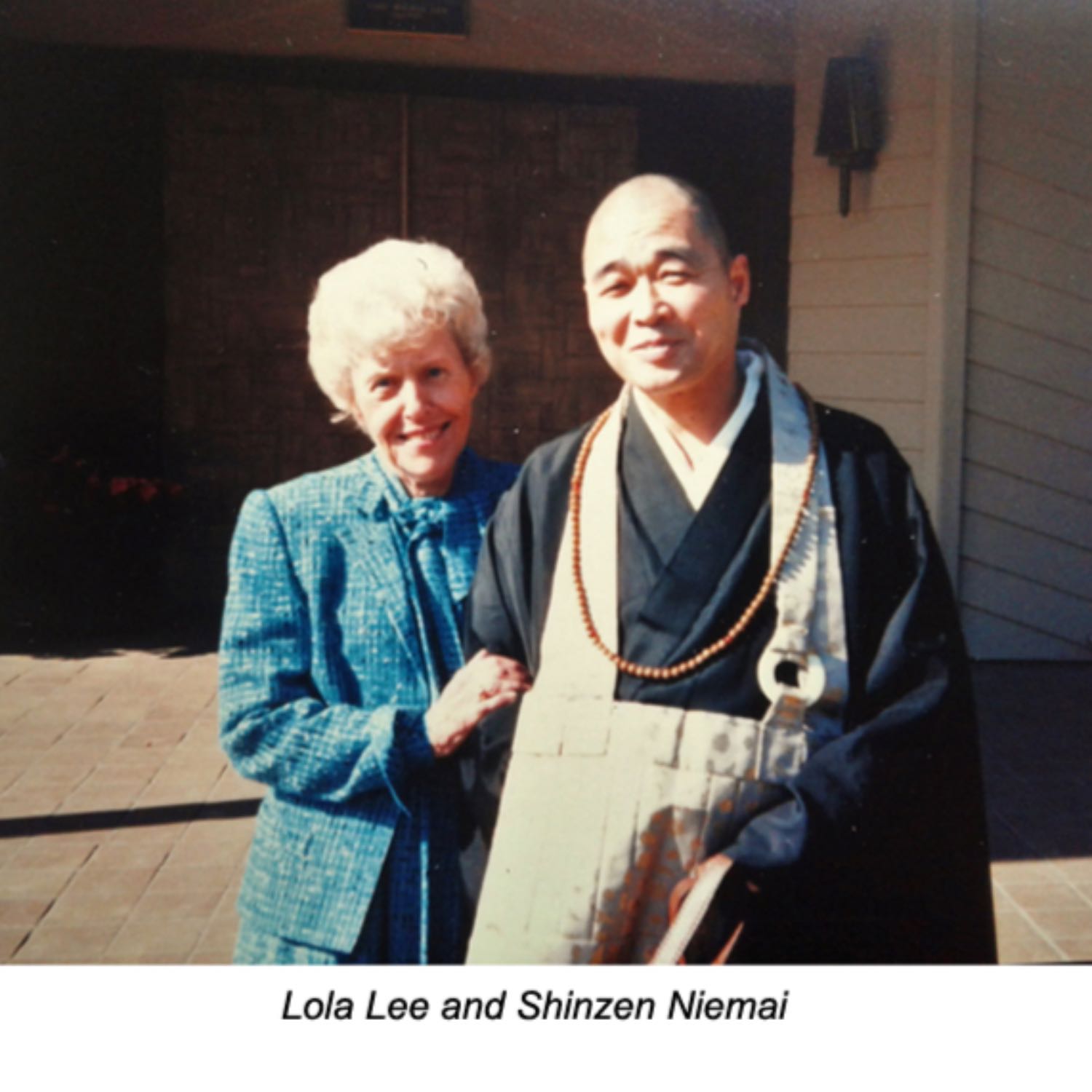
This is a series of newly digitized talks by spiritual teacher, Lola McDowell Lee, spanning two decades—from the early Seventies through the Nineties. Lola was a Zen Roshi whose Rinzai lineage included Doctor Henry Platov and renowned Zen master, Shigetsu Sasaki. Lola was a religious scholar as well as an ordained Christian minister. While the talks are focused mainly on Zen and Buddhism, Lola drew on many spiritual traditions—including those of Jesus, Plato, Lao-Tzu, the Hindu Vedas, Meister Eckhart and Gurdjieff. If you find Lola’s talks valuable, more will be posted in days to come. RSSVERI...
Where to listen?
Podcasts in the app Replaio Radio Coming soonPodcasts are coming to the app soon. Install now and be the first to see a whole new take on podcasts
 Install for free
Android 5M+ downloads · 4.8 rating
iOS soon
Install for free
Android 5M+ downloads · 4.8 rating
iOS soon
Episodes
When you look in the mirror, do you see you? When you are silent, it speaks. Your absence is its presence. Feb 10, 1985 14.01.2024 1:00:17
Zen Roshi, Lola McDowell Lee, discusses Chinese Master Yoka Daishi. We were all born with our true religion. It is essential in us. Not some borrowed doctrine. It’s not something outside which you seek. It’s the seeker. When you are silent, it speaks. Your absence is its presence. When you look in the mirror, do you see you? Feb 10, 1985
Understanding Lao Tsu’s Tao Te Ching and the Middle Way. Non-action, yet nothing remains undone. Sep 22, 1985 13.01.2024 49:38
Zen Roshi, Lola McDowell Lee, discusses Lao Tsu’s Tao Te Ching. Also, the tale of the master swordsman, the rat and the palace cat. If you look for an enemy, you will find one. If I give a gift and it’s not accepted, to whom does the gift belong? Sep 22, 1985
Do not sit in meditation waiting for enlightenment. Direct your attention to the mind. And, what is faith? Mar 2, 1986 05.01.2024 59:07
Zen Roshi, Lola McDowell Lee, discusses the beginning stanzas of the Diamond Sutra. What to do with our thoughts? Where is the mind? What is faith? Is there a wisdom that is the ground of mind? Where does it abide? What do you think is holy? Do not sit in meditation waiting for enlightenment. Direct your attention to the mind. Mar 2, 1986
Exploring the meaning of the Dhammapada. Listening to teachings as if you are an empty tape recorder. Sep 4, 1983 04.01.2024 1:00:04
Zen Roshi, Lola McDowell Lee, on listening to teachings as if you are an empty tape recorder—not judging, evaluating, or comparing. The Dhammapada, or stepping into the dharma. Also, our world is real, but it is illusory. Like looking at reality through a keyhole. A limited view. Also, when your thoughts cease, who are you? And Rainer Maria Rilke. Sep 4, 1983
What is this life living you? It’s the same as that which sings in the birds. Jan 8, 1984 30.12.2023 50:47
Zen Roshi, Lola McDowell Lee, explains that when you breathe, it is not you doing the breathing. As you watch this breath, in time you’ll discover something remarkable about it. To begin work toward realization, focus on the breath. Not breathing. The breath. What is this life living you? It’s the same as that which sings in the birds. In your eyes He is seeing. In your hands He is doing. Jan 8,...
A Christmas message for Zen practitioners about the birth of the light within. Dec 20, 1986 25.12.2023 55:19
Zen Roshi, Lola McDowell Lee, was also an ordained Christian minister. At the holiday she shared a message about Christ within each of us. How we live a dark, deep mystery, and within that darkness there is light. Dec 20, 1986
To witness the apparent in the real and the real in the apparent. One mind sees both worlds. Jan 26, 1986 24.12.2023 57:14
Zen Roshi, Lola McDowell Lee, explains that what we see with our senses—the world in which we live—is a world of effects. The causes are hidden. To witness the apparent in the real and the real in the apparent. One mind sees both worlds. Also, why do we not recognize those among us who are enlightened? Jan 26, 1986
We try to both change and remain the same—the hook that many are on. Jun 7, 1981 20.12.2023 54:05
Zen Roshi, Lola McDowell Lee, suggests we resist trying to recreate an earlier experience in meditation. The sword loses its edge with constant feeling. Your earliest memories at 3 or 4 or 5… that was the beginning of your ego. So what were you before that? Lao Tzu says when you reach success to step back into obscurity. Also, trying to change and remain the same at the same time—the hook that ma...
Meditation is about life and death. Nirvana is not. The thundering silence. 1990 Sesshin Friday 17.12.2023 1:15:22
We are born with this body which brings with it our parents, our grandparents and other lives. Then our essence is added. Then circumstances. Then there is what we do with all this. Also, the thundering silence within. 1990 Sesshin Friday
Learning to differentiate what you see, what you think and what you feel. Aug 16, 1981 13.12.2023 52:17
Zen Roshi, Lola McDowell Lee, asks: who will tell you when your mind is playing tricks on you? The importance of learning to differentiate what you see, what you think and what you feel. Also, distinguishing sentimentality from genuine sensitivity. The no-mind of the Buddha is not blankness. It is perceiving your world differently. Aug 16, 1981
Your ego has no power to do anything. It’s impotent. Dec 6, 1981 07.12.2023 46:10
Zen Roshi, Lola McDowell Lee, asks: If you were absolutely alone on the planet, would you be rich or poor? Would you be beautiful or ugly? Your ego, which establishes all your opinions, isn’t even real. The ego has no power. It's impotent. Yet we spend our lives doing its bidding. Dec 6, 1981
Misfortune and our identity. And the tale of the farmer who asks God to let him choose the weather. Dec 03, 1981 05.12.2023 46:17
Zen Roshi, Lola McDowell Lee, explains how many of us create an identity around our misfortune. But it is life’s challenges that helps us find our true selves. Lola recounts the story of the farmer who complains about the storms and freezes and asks God to let him choose the weather. Dec 03, 1981
Lao Tzu uses the metaphor of a vessel to show that while existence renders it (and us) actual, it is the vessel's non-existence (or emptiness) that renders it useful. Aug 23, 1981 04.12.2023 50:42
Zen Roshi, Lola McDowell Lee, explains passages from Lao Tzu’s book, The Tao Te Ching. Elaborating on the metaphor of the knave of a wheel, or the emptiness of a vessel. And how their existence renders them actual in our world, but it is their non-existence (or emptiness) that renders them useful. Aug 23, 1981
What is consciousness? Does a rock have consciousness? Who are we? Summer 1990 Wed Night Sesshin 30.11.2023 49:36
One of the later talks by Zen Roshi, Lola McDowell Lee. Mid-way through a sesshin, this talk discusses what consciousness is. And how much do we know the world around us. Summer 1990 Wed Night Sesshin
The mind-body relationship. And breathing from the Hara. Apr 14, 1981 28.11.2023 51:09
Zen Roshi, Lola McDowell Lee, explores the mind-body relationship. And breathing from the Hara. Apr 14, 1981
Lola shares the tale of the monk and the bottomless pitcher. And how to focus with a no-thinking mind. 1990 Summer Sesshin Monday 25.11.2023 1:02:38
Zen Roshi, Lola McDowell Lee, gives this talk at night during a week-long sesshin. We hear the crickets chirping and a dog barking. We can sense the atmosphere in which the sesshin takes place. Lola explores in a granular way what one might find during an exploration of one’s mind during meditation. 1990 Summer Sesshin Monday.
When you're fast asleep and hear a noise you wake up. What wakes up? What was awake to hear the noise? Jan 27, 1985. 20.11.2023 51:24
Zen Roshi, Lola McDowell Lee, explores the Hindu concepts of Prakriti and Purusha. And the nature of karma. Lola also asks, When you're fast asleep, hear a noise and wake up... what wakes up? What hears the noise? Jan 27, 1985
First one finds quiet, explains Lola. Then one goes further and finds silence, or Shunyata. Mar 28, 1982. 17.11.2023 55:01
Zen Roshi, Lola McDowell Lee, explains what is meant by Shunyata, or emptiness. First you find quiet. Then go further and find silence, or Shunyata. Mar 28, 1982.
An early talk by Lola where she explains the metaphor of a boat crossing a river to reach the other side. Apr 20, 1975. 15.11.2023 48:31
This is an early talk by Zen Roshi, Lola McDowell Lee, where she describes an iron bar without a hole. And explains the metaphor about one’s spiritual discipline as a boat crossing a river to reach the other side. Apr 20, 1975.
We can live in the valley—but be the peak. Lola explains how to live an awakened life. Apr 4, 1982 13.11.2023 55:52
Zen Roshi, Lola McDowell Lee, explains how, when the world seems tedious or boring—with repeating sameness—we need only remember that the flower we see today is not the same one we saw yesterday. Each moment is new. To live we dress, we eat. Live in the valley, but be the peak. Apr 4, 1982
What is the power with which you look at yourself? Lola explores the meaning of religion and non-discrimination. Feb 2, 1985 06.11.2023 1:00:19
Zen Roshi, Lola McDowell Lee, explores how to understand the intuitive knowing with which you look into yourself. Non-discrimination and seeing through the dust on the mirror. Lessons from 8th Century Chinese Zen master, Yoka Daishi. Feb 2, 1985
Lola asks: What gives the eye its sight, the ear its hearing? Mar 22, 1987 31.10.2023 1:01:32
Zen Roshi, Lola McDowell Lee, asks: Where is your consciousness? Our True Self is both Being and Becoming. Like a candle flame — unmoving, yet moving. Mar 22, 1987.
Lola explains how the process of becoming awakened depends on two factors—the information you feed your mind—and your meditation. Sep 24, 1989 22.10.2023 54:31
Zen Roshi, Lola McDowell Lee, discusses spiritual hedonism, or spiritual pride, the seeking of pleasure in spiritual things, which is our egos patting ourselves on our backs for our seeking. She shows how the process of becoming awakened depends on two factors—the information you feed your mind and your meditation. Sep 24, 1989
Lola suggests we ask ourselves Agathon’s question: What in your life is the greatest good? She also explains that truth is not an idea but an encounter, an adventure. Mind is just a record of what has happened. Sep 10, 1989. 20.10.2023 56:14
Zen Roshi, Lola McDowell Lee, explains that’s it’s easy to forsake the world—much harder to become a true man of no rank. She describes of an Eastern Orthodox sect, the Hesychasts. Known for their "way of stillness,” their contemplation technique earned them the name, “the belly-gazers.” Sep 10, 1989.
Lola mentions an early experience of awakening. And shares the tale of the Duke and the wheelwright. Feb 15, 1987 08.10.2023 51:37
Zen Roshi, Lola McDowell Lee, discusses the middle way. Also, have you ever read something that inspired you, but then you reread the same passage and it seemed dead? Lola explains why this happens. Feb 15, 1987
Similar podcasts







Listen to the Talks by Zen Roshi, Lola McDowell Lee podcast in Replaio
Radio and podcasts in one app - free, with no sign-up. Install today and do not miss the launch
Replaio is not a podcast publisher; show names, artwork and audio belong to their authors and are distributed through public RSS feeds.