Speeches That Changed History
Speeches That Changed History
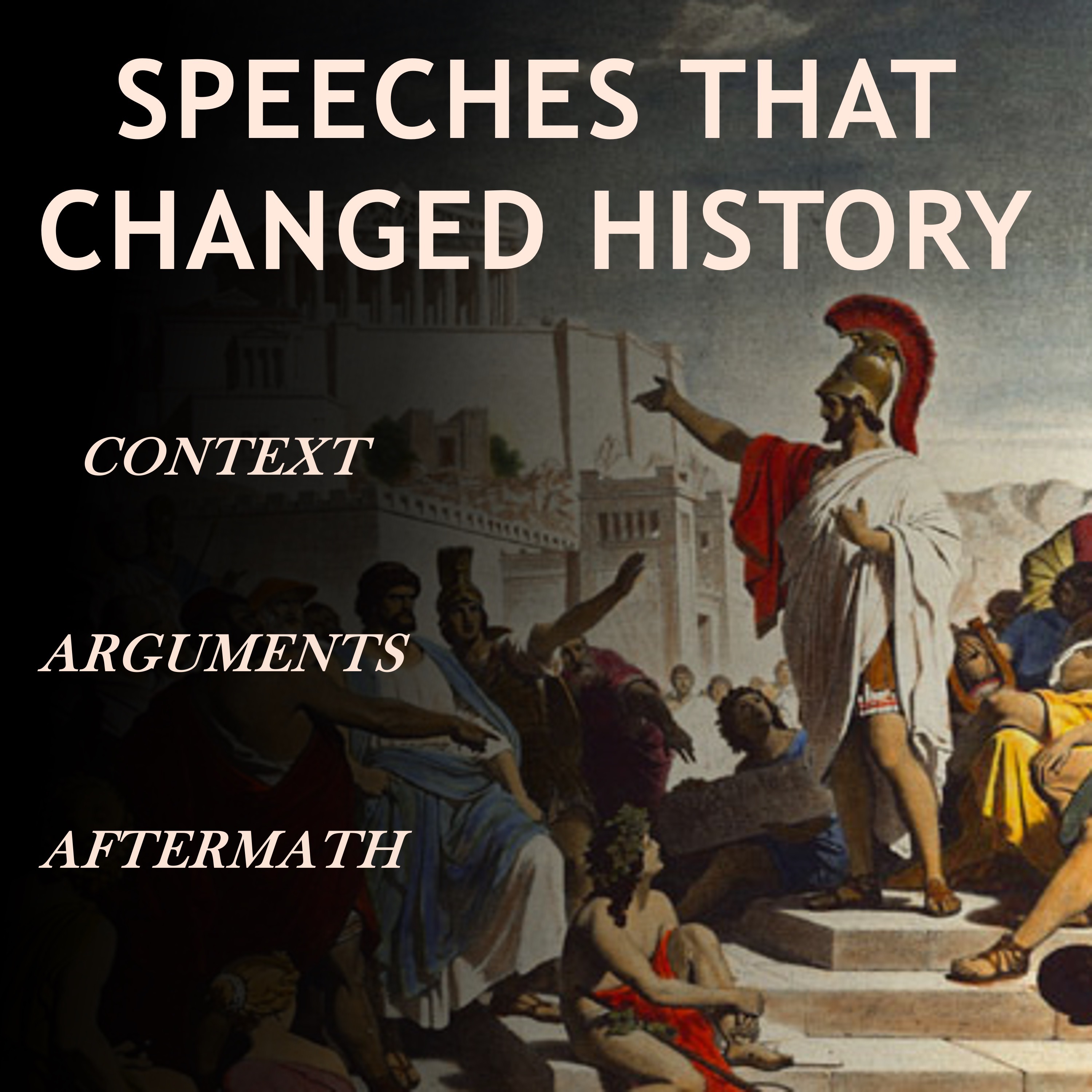
The purpose of this channel is to reanimate historic speeches by reading and performing them aloud, giving a voice once again to the words that changed our world. To truly appreciate these speeches, we must understand the world they were spoken in. That is why we dive deep into the high stakes and complex backgrounds of each moment, ensuring that when the speech begins, you aren’t just listening to a text, you are experiencing it as if you were there. Together, we investigate the history behind them, the arguments within them, and the consequences that followed. For contact and feedback: speec...
Where to listen?
Podcasts in the app Replaio Radio Coming soonPodcasts are coming to the app soon. Install now and be the first to see a whole new take on podcasts
 Install for free
Android 5M+ downloads · 4.8 rating
iOS soon
Install for free
Android 5M+ downloads · 4.8 rating
iOS soon
Episodes
10. "The Strong Do What They Can..." - The End of Athenian Virtue? (The Melian Dialogue) 07.07.2026 47:28
"The strong do what they can and the weak suffer what they must." 416 BC. Athens sends envoys to the neutral island of Melos with an ultimatum: surrender or die. What follows is one of history's most chilling debates, a brutally honest argument about power, justice, and survival, stripped of every illusion. In this episode we walk through the road to Melos, perform the full dialogue, and unpack th...
9. Calculated Mercy - Diodotus Against Cleon (The Mytilenean Debate) 30.06.2026 30:43
In 427 BC, Athens voted to massacre the entire population of Mytilene, and then voted again. This is the story of that second vote, and what is meant. The Mytilenean Debate is one of the most important political exchanges in ancient history. Thucydides records it in full in Book 3 of his History of the Peloponnesian War : a confrontation between Cleon, the most powerful demagogue in Athens, and Di...
8. Cleon and the Vote for Massacre - What Came After Pericles? (The Mytilenean Debate) 23.06.2026 23:23
Pericles is dead and after him a more sinister politician fills the vacuum. 428 BC. Three years of plague. Three years of Spartan soldiers burning the countryside. Then news arrived: Mytilene, Athens' trusted ally, has betrayed them. Athens moved quickly and managed to force the city to surrender. What would they do with the prisoners? The assembly voted for massacre. Every man on the island execu...
7. Pericles' Last Speech - The End of an Era (How the Plague of Athens Changed Everything) 16.06.2026 28:37
The plague had come. Athens was already crowded beyond anything it had been built to sustain thousands of refugees from the Attic countryside packed behind the walls. Into that compression came a pestilence unlike anything in living memory. And alongside the dying bodies, something else began to break down, namely the social fabric itself. Estimates suggest as many as a hundred thousand people die...
6. Pericles' Funeral Oration - Performed in Full (Modern Translation) 09.06.2026 22:17
The Funeral Oration of Pericles with modern translation (Book 2, Chapters 35-46). Athens. Winter, 431 BC. The first year of the Peloponnesian War is over. The bones of the dead have been carried through the city. The coffins have been lowered. And Pericles steps forward to speak. If you want the full historical context and rhetorical analysis, that is in episode 5. Sources: Thucydides. (1874). His...
5. Pericles' Funeral Oration - Did He Describe Athens or Invent It? 09.06.2026 39:42
The war had begun. Sparta had burned the Attic countryside. Thousands of Athenians had abandoned their farms and crowded inside the city walls at Pericles' instruction. The anger toward him was real, raw, and barely contained. That winter, Athens buried its dead. And by tradition, a man chosen by the city stepped forward to speak over the open graves. Athens chose Pericles. What followed was not a...
4. No Concessions - Did Pericles Make the Right Call? 02.06.2026 31:11
Sparta had sent three messengers to Athens. Each carried demands. Each was sent home with a refusal. The first invoked an ancient religious curse, a veiled attempt to expel Pericles himself from Athens through sacred procedure rather than military force. Athens saw through it immediately. The second carried a list of concrete grievances — lift the Megarian Decree, abandon the siege of Potidaea, re...
3. Corinth's Ultimatum - The Speech That Cornered Sparta 26.05.2026 31:05
Corinth had lost Epidamnus. Failed at Sybota. Watched its volunteers trapped inside the walls of Potidea while Sparta did nothing. Its patience was gone. So Corinth called a meeting. And the invitation went wide — any city with a grievance against Athens was welcome. They came from across the Greek world, one by one, each with their own account of Athenian pressure applied quietly, carefully, neve...
2. The Warning - Did Athens Make the Right Choice? 19.05.2026 21:39
Athens had heard Corcyra's case. A powerful fleet. A strategic alliance. A warning that war with Sparta was coming regardless. It was a compelling argument but Corinth had been sitting there listening to every word, and now it was their turn to speak. In this episode we hear the Corinthian reply: A careful, methodical dismantling of everything Corcyra had just argued. A case built on law, on histo...
1. The Spark - The Epidamnian Affair and the Double Embassy 12.05.2026 29:01
In the autumn of 433 BC, two delegations arrived in Athens uninvited, unexpected, and desperate. One came to ask for an alliance. The other came to prevent it. What the Athenian assembly decided that day would set in motion a war that killed hundreds of thousands, erased cities from the map, and ended the Greek golden age. But to understand that decision, we first need to understand the world it s...
0. The Speeches of the Peloponnesian War Series: Sources & Translations 12.05.2026 3:03
As a short note before we enter the narrative of the series, we address our sources and translations of the sources.
Purpose: The Reanimation of Greatness 08.05.2026 4:19
Introduction to the project. I intend to reanimate the greatest speeches of history. Welcome
Similar podcasts







Listen to the Speeches That Changed History podcast in Replaio
Radio and podcasts in one app - free, with no sign-up. Install today and do not miss the launch
Replaio is not a podcast publisher; show names, artwork and audio belong to their authors and are distributed through public RSS feeds.