Selenius Media
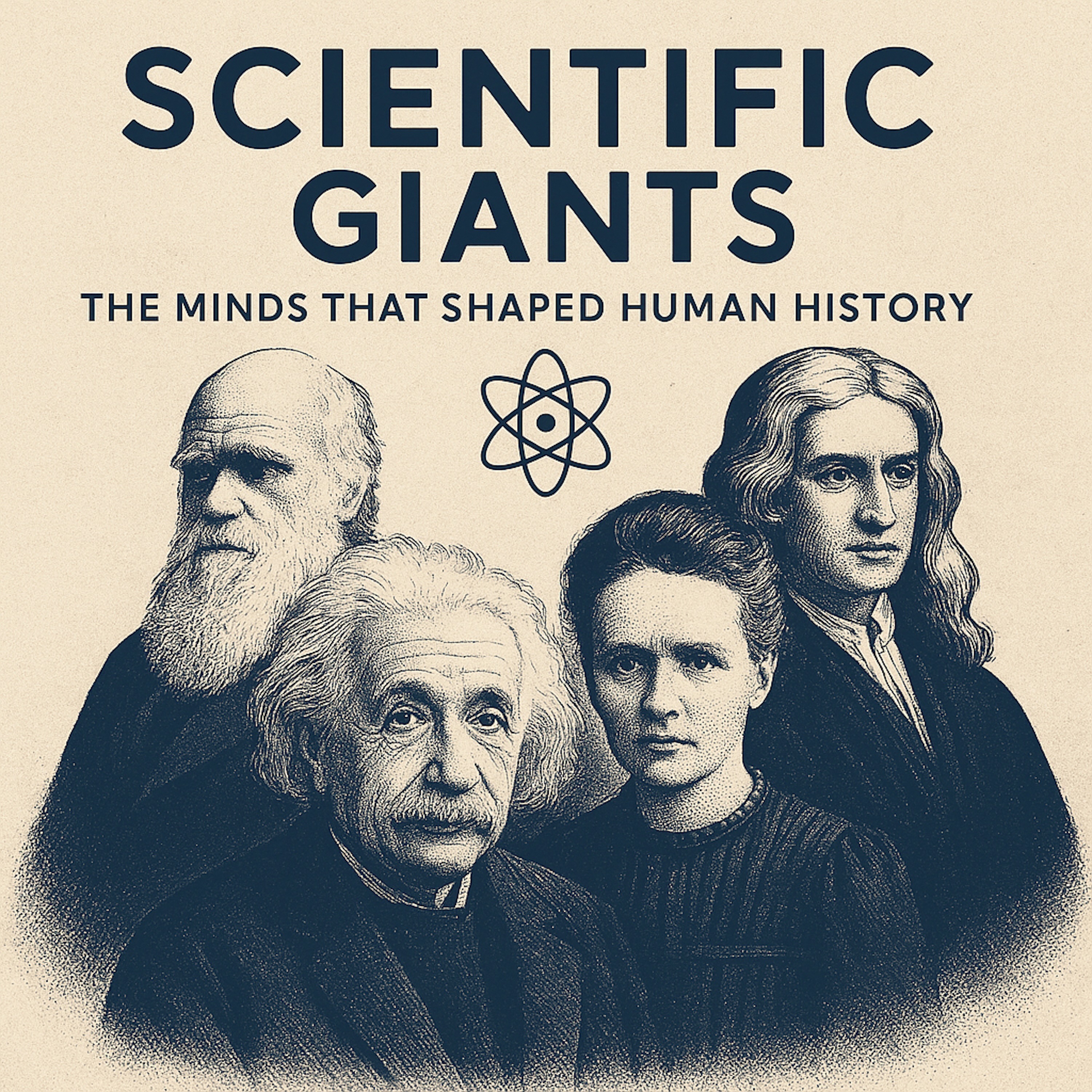
Scientific Giants - Minds that Shaped Human History
Scientific Giants takes you on a journey through the lives and legacies of history’s greatest minds. From Newton and Curie to Einstein and beyond, these are the thinkers who reshaped our understanding of the universe and our place within it. Each episode uncovers the struggles, breakthroughs, and lasting influence of the scientists who changed the course of human history — showing how their ideas continue to shape the world we live in today. Produced by Selenius Media
Where to listen?
Podcasts in the app Replaio Radio Coming soonPodcasts are coming to the app soon. Install now and be the first to see a whole new take on podcasts
 Install for free
Android 5M+ downloads · 4.8 rating
iOS soon
Install for free
Android 5M+ downloads · 4.8 rating
iOS soon
Episodes
Tu Youyou – Old Remedies, New Trials 10.06.2026 10:06
Digging through ancient Chinese texts and modern lab methods, Tu Youyou extracted artemisinin and reshaped the global fight against malaria.
Rachel Carson – Silent Springs and Long Tails 03.06.2026 10:22
Carson’s careful synthesis of scattered data on pesticides forced the world to see that technologies can echo for generations in soils, rivers, and bodies.
Jane Goodall – Among the Chimpanzees 30.05.2026 8:51
From termite fishing to war between bands, Goodall’s close work with chimpanzees blurred the line between human and animal minds.
Eric Kandel – Memory in the Sea Snail 23.05.2026 8:12
By shocking sea slugs and tracing changes at synapses, Kandel turned “remembering” into something you could see in a circuit.
Wilder Penfield – Sparks on the Cortex 16.05.2026 9:16
In awake brain surgeries, Penfield probed the cortex and heard patients relive sounds, smells, and memories, turning the brain into a mapped landscape.
Santiago Ramón y Cajal – The Forest of Neurons 09.05.2026 9:11
With pen, ink, and patience bordering on obsession, Cajal drew neurons as individual trees, overthrowing the idea that the brain was one continuous web.
Jonas Salk – The Vaccine and the Public Good 02.05.2026 9:46
At the height of polio terror, Salk’s vaccine promised mass immunity, and he stunned the world by refusing to patent it: “Could you patent the sun?”
Frederick Banting & Charles Best – Stealing Fire for Diabetics 30.04.2026 10:13
Two young researchers in a sweltering Toronto lab isolated insulin, turning a fatal disease into a manageable condition—and raising questions about patents and profit.
Alexander Fleming – Accident, Mold, and the First Antibiotic 23.04.2026 6:35
A contaminated petri dish, a ring of dead bacteria, and a man who saw meaning where others saw mess birthed penicillin and the antibiotic age.
Barbara McClintock – The Cornfield and the Jumping Gene 16.04.2026 11:49
Alone with her maize plants, McClintock discovered mobile genetic elements and patiently waited decades for biology to catch up to what she’d seen.
Thomas Hunt Morgan – The Fly Room and the Chromosome Map 09.04.2026 11:45
In a cramped Columbia lab buzzing with fruit flies, Morgan and his students mapped genes onto chromosomes and made heredity something you could literally see.
Gregor Mendel – The Monk of Ratios 24.03.2026 12:48
In a cloister garden, Mendel counted peas, and from those quiet numbers emerged the laws of inheritance that underlie modern genetics.
Fritz Haber – Bread from Air, Poison from Science 24.03.2026 10:00
Haber’s process fed billions by pulling nitrogen from the air, but he also pioneered chemical warfare, making his life a case study in the double edge of discovery.
Linus Pauling – Bonds, Helices, and Moral Courage 12.03.2026 11:23
Pauling explained how atoms bond, sketched early models of DNA, and then turned his authority toward nuclear disarmament, earning both a Nobel in chemistry and a peace prize.
Dmitri Mendeleev – The Man Who Dreamed the Table 05.03.2026 11:23
Mendeleev’s periodic table wasn’t just arrangement; it was a set of bold predictions about missing elements that turned out, one by one, to exist.
Chien-Shiung Wu – The Symmetry That Failed 25.02.2026 13:15
Wu’s precision experiments on beta decay overturned a sacred symmetry of physics and exposed how talent and recognition can fall out of symmetry too.
Rosalind Franklin – The Woman in the Diffraction Pattern 19.02.2026 10:46
Working in a basement lab with dangerous X-rays, Franklin captured patterns that revealed DNA’s structure, only to see the spotlight land elsewhere.
Lise Meitner – Fission and the Burden of Insight 18.02.2026 13:31
An exiled Jewish physicist, Meitner explained nuclear fission yet saw others take the credit, forcing her to wrestle with the science and the weapon it made possible.
Erwin Schrödinger – Waves, Cats, and the Question of Life 11.02.2026 13:30
Schrödinger’s wave equation made quantum mechanics calculable, but his thought experiments and later book What Is Life? pushed physics into biology and philosophy.
Werner Heisenberg – Uncertainty at the Heart of Nature 04.02.2026 14:44
In a feverish burst of work on a North Sea island, Heisenberg discovered that at the smallest scales, the more we know of one thing, the less we know of another.
Niels Bohr – The Architect of the Quantum Atom 31.01.2026 17:36
Bohr’s model of the atom, his Copenhagen Institute, and his idea of “complementarity” changed not only physics, but what it means to describe reality.
Max Planck – The Reluctant Father of the Quantum 29.01.2026 15:35
Trying to fix a minor problem in blackbody radiation, Planck quantized energy, cracked classical physics, and launched a revolution he never fully trusted.
James Clerk Maxwell – When Light Became an Equation 29.01.2026 17:52
Maxwell turned Faraday’s lines of force into four dense equations that quietly unified electricity, magnetism, and light—and laid the rails for Einstein.
Marie Curie – The Radiance of the Invisible 23.01.2026 22:26
You're listening to "Scientific Giants Who Changed the World." Each episode stands beside one mind and follows a thread of curiosity until it ties to the world we inhabit. Today we descend into a converted shed on the rue Lhomond in Paris, where winter seeps through walls that were never meant to shelter precision work. The air tastes of coal smoke and chemicals. A glass tube glows faintly in the...
Nicolaus Copernicus - Astronomer - The Sun, not the Earth, is at the center of the universe. 30.11.2025 36:24
Nicolaus Copernicus - Astronomer - The Sun, not the Earth, is at the center of the universe. Today we climb a chilly tower stair in Royal Prussia, where sea wind presses against old brick and a bellrope hums in the draft. The town is Frombork—Frauenburg in the Latin letters of the time—perched on the Vistula Lagoon. Below us a canon’s garden is squared into beds; a copper astrolabe hangs near a wi...
Similar podcasts







Listen to the Scientific Giants - Minds that Shaped Human History podcast in Replaio
Radio and podcasts in one app - free, with no sign-up. Install today and do not miss the launch
Replaio is not a podcast publisher; show names, artwork and audio belong to their authors and are distributed through public RSS feeds.