JOY 94.9 - Rainbow Community Podcasts for our LGBTI, LGBTIQA+, LGBTQIA+, LGBT, LGBTQ, LGB, Gay, Lesbian, Trans, Intersex, Queer Communities
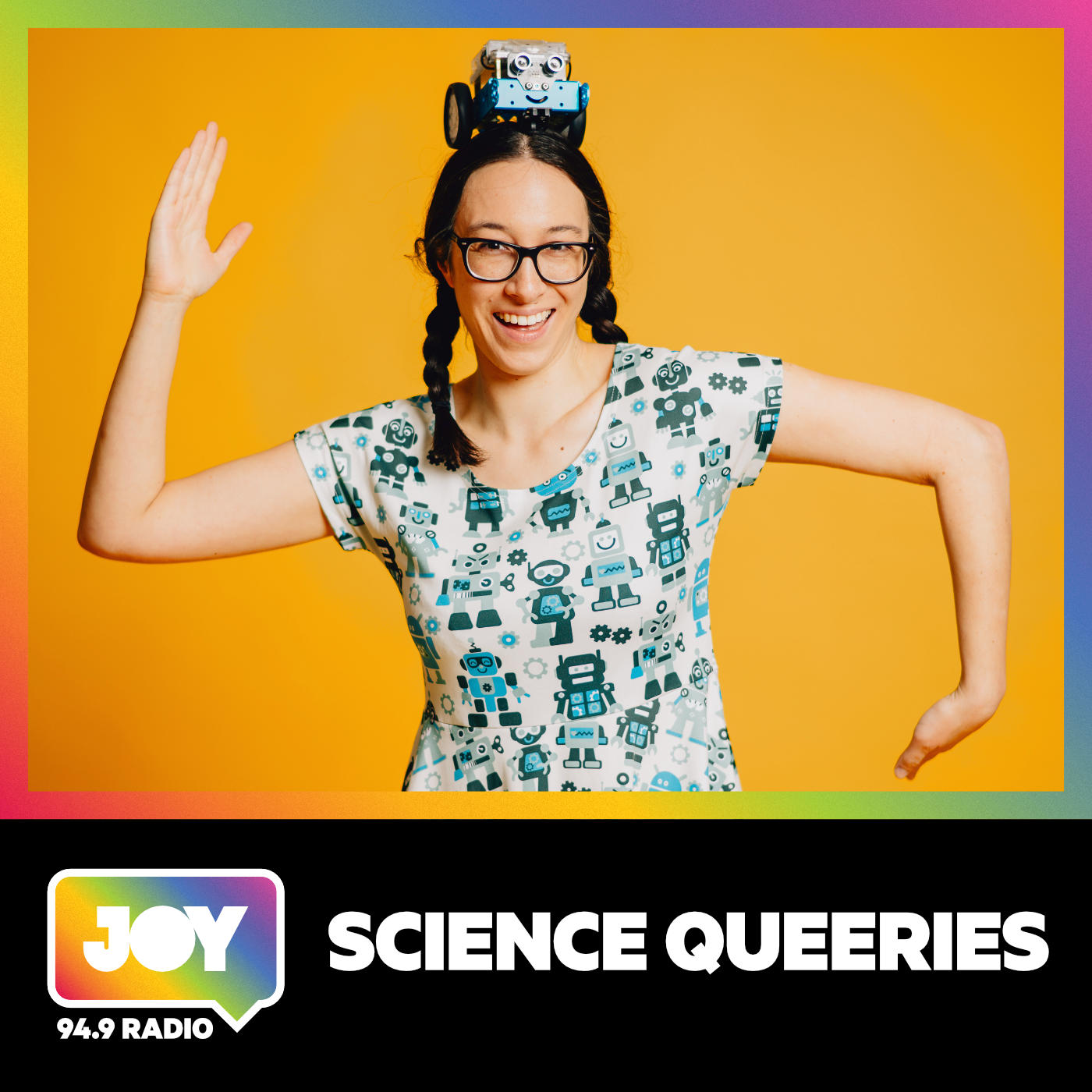
Science Queeries
Delve into the world of science with Cat
Be sure to visit the podcast's website and support the creator: joy.org.au
Author
JOY 94.9 - Rainbow Community Podcasts for our LGBTI, LGBTIQA+, LGBTQIA+, LGBT, LGBTQ, LGB, Gay, Lesbian, Trans, Intersex, Queer Communities
Category
Podcast website
Latest episode
Oct 21, 2026
Where to listen?
Podcasts in the app Replaio Radio Coming soonPodcasts are coming to the app soon. Install now and be the first to see a whole new take on podcasts
 Install for free
Android almost 10M downloads · 4.8 rating
iOS soon
Episodes
Bin there, solved that – our waste’s wasted potential 21.10.2026 43:53
We’re talking trash. Quite literally. Listening to this episode is by no means a waste of time. In fact, you’ll learn how we can deal with waste. It’s a takeover. Dr Cat sits back from the microphones this week to let three science communication students take the reins. From “forever chemicals” and plastics that seem to never degrade, to mountains of green gunk, they’ve been digging into how scien...
Sharks in hot water 12.10.2026 41:54
Sharks are fin-credible creatures. They have survived for over 450 million years – but they’re now facing unprecedented challenges. Sharks are essential to ocean ecosystems. They’re apex in every sense: apex predators, apex indicators of ocean health, apex examples of why we need to act now. Adrienne Gooden is a marine ecologist at Southern Cross University who tracks the movements and...
High time for space plants: cannabis clocks and trusty tomato 05.10.2026 38:27
Branch into the world of high‑stakes horticulture. There’s no room to waste space – literally. Laura Steel is a post-doctoral researcher with the Australian Research Council Centre of Excellence for Plants for Space at La Trobe University. She is a plant scientist who has helped cannabis tell time and know when to flower, fine-tuned taro’s diet in nutrient-poor soil, and is now tweaking toma...
Understanding pain and feeling heard 22.09.2026 38:40
Pain is something we all feel – but for young people with cerebral palsy, it’s a daily reality that remains poorly understood. In fact, some don’t even register “pain”, because it’s simply the norm. Aayushi Khillan is a medical student and PhD researcher who’s mapping out chronic pain in cerebral palsy. She is building tools at the Murdoch Children’s Research Institute to help understa...
Neutron stars and the universe’s pulse 13.09.2026 45:26
The universe is spinning with mysteries – and we’re tuning in to hear them. Pulsars are neutron stars so dense that a teaspoon of their material would weigh as much as Mt Everest. They spin hundreds of times per second, emitting beams of radio waves like cosmic lighthouses sweeping across space. Dr Cat chats to astrophysicist Rami Mandow about detecting their radio waves, on radio. Rami stud...
Scales of climate change: the hiss-story and future of reptiles 30.08.2026 40:39
Australia is the land of lizards and snakes – with over 1,000 species. But they’re in trouble. Here’s a cold (blooded) hard truth*: reptiles can’t regulate their body temperature, which makes them incredibly vulnerable to climate change. Dr Jane Melville is Senior Curator, Terrestrial Vertebrates at Museums Victoria and Acting Director of the Museums Victoria Research Institute. She’s...
Rooting for the Future: Tales from the Seedbank 23.08.2026 40:57
Over 2,330 native Victorian plant seeds and fungal spores are frozen in time. They are quietly waiting as time capsules that sprout hope for our future landscapes. We’re digging into the world of plants with Alastair Robinson, Manager of Biodiversity Services at Royal Botanic Gardens Victoria. He manages the Victorian Conservation Seedbank – Victoria’s “backup hard drive” for seeds and spore...
Writing the future with Postcards from Antarctica 17.08.2026 46:08
What happens when 124 women and non-binary STEMM leaders, 132 postcards and one very ice-solated continent come together? You get Postcards from Antarctica, a collaborative artwork created aboard the final Homeward Bound Antarctic voyage in 2025. Each postcard captures something meaningful about Antarctica, from its wildlife and landscapes to the profound experience of being there. Turn them over,...
Shift Happens: Understanding AI and Change 08.08.2026 43:20
Everyone’s talking about AI. But many people don’t fully understand what AI means for them and their future. What’s actually changing – beyond the hype? Conversations around AI are often missing something crucial: the human perspective. This week, we’re exploring why the human lens matters. Explore why we’re talking about AI all wrong, how it’s reshaping our rol...
Drawing blood cancer diagnoses when resources are scarce 03.08.2026 45:06
How can you treat a disease that you don’t know you have? You can’t. Blood cancers like leukaemia and lymphoma account for one in every 10 cancers diagnosed. In children, it drops to one in every two. These cancers are treatable if caught early. But in some parts of the world – including within Australia – the resources needed to accurately diagnose them aren’t always...
100 Queeries and Novel Science Ideas 19.07.2026 40:33
Can great stories predict great science? For the 100th episode and 2nd birthday of Science Queeries, we’re reading between the lines of literature. Just how much science is hiding on the page of our favourite sci-fi books? From Frankenstein to Jurassic Park, and 1984 to War of the Worlds, Dr Cat is joined by her history-and-English-teacher brother Sasha Kober to separate science fact from sc...
Star-crossed Lovers of the Cosmos 13.07.2026 39:01
Constellations of the night sky carry both science and story. Science Queeries teams up with Big Bi Questions to share cosmic love stories and sky knowledge. Two bisexual presenters – Dr Cat bringing astronomy and Greek mythology, and Little Jase sharing First Peoples lore – sit under the same sky and compare notes on the stars. We’ll wander through love…not quite triangles…but larger...
Glasses Half Full: Seeing the Future with JOY 13.07.2026 35:07
Strap on your smartwatches and adjust your metaphorical lab goggles. This Radiothon episode is all about the speculative future of wearable tech and dramatic science explainers. From continuous glucose monitors quietly live‑streaming blood sugar, to speculative glasses that let us see UV patterns in nature, heat leaking from our houses, or live subtitles for reality, we ask: when does “assistive”...
Navi-gay-ting the Winter Solstice 28.06.2026 34:05
Having just passed the longest night/the winter solstice, we’re looking at the cosmic choreography that shapes our whole year. We’ll talk about why the winter solstice is the ultimate dark night of the soul-ar system. Dr Cat untangles the tilt that gives Earth its seasons, and explains why the coldest days rudely arrive just as the days start getting longer. She shares ancient calendars of astrono...
Hop to It: Saving Australian Marsupials 22.06.2026 39:50
Australia’s iconic marsupials are going extinct at an alarming rate. But innovative science is offering hope. One in six human couples rely on assisted reproduction technologies like IVF…and marsupials may need to rely on these technologies too – it’s just that we can’t use the exact same tools across humans and marsupials. Understanding the unique biology of marsupial reproduction could rev...
Bug Appetite for Sustainable Food 09.06.2026 44:38
Would you snack on some insects? What if they were blended into your chocolate mousse and you couldn’t even tell? The human population is heading toward 9 billion and traditional livestock farming can’t sustainably feed our hungry world. We need new solutions – fast. The answer may be crawling right in front of us. Insect farming could be the solution. Bugs are more sustainable t...
Brain-storming Solutions for Neurological Disorders 02.06.2026 42:06
The brain is complex – billions of neurons, trillions of connections, and countless ways things can go wrong. Brain malformations and severe epilepsies can derail development, disrupt learning, and change lives forever. And sometimes, the cause remains a mystery. Until now. Genetic testing is unlocking answers. Translational genetics is rewiring how we approach treatment. And understanding the gen...
Ovary-coming obstacles for ovarian cancer treatment 23.05.2026 41:09
Ovarian cancer is a disease that’s often invisible, often deadly, and often overlooked. Over 1900 estimated new cases of ovarian cancer were diagnosed last year, and women diagnosed have been stuck with limited options…but that may be changing. Cancer is cunning. It hides and our immune cells can’t find it to fight back. But what if we could bring the cancer out of hiding and unleash t...
Digging up Dirt on Soil Ecotoxicology 20.05.2026 37:49
Soil is often overlooked – we walk on it, we grow food in it, but we rarely think about what’s actually in it. Yet soil is one of the most important ecosystems on Earth. And it’s under siege. From traditional pollutants like heavy metals and petroleum compounds to emerging threats like PFAS and microplastics, our soils are becoming increasingly contaminated. But how do we know how bad...
Mould Matters & Future Fungicides 16.05.2026 41:32
Fungi aren’t all bad. They’ve given us penicillin – one of the most important medicines ever discovered. But they can also rot our crops, threaten food security, and spread resistance to our best fungicides. Climate change is introducing fungal diseases where they previously didn’t exist. And as farmers use more fungicides to combat these threats, fungi develop resistance – creat...
B Positive: Immune Cell-ebrating Immunity 30.04.2026 38:50
Every day, we encounter tens of thousands of microbes. Our antibodies are our anti-buddies, protecting us from infection. The Day of Immunology is the perfect day to immune cell-ebrate this biology that keeps us alive. We also celebrate a literally life-saving change to blood donation eligibility rules. Gay and bisexual men, trans people, and other previously excluded communities can now donate bl...
Clits, Tits and Science Bits 22.04.2026 44:31
What do clitoral erections, lesbian co‑lactation and bimbo branding have in common? Dr Naomi Koh Belic. Bedazzled with hot‑pink and glam, Dr Naomi Koh Belic is rewriting what science education looks like. In this episode, the biracial, bisexual, bimbo biologist joins Dr Cat to unpack the inspiration behind her Bimbo Biology series. Along the way, Dr Naomi explains why visibility matters and how sh...
Sperm-ission Impossible: Male Contraceptives 20.04.2026 38:53
For so long, contraception has been a woman’s burden. The pill. The IUD. The implant. The patch. While condoms and vasectomies exist for people who produce sperm, the responsibility for preventing pregnancy has overwhelmingly fallen on those with ovaries. But what if that changed? Luke Baz at The University of Melbourne is working on a non-hormonal contraceptive that targets sperm. He is try...
Infection Inspection 12.04.2026 38:20
Pathogens are everywhere. They’re invisible to our eyes, but they’re not invincible. This week, we’re diving deep into three very different infections: Talaromyces marneffei – a fungus that’s thriving in South-East Asia and emerging as a serious threat, tuberculosis – a bacterial infection that’s been coughing up trouble for centuries, and shingles – a viral infection that...
Reef-ormation Through Crab-servation 12.04.2026 39:03
Seventy percent of Australians live within 50 kilometres of the Great Southern Reef. Yet many of us have never heard of it. This reef is home to species found nowhere else on Earth. It’s a place where cuttlefish perform spectacular mating displays, where giant spider crabs gather in their tens of thousands, and where nature’s mysteries are waiting to be uncovered. Every winter, giant s...
Similar podcasts








Listen to the Science Queeries podcast in Replaio
Radio and podcasts in one app - free, with no sign-up. Install today and do not miss the launch
Replaio is not a podcast publisher; show names, artwork and audio belong to their authors and are distributed through public RSS feeds.