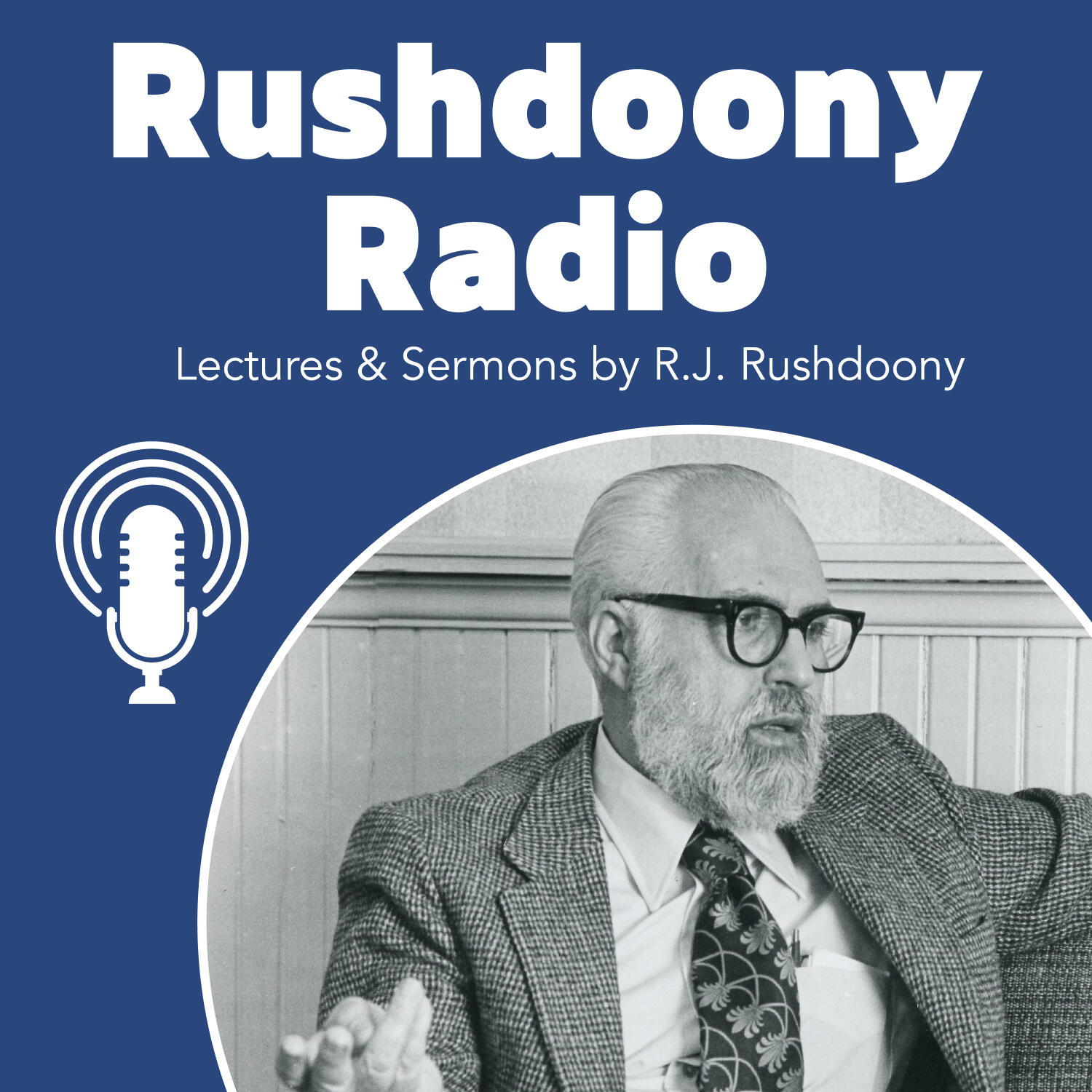
R.J. Rushdoony
Rushdoony Radio
Welcome to Rushdoony Radio, your gateway to a wealth of wisdom and insight from the teachings of R.J. Rushdoony.
Be sure to visit the podcast's website and support the creator: rushdoonyradio.org
Author
R.J. Rushdoony
Category
Podcast website
Latest episode
Nov 12, 2026
Where to listen?
Podcasts in the app Replaio Radio Coming soonPodcasts are coming to the app soon. Install now and be the first to see a whole new take on podcasts
 Install for free
Android 10M+ downloads · 4.7+ rating
iOS soon
Episodes
The Disappearing Cornerstone (Remastered) 19.03.2026 1:16:46
Rushdoony frames modern culture as a return to pagan totalitarianism, using the prosecution of cryptographer Philip Zimmermann as a symbol of the state’s demand for total surveillance and control. Privacy, property, and due process are eroding, while biblical morality is displaced by licentiousness enforced through law and education. He argues that chastity is now treated as illegal “religion,” wh...
Christian Mandate in Parable on God's Judgment (Remastered) 17.03.2026 26:40
Philippians 2:9–11 is presented as a trumpet-blast declaration that Jesus Christ is Lord God incarnate, exalted by the Father, and sovereign over heaven, earth, and all powers. That confession meant Caesar was under Christ, not the other way around. The early church therefore functioned like an embassy of a foreign kingdom within Rome: obedient to civil order where possible, but ultimately governe...
Christianity and Culture: Future (Remastered) 12.03.2026 1:25:25
Rushdoony’s central claim is that culture reveals religion, most clearly through law and education. By these measures, modern society is humanistic, having confined faith to private worship while surrendering public life to the state. In antiquity this was normal: the state was the church. Rulers functioned as divine figures, and there was no separation of church and state. As societies abandon Ch...
Questions and Answers (Remastered) 05.03.2026 26:32
Rushdoony’s core claim is that law flows from sovereignty: whoever is lord in a society defines its rule of life. When churches deny God’s law through antinomianism, they effectively confess, “We have no king but Caesar.” The early church refused Rome’s demand to say “Caesar is Lord” and instead confessed Christ’s universal lordship (Phil. 2:9–11). They did not seek change through protests but by...
Philosophy of Freud: Q&A (Remastered) 03.03.2026 49:54
In this wide-ranging Q&A, Rushdoony presses home that modern mental-health theory, medicine, and social policy are increasingly instruments of control rather than healing, whether in Soviet psychiatry, Freudian psychology, or Western technocracy. He contrasts Freud, Jung, and Adler while insisting Freud’s guilt-without-sin framework remains dominant, then applies the same critique to medical e...
Philosophy of Freud (Remastered) 26.02.2026 45:35
Rushdoony argues that the modern world’s inversion of justice celebrating crime while erasing responsibility flows from the legacy of Marx, Darwin, and Freud, who completed the Enlightenment’s turn from God to man and ultimately against man himself. Focusing on Freud, he warns that redefining guilt as a scientific problem rather than a moral one severs guilt from sin, abolishes true accountability...
The Future of Law (Remastered) 24.02.2026 32:00
Rushdoony argues that Christianity’s future depends on remembering and applying past victories, not merely believing abstractly. Early Christians transformed society by practicing a total faith establishing justice, charity, education, and care for the poor so effectively that the church became an “empire within the empire.” When these victories were forgotten, Christianity retreated into private...
The Future of Politics (Remastered) 19.02.2026 33:40
Rushdoony’s theme is that forgotten victories become present defeats: the church has lost strength because it remembers Scripture but forgets how earlier Christians applied it. He cites 1 Corinthians 6: churches formed courts of arbitration so just that even pagans sought their rulings making Christianity an “empire within the empire” that Rome resented. He then sketches a long shift from Christia...
The Future of Christianity (Remastered) 17.02.2026 44:31
Rushdoony argues that Christian reconstruction rests on God’s promise of victory: the meek shall inherit the earth. Scripture consistently teaches that God’s kingdom advances in history, fulfilled in Christ the true lawgiver and judge who inaugurates the new creation through His resurrection. Regenerated believers are therefore called to bring every area of life into obedience to Christ the King....
Condition of Christianity (Remastered) 12.02.2026 44:03
Rushdoony argues that the book of Acts shows persecution is inevitable wherever Christianity becomes effective. The real issue is always lordship by what power and by what name things are done. The early church was not persecuted for immorality or disorder, but because it manifested God’s power outside state control, making Christ a rival to Caesar. Any ruling order that sees itself as man’s savio...
Who Shall Be Lord? - Challenge of the Book of Acts (Remastered) 05.02.2026 34:19
Rushdoony argues that the future of society rises or falls with the family. Scripture places the family not the church or the state at the center of social power, entrusting it with education, charity, inheritance, property, and the training of children. When these responsibilities shift to the state, freedom declines and statism grows. By contrast, when families reclaim these callings through Chr...
Dynamic Christian Hospitality and Strangers (Remastered) 03.02.2026 26:34
Biblical law places the family at the center of society because God entrusts it with decisive powers: children (the future), property, inheritance, education, and welfare. When these are taken over by the state, society weakens. True renewal comes as families reclaim these responsibilities through Christian education, care for their own, and faithful stewardship. Rushdoony argues that this reclama...
The Future of the Family (Christian Reconstruction and the Future) 29.01.2026 35:41
Rushdoony argues that only the Christian family has a future because it alone lives by God’s law rather than statist planning, making the family—not church or state—the primary engine of social renewal through its biblical duties of provision, education, charity, inheritance, discipline, and dominion; drawing from Scripture and history, he insists that neglect of family law hollows out faith, fuel...
Biblical Importance of an Empowered Family (Christian Reconstruction and the Future) 27.01.2026 37:59
Rushdoony contends that biblical law makes the family the primary power-center of society—entrusted by God with children, property, inheritance, education, and welfare—and that modern statism systematically attacks and replaces these jurisdictions by denying creation, order, and harmony in favor of evolutionary conflict and centralized control; he argues that only belief in the sovereign Creator,...
Resurrection, Communion, and the Family (Christian Reconstruction and the Future) 22.01.2026 1:02:19
Rushdoony argues that the removal of the Ten Commandments from public schools exposed a basic truth: all law is religious. While the courts rejected biblical law for fear students might obey it, schools freely promote Humanism as a state religion. He says decades of educational “reform” have failed because statist education is built on false premises; pouring in more money only deepens the collaps...
Strategy for Christian Reconstruction (Christian Reconstruction and the Future) 20.01.2026 27:39
Rushdoony argues that only the Christian family has a future because it alone lives by God’s law rather than statist planning, making the family—not church or state—the primary engine of social renewal through its biblical duties of provision, education, charity, inheritance, discipline, and dominion; drawing from Scripture and history, he insists that neglect of family law hollows out faith, fuel...
Homeschooling (Christian Education: Christian Schools) 15.01.2026 58:20
Rushdoony, Blumenfeld, and Otto Scott argue that homeschooling works so well because it’s essentially one-on-one tutoring: parents know their children, can hold them accountable, and can move faster without the time-wasting and peer-driven dynamics of institutional schooling. They say homeschoolers tend to become strong readers, good conversationalists, and adult-oriented, while public schools pri...
Dangers Inherent in Public Education (Christian Education: Christian Schools) 13.01.2026 56:25
Rushdoony and Blumenfeld warn that public schooling is a means of controlling the future by shaping children away from Christian faith. Blumenfeld says students face four major risks: academic (functional illiteracy), spiritual (humanist/anti-Christian influences), moral (drugs, promiscuity, blasphemy), and physical (violence). They argue parents are mistaken to assume their child will be unharmed...
The Biblical Basis for Christian Reconstruction (Remastered) 10.01.2026 33:56
Rushdoony argues that hospitality and charity are moral institutions, commanded by God and central to biblical faith not optional niceties. From Israel to the early church, caring for strangers and fellow believers was essential to covenant life and survival, especially under persecution. Scripture commands hospitality, but also sets clear boundaries: charity is not unconditional and must honor di...
Relationship of the Look-Say Teaching to Idolatry (Christian Education: Christian Schools) 08.01.2026 56:59
Rushdoony and Samuel Blumenfeld argue that progressive public education—especially John Dewey’s “look-say”/whole-word approach—functions as a modern form of idolatry by replacing the primacy of God’s Word with the primacy of the image, training children to guess meaning from pictures rather than read words accurately. Blumenfeld contends this shift is not neutral pedagogy but a deliberate program...
Christian Discipline: Need for Training in the Home, School, and Church (Christian Education: Christian Schools) 06.01.2026 39:29
True Christian discipline is not about punishment, but about living under Christ’s authority. Rooted in the word disciple, discipline shapes character through self-control, ordered homes, faithful churches, and purposeful schools. When authority is grounded in God’s Word—not personalities—discipline brings freedom, clarity, and growth. In the home, school, and church, discipline trains hearts and...
The Bible in the Curriculum: A Separate Subject or Foundation for Each Subject? (Christian Education: Christian Schools) 01.01.2026 39:19
The Bible in the Curriculum: A Separate Subject or Foundation for Each Subject? (Christian Education: Christian Schools) Rushdoony argues that the Bible must be taught as a subject and function as the integrating foundation for every subject, because Scripture is not a “devotional add-on” but God’s authoritative “command-word” that alone gives meaning, coherence, and true knowledge in a created, l...
Religious Nature of Education or Can Education Be Neutral? (Remastered) 30.12.2025 32:17
Rushdoony argues that education can never be neutral because creation itself is not neutral: everything is made by God, given purpose and boundaries, so there are no “brute facts” detached from meaning. The myth of neutrality, he says, is really the logic of the Fall (Gen. 3:5)—man claiming autonomy (self-law) over against theonomy (God’s law)—and it shows up in modern humanistic, state-run school...
England 18th and 19th Century: Part I (A Christian Survey of World History) 30.12.2025 46:01
Join R.J. Rushdoony for another sermon in his lecture series, "A Christian Survey of World History!"
Similar podcasts





Listen to the Rushdoony Radio podcast in Replaio
Radio and podcasts in one app - free, with no sign-up. Install today and do not miss the launch
Replaio is not a podcast publisher; show names, artwork and audio belong to their authors and are distributed through public RSS feeds.