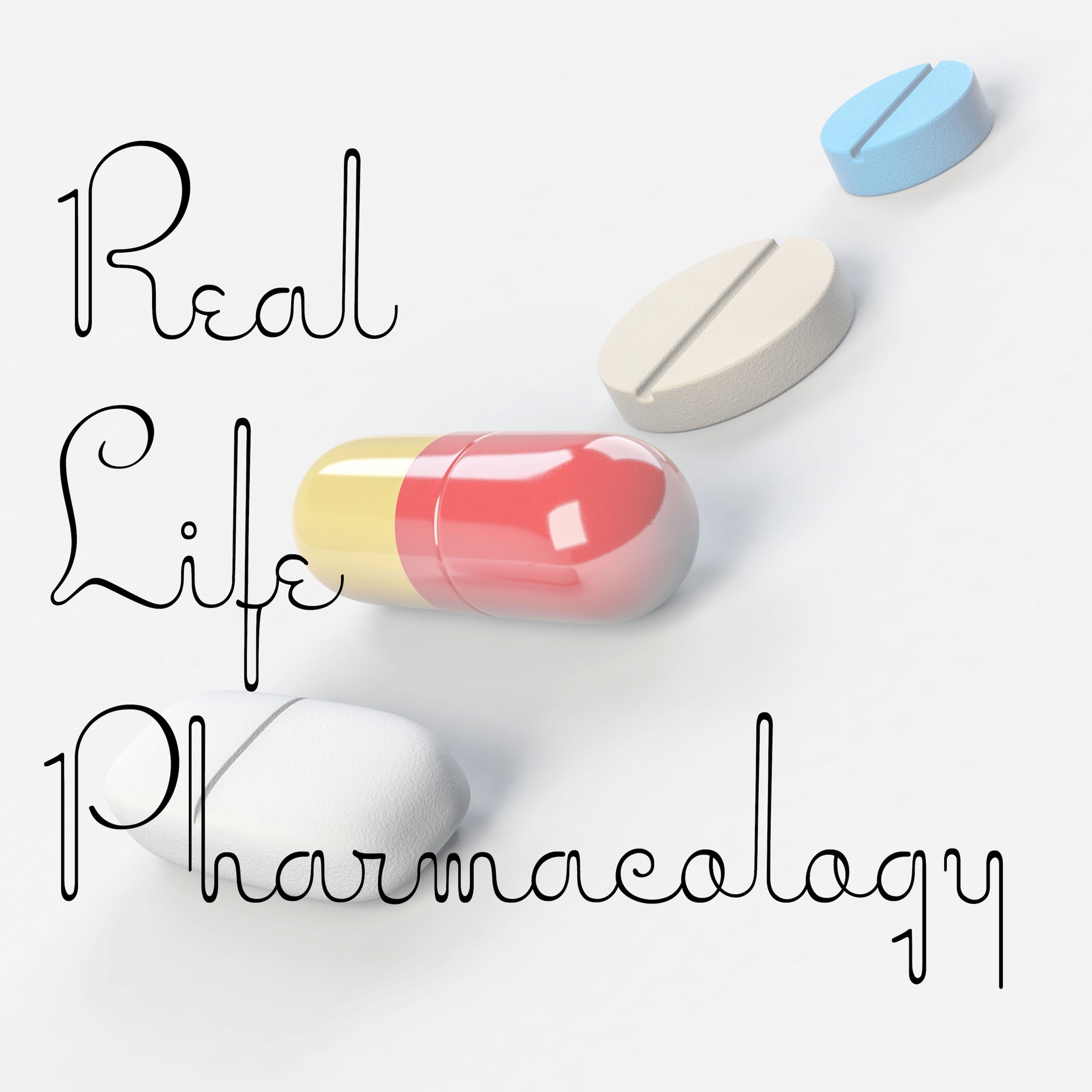
Eric Christianson, PharmD; Pharmacology Expert and Clinical Pharmacist
Real Life Pharmacology - Pharmacology Education for Health Care Professionals
A Meded101.com Production
Be sure to visit the podcast's website and support the creator: www.reallifepharmacology.com
Author
Eric Christianson, PharmD; Pharmacology Expert and Clinical Pharmacist
Category
Podcast website
Latest episode
Oct 1, 2026
Where to listen?
Podcasts in the app Replaio Radio Coming soonPodcasts are coming to the app soon. Install now and be the first to see a whole new take on podcasts
 Install for free
Android almost 10M downloads · 4.8 rating
iOS soon
Install for free
Android almost 10M downloads · 4.8 rating
iOS soon
Episodes
Free Nursing Pharmacology Review Course – Atrial Fibrillation – Section 2.5 14.02.2026 13:39
Atrial fibrillation is one of the most common cardiac arrhythmias nurses encounter, and understanding its management is essential for safe patient care. In this episode, we break down what atrial fibrillation is, why it increases stroke risk, and how treatment strategies focus on rate control, rhythm control, and anticoagulation. We’ll review common medications, monitoring priorities, and key asse...
Free Nursing Pharmacology Review Course – Antiplatelet Medications – Section 2.4 14.02.2026 13:16
Antiplatelet medications play a critical role in preventing heart attacks and strokes, and nurses are often on the front lines of monitoring their safety and effectiveness. In this episode, we break down key agents like aspirin, P2Y12 inhibitors such as clopidogrel, and other commonly used therapies in a clear, practical way. You’ll learn how these medications work, when they’re indicated, and the...
Free Nursing Pharmacology Review Course – Hypertension Medication – Section 2.3 14.02.2026 27:45
Hypertension medications are a cornerstone of nursing practice, and understanding how they work can dramatically improve patient safety and outcomes. In this episode, we break down the major antihypertensive drug classes, including ACE inhibitors, ARBs, beta blockers, calcium channel blockers, and diuretics, in a practical and easy-to-understand way. You’ll learn how each class lowers blood pressu...
Free Nursing Pharmacology Review Course – Hypertension Pearls – Section 2.2 14.02.2026 9:28
Hypertension is one of the most common conditions nurses manage, yet small details can make a big difference in patient outcomes. In this episode, we break down essential hypertension pearls every nurse should know. Whether you’re preparing for exams or caring for patients at the bedside, this episode delivers concise, high-yield strategies to help you manage hypertension with confidence and clari...
Free Nursing Pharmacology Review Course – Autonomic Medications – Section 2.1 14.02.2026 20:16
Autonomic medications are some of the most commonly used — and commonly tested — drugs in nursing practice. In this episode, we break down the sympathetic and parasympathetic nervous systems in a clear, practical way so you can connect receptors to real-world patient care. We’ll review key drug classes like beta blockers, alpha agonists, anticholinergics, and cholinergic agents, focusing on mechan...
Ezetimibe and PCSK-9 Inhibitors – Cholesterol Test Prep and Practice Pearls 12.02.2026 14:21
In this pharmacology podcast episode, we focus on two key non-statin cholesterol-lowering therapies: ezetimibe and PCSK9 inhibitors ( Click here to listen to the statin podcast episode ). These agents play a role in lipid management, particularly for patients who are unable to reach LDL cholesterol goals with statins alone or who have statin intolerance. Ezetimibe works by inhibiting the absorptio...
Fibrates – Test Prep and Practice Pearls 05.02.2026 12:44
Fibrate derivatives are lipid-lowering medications that primarily target triglycerides rather than LDL cholesterol. Common agents include gemfibrozil, fenofibrate, and fenofibric acid. While their use has declined with the widespread adoption of statins, fibrates remain an important option for patients with severe hypertriglyceridemia, particularly to reduce the risk of acute pancreatitis rather t...
Statin Test Prep and Practice Pearls 29.01.2026 16:33
On this podcast episode, I discuss important practice pearls and important test prep information about statins. Statins are cornerstone agents for ASCVD risk reduction, so test questions often focus on indication, intensity, and monitoring. Health care professionals should quickly identify statin intensity: high-intensity therapy (atorvastatin 40–80 mg, rosuvastatin 20–40 mg) lowers LDL by ~50% an...
Free Nursing Pharmacology Review Course – Calculations – Section 1.7 25.01.2026 37:42
Medication calculations are a foundational nursing skill—and one of the most critical for patient safety. From weight-based dosing and IV drip rates to unit conversions and dose adjustments, small calculation errors can have serious consequences. In this episode, we’ll break down medication calculations in nursing pharmacology with a clear, practical approach focused on real clinical scenarios. Wh...
Free Nursing Pharmacology Review Course – Routes of Administration – Section 1.6 25.01.2026 19:11
The route of administration can change everything about how a medication works—from how fast it takes effect to how safe and effective it is for a specific patient. For nurses, choosing and administering the correct route is a critical clinical responsibility that directly affects outcomes. In this episode, we’ll explore common routes of administration in nursing pharmacology, including oral, IV,...
Free Nursing Pharmacology Review Course – Dosage Forms – Section 1.5 25.01.2026 18:46
Dosage forms are more than just pills and injections—they directly impact how medications work, how quickly they act, and how safely they’re used. For nurses, understanding the differences between tablets, liquids, injectables, patches, and modified-release products is critical to proper administration and patient education. In this episode, we’ll explore common dosage forms in nursing pharmacolog...
Free Nursing Pharmacology Review Course – Pharmacokinetics – Section 1.4 25.01.2026 27:07
Pharmacokinetics explains what the body does to a medication—and for nurses, it’s essential to understanding how and why drugs work differently from one patient to the next. Absorption, distribution, metabolism, and excretion all influence onset, duration, and safety of therapy at the bedside. In this episode, we’ll break down pharmacokinetics with a nursing lens, tying key concepts to real-world...
Free Nursing Pharmacology Review Course – Pharmacodynamics – Section 1.3 24.01.2026 13:29
This is section 1.3 of the nearly 20-hour Nursing Pharmacology Review Course from Meded101! Enjoy! Pharmacodynamics is the “why” behind what medications do in the body—and for nurses, understanding it is key to safe and effective patient care. From receptor binding and dose–response relationships to therapeutic effects and adverse reactions, pharmacodynamics helps explain how medications produce b...
Free Nursing Pharmacology Review Course – Ethical Considerations – Section 1.2 23.01.2026 14:04
This is section 1.2 of the Nursing Pharmacology Review Course From Meded101. Every medication decision carries ethical weight, and nurses are often at the center of those moments. From advocating for patient autonomy and informed consent to navigating high-risk medications, resource limitations, and end-of-life care, nurses face ethical challenges in pharmacology every day. In this episode, we’ll...
Free Nursing Pharmacology Review Course – Nurses Role in Med Management – Section 1.1 22.01.2026 30:54
This is section 1.1 of the Nursing Pharmacology Review Course From Meded101. Medication management is one of the most powerful ways nurses influence patient outcomes—often in ways that go unseen. From administering medications at the bedside to identifying adverse effects, preventing errors, and advocating for safer therapy, nurses are the final safeguard in the medication-use process. In this epi...
Antihypertensives Part 4 – Nitrates 15.01.2026 14:25
Welcome to today’s episode, where we’re diving into the world of nitrate medications—one of the cornerstone therapies in cardiovascular care. Whether you’re a pharmacist, nurse, med student, or just curious about how medications keep the heart happy, nitrates are fascinating because of their unique mechanism and versatile clinical uses. Nitrates work by releasing nitric oxide, a powerful molecule...
Alprazolam Pharmacology 08.01.2026 14:46
Alprazolam is a short-acting benzodiazepine that enhances the inhibitory effects of gamma-aminobutyric acid (GABA) at the GABA-A receptor. Clinically, this results in anxiolytic, sedative, muscle-relaxant, and anticonvulsant effects. After oral administration, alprazolam is rapidly absorbed, with onset of action typically within 30–60 minutes. It undergoes extensive hepatic metabolism primarily vi...
Pimavanserin Pharmacology Podcast 01.01.2026 12:53
Pimavanserin is an atypical antipsychotic approved for the treatment of hallucinations and delusions associated with Parkinson’s disease psychosis. Unlike traditional antipsychotics, it does not block dopamine receptors, making it a unique option for patients with Parkinson’s disease who are highly sensitive to dopamine antagonism. Mechanism of Action Pimavanserin works primarily as a...
Antihypertensives Test Prep and Practice Pearls; Part 3 – Aldosterone Antagonists and Vasodilators 25.12.2025 14:28
Aldosterone antagonists, such as spironolactone and eplerenone, are potassium-sparing diuretics that block aldosterone at the mineralocorticoid receptor in the distal nephron. By reducing sodium and water reabsorption while conserving potassium, they play a key role in heart failure, resistant hypertension, and primary hyperaldosteronism. Clinically, they improve mortality in heart failure with re...
Antihypertensives Test Prep and Practice Pearls; Part 2 – ARBs and Thiazides 18.12.2025 16:43
This podcast is designed to help pharmacy and nursing learners cut through the noise and focus on the high-yield concepts that matter most when it comes to angiotensin receptor blockers (ARBs) and thiazide diuretics. These two medication classes show up constantly on exams and in clinical practice, yet small details about their mechanisms, adverse effects, and monitoring parameters are often where...
Antihypertensives Test Prep and Practice Pearls; Part 1 – ACEIs and CCBs 11.12.2025 13:03
Welcome to today’s episode, where we dive into two cornerstone classes of antihypertensives: ACE inhibitors and calcium channel blockers. These drugs are among the most frequently prescribed agents in both primary care and specialty settings, making a solid understanding of their practical nuances essential for clinicians, pharmacists, and learners alike. In this episode, we’ll break down the most...
Moxifloxacin Pharmacology 04.12.2025 14:47
Moxifloxacin is a fourth-generation fluoroquinolone that works by inhibiting bacterial DNA gyrase and topoisomerase IV—two enzymes essential for DNA replication, repair, and transcription. By blocking both targets, it provides broad-spectrum activity against gram-positive, gram-negative, and atypical pathogens. Its enhanced gram-positive coverage, especially against Streptococcus pneumoniae , dist...
Albuterol Pharmacology 27.11.2025 17:29
On this episode of the Real Life Pharmacology Podcast, I cover albuterol pharmacology, adverse effects, and a rare indication for this classic respiratory medication. Albuterol is a short-acting beta-2 adrenergic agonist (SABA) that works by stimulating beta-2 receptors in the bronchial smooth muscle. This stimulation activates adenylate cyclase, increases cyclic AMP, and leads to relaxation of ai...
Glycopyrrolate Pharmacology 20.11.2025 11:47
Glycopyrrolate is an anticholinergic medication commonly used to reduce excessive secretions, particularly in palliative care, postoperative settings, and certain neurologic conditions. It works by blocking acetylcholine at muscarinic receptors, which decreases salivary and respiratory secretions. Clinically, glycopyrrolate is often used to manage terminal respiratory secretions (“death rattle”)....
Bisacodyl (Dulcolax) Pharmacology 13.11.2025 15:53
Bisacodyl, commonly known by the brand name Dulcolax, is a stimulant laxative widely used for short-term relief of constipation and bowel preparation before procedures. It works by directly stimulating the enteric nerves in the colon, increasing peristalsis, and promoting bowel evacuation. Mechanism of Action: Bisacodyl acts primarily on the large intestine. It stimulates intestinal smooth muscle...
Similar podcasts







Listen to the Real Life Pharmacology - Pharmacology Education for Health Care Professionals podcast in Replaio
Radio and podcasts in one app - free, with no sign-up. Install today and do not miss the launch
Replaio is not a podcast publisher; show names, artwork and audio belong to their authors and are distributed through public RSS feeds.