Predictive History
Professor Jiang
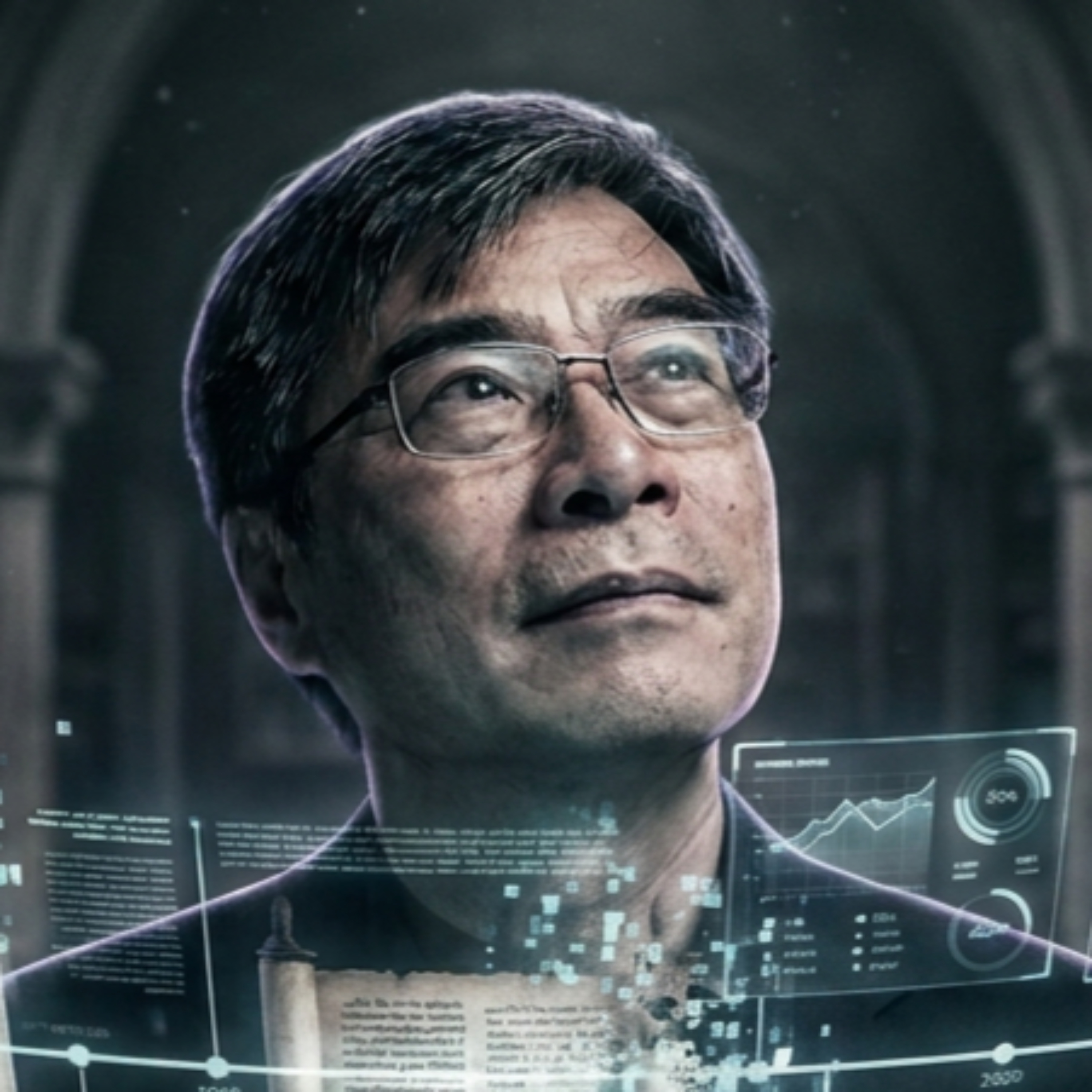
Audio format of Predictive History youtube videos by Professor Jiang XueqinGame Theory explores the future of global politics through the lens of data, geography, and historical patterns. Using minimalist map animations and strategic analysis, the channel breaks down complex geopolitical conflicts, military strategies, and resource competition to project where the world is heading next.
Author
Predictive History
Category
Podcast website
Latest episode
Jun 28, 2026
Where to listen?
Podcasts in the app Replaio Radio Coming soonPodcasts are coming to the app soon. Install now and be the first to see a whole new take on podcasts
 Install for free
Android 5M+ downloads · 4.8 rating
iOS soon
Install for free
Android 5M+ downloads · 4.8 rating
iOS soon
Episodes
Cyrus the Great as Messiah 24.05.2026 1:04:02
Professor Jiang Xueqin explains the influence of Zoroastrianism on the development of the Hebrew Bible. After Cyrus the Great conquered Babylon, he enabled the Jews to return to Jerusalem to build the Second Temple. Ezra oversaw major religious reforms, including the creation and redaction of what we know today as the Hebrew Bible. Because of the influence of Zoroastrianism, the Bible began to emp...
Resurrecting the Gnostic Jesus 24.05.2026 56:41
Professor Jiang Xueqin argues that Jesus was a unique religious genius who synthesized the major global religions of his day to create a new religion, which we today refer to as Gnosticism. Like other great religious leaders, Jesus had a three-tier gospel. To the public, he taught that true faith demanded compassion. To his disciples, he taught that true faith demanded self-sacrifice. Then there w...
Paul of Tarsus, Messiah of Rome 24.05.2026 55:31
Why are the teachings of Jesus and his apostle Paul so different? Jesus preached compassion and mercy towards all, while Paul preached that Jesus was the son of God who atoned for our sins with his sacrifice. Professor Jiang Xueqin presents a unique perspective on Paul’s motivations. He argues that Paul was an agent of the Roman empire who wanted to use Jesus to combat messianic Judaism. The Roman...
Constantine's Monotheistic Revolution 24.05.2026 56:40
Professor Jiang Xueqin argues that the idea of monotheism launched modernity. At the Council of Nicaea in 325 CE, the bishops of the Roman Empire had to decide on the relationship between God and Jesus. They established the Godhead as orthodoxy, and rejected Arianism as heresy. The Holy Trinity marked a radical intellectual revolution that would eventually give birth to capitalism, science, and th...
Augustine's Empire of God 24.05.2026 52:43
Professor Jiang Xueqin explains why Europe experienced the Dark Ages. After Rome was sacked in 410 CE, Europe experienced a crisis of faith. Were the Pagan Gods taking vengeance? Did Christianity preach a religion of meekness? In response, the Catholic theologian Augustine wrote "The City of God," in which he proposed to take the Catholic Church "out of history." From now on, k...
Muhammad's Revolution of God 24.05.2026 47:04
Who was the historical Muhammad? How did Islam triumph over both the Byzantine and Sasanian empires? In this talk to his Chinese high school students, Professor Jiang Xueqin argues that Islam was the first global revolution. While the Byzantine and Sasanian empires appeared to be superpowers, they were weak and fragile due to decades of plague, war, and succession struggles. The Arabian peninsula...
Dante's Divine Comedy and the Liberation of the Human Imagination 24.05.2026 47:44
Professor Jiang Xueqin explains that Dante's Divine Comedy was the intellectual blueprint for the Renaissance, the Protestant Reformation, and the Scientific Revolution. In a previous lecture, we explored how Augustine's writings would pave the way for Europe's Dark Ages. In his treatise "City of God," Augustine argued that we were born in sin, and we can commit only more sin...
Dante as the Second Coming of Homer 24.05.2026 1:00:57
Professor Jiang explains the enduring influence of Dante. Dante recognized that if he is to succeed in birthing a new European mind he must displace Vergil's Aeneid. To do this, Dante makes Vergil into his guide, and Vergil reveals that he is an unreliable narrator. At the beginning of their epic journey, Vergil insists to Dante that only the baptized can enter Heaven. Those who were virtuous...
The Oceanic Currents of History 24.05.2026 1:10:12
Traditionally, we have understood historical movement as either a line or a circle. We are either progressing towards the truth, or trapped in an endless loop. In this talk to his Chinese high school students, Professor Jiang proposes a new theory, which he calls "the oceanic currents of history."When we examine the fall and decline of global empires, a pattern emerges. As the empire exp...
Rome's Rise, Fall, and Legacy 24.05.2026 1:06:35
How was Rome able to defeat all its powerful enemies in the Mediterranean world? Why did Rome decline and fall? What is Rome's influence on the world today? What lessons can we learn from it? Professor Jiang argues that it was Rome's distinct cultural system (which focused on liberty, public virtue, and piety) which permitted it to triumph over its rivals. But after Rome became an empire,...
The Rise and Fall of the Byzantine Empire 24.05.2026 1:05:35
The Byzantine empire saw itself as the continuation of the Roman empire. Professor Jiang argues that Constantinople and Rome had opposing cultural systems. Rome was a pagan Latin republic, and Constantinople was a Christian multicultural empire.
The Useful Fiction of the Holy Roman Empire 24.05.2026 1:04:05
Voltaire once wrote: "The Holy Roman Empire was in no way holy, nor Roman, nor an empire.” Professor argues that Voltaire was right, and the Holy Roman Empire was a useful fiction created to legitimize the rule of Charlemagne and his successors.
The Viking Legacy 24.05.2026 1:11:40
We have understood Western civilization to be composed of four major traditions -- that of the Greeks, Romans, Jews, and Christians. In this talk to his Chinese high school students, Jiang Xueqin argues that the Viking legacy is just as important for the development of Western civilization. During the Viking Age (793 - 1066 CE), the Vikings would interact with and influence the regions from which...
Memory of the Norse 24.05.2026 1:11:50
What was the Viking worldview? What was their value system? Why did they venture out into the world? Unfortunately, the Vikings maintained an oral tradition, most of which was lost after they converted to Christianity. What we do know about the Vikings comes from archaeology and the Norse mythology that was written down in the Poetic and Prose Edda. In this talk to his Chinese high school students...
The Golden Age of Islam 24.05.2026 1:18:18
The Abbasid Caliphate was considered the Golden Age of Islam. Before the Mongolian conquest, the House of Wisdom in Baghdad was the global center of learning and literacy. Muslim scientists and mathematicians were respected and influential even in Europe. Why did the Islamic world enter its Golden Age, while Europe was stuck in its Dark Ages? Why did this Golden Age come to an end? Why did Christi...
Twilight of the Middle Kingdom 24.05.2026 1:08:10
Why did China stop being creative after the Song dynasty (960-1279 CE)? In this talk to his Chinese high school students, Jiang Xueqin explains that it's because the Ming and Qing dynasties achieved a level of national unity that was not possible in the past. While this national unity ensured the longevity of the emperor and his imperial bureaucracy, it made the nation insular and stagnant. Th...
Genghis Khan, World Shatterer 24.05.2026 1:09:22
Genghis Khan is considered the world's greatest conquerer. Why was he so successful? In this talk to his Chinese high school students, Jiang Xueqin argues that Genghis Khan had the same characteristics as other great conquerors, such as Sargon of Akkad, Philip of Macedon, and Julius Caesar. Genghis Khan believed that he had a divine mission to re-make the world. In overcoming hardship and defe...
Church and Empire 24.05.2026 1:09:37
What were the Crusades? Why did they start? Why did they end? In this talk to his Chinese high school students, Jiang Xueqin explores the history of Europe's late middle ages. He shows that while the Roman Catholic Church was dominant, there were still challenges to its authority. Muslims controlled the Holy Land, Muslim Iberia was more wealthy and innovative, and the Orthodox Church claimed s...
Dante's Quiet Revolution 24.05.2026 1:15:02
The Renaissance was a re-imagining of Classical Greece in a Christian European context, a spirit that would birth modernity. How did it start? Scholars argued that the Renaissance came about due to a perfect storm of structural factors. The build-up of commercial trade, the re-discovery of Greco-Roman thinkers, and the development of intellectual centers (such as universities and monasteries) were...
The Protestant Reformation and the Birth of Capitalism 24.05.2026 1:23:46
In this talk to his Chinese high school students, Jiang Xueqin explains how the Protestant Reformation birthed capitalism. Martin Luther and John Calvin saw the Catholic Church as inherently and irredeemably corrupt. Martin Luther proposed "justification by faith," which argued that Christians can only be redeemed by their unwavering faith in God (regardless of how much money they donate...
The Structure of Scientific Revolutions 24.05.2026 1:18:44
What is the Scientific Revolution, and how did it happen? Why did it happen in Europe, and not anywhere else? In this talk to his Chinese high school students, Jiang Xueqin explains that the Scientific Revolution happened because of a change in focus from asking "What is Truth?" to asking "How can we know Truth?". To resolve the geocentric vs. heliocentric debate, Europeans pio...
The Spanish Conquest of the New World 24.05.2026 58:25
How did a few thousand Spanish Conquistadors subdue and conquer millions of Aztecs, Incas, and Mayans. Most scholars believe it's a combination of superior Spanish military technology, spreading of deadly infectious diseases, and internal tribal conflict that led to the demise of once powerful empires. In this talk to his Chinese high school students, Jiang Xueqin argues that it was the religi...
The Gunpowder Revolution 24.05.2026 1:11:52
The Ottomans, Safavids, Mughals, and Chinese were the first four gunpowder empires. So how did Europe come to conquer the world? In this talk to his Chinese high school students, Jiang Xueqin explains that it's because Europe adopted a whole society approach to warfare. Because of open co-operative competition within Europe, nations were forced to transition from feudalism to the nation-state,...
The Revolution of Reason 24.05.2026 1:28:14
This video begins a three-part series on the French Revolution. The over-arching thesis is that the French Revolution was a religious crusade, and it was made successful by the contributions of three geniuses. Jean-Jacques Rousseau was the Poet of the Revolution who dreamed of a better world based on Reason. Maximilien De Robespierre was the Prophet who had the courage and conviction to lead his p...
The Passion of Robespierre 24.05.2026 1:26:49
The French Revolution allowed for the meteoric rise of an idealistic provincial lawyer. During the Reign of Terror, Robespierre could have been king, but ultimately fell to the guillotine, like thousands of his victims. What explains his spectacular rise and fall? In this talk to his Chinese high school students, Jiang Xueqin argues that Robespierre saw himself as the Prophet of the French Revolut...
Similar podcasts







Listen to the Professor Jiang podcast in Replaio
Radio and podcasts in one app - free, with no sign-up. Install today and do not miss the launch
Replaio is not a podcast publisher; show names, artwork and audio belong to their authors and are distributed through public RSS feeds.