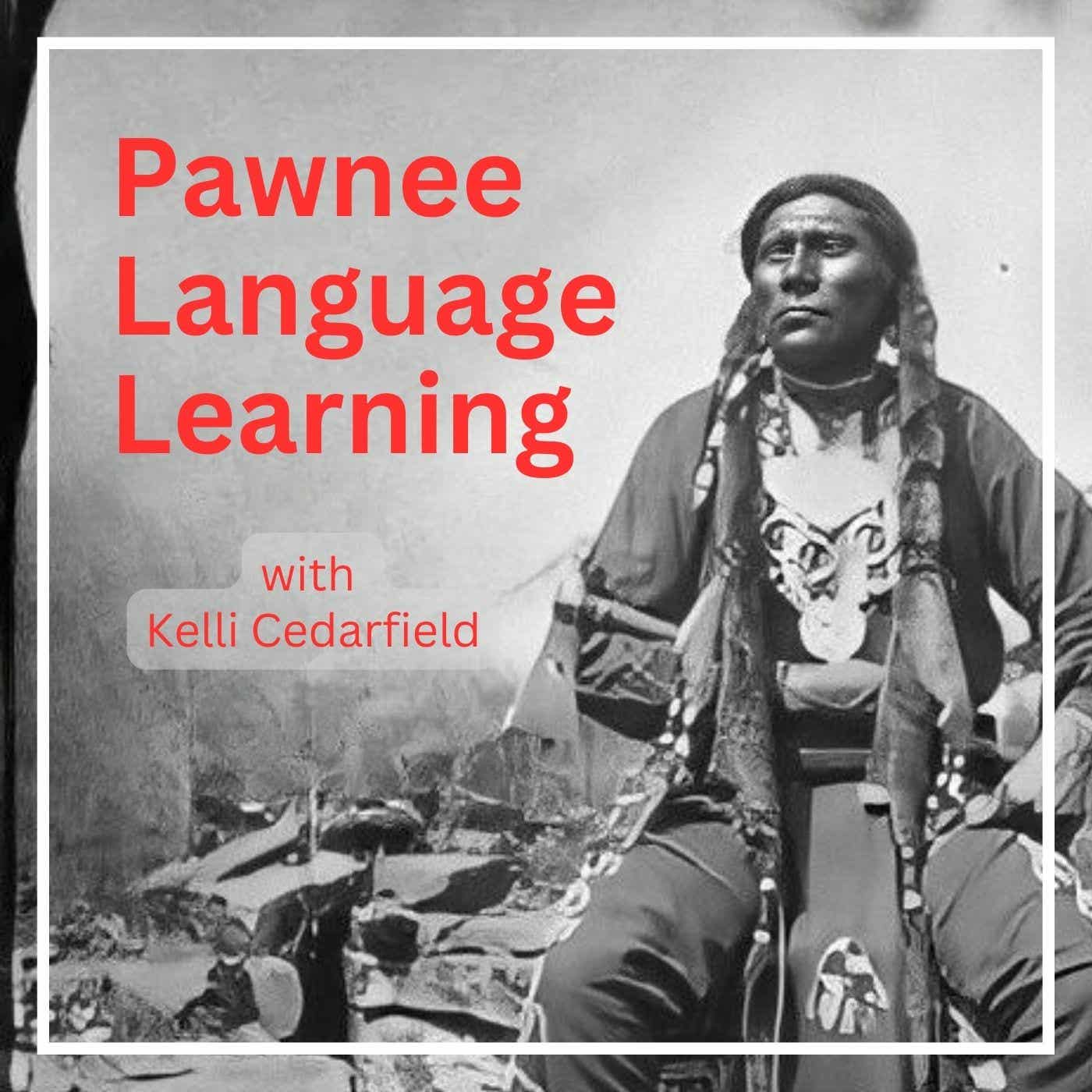
Kelli Cedarfield
Pawnee Language Learning
The beautiful Pawnee language in small doses. Word of the Day a few days a week, quick grammar lessons, with the occasional dose of history and culture. pawneelanguagelearning.substack.com
Be sure to visit the podcast's website and support the creator: pawneelanguagelearning.substack.com
Author
Kelli Cedarfield
Category
Podcast website
Latest episode
Apr 5, 2026
Where to listen?
Podcasts in the app Replaio Radio Coming soonPodcasts are coming to the app soon. Install now and be the first to see a whole new take on podcasts
 Install for free
Android almost 10M downloads · 4.8 rating
iOS soon
Install for free
Android almost 10M downloads · 4.8 rating
iOS soon
Episodes
Ep. 34 - Steps, Halfs and Greats 23.03.2024 2:24
Pawnee Language Learning is a reader-supported publication. To support the Pawnee Language Program, consider becoming a free or paid subscriber. Get full access to Pawnee Language Learning at pawneelanguagelearning.substack.com/subscribe
Ep. 33 - My Uncle (my mother's brother) 22.03.2024 1:56
tiwačiriks - my mother’s brother, my uncle. Modern Pawnee will address their uncles as “Tiwačiriks Bob”, or “Tiwačiriks Roger.” Pawnee Language Learning is a reader-supported publication. To support the Pawnee Language Program, consider becoming a free or paid subscriber. Get full access to Pawnee Language Learning at pawneelanguagelearning.substack.com/subscribe
Ep. 32 - My Uncle (my father's brother) 22.03.2024 2:03
ati’as - my uncle (my father’s brother). Yes, this is the same word as “my father.” You’ll hear modern Pawnee people address their uncles as “Ati’as Tom” or “Ati’as Jack.” Pawnee Language Learning is a reader-supported publication. To support the Pawnee Language Program, consider becoming a free or paid subscriber. Get full access to Pawnee Language Learning at pawneelanguagelearning.substack.com/...
Ep. 31 - My Aunt 20.03.2024 1:28
atira’ - my mother AND my aunt. Your mother’s sisters and your father’s sisters, they are all called “atira’.” Modern Pawnee use atira’ the same way Europeans use “aunt”, as in “Atira’ Deb” or Atira’ Gwen.” Pawnee Language Learning is a reader-supported publication. To support the Pawnee Language Program, consider becoming a free or paid subscriber. Get full access to Pawnee Language Learning at p...
Ep. 30 - Grandmother 19.03.2024 1:49
Some Pawnee call their Grandmas “atika”. Some call them “aka’.” What’s the difference? Pawnee Language Learning is a reader-supported publication. To support the Pawnee Language Program, consider becoming a free or paid subscriber. Get full access to Pawnee Language Learning at pawneelanguagelearning.substack.com/subscribe
Ep. 29 - Grandfather 19.03.2024 3:09
Some Pawnee call their Grandpas “atipat”. Some call them “apit.” What’s the difference? Pawnee Language Learning is a reader-supported publication. To support the Pawnee Language Program, consider becoming a free or paid subscriber. Get full access to Pawnee Language Learning at pawneelanguagelearning.substack.com/subscribe
Ep. 27 - Pronouncing the Pawnee 'R' 16.03.2024 8:52
Pawnee Language Learning is a reader-supported publication. To support the Pawnee Language Program, consider becoming a free or paid subscriber. Get full access to Pawnee Language Learning at pawneelanguagelearning.substack.com/subscribe
Ep. 26 - Brother of a female 15.03.2024 2:05
irâcti - If you are female, you would call your brother irâhcti’. Remember the naked C (as apposed to the Č) says “ts”. Nora Pratt says, Irâcti' Pawnee Language Learning is a reader-supported publication. To support the Pawnee Language Program, consider becoming a free or paid subscriber. Get full access to Pawnee Language Learning at pawneelanguagelearning.substack.com/subscribe
Ep. 25 - Sister of a male 14.03.2024 1:38
SOUTHBAND itâhri’ - a Southband male calls his sister itâhri’. SKIDI itâhi’ - a Skidi male calls his sister itâhi’. Pawnee Language Learning is a reader-supported publication. To support the Pawnee Language Program, consider becoming a free or paid subscriber. Get full access to Pawnee Language Learning at pawneelanguagelearning.substack.com/subscribe
Ep. 24 - Same-sex Sibling 13.03.2024 1:32
irâri’ - same sex sibling. For example, if you are female, you would call your sister(s) irâri’. If you are male, you would call your brother(s) irâri’. Pawnee Language Learning is a reader-supported publication. To support the Pawnee Language Program, consider becoming a free or paid subscriber. Get full access to Pawnee Language Learning at pawneelanguagelearning.substack.com/subscribe
Ep. 23 - My Father 13.03.2024 1:55
ati’as - my father. Not your father, or his father, not even their father, but your father. You would use ati’as to refer to your own father, you can also call your father Ati’as. Nora Pratt says, Ati'as Pawnee Language Learning is a reader-supported publication. To support the Pawnee Language Program, consider becoming a free or paid subscriber. Get full access to Pawnee Language Learning at pawn...
Ep. 22 - My Mother 13.03.2024 2:03
atira - my mother. Not your mother, or her mother, not even their mother, but “my mother”. You use atira when referring to your own mother, you can also call your mother Atira. Pawnee Language Learning is a reader-supported publication. To support the Pawnee Language Program, consider becoming a free or paid subscriber. Get full access to Pawnee Language Learning at pawneelanguagelearning.substack...
Ep. 20 - Grammar 09.03.2024 6:56
SENTENCE MARKERS: kara - yes/no question ta - positive statement kâka - negative statement * čikstit karaspari’ čikstit - to be well kara - y/n question s - you pari’ - to be going about Are you (going about) well? * čikstit tatpari’ čikstit - to be well ta - positive statement t - I pari’ - to be going about I am (going about) well. * čikstit kâkatpari’ čikstit - to be well kâka - negative statem...
Ep. 19 - No, I'm not (going about) well. 08.03.2024 3:25
kâkî - no čikstit - to be well pari’ - to go about We’ll dissect the rest of the sentence in episode 20. Pawnee Language Learning is a reader-supported publication. To support the Pawnee Language Program, consider becoming a free or paid subscriber. Get full access to Pawnee Language Learning at pawneelanguagelearning.substack.com/subscribe
Ep. 18 - Yes, I am (going about) well. 07.03.2024 2:39
SOUTHBAND DIALECT âhu’ - yes SKIDI DIALECT hâ’u’ - yes SOUTHBAND AND SKIDI čikstit - to be well. [ č ] is pronounced ‘ch’ as in “church” pari’ - to go about We’ll dissect this sentence and all its grammatical parts in episode 20. Pawnee Language Learning is a reader-supported publication. To support the Pawnee Language Program, consider becoming a free or paid subscriber. Get full access to Pawnee...
Ep. 17 - No 06.03.2024 2:09
kâkî’ - no (There are some native speakers who ignore the glottal stop on the end.) Nora Pratt says, kâkî' Pawnee Language Learning is a reader-supported publication. To support the Pawnee Language Program, consider becoming a free or paid subscriber. Get full access to Pawnee Language Learning at pawneelanguagelearning.substack.com/subscribe
Ep. 16 - Yes 05.03.2024 3:27
SOUTHBAND âhu' - yes SKIDI hâ’u' - yes Which dialect to you choose if your Pawnee family comes from multiple bands? Traditionally, the Pawnee were a matriarchal society, and bands were chosen based on the mother’s family. Husbands who married into the family from a different band were adopted into the wife’s band and their children were considered part of their mother’s band. But, colonization cha...
Ep. 15 - Are you (going about) well? 04.03.2024 2:52
čikstit - to be well. [ č ] is pronounced ‘ch’ as in “church".” pari’ - to go about We’ll dissect the sentence and all its parts in episode 20. In Pawnee, your voice does not rise at the end of a sentence if it’s a question. Your voice drops for questions in Pawnee. Funny PS: Substack automatically creates a transcript for these podcasts. It auto-created “Chick Stit Cut A Spuddy” for čikstit karas...
Ep. 13 - Pawnee Consonants 02.03.2024 11:27
c - the ‘ts’ sound in tsk, tsunami, tsar, catsup, hotspot, cats, suits. č - the ‘ch’ sound in Charlie, church, churlish h - the breathy ‘h’ in “aha!” k - the soft ‘k’ in skate, skip, skin; not the hard ‘k’ in Kate, king, kind. p - soft ‘p’ as in spot, special, spice; not the hard ‘p’ in pop, pot, pebble. s - as in snake, snout, sassy. t - soft ‘t’ as in stop, stay, sting; not the hard ‘t’ in top,...
Ep. 12 - I am White / Black / Asian 01.03.2024 3:19
tâtakita - I am SOUTHBAND (SB) čârikstâka’ - white (Caucasian); čâriks=person, tâka’=white čârikskâtît - Black; čâriks=person, kâtît=black SKIDI (SK) čâhikstâka’ - white (Caucasian); čâhiks=person, tâka’=white čâhikskâtît - Black; čâhiks=person, kâtît-black BOTH BANDS kiripasi’ - Asian; kiri=eyes, pasi’=narrow The Pawnee [ č ] is pronounced ‘ch’, like the ‘ch’ in “church” and “Charlie.” Nora Pratt...
Ep. 11 - I am Wichita / Osage 29.02.2024 2:21
tâtakita - I am kirikûruks - Wichita. Literally, it means ‘bear eyes’. pasâsi’ - Osage The Pawnee ‘k’ is a soft ‘k’, pronounced like the ‘k’ in ‘skate’, not a hard ‘k’ as in ‘Kate.’ We will review all the Pawnee consonants in episode 13. Nora Pratt says, Kirikûruks Nora Pratt says, Pasâsi' Pawnee Language Learning is a reader-supported publication. To support the Pawnee Language Program, consider...
Ep. 10 - I am Arikara / Otoe 28.02.2024 2:06
tâtakita - I am astârâhi - Arikara pasûhara - Otoe The Pawnee ‘h’ in between vowels is pronounced like the English ‘h’ in ‘hat’. We will review all the Pawnee consonants in episode 12. Nora Pratt says, Pasûhara Nora Prat says, Astârâhi Pawnee Language Learning is a reader-supported publication. To support the Pawnee Language Program, consider becoming a free or paid subscriber. Get full access to...
Ep. 9 - I am Pawnee 28.02.2024 4:23
tâtakita - I am pâri’ - Pawnee The Pawnee ‘r’ is a flapped ‘r’, pronounced like the Spanish ‘r’ in Rodriguez or Rafael, or the Japanese ‘r’ in ramen. English does have this sound, it’s the middle sound in the word “butter” and “ladder”. If you are having trouble flapping your ‘r’, you can use a soft ‘d’ sound, or an ‘L’ or even an ‘n’ sound. The early English-speaking settlers couldn’t pronounce P...
Ep. 8 - I am called [name]. 27.02.2024 3:04
Tâtasa’ - I am called______. It’s the equivalent of the English, My name is____. The Pawnee ‘t’ is pronounced like the soft ‘t’ in ‘stop’ and ‘stay’, not the hard ‘t’ in Tom, trouble, or truck. Your tongue is behind your teeth. Pawnee Language Learning is a reader-supported publication. To support the Pawnee Language Program, consider becoming a free or paid subscriber. The Pawnee ‘s’ is pronounce...
Ep. 6 - Pawnee Vowel Sounds 14.02.2024 8:25
*Vowel sounds used by both the Skidi and Southband dialects: a - ‘a’ as in about, around, above, what, was. The “uh” sound. â - ‘a’ as in father, water, walk and talk. i - ‘i’ as in hit, sit, it, Indian. î - ‘i’ as in machine, trampoline, magazine. u - ‘u’ as in bush, push, cushion, and the vowel sound in foot and book. û - ‘u’ as in consume, resume, tune and costume. *Southband dialect has two mo...
Similar podcasts







Listen to the Pawnee Language Learning podcast in Replaio
Radio and podcasts in one app - free, with no sign-up. Install today and do not miss the launch
Replaio is not a podcast publisher; show names, artwork and audio belong to their authors and are distributed through public RSS feeds.