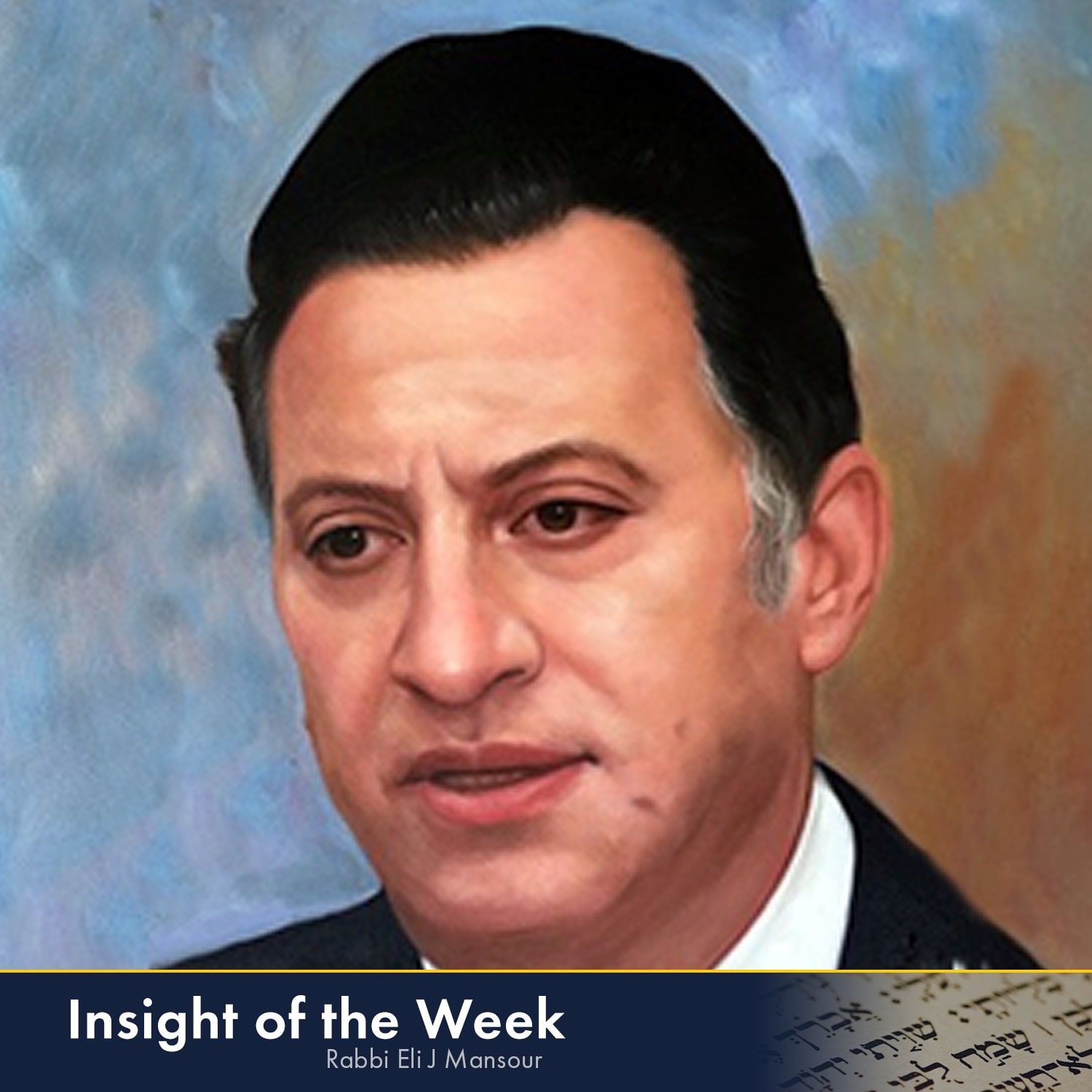
Rabbi Eli Mansour
Parasha Insight
Insights into the weekly parasha or upcoming holiday by Rabbi Eli Mansour
Be sure to visit the podcast's website and support the creator: itorah.com
Where to listen?
Podcasts in the app Replaio Radio Coming soonPodcasts are coming to the app soon. Install now and be the first to see a whole new take on podcasts
 Install for free
Android 10M+ downloads · 4.7+ rating
iOS soon
Episodes
Parashat Vayetze- Rising to the Challenge 17.11.2026
As Yaakob made his way to Haran, where he would spend twenty years with his corrupt, wily uncle, Laban, he slept along the roadside and beheld a famous dream of a ladder extending from the ground to the heavens. Angels ascended and descended the ladder. Rashi explains this vision as indicating that the angels which accompanied Yaakob in the Land of Israel were now returning to the heavens, as Yaak...
Parashat Toldot- Our Negative Tendencies 11.11.2026
When Ribka instructed Yaakob to disguise himself as Esav so he could receive Yishak's blessing, she told him, "Lech Na El Ha'son" – to go and bring two goats for her to prepare meat for Yishak (27:9). The Midrash (Bereshit Rabba 65:14) finds in these words an allusion to Beneh Yisrael, her future descendants. Ribka was telling Yaakob, in the words of the Midrash, "Lech Ve'kadem Et Ha'uma She'meshu...
Parashat Haye Sara- Being a Faithful Servant 03.11.2026
We read in Parashat Hayeh-Sara the famous story of Abraham sending his trusted servant, Eliezer, to his hometown of Aram Naharayim for the purpose of finding a suitable match for Yishak. The Midrash, cited by Rashi (Bereshit 24:39), reveals to us an astounding detail about this story, one which sheds Eliezer's character in an entirely new light. Eliezer, the Midrash tells, had a daughter, and he v...
Parashat Vayera- Making a Covenant With Hashem 28.10.2026
Parashat Vayera begins, "G-d appeared to him in Eloneh Mamreh." Hashem appeared to Abraham, but, surprisingly, the Torah does not tell us that Hashem spoke to Abraham or communicated with him at all during this revelation. This might be the reason why Rashi explains that G-d appeared for the purpose of Bikur Holim – to visit the sick. Abraham, at the age of 99, had just undergone circumcision, and...
Parashat Lech Lecha- Defeating Yishmael Through Sacrifice 20.10.2026
The Torah in Parashat Lech-Lecha tells of the birth of Abraham Abinu's first son, Yishmael. When Sara saw that she could not conceive, she had Abraham marry her maidservant, Hagar, as his second wife, and Hagar conceived and gave birth to Yishmael. The Torah informs us that Abraham was 86 years when Yishmael was born (16:16). Rashi explains that the Torah did not provide this information merely as...
Parashat Noah- Destroying the Yeser Ha’ra 14.10.2026
The Gemara in Masechet Zevahim (116) tells that at the time of Matan Torah, a loud, thunderous noise was heard throughout the world. The kings came to Bilam, the gentile prophet, to ask what was happening. They feared that G-d was bringing a flood to destroy the earth, as He had done during the times of Noach. Bilam assured them by reminding them of the promise Hashem made to Noach after he left t...
Parashat Bereshit- Our Weekly Boost of Emuna 06.10.2026
The Midrash (Midrash Tehillim 92) relates that after Adam was forgiven for his sin of eating the forbidden fruit in Gan Eden, he sang a song – a song known to us as "Mizmor Shir La'Yom Ha'Shabbat," the 92 chapter of Tehillim. It was on Shabbat that Adam was told that he was forgiven, and so he sung this special song about Shabbat. Appropriately, we recite this chapter as part of our Kabbalat Shabb...
“Zeman Simhatenu” – The Special Joy of Sukkot 22.09.2026
Why is Sukkot celebrated for seven days? Pesach is a seven-day holiday because the miracle of the Exodus culminated a week after our ancestors left Egypt, with the splitting of the sea and the drowning of the Egyptian army. But for what reason is Sukkot observed as a seven-day celebration? An answer could perhaps be suggested based on the famous explanation of the Gaon of Vilna (1720-1797) for the...
Shabbat Shuva- Self-Motivated Repentance 15.09.2026
The Haftarah read on Shabbat Shuba – the Shabbat between Rosh Hashanah and Yom Kippur – is among the most famous Haftarot read throughout the year. Taken from the Book of Hoshea, it begins with the prophet Hoshea's timeless cry, "Shuba Yisrael Ad Hashem Elokecha" – "Return, O Israel, unto Hashem your G-d" (Hoshea 14:2). The Midrash (Bereshit Rabba 84:19) traces the origins of this prophecy all the...
Rosh Hashana- How Do We Make Hashem King? 08.09.2026
It is clear that "Malchut" – G-d's Kingship over the world – is the dominant theme of Rosh Hashanah. If we quickly review the text of the Rosh Hashanah prayers, this becomes very evident. We repeat numerous times that Hashem is King over the universe. And Rav Saadia Gaon (882-942) writes that one of the reasons we blow the Shofar is because Rosh Hashanah is the day of G-d's coronation, and so we b...
Parashat Nitzavim-Vayelech: The Enlarged “Lamed” 01.09.2026
The Torah in Parashat Nisavim foresees the time when Beneh Yisrael would be banished into exile on account of their breach of their covenant with G-d, describing, "Va'yashlichem Be'eretz Aheret" – Hashem's casting the nation into a different land (29:27). Those who look carefully at the Torah scroll will notice that the letter Lamed in the word "Va'yashlichem" is written larger than the other lett...
Parashat Ki Tabo- The Symbolism of Tefillin 27.08.2026
The Torah promises in Parashat Ki-Tabo (28:10), "All the nations of the earth will see that the Name of G-d is called upon you, and they will be afraid of you." Targum Yonatan Ben Uziel explains that this refers to the Tefillin Shel Rosh, which we proudly wear upon our heads. The Torah promises that when the enemies of the Jewish People see the Tefillin on our heads, they will be gripped by fear a...
Parashat Ki Teseh- The Rewards for Unintentional Charity – Material and Spiritual 19.08.2026
The Torah in Parashat Ki-Teseh (24:19) introduces the Misva known as "Shicheha," which applies when a farmer forgets some of his produce behind during the harvest. This forgotten produce, the Torah commands, must be left for the poor. If one later realizes that he left some grain behind, he is not permitted to go back to retrieve it. The Torah writes: "It shall be for the foreigner, the orphan and...
Parashat Shoftim- Judging Ourselves 13.08.2026
Parashat Shofetim begins with the command, "Shofetim Ve'shoterim Titen Lecha Be'chol She'arecha" – "You shall place for yourselves judges and enforcers in all your gates." This establishes the Biblical obligation to appoint in every city ("in all your gates") courts to determine the laws, and officials to enforce them. The verse later adds, "LI'shbatecha" – "for your tribes," which the Sages under...
Parashat Re'eh- The Journey 06.08.2026
The Journey Parashat Re'eh concludes with the Misva known as Aliya Le'regel – appearing before G-d in the Bet Ha'mikdash three times each year, on the holidays of Pesach, Shabuot and Sukkot. The Gemara in Masechet Hagiga (3a) makes a comment that sheds light on the nature of this Misva, and on the vital lesson that it teaches us. King Shelomo exclaims in Shir Hashirim (7:2), "Ma Yafu Fe'amayich Ba...
Parashat Ekeb- We Don’t Hide Our Jewishness 30.07.2026
In the second paragraph of Shema, which appears in Parashat Ekeb, the Torah warns of the harsh punishments that would befall Beneh Yisrael if they abandon G-d's laws. Specifically, it warns of poverty that would be followed by exile from the Land of Israel and dispersion among the other nations. The Torah then commands, "Ve'samtem Et Debarai Eleh Al Lebabchem Ve'al Nafshechem" – "You shall place t...
Parashat VaEtchanan- A Fence With a Hole Is Not a Fence 23.07.2026
The Torah in Parashat Va'et'hanan (4:2) introduces the prohibitions known as "Bal Tosif" and "Bal Tigra" – adding to, or diminishing from, the Torah. Rashi explains that this refers to the way we observe the Misvot. If a person adds a fifth piece of parchment to the four pieces of parchment in the Tefillin, or if he adds a fifth species to the Arba Minim on Sukkot, then he violates "Bal Tosif," wh...
Parashat Devarim- Turning Tisha B’Ab Into Simhat Torah 16.07.2026
A number of books draw an intriguing – though puzzling – parallel between two periods on the Jewish calendar: the period of Ben He'mesarim (the Three Weeks from Shiba Asar Be'Tammuz through Tisha B'Ab) and the period of the holidays in the month of Tishri. The month of Tishri begins with Rosh Hashanah, and the holiday season concludes with the celebration of Shemini Aseret on the 22nd of Tishri. (...
Parashat Matot- Rabbi Akiba’s Tears 09.07.2026
Rabbi Akiba's Tears Parashat Matot begins with a number of laws regarding vows, including the authority given to a husband to annul certain vows taken by his wife. The Torah states that in such a case, when a wife takes a vow and the husband declares its annulment, "V'Hashem Yislah Lah" – G-d will forgive the woman (30:13). The Sages understood this verse as referring to a situation where the wife...
Parashat Pinhas- Teshuba Thoughts 02.07.2026
We read in Parashat Pinhas of the census taken of Beneh Yisrael at the end of their forty-year sojourn in the wilderness. The Torah lists the families of the various tribes, and in listing the families of Reuben, the Torah explains that two families – those of the brothers Datan and Abiram – were not counted, because they perished after joining Korah's revolt against Moshe Rabbenu. In this context...
Don't Be Too Smart! 25.06.2026
We are all familiar with the story of Moshe hitting the rock, an act for which he was punished. Less familiar, however, are the circumstances that led to Moshe's decision to strike the rock, after he was commanded to produce water by speaking to it. The background to the story is the death of Moshe's sister, the righteous prophetess Miriam, in whose merit a miraculous well provided water for Beneh...
Parashat Korah- Recognizing the Good 18.06.2026
Two of the important figures in Korah's brazen uprising against Moshe were two brothers named Datan and Abiram. Interestingly, we are not told what it is that they were fighting for. Korah himself, as Rashi brings, resented the fact that his cousin was chosen over him for a prestigious leadership role (head of one of the three families of Leviyim). The 250 men who joined Korah vied for the privile...
Parashat Shelah- The Arrogance of the Spies, the Humility of Yehoshua 11.06.2026
Parashat Shelah is famous for the story of Het Ha'meragelim – the sin of the spies. Moshe sent twelve men – one representative from each tribe – to survey the Land of Israel and report back to the people, and when the spies returned, they persuaded Beneh Yisrael that they could not conquer the land, for which thy were severely punished. The Torah makes a point of mentioning that before Moshe sent...
Parashat Be'HaAlotecha- Don’t Miss the Point 04.06.2026
The Torah commands in Parashat Beha'alotecha (10:9) that when Beneh Yisrael are compelled to fight a war against an enemy, "Va'hare'otem Ba'hasoserot" – they must sound trumpets. The Rambam, in the beginning of Hilchot Ta'aniyot, understands this verse as a more general command to pray to G-d during times of crisis. The Torah speaks of a war against "Ha'sar Ha'sorer Etchem" ("the enemy who terrori...
Parashat Naso- Defeating the Enemies of the Jewish People 28.05.2026
Parashat Naso is famous for being the longest Parasha in the entire Torah, as it consists of 176 verses. Not coincidentally, this is also the number of verses in the longest chapter of Tehillim (119), and the number of pages in the longest Masechet in the Talmud, Masechet Baba Batra. The unique significance of this number is revealed to us by the Maharal of Prague (Rav Yehuda Loew, d. 1609). He be...
Similar podcasts








Listen to the Parasha Insight podcast in Replaio
Radio and podcasts in one app - free, with no sign-up. Install today and do not miss the launch
Replaio is not a podcast publisher; show names, artwork and audio belong to their authors and are distributed through public RSS feeds.