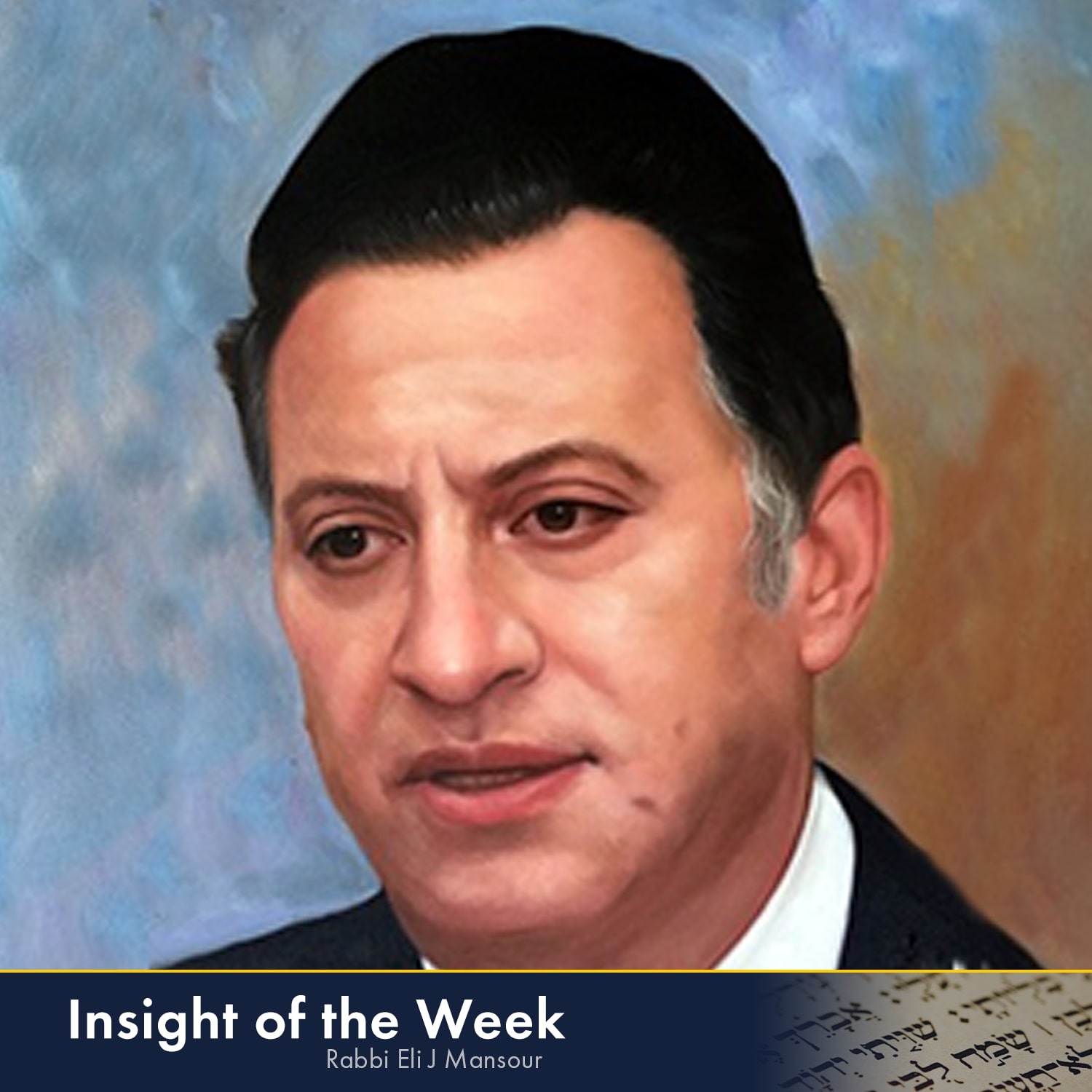
Rabbi Eli Mansour
Parasha Insight
Insights into the weekly parasha or upcoming holiday by Rabbi Eli Mansour
Where to listen?
Podcasts in the app Replaio Radio Coming soonPodcasts are coming to the app soon. Install now and be the first to see a whole new take on podcasts
 Install for free
Android 5M+ downloads · 4.8 rating
iOS soon
Install for free
Android 5M+ downloads · 4.8 rating
iOS soon
Episodes
Parashat Matot- Rabbi Akiba’s Tears 09.07.2026
Rabbi Akiba's Tears Parashat Matot begins with a number of laws regarding vows, including the authority given to a husband to annul certain vows taken by his wife. The Torah states that in such a case, when a wife takes a vow and the husband declares its annulment, "V'Hashem Yislah Lah" – G-d will forgive the woman (30:13). The Sages understood this verse as referring to a situation where the wife...
Parashat Pinhas- Teshuba Thoughts 02.07.2026
We read in Parashat Pinhas of the census taken of Beneh Yisrael at the end of their forty-year sojourn in the wilderness. The Torah lists the families of the various tribes, and in listing the families of Reuben, the Torah explains that two families – those of the brothers Datan and Abiram – were not counted, because they perished after joining Korah's revolt against Moshe Rabbenu. In this context...
Don't Be Too Smart! 25.06.2026
We are all familiar with the story of Moshe hitting the rock, an act for which he was punished. Less familiar, however, are the circumstances that led to Moshe's decision to strike the rock, after he was commanded to produce water by speaking to it. The background to the story is the death of Moshe's sister, the righteous prophetess Miriam, in whose merit a miraculous well provided water for Beneh...
Parashat Korah- Recognizing the Good 18.06.2026
Two of the important figures in Korah's brazen uprising against Moshe were two brothers named Datan and Abiram. Interestingly, we are not told what it is that they were fighting for. Korah himself, as Rashi brings, resented the fact that his cousin was chosen over him for a prestigious leadership role (head of one of the three families of Leviyim). The 250 men who joined Korah vied for the privile...
Parashat Shelah- The Arrogance of the Spies, the Humility of Yehoshua 11.06.2026
Parashat Shelah is famous for the story of Het Ha'meragelim – the sin of the spies. Moshe sent twelve men – one representative from each tribe – to survey the Land of Israel and report back to the people, and when the spies returned, they persuaded Beneh Yisrael that they could not conquer the land, for which thy were severely punished. The Torah makes a point of mentioning that before Moshe sent...
Parashat Be'HaAlotecha- Don’t Miss the Point 04.06.2026
The Torah commands in Parashat Beha'alotecha (10:9) that when Beneh Yisrael are compelled to fight a war against an enemy, "Va'hare'otem Ba'hasoserot" – they must sound trumpets. The Rambam, in the beginning of Hilchot Ta'aniyot, understands this verse as a more general command to pray to G-d during times of crisis. The Torah speaks of a war against "Ha'sar Ha'sorer Etchem" ("the enemy who terrori...
Parashat Naso- Defeating the Enemies of the Jewish People 28.05.2026
Parashat Naso is famous for being the longest Parasha in the entire Torah, as it consists of 176 verses. Not coincidentally, this is also the number of verses in the longest chapter of Tehillim (119), and the number of pages in the longest Masechet in the Talmud, Masechet Baba Batra. The unique significance of this number is revealed to us by the Maharal of Prague (Rav Yehuda Loew, d. 1609). He be...
Commemorating the Shabuot Offering 21.05.2026
Numerous reasons have been given for the time-honored, cherished custom to eat dairy foods on Shabuot. One of the lesser-known explanations is that offered by the Rama (Rav Moshe Isserles, Poland, 1530-1572), in his glosses to the Shulhan Aruch (Orah Haim 494). Interestingly enough, the custom the Rama describes is to eat a dairy meal followed by a meat meal. As Halacha forbids using the same loaf...
Parashat BaMidbar- The Book of Transition 14.05.2026
The Midrash teaches that the five Humashim – the books that comprise the Torah – are alluded to in the opening verses of the Torah, which tell of the creation of light on the first day of the world's creation. The word "Or" (light) appears five times in these verses, and they parallel the five Humashim. It follows, then, that the fourth Humash – the Book of Bamidbar, which we begin reading this Sh...
Parashat Behar-Behukotai- Learning & Toiling 07.05.2026
In the opening verses of Parashat Behukotai, the Torah promises great reward "Im Be'hukotai Telechu" – "If you follow My statutes." Rashi, in one of the more famous passages in his Torah commentary, writes that this phrase does not actually refer to Misva observance. After all, the very next words of the verse are "Ve'et Misvotai Tishmeru" – "and you observe My commands." Necessarily, then, the ph...
Parashat Emor- Two Guilty Parties 30.04.2026
Parashat Emor concludes with the disturbing story of the "Megadef," the individual who publicly blasphemed G-d. The man was brought before Moshe, and Hashem informed Moshe that blasphemy is a capital crime, and this individual must therefore be put to death. Rashi (24:10) brings different explanations for what drove the "Megadef" to blaspheme G-d. One approach is that he had found himself on the l...
Parashat Ahare Mot- Loving Without Seeing 23.04.2026
In one of the most famous – and most misquoted – verses in the Torah, we are commanded in Parashat Kedoshim (19:18), "Ve'ahabta Le're'acha Kamocha' – "You shall love your fellow as yourself." I say "misquoted" because the command does not conclude with the word "Kamocha" ("as yourself"). The verse continues, "Ani Hashem" – "I am G-d." It stands to reason that the pronouncement "Ani Hashem" constit...
Parashat Tazria-Metzora - The Psychology of Lashon Ha’ra 16.04.2026
Much of Parashiyot Tazria-Mesora is devoted to the topic of Sara'at – the affliction that would befall a person on account of certain misdeeds, primarily, the grievous sin of Lashon Ha'ra, negative speech about other people. King David, in a famous verse in Tehillim (34:14), instructs us, "Nesor Leshoncha Me'ra" – "Guard your tongue from evil," urging us to refrain from Lashon Ha'ra. Curiously, th...
Parashat Shemini- A Lesson in Humility 10.04.2026
The Torah in Parashat Shemini tells the tragic story of Nadab and Abihu – two of Aharon's sons, who perished on the very first day they began serving as Kohanim in the Mishkan. After a special series of sacrifices were offered, with Aharon's sons performing the service for the first time, a fire descended from the heavens onto the altar and consumed the sacrifices, signalling the arrival of the Sh...
Pesah- The Haggadah & the Process of Teshuba 31.03.2026
Toward the end of the Maggid section, we read the famous teaching of Rabban Gamliel: "Whoever did not say the following three things on Pesach has not fulfilled his obligation: Pesach, Masa, and Marror." Rabban Gamliel then proceeds to explain the meaning and significance of these three Misvot. The Pesach sacrifice was offered in the times of the Bet Ha'mikdash to commemorate the miracle of the pl...
Shabbat Ha’gadol & Abraham Abinu 26.03.2026
Several different explanations have been given for why the Shabbat preceding Pesach is given the name "Shabbat Ha'gadol" – literally, "the Great Shabbat." One of the lesser-known reasons is a fascinating connection between this Shabbat and Abraham Abinu. The Gemara in Masechet Rosh Hashanah (11) brings a debate between Rabbi Eliezer and Rabbi Yehoshua as to the month in which the Abot (patriarchs)...
Parashat VaYikra- The Power of Nissan 19.03.2026
The Mishna in Pirkeh Abot (3:16) teaches: "The shop is open, the shopkeeper gives on credit, the ledger is open, the hand writes, and whoever wishes to borrow may come and borrow." Meaning, G-d invited us to come and enjoy the blessings of the world, "on credit," even before we deserve them, though with the expectation that repay our "debt" through the performance of Misvot. The Megaleh Amukot (Ra...
Parashat VaYakhel- Doing Our Best 12.03.2026
After describing in great detail the construction of the Mishkan and its furnishings, the Torah tells: "All the work for the Mishkan…was completed; Beneh Yisrael did in accordance with all that G-d had commanded Moshe; so did they do" (39:32). Rav Moshe Alshich (Safed, 1508-1593) observes that the sequence in this verse seems difficult. We would have expected the Torah to first tell us that Beneh...
Parashat Kit Tisa- Shabbat & Changing Our Perspective 05.03.2026
Hashem commands in Parashat Ki-Tisa, "Ach Et Shabetotai Tishmoru" – "However, you shall observe my Shabbatot" (31:13). Rashi explains that after Hashem presented the commands regarding the construction of the Mishkan, He emphasized that the work on the Mishkan must be discontinued on Shabbat. The question arises, however, as to why Hashem here commands observing "Shabetotai" – His "Shabbatot." Ins...
Purim and the Rectification of Fraternal Strife 26.02.2026
Numerous sources point to a connection between the celebration of Purim and the story of Yosef. For example, Rav Levi Yishak of Berditchev (1740-1809) taught that each of the twelve months corresponds to one of the twelve sons of Yaakob Abinu, and the month of Adar – the month when Purim is celebrated – corresponds to Yosef. And already the Gemara (Megilla 16a-b) draws an association between the P...
Parashat Teruma: The Precious Gift of Giving 19.02.2026
Parashat Teruma begins with G-d's command, "Ve'yikhu Li Teruma" – that Beneh Yisrael should donate materials toward the construction of the Mishkan. Surprisingly, Hashem here commands that the people donate toward this project with the word "Ve'yikhu," which means "They shall take." Instead of saying that the people should give, that they should donate, Hashem commands them to "take" a donation. T...
Parashat Mishpatim- Only Hashem Can Judge 12.02.2026
Parashat Mishpatim is well known for its presentation of a series of civil laws. These laws govern interpersonal relations, mainly matters related to conflicts over money or property. Speaking to Moshe, Hashem introduces this series of laws by saying, "Ve'eleh Ha'mishpatim Asher Tasim Lifnehem" – "And these are the statutes that you shall place before them." Rashi, citing the Gemara, comments that...
Parashat Yitro- What Led Yitro to Join Beneh Yisrael? 05.02.2026
The opening verses of Parashat Yitro tell of Yitro's arrival at Beneh Yisrael's camp. Yitro, Moshe's father-in-law, had been a pagan priest, but then recognized the truth of monotheism. He now took the next step, and joined Beneh Yisrael as they encamped at the foot of Mount Sinai. Rashi comments that Yitro was motivated to join the nation upon hearing of two events: Keri'at Yam Suf (the splitting...
Parashat Beshalah- Prayer as a “Profession” 29.01.2026
REM-SS85-08 The Torah tells that as Beneh Yisrael stood at the shores of the sea, and they saw the Egyptian army pursuing them, they cried out to G-d – "Va'yis'aku Beneh Yisrael El Hashem" (14:10). Rashi comments: "Tafesu Umanut Abotam" – "They took hold of their forefathers' craft." Meaning, Beneh Yisrael here followed the example set for them by the patriarchs, who likewise prayed to G-d. Rashi...
Parashat Bo- The Tribe of Efrayim’s Mistake 22.01.2026
The Torah in Parashat Bo (12:40) states that Beneh Yisrael spent a total of 430 years in Egypt. Already Rashi notes the seeming contradiction between this verse and G-d's prophecy to Abraham Abinu that his descendants would endure a 400-year period of exile and oppression (Bereshit 15:13). Why did G-d predict a period of 400 years, if Beneh Yisrael were going to spend 430 years in exile? Rashi exp...
Similar podcasts








Listen to the Parasha Insight podcast in Replaio
Radio and podcasts in one app - free, with no sign-up. Install today and do not miss the launch
Replaio is not a podcast publisher; show names, artwork and audio belong to their authors and are distributed through public RSS feeds.