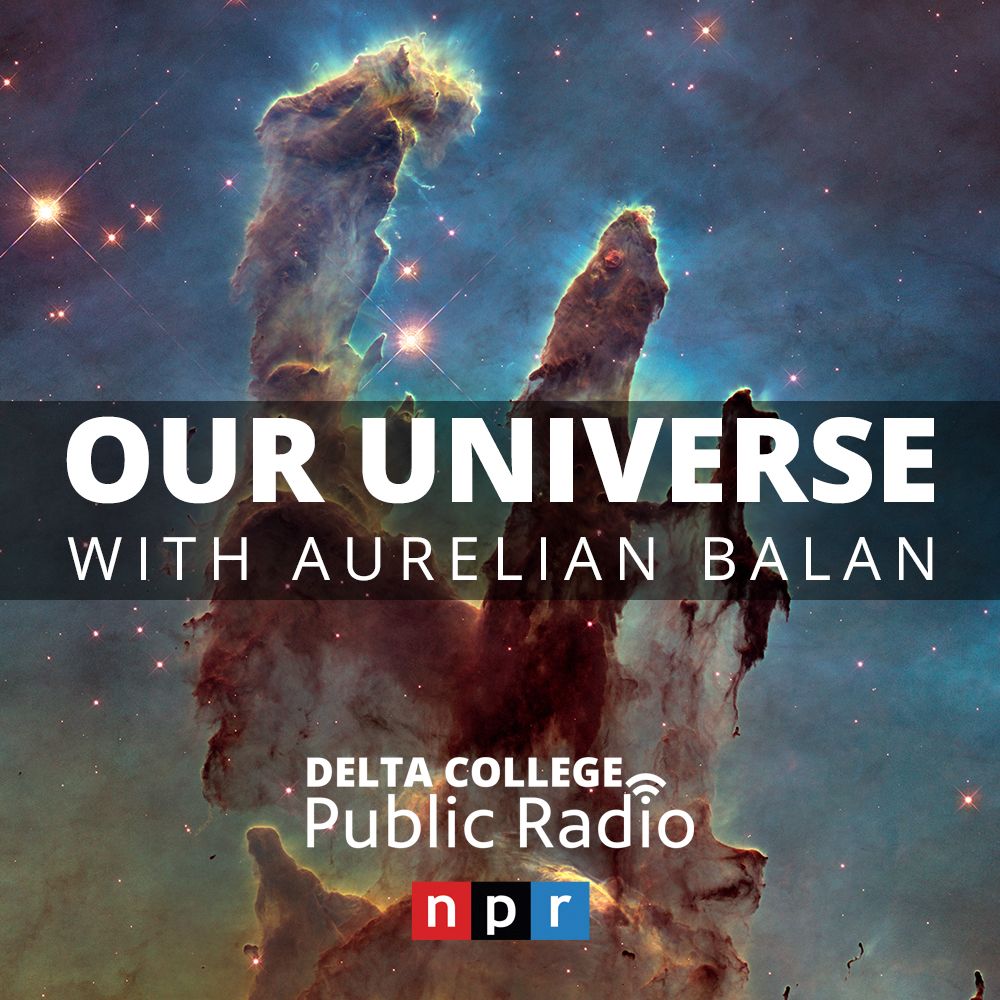
Delta College Public Radio
Our Universe - Delta College Public Radio
Do you have questions about space, time and the nature of the universe? Join Aurelian Balan, Delta College associate professor of physics, as he uses astronomy and physics to help answer your questions while diving into some amazing topics.
Author
Delta College Public Radio
Category
Podcast website
Latest episode
May 7, 2026
Where to listen?
Podcasts in the app Replaio Radio Coming soonPodcasts are coming to the app soon. Install now and be the first to see a whole new take on podcasts
 Install for free
Android 5M+ downloads · 4.8 rating
iOS soon
Install for free
Android 5M+ downloads · 4.8 rating
iOS soon
Episodes
How a Nuclear Reactor Works 07.05.2026 4:00
If your city decided to build a nuclear power plant a few miles from your home, how would you feel? Today, we’re going to explore what goes on inside one of these energy production machines to help us answer this question. Support this podcast: https://www.deltapublicmedia.org/donate/
Artemis II to the Moon 24.04.2026 4:00
The Artemis program is NASA’s current multi-mission campaign to return humans to the Moon for the first time since 1972. The Apollo missions were about visiting the Moon, while Artemis is designed for long-term presence on the Moon. Support this podcast: https://www.deltapublicmedia.org/donate/
Cell Phone Radiation 05.03.2026 4:30
We already know about how certain wavelengths of high energy light from a cell phone can disrupt sleep and concentration. But what about the radiation that we can’t see? Support this podcast: https://www.deltapublicmedia.org/donate/
Saturn’s Rings and Gas Giants 26.02.2026 4:00
While Saturn’s rings are best known, Jupiter, Uranus, and Neptune each have their own rings. They’re just a lot harder to see. Support this podcast: https://www.deltapublicmedia.org/donate/
Radiocarbon Dating 13.02.2026 4:30
How do we know the age of fossils? Today we’ll focus on how radiocarbon dating works and explore a couple other methods for figuring out how long something has been around. Support this podcast: https://www.deltapublicmedia.org/donate/
Fundamental Particles 06.02.2026 4:30
We used to think atoms were the smallest unit of matter, but they are made up of smaller particles which are, in turn, made up of even smaller particles. Support this podcast: https://www.deltapublicmedia.org/donate/
The Exoplanet K2-18b 29.01.2026 4:00
Could this planet beyond our solar system support life? Support this podcast: https://www.deltapublicmedia.org/donate/
The Local Group 08.05.2025 4:30
We live in the Milky Way galaxy, a member of a collection of around 80 galaxies known as the Local Group.
Asteroid 2024 YR4 30.04.2025 4:30
An asteroid called 2024 YR4 currently has a small chance of hitting Earth in December of 2032. While it’s not massive enough to be considered a planetary threat, it is capable of leveling a city.
Traveling to Mars and Beyond 30.01.2025 4:30
How long would it take to fly to Mars? What about Pluto? Let’s look at how long interplanetary travel takes.
The Orion Nebula 21.01.2025 4:30
Right now, in a nebula not so far from you, new stars are forming. How do stars form, and how close to Earth does star formation happen? In this episode, we’ll take a look at a region of stellar birth that’s about as close to Earth as it gets.
The Hubble Tension 19.12.2024 4:30
The universe is expanding, but how different methods for measuring its expansion give us different results. We call this the Hubble Tension.
How Fast is Earth Moving? 19.12.2024 4:30
Earth is always moving through the Solar System, and the Solar System is always moving through the galaxy, so just how fast are we moving through space?
Light Pollution: How Many Stars in the Night Sky? 25.10.2024 4:00
How many stars can you see with the naked eye at night? 40 or 50 thousand? Or is it 100,000 stars? Have you ever tried to count? Well, a few astronomers have counted, and the number is pretty… disappointing.
Quantum Computing 10.10.2024 4:00
Computers, tablets, and phones have become very fast. The latest multicore processors are capable of an incredible number of calculations each and every second. Yet, we are changing the way we do computing thanks to our ever-increasing knowledge in the field of quantum physics. How does quantum computing work, and are quantum computers faster than classical computers?
How Magnetism Works 27.06.2024 4:00
Let’s study the mystery of magnetism, exploring the tiny particles and invisible fields that govern this powerful interaction.
The Physics of Polarizing Sunglasses 02.05.2024 3:30
Have you ever squinted at a shimmering lake or felt blinded by the reflection off a wet road? That's glare, and it's not just uncomfortable – it can make it difficult to see clearly.
Your Best Chance to See a Nova 08.04.2024 3:30
A nova called T Coronae Borealis erupts every 80 years and your only chance to see it is sometime between right now and September of 2024.
NASA’s Deep Space Optical Communications Experiment 29.02.2024 4:00
Imagine sending massive amounts of data from our spacecraft and receiving high-res video in minutes, not hours or days. It might sound like science fiction, but that's the reality NASA's Deep Space Optical Communications Demo, or DSOC, is aiming for.
The Radio Spectrum 01.02.2024 3:30
The radio spectrum is a fascinating realm of invisible energy carrying everything from your favorite radio station to your Wi-Fi connection and beyond. So how does it work?
The Acceleration Due to Gravity 26.01.2024 3:30
We’ve all heard this number before – 9.8 m/s² – But what does that really tell us? And what does it have to do with our weight?
The Most Promising Dark Matter Experiment 19.01.2024 4:00
Most of the universe is made of a type of matter that doesn’t interact with light—dark matter. This is a big deal—throughout history we’ve studied and learned about the universe by observing it, yet we can’t directly observe most of the universe!
The Elusive Oxygen-28 13.10.2023 3:30
Physicists have finally detected the elusive oxygen-28 isotope, but the observations are surprising and unexpected.
Nuclear Fission Reactors 06.10.2023 4:00
In 1942, a team working on the Manhattan Project were the first scientists to build a nuclear fission reactor, but it was only the first *man-made* fission reactor on Earth.
Exoplanets 05.05.2023 3:30
How many planets do we know of outside of our own Solar System? Are any of these planets habitable? How do we even find them?
Similar podcasts







Listen to the Our Universe - Delta College Public Radio podcast in Replaio
Radio and podcasts in one app - free, with no sign-up. Install today and do not miss the launch
Replaio is not a podcast publisher; show names, artwork and audio belong to their authors and are distributed through public RSS feeds.