
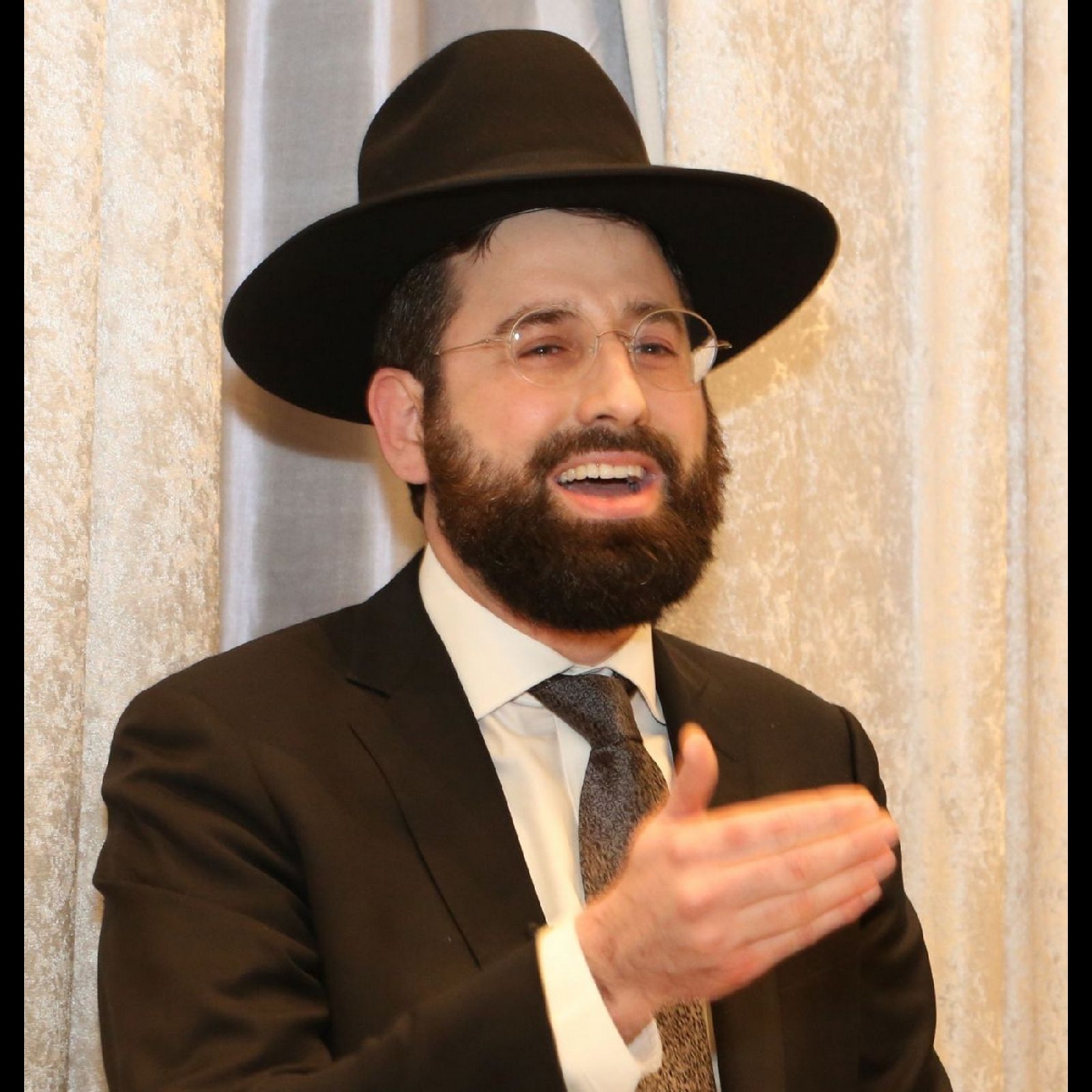
Torah Teacher Ariel ben-Lyman HaNaviy
Numbers (Messianic)
We invite and encourage you to join the reading schedule that has so inspired the Jewish community since before the birth of “The Church.” At the same time, we challenge you to read the portions on your own, mining God’s rich, spiritual garden, gleaning the precious nuggets that lay in store for you. A Messianic commentary for each portion has been provided to assist you in your journey to become a more mature child of HaShem. May His Spirit richly bless you as you “Study to show thyself approved!” 2 Timothy 2:15
Author
Torah Teacher Ariel ben-Lyman HaNaviy
Category
Podcast website
Latest episode
Nov 19, 2025
Where to listen?
Podcasts in the app Replaio Radio Coming soonPodcasts are coming to the app soon. Install now and be the first to see a whole new take on podcasts
 Install for free
Android 5M+ downloads · 4.8 rating
iOS soon
Install for free
Android 5M+ downloads · 4.8 rating
iOS soon
Episodes
34 B’midbar - In the desert - Numbers 1:1-4:20 19.11.2025 42:05
The Worth of a Man Rashi (Rabbi Shlomo Yitzchaki) notes at the beginning of the Book that God counted the nation at every significant turn because he loves it. So too, the fact that the people were counted as individuals proves the infinite worth of every Jew, and sets the precedent for God’s undying love to see every one of his created subjects return to a loving relationship with him through his...
35 Naso - Take - Numbers 4:21-7:89 18.11.2025 1:00:34
I personally believe that our sages had some wise things to say about the Torah, considering the fact that they lived in an era when the knowledge of the Messiah was either suppressed or rejected. However, we who know the Blessed Name of the Messiah Yeshua, and the power of his fellowship, can add further insight to this ancient benediction. 'Y’varekh’kha ADONAI v’yishmerekha. [May ADONAI bless yo...
36 B’ha'alotkha (Part A) - When you set up - Numbers 8:1-12:16 17.11.2025 39:10
In Yesha'yahu 11:1-5, we are given a vivid description of the coming Messiah. All rabbinical sources, as well as Christian scholars agree that this passage is a prophecy concerning the long-awaited Savior. The "Branch of Yishai" is a reference to his bloodline. Yishai (Jesse) was the father of Dah-vid the King. It was a well-known fact that the Messiah was to be born from Dah-vid's loins. The Tora...
36 B’ha'alotkha (Part B) - When you set up - Numbers 8:1-12:16 16.11.2025 28:15
In the opening few verses of our current parashah, we learn that the actual, removable lamps, which rest upon each branch, “face” inward towards the central shaft, and consequently towards the center lamp as well (picture an “Aladdin’s type” lamp with a handle on one end and a spout at the opposite end where the wick protrudes). Rashi confirms this in his commentary to these p’sukim: Our Sages fur...
36 B’ha'alotkha (Part C) - When you set up - Numbers 8:1-12:16 15.11.2025 33:31
In Genesis chapter one, verses 1-5, the Hebrew word “Torah” can be found if we count every 50th letter. Now, we must remember that Hebrew reads right-to-left, so our Hebrew word “Torah”, consisting of the four letters “Tav”, “Vav”, “Resh”, and “Heh” (T-V-R-H) would look like this in our text (beginning with the first “Tav” that we find: H-(49 spaces)-R-(49 spaces)-V-(49 spaces)-T In Exodus chapter...
37 Shlach L’kha (Part A) - Send on your behalf - Numbers 13:1-15:41 14.11.2025 43:06
Shabbat Violation The Torah helps to paint a picture of work and rest, slavery and freedom, which spiritually amounts to life and death. How so? In the Renewed Covenant book of Galatians, Rabbi Sha’ul tell us: "Don’t delude yourselves: no one makes a fool of God! A person reaps what he sows. Those who keep sowing in the field of their old nature, in order to meet its demands, will eventually reap...
37 Shlach L’kha (Part B) - Send on your behalf - Numbers 13:1-15:41 13.11.2025 38:36
Garment of Praise The portion this week contains Judaism’s first mitzvah (commandment) concerning the tzitzit, that is, the tassel that adorns a modern observant Jewish person’s clothing. Chapter 15:37-41 clearly teaches the offspring of Avraham to attach a “ribbon of blue” to the extremity or “wing” (Heb: kanaf) of their garments. It is easy to assume that these p’sukim (verses) are meant to be a...
37 Shlach L’kha (Part C) - Send on your behalf - Numbers 13:1-15:41 12.11.2025 41:10
Traditions play an important part of our daily walk as new creations in Messiah Yeshua. In my opinion, some traditions enhance that walk, while other traditions hinder it. Logic dictates that if a tradition comes directly from the Torah, then HaShem designed it to enhance our walk. According to Jewish tradition, men wear a tallit to signify obedience to the above-mentioned mitzvah, to signify the...
37 Shlach L’kha (Part D) - Send on your behalf - Numbers 13:1-15:41 11.11.2025 42:23
Menachot 42b And for what purpose do the Rabbis use the expression ‘That ye may look upon it’? — They require it for the following teaching: ‘That ye may look upon it, and remember’, that is, look upon this precept and remember another precept that is dependent upon it, namely, the reading of the Shema’. As we have learnt: From what time in the morning may the Shema’ be read? From the time that on...
37 Shlach L’kha (Part E) - Send on your behalf - Numbers 13:1-15:41 10.11.2025 11:28
Conclusions If you are still not sure you understand the true intent behind Torah observance (which includes the command to wear fringes), I suggest reading my introductory teachings in this series. They are available at this web site, or you may write to me personally. As you seek to become more obedient to HaShem's Torah, by adding the mitzvah of the tzitzit, here is the traditional blessing by...
38 Korach - Korah - Numbers 16:1-18:32 09.11.2025 46:05
This is Parashat Korach. This is the telling of the story of the disloyalty of Korach, son of a Levite, and that rebellious bunch that followed him. I call it disloyalty owing to the fact that this complaint of Korach's was an audience designed to address the current leadership of Moshe and Aharon. However, knowing Korach’s heart, a better-suited term might be open mutiny! A summary of the story g...
39 Hukkat (Part A) - Regulation - Numbers 19:1-22:1 08.11.2025 39:48
Parah Adumah - A Unique Commandment The mitzvah of the Red Heifer (referred to in Judaism as Parah Adumah, literally “Red Cow”) is a peculiar command indeed. A couple of details make this mitzvah unique. To begin with, the participants are commanded to slaughter and burn completely this female cow without blemish. If you will recall from reading Vayikra, touching a dead animal’s carcass renders on...
39 Hukkat (Part B) - Regulation - Numbers 19:1-22:1 07.11.2025 54:46
From Kadesh to Moab – Disobedience, Death, and Desert Dilemmas The parashah goes on to narrate the tragic story of Moshe’s disobedience. Chapter 20 records for us the sobering reason as to why this otherwise stalwart leader succumbs to human weakness. It is true that he was incredibly faithful to perform all that HaShem asked him to do. Yet, even Moshe was not perfect. The pressure mounted and in...
40 Balak (Part A) - Balak - Numbers 22:2-25:9 06.11.2025 38:50
The power of rumor… Balak had not only heard of what terrible acts Isra'el had committed in destroying the ‘Emori, according to the first verse of our Torah portion, he also saw it! Did he witness it firsthand? Perhaps. Perhaps he saw the aftermath of the campaign and did the mental math. Whatever the case, the fame and reputation of HaShem was becoming more and more known among the tribes of Kena...
40 Balak (Part B) - Balak - Numbers 22:2-25:9 05.11.2025 36:12
Our Stark Warning Couched in the tiny book of Y’hudah (Jude), we hear the Torah’s final warning against men like Bil’am: “Dear friends, although I was very eager to write to you about the salvation we share, I felt I had to write and urge you to contend for the faith that was once for all entrusted to the saints. For certain men whose condemnation was written about long ago have secretly slipped i...
41 Pinchas (Part A) - Phinehas - Numbers 25:10-30:1 04.11.2025 46:38
QUESTION: In the Torah the name Pinchas is written with a "yud", and according to the Zohar (237b) Pinchas with a "yud" has the numerical value of two hundred and eight, as does the name of the patriarch Yitzchak. What is the connection between Pinchas and Yitzchak? ANSWER: The prophet Eliyahu encountered the false prophets of the idol Ba'al and challenged them to prove whose God was the true one....
41 Pinchas (Part B) - Phinehas - Numbers 25:10-30:1 03.11.2025 49:27
The name “Mel-chiz-ed-ek” (KJV) or “Malki-Tzedek” as it is written in the Hebrew, means, “my king is righteousness”, or “king of righteousness”. He is first mentioned in the Torah in the book of Genesis, in a meeting with the patriarch Avram. Chapter 14 verses 18-20 reads, “Malki-Tzedek king of Shalem brought out bread and wine. He was cohen [priest] of El ‘Elyon [God Most High], so he blessed him...
42 Mattot - Tribes - Numbers 30:2-32:42 02.11.2025 50:57
This is Parashat Mattot. From here until the ending of B'midbar (Numbers), the subject of Tribes is in full view. HaShem is preparing the desert-weary people for entering into their long-awaited inheritance. After 40 years of wandering under the divine judging hand of the Almighty, coupled with over 400 years in physical, mental, and (in every way) spiritual bondage in a foreign land, the descenda...
43 Masa'ei - Stages - Numbers 33:1-36:13 01.11.2025 1:06:12
Parashat Masa’ei (say “mah-sah-ey”) marks the end of the book of B’midbar (Numbers). As the book closes, we find the people anxiously poised in the east side of the Yarden (Jordan) wanting to finally leave this Wilderness (Heb: midbar) and enter into the promise that HaShem made so long ago with their forefathers. The Land and the Tribes are in full view here. I want to open our commentary by reca...
Similar podcasts







Listen to the Numbers (Messianic) podcast in Replaio
Radio and podcasts in one app - free, with no sign-up. Install today and do not miss the launch
Replaio is not a podcast publisher; show names, artwork and audio belong to their authors and are distributed through public RSS feeds.
