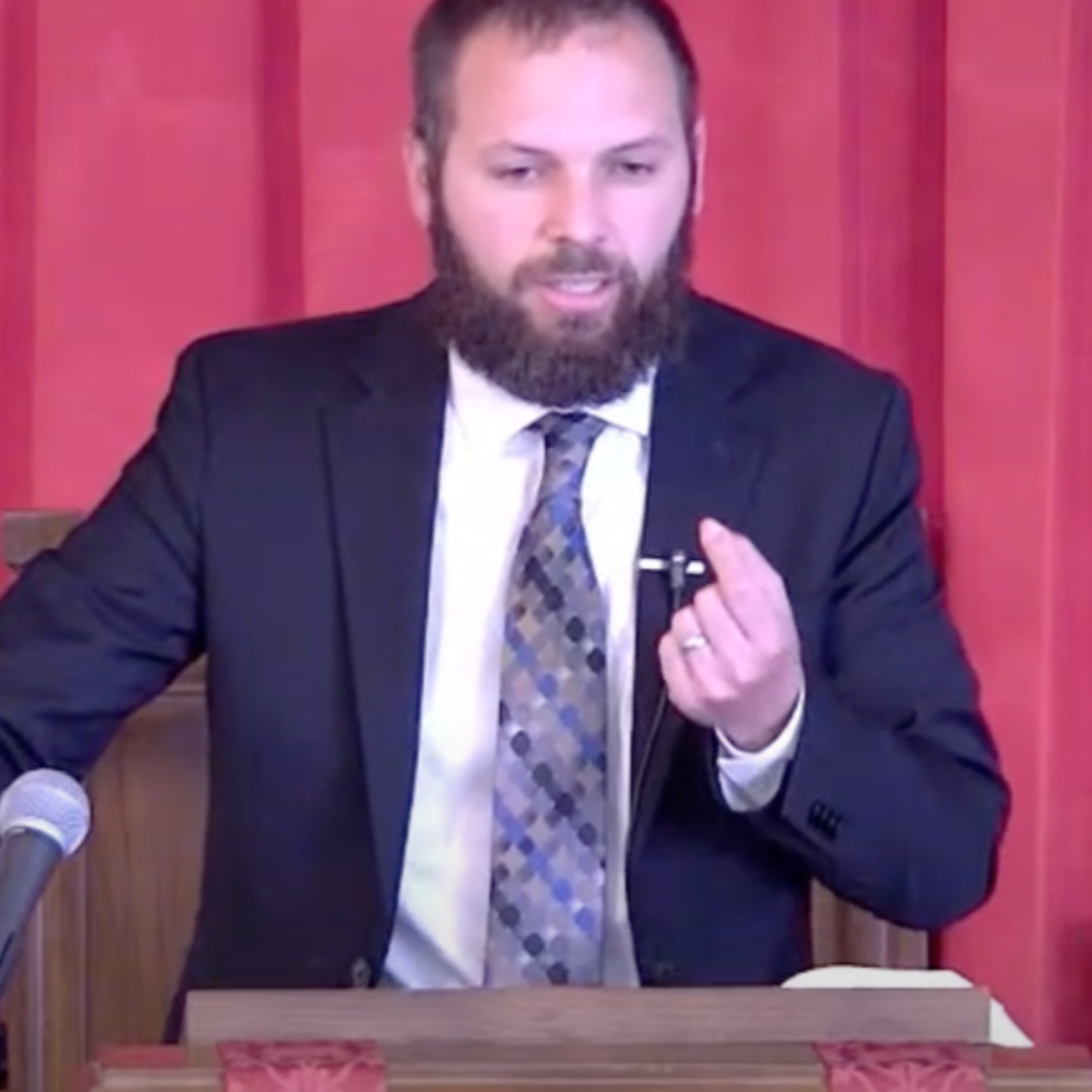
Michael Grasso
Love of Truth
Love of Truth is dedicated to biblical theology, careful exegesis, and thoughtful engagement with the most pressing theological, cultural, and ecclesiastical questions of our time. This podcast is rooted in historic, confessional Christianity and seeks to:Exposit Scripture with seriousness and depthDefend the coherence and unity of the Bible, especially the Old Testament’s witness to ChristAddress doctrinal error, cultural confusion, and rival truth claims with charity and precisionEquip Christians to love God with both heart and mind
Author
Michael Grasso
Category
Podcast website
Latest episode
Feb 18, 2026
Where to listen?
Podcasts in the app Replaio Radio Coming soonPodcasts are coming to the app soon. Install now and be the first to see a whole new take on podcasts
 Install for free
Android 5M+ downloads · 4.8 rating
iOS soon
Install for free
Android 5M+ downloads · 4.8 rating
iOS soon
Episodes
Is Isaiah 53 About Jesus? Responding to Rabbi Tovia Singer 18.02.2026 10:37
Does Isaiah 53 describe Israel—or does it describe the Messiah who suffers for Israel? In this video, I respond directly to claims made by Tovia Singer, focusing especially on a key concession that ultimately undermines his own interpretation. Singer openly acknowledges that the Messiah is the servant in Isaiah 52:13–15. That admission is crucial. He argues that the nations (“the goiim”) were mist...
Is Deuteronomy 18 about Christ? Responding to Rabbi Tovia Singer 14.02.2026 13:16
Does Deuteronomy 18 really exclude Jesus as the Prophet like Moses? In this video, I respond to arguments made by Tovia Singer, who maintains that Joshua is the complete fulfillment of Moses’ prophecy and that no future messianic expectation remains. I begin with an important concession: Joshua is indeed a genuine fulfillment of Deuteronomy 18. Singer is right to highlight the strong textual conne...
Is Isaiah 53 about Israel?... Or the Messiah? Response to Dan McClellan 11.02.2026 13:11
Does Isaiah 53 describe corporate Israel—or does it prophesy a suffering, atoning Messiah? In this video, I respond directly to claims made by Dan McClellan, particularly the assertion that the Christian reading of Isaiah 53 arose only after Jesus’ death and resurrection. I begin by identifying a central problem with this approach: it relies almost entirely on speculation. We are told that the dis...
Does Isaiah 9:6 say that the Messiah is God? 06.02.2026 11:11
Does Isaiah 9:6 really call the Messiah “Mighty God,” or is that reading imposed by later theology? In this video, I respond to claims popularized by Dan McClellan that rely heavily on Ancient Near Eastern royal parallels to reinterpret the text. I begin by questioning the assumption that ANE conventions—especially Egyptian models of kingship—are the controlling key for interpreting the prophecy....
Does 2 Thessalonians 2:15 Refute Sola Scriptura? 02.02.2026 8:29
Does Paul’s command to “hold fast to the traditions” in 2 Thessalonians 2:15 prove that binding Christian doctrine can exist outside of Scripture? In this video, I examine the appeal to apostolic oral tradition and the assumption that the Church today possesses authoritative teachings handed down orally from the apostles. I argue that this assumption collapses once we ask a simple but unavoidable...
Did the Church Create the Bible? 30.01.2026 10:25
How do we know which books belong in the Bible? Did the early Church create the canon—or did it simply recognize what was already Scripture? In this video, I address the common claim that Christians cannot know which books belong in the Bible without the authority of the Church. I argue instead that Scripture itself gives us the boundaries, categories, and criteria for the canon—and that the Churc...
Is Sola Scriptura Unbiblical? 28.01.2026 6:35
Does the Bible actually teach sola Scriptura, or is this a later Protestant invention? In this video, I examine Jesus’ confrontation with the Pharisees in Matthew 15 and Mark 7, where the issue is not whether tradition exists, but whether tradition may function as a parallel authority that overrides the Word of God. When the Pharisees challenge Jesus for not keeping the “tradition of the elders,”...
Does Exodus 21 Deny Fetal Personhood? 26.01.2026 14:06
Does the Bible grant full personhood to the unborn? Some modern scholars argue that it does not—and that even key legal texts in the Old Testament fail to protect unborn life. In this video, I examine that claim by engaging directly with Exodus 21:22–25, one of the most frequently cited passages in the debate. Responding to arguments made by Dan McClellan, I walk through the text carefully and sho...
Does Transubstantiation Imply Cannibalism? 24.01.2026 10:35
The charge of cannibalism has accompanied the Christian church from its earliest days, largely because of its practice of the Lord’s Supper. From the beginning, Christians have rejected this accusation—but the way they rejected it is historically and theologically significant. In this video, I examine a modern Roman Catholic attempt to answer the charge of cannibalism by appealing to the glorified...
Was the Trinity Common Knowledge in the OT? 15.01.2026 11:02
Many Christians assume that the doctrine of the Trinity is either absent from the Old Testament or present only in vague, implicit form. Even defenders of Trinitarian theology often hesitate to argue that the Old Testament itself clearly taught a plurality of persons within the one God. In this video, I argue that this hesitation is unnecessary—and historically inaccurate. Building on earlier disc...
Is Wisdom in Proverbs 8 the Son of God? 14.01.2026 15:34
Many Christians today are hesitant to argue that the doctrine of the Trinity is clearly taught in the Old Testament. Even when it is defended, it is often presented as merely implicit or embryonic. In this video, I argue that the book of Proverbs presents a fully Trinitarian theology, and that it does so at the most structurally significant points in the book. In Proverbs 1, 8, and 9, Wisdom is no...
The Messiah in the Book of Ruth 10.01.2026 11:56
What is the theological message of the book of Ruth? Is it merely a story about God’s kindness to a Moabite woman, or does it play a larger role in redemptive history? In this video, I argue that Ruth is a thoroughly messianic book. Far from being an isolated moral tale, Ruth advances the biblical storyline toward the coming of Christ. Its climax—the genealogy at the end of the book—signals that t...
The Messiah in the Book of Judges 08.01.2026 14:39
The book of Judges is often remembered as one of the darkest periods in Israel’s history—marked by moral collapse, repeated apostasy, and failed leadership. Because of this, many assume it is an unlikely place to find a robust doctrine of Christ or a meaningful anticipation of the Messiah. This video argues the opposite. By examining the structure, theology, and narrative logic of Judges, we see t...
Christ's Miracles: Historical Fact or Fiction? 06.01.2026 16:09
The miracles of Jesus are often misunderstood. Some dismiss them outright as impossible, assuming that miracles simply do not happen. Others treat miracles as common and ongoing, failing to see what makes Christ’s works utterly unique. Both errors obscure the true significance of what the Gospels record. In this video, we examine the miracles of Christ as they are presented in Scripture—public, un...
Out of Egypt I Called My Son: Matthew's Use of Hosea 11:1 (Part 2) 03.01.2026 15:08
In Matthew 2:15, we read that Jesus’ coming out of Egypt fulfills Hosea 11:1 — “Out of Egypt I called my Son.” Critics like Rabbi Tovia Singer claim Matthew took this verse out of context. In a previous video, we looked at Hosea itself and showed that Matthew’s use of it was faithful to Hosea’s message. But the truth goes even deeper. In this video, we turn to the Pentateuch to see that the idea o...
Out of Egypt I called My Son: Matthew's Use of Hosea 11:1 (Part 1) 01.01.2026 13:33
Did Matthew take Hosea 11:1 out of context when he said, “Out of Egypt I called my son”? Rabbi Tovia Singer argues that Matthew misused the Hebrew Bible — but a closer look shows that Matthew understood Hosea far better than his critics realize. Hosea does speak of the first exodus under Moses, but he also teaches that this historical event points forward to a greater exodus — one led by the Messi...
Sola Scriptura in the Early Church 30.12.2025 13:45
Did the early church believe in Sola Scriptura , or was Scripture always subordinate to church tradition as Roman Catholic and Eastern Orthodox apologists often claim? In this episode, I examine the historical evidence from the first three centuries of the Christian church to address the claim that Sola Scriptura was a 16th-century Protestant innovation. While it is frequently asserted that the ea...
Is the Trinity in the Bible? Response to Rabbi Tovia Singer (Part 3) 27.12.2025 11:26
Rabbi Tovia Singer has recently claimed that the doctrine of the Trinity was a later invention—that neither the New Testament writers nor even the early church fathers believed that Jesus is God. But is that true? In this video, we examine what the earliest Christian writers actually said about the deity of Christ long before the Council of Nicea. We look at direct quotations from the Apostolic Fa...
Is the Trinity in the Bible? Response to Rabbi Tovia Singer (Part 2) 26.12.2025 17:01
In a recent episode, I responded to Rabbi Tovia Singer’s claim that the New Testament authors never taught that Jesus is God. We saw that the NT overwhelmingly proclaims His deity. But the truth goes even deeper: the Old Testament itself—the very Scriptures Rabbi Singer claims to defend—also teaches the deity of the Messiah and the foundation of the Trinity. In this episode, we walk through severa...
Is the Trinity in the Bible? Response to Rabbi Tovia Singer (Part 1) 23.12.2025 24:38
Rabbi Tovia Singer recently claimed that the New Testament writers did not believe Jesus is God, arguing that the Trinity was a late, 4th-century invention. But this claim directly contradicts the plain teaching of Scripture itself. In this video, we examine the biblical evidence that Jesus is fully God—not only in the Gospel of John but throughout the entire New Testament, including the Synoptic...
Similar podcasts






Listen to the Love of Truth podcast in Replaio
Radio and podcasts in one app - free, with no sign-up. Install today and do not miss the launch
Replaio is not a podcast publisher; show names, artwork and audio belong to their authors and are distributed through public RSS feeds.