Let's ReThink History
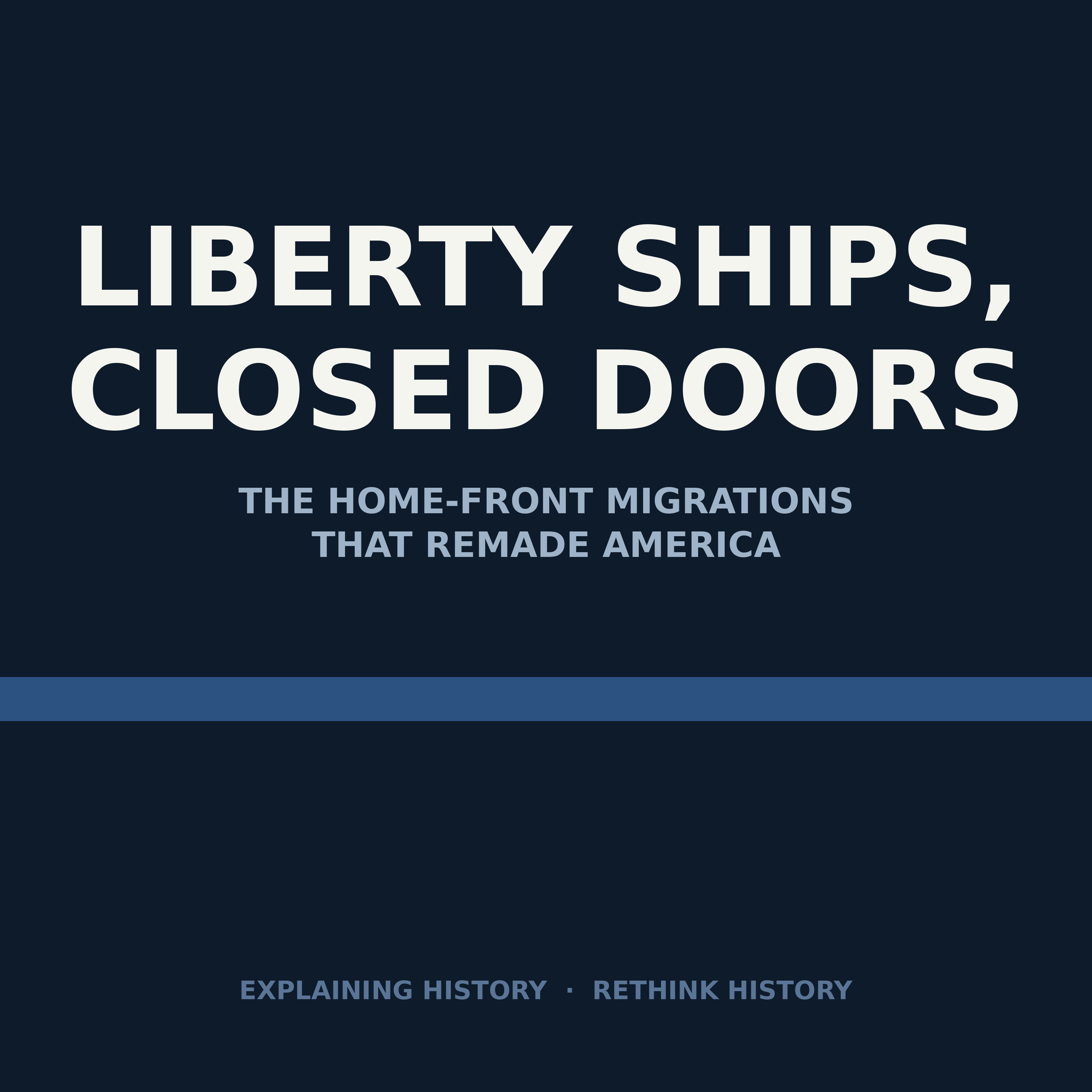
Liberty Ships, Closed Doors
The home-front migrations that remade America. When World War II turned the United States into the Arsenal of Democracy, it set the largest internal migration in the nation's history in motion — and cracked open the industrial workforce for Black Southerners, women, and others long shut out, even as it forced some groups out entirely and tried to close the doors again when the war ended. A ReThink History series, told evenhandedly and grounded in the record, that follows every group the boom moved — and comes home to one shipyard town: Marinship, Marin City, and Sausalito. Narrated by AI voice...
Author
Let's ReThink History
Category
Podcast website
Latest episode
Jun 21, 2026
Where to listen?
Podcasts in the app Replaio Radio Coming soonPodcasts are coming to the app soon. Install now and be the first to see a whole new take on podcasts
 Install for free
Android 5M+ downloads · 4.8 rating
iOS soon
Install for free
Android 5M+ downloads · 4.8 rating
iOS soon
Episodes
Episode 13 — The Door Half-Shut, the Door Held Open (Finale) 21.06.2026 40:03
The series ends where it began, on a shoreline north of San Francisco — but first it reckons with how the war's open doors were forced shut. When peace came, women were pushed out of the factories, the boomtowns emptied or drowned, and Black families who had come for the shipyards were locked out of the rising postwar middle class by restrictive covenants, redlining, and a GI Bill whose benefits f...
Episode 12 — Marinship: The Welder Who Sued His Own Union 21.06.2026 40:51
Marinship is the whole series compressed onto one waterfront. In 1942 the Bechtel company raised an entire shipyard out of a Sausalito mudflat in a matter of months, and by its peak some twenty thousand people — among them Black migrants drawn from the South — were building Liberty ships and tankers there, in one of the most genuinely integrated workforces of the war. And yet, to hold those jobs,...
Episode 11 — 1943: The Year It Boiled Over 21.06.2026 28:21
The migration this series has followed did not happen in calm. It jammed millions of people of every background into overcrowded boomtowns and mixed workplaces, with the color line under strain as Black workers pressed for jobs long denied them — and in a single year, 1943, it boiled over. White mobs and 'hate strikes' turned on Black workers and neighborhoods in Detroit, in the Mobile shipyards,...
Episode 10 — Boomtowns: Life and Death in America's Disposable Cities 21.06.2026 29:51
Where did the millions actually live? The answer is the boomtown — the instant city raised beside a shipyard or aircraft plant, with federal money, to shelter workers who arrived faster than any ordinary place could hold them. Rooms were so scarce that strangers shared beds in shifts; water, sewers, and schools buckled; so whole towns were conjured from mudflats and fields almost overnight. It was...
Episode 9 — The Other Workers: Native, Chinese, and Filipino Americans at War 21.06.2026 30:03
The big migration stories — Black Southerners, women, white Appalachians — leave people out, and this episode is for them. The war's hunger for workers and soldiers reached groups long shut out of American life, and in each case cracked a door open: Native Americans left the reservations in unprecedented numbers for war plants and the armed forces, including the famed code talkers; Chinese America...
Episode 8 — The Bracero Bargain and the Zoot Suit Riots 21.06.2026 17:25
In the same year, the United States did two things to people of Mexican descent that, set side by side, tell the whole story. It signed an agreement to import Mexican men by the hundreds of thousands to harvest its crops and maintain its railroads — the Bracero Program — welcoming them strictly as temporary hands, on contracts whose promises of fair wages and decent housing were often broken. And...
Episode 7 — Forced Out: Japanese American Incarceration and the War's Mirror Image 21.06.2026 33:41
Every other chapter of this series is about people moving toward the war boom. This one is about a group forced away from it. Ten weeks after Pearl Harbor, Executive Order 9066 authorized the removal of everyone of Japanese ancestry from the West Coast — about 120,000 people, roughly two-thirds of them American citizens — giving families days to sell or abandon their homes, farms, and businesses b...
Episode 6 — The Hillbilly Highway: How the Other Southern Migration Rewired America 21.06.2026 34:09
The migration the famous home-front story tends to skip: the millions of white Southerners and Appalachians who, pushed by failing coal and cotton and pulled by the war's bottomless demand for labor, drove north up roads so crowded with their own that they were called the Hillbilly Highway — U.S. 23 and U.S. 25, out of Kentucky, West Virginia, and Tennessee toward Detroit's auto-turned-war plants,...
Episode 5 — Rosie and the Real Women 21.06.2026 35:09
The poster shows a woman flexing her arm under the words 'We Can Do It!' — but the real history of women war workers is bigger, harder, and more double-edged than any poster. The war pulled nearly twenty million women into the workforce, a third of all American workers, and sent them into work that had been all but closed to them: welding the hulls of Liberty ships, riveting bombers, running the h...
Episode 4 — Executive Order 8802: How Randolph Forced FDR to Open the Door 21.06.2026 34:37
The door the war cracked open for Black workers did not swing wide on its own — someone forced it. In 1941, with defense plants booming and still refusing to hire Black Americans, labor leader A. Philip Randolph threatened to bring tens of thousands of marchers to Washington to demand a share of the work. A week before the planned march, Roosevelt signed Executive Order 8802 — the first federal ba...
Episode 3 — The Second Great Migration: The South to the Coast 21.06.2026 39:11
The migration at the heart of the series. Pushed by the collapsing economics of Southern cotton and the daily dangers of Jim Crow, and pulled by the war's insatiable hunger for workers, more than a million Black Southerners left the South in the 1940s alone — part of a Second Great Migration that would move over five million people across three decades. What made the wartime wave new was the map:...
Episode 2 — The Arsenal Calls: How War Factories Remade the American Map 21.06.2026 39:03
Before the series can follow the people who moved, it has to explain what pulled them. Beginning with Franklin Roosevelt's December 1940 promise that America would be the 'great arsenal of democracy,' this episode tells the most astonishing industrial mobilization in history — the War Production Board, the Maritime Commission's Liberty ships, cost-plus contracts, and federally financed plants that...
Episode 1 — A Town the War Built: Marin City's Long Fight to Integrate 21.06.2026 36:52
A series about the greatest movement of people in American history begins with one town the movement created. In 1942 the federal government raised a shipyard, Marinship, on a Sausalito mudflat and built a whole town — Marin City — to house the workers who poured in from across the country, including Black families from the South. The yard closed after the war; the town remained, and so did a ques...
Similar podcasts




Listen to the Liberty Ships, Closed Doors podcast in Replaio
Radio and podcasts in one app - free, with no sign-up. Install today and do not miss the launch
Replaio is not a podcast publisher; show names, artwork and audio belong to their authors and are distributed through public RSS feeds.