Christopher Michael Patton
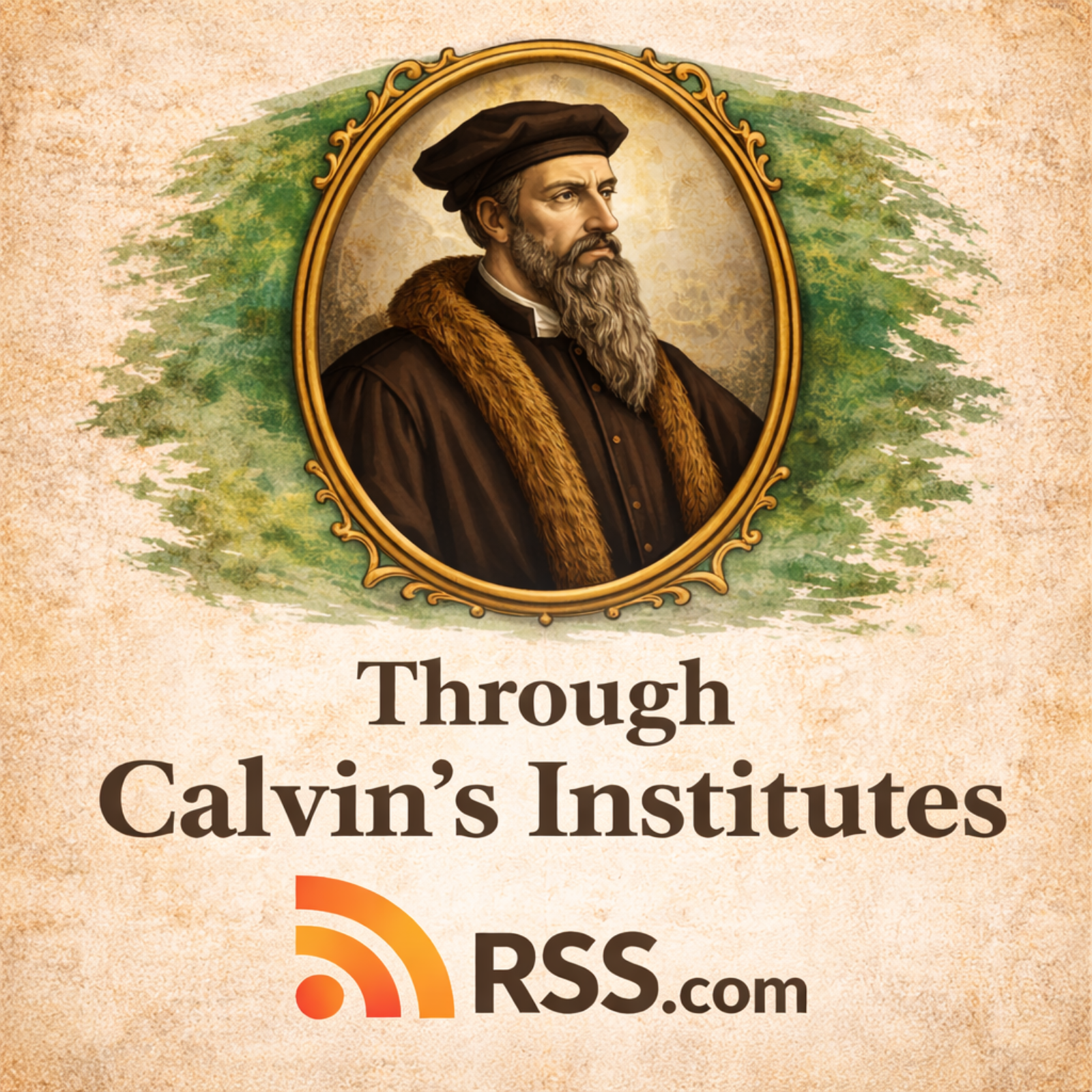
John Calvin's Institutes in a Year
Ever stared at John Calvin’s Institutes of the Christian Religion on your shelf and thought, “One day I’ll finally read that… but where would I even start?” This podcast is for that moment. Calvin’s Institutes in a Year is a guided, day-by-day journey through one of the most influential works in Christian theology. Together, we read through the entire Institutes over the course of a full year—one manageable section at a time—so that a book many admire from a distance finally becomes something you actually finish. Each daily episode is short, focused, and intentional. We keep the pace steady, t...
Be sure to visit the podcast's website and support the creator: rss.com
Where to listen?
Podcasts in the app Replaio Radio Coming soonPodcasts are coming to the app soon. Install now and be the first to see a whole new take on podcasts
 Install for free
Android almost 10M downloads · 4.8 rating
iOS soon
Install for free
Android almost 10M downloads · 4.8 rating
iOS soon
Episodes
Calvin's Institutes: February 9 09.02.2026 11:21
God is not a distant Creator who wound up the world and stepped away—he is the living Governor who sustains, directs, and rules every moment of creation, so that what appears to us as chance is in fact ordered by his wise and deliberate counsel (Hebrews 11:3; Psalm 33:6, 13; Psalm 104:27–30; Matthew 10:30; Psalm 115:3). In these opening sections of Book 1, Chapter 16, Calvin presses past vague app...
Calvin's Institutes: February 8 08.02.2026 11:20
Providence is not God watching the world from a distance—it is God holding the helm, governing every moment, every creature, and every detail down to the sparrow and the numbered hair, which means that what looks like “chance” is actually the hidden wisdom of the Father at work for his own ends (Hebrews 11:3; Matthew 10:30; Psalm 33:6, 13; Psalm 104:27–30; Acts 17:28; Psalm 115:3; Jeremiah 10:2)....
Calvin's Institutes: February 7 07.02.2026 8:40
In this reading, John Calvin turns from speculation to consolation, showing how the doctrine of angels is meant not to satisfy curiosity but to strengthen faith. He grounds the reality of angels firmly in Scripture, presenting them as real, personal, ministering spirits appointed by God for the protection and care of His people. Calvin resists both extremes—denying angels altogether on the one han...
Calvin's Institutes: February 6 06.02.2026 11:34
How do we truly know the invisible God when nature alone leaves us prone to confusion and speculation? In this reading, Calvin explains why Scripture provides a clearer portrait of God than creation by itself ever could, grounding our knowledge of the Creator in the historical account given through Moses. He rebukes arrogant curiosity about time, eternity, and creation, urging humility where God h...
Calvin's Institutes: February 5 05.02.2026 10:02
of God? In today’s reading, Calvin carefully addresses this tension by showing how Scripture speaks of the Father and the Son according to order and role without dividing the divine essence. He explains Christ’s words as Mediator, clarifies passages that seem to imply inferiority, and demonstrates that the Son’s submission belongs to His redemptive office, not to His nature. Drawing on Irenaeus, T...
Calvin's Institues: February 4 04.02.2026 6:28
When people try to protect monotheism by shrinking Christ, they do not save the doctrine of God—they replace it with a Trinity that collapses into fiction. Today Calvin confronts the claim that the word “God” belongs to the Father alone and shows why that move cannot survive the Bible’s own logic: if only God is good, immortal, wise, and worthy of exclusive worship, and yet these belong to Christ,...
Calvin's Institues: February 3 03.02.2026 12:21
The doctrine of the Trinity is not a puzzle for clever minds but a boundary line that keeps the church worshiping the true God rather than a god of our own speculation. Today Calvin tightens the distinction that must be held without tearing the unity: one divine essence fully present in Father, Son, and Spirit, distinguished not by parts of deity but by personal relations that do not divide God. H...
Calvin's Institutes: February 2 02.02.2026 11:15
If the Son is truly divine, then the Spirit cannot be a lesser afterthought, a mere force, or an impersonal influence—and Calvin refuses to let the Bible be softened into that kind of half-truth. Today’s reading gathers Scripture’s testimony and the believer’s lived experience into a single confession: the Spirit was active before the world had form, sustains creation by divine power, grants new b...
Calvin's Institutes: February 1 01.02.2026 12:07
Unity is not a late Christian invention—it is the native air of Scripture, because the one God has always made Himself known through the one Mediator. Today Calvin presses the Old Testament appearances of “the Angel of the Lord” until the reader feels the weight of the claim: this Angel receives divine honor, bears the divine name, and is recognized as God, and therefore cannot be a created messen...
Calvin's Instutes: January 31 31.01.2026 5:52
In today’s reading from Calvin’s Institutes , we are confronted with one of the most decisive claims of historic Christianity: that the Word is eternally God, without beginning, change, or diminution. Calvin shows that denying the eternity of the Word—even while claiming to honor Christ—introduces change into God Himself and collapses the doctrine of divine immutability. Drawing from Moses, the pr...
Calvin's Institutes: January 30 30.01.2026 5:12
What does it really mean to say that God is one—and yet Father, Son, and Holy Spirit? In this reading, John Calvin confronts both ancient and modern distortions of God by grounding our knowledge of Him in Scripture’s revelation of His infinite, spiritual nature and His triune being. Calvin explains why God cannot be reduced to creation, imagination, or philosophical abstraction, and why the Church...
Calvin's Institutes: January 29 29.01.2026 6:27
In this reading from Institutes of the Christian Religion , John Calvin presses a simple but unsettling claim: true knowledge of God always demands exclusive worship, and the moment that worship is shared—even subtly—true religion collapses into superstition. Calvin exposes how idolatry rarely begins with open rebellion, but with divided devotion: God is confessed as supreme while His honor is qui...
Calvin's Instittues: January 27 28.01.2026 5:40
Here Calvin traces idolatry to its true source: the human desire to make God tangible. Once the mind fashions a visible form of God, worship inevitably attaches itself to that form, no matter how carefully the act is explained or renamed. Calvin exposes the long-standing defense that images merely assist devotion, showing that the same arguments were used by ancient idolaters and rejected by Scrip...
Calvin's Institues: January 28 28.01.2026 6:28
Calvin closes this chapter by appealing not only to Scripture but to history itself. For the first five centuries of the Church—when doctrine was purer and faith more disciplined—Christian worship spaces were entirely without images. This was not oversight, but wisdom. Augustine warned that once images are placed before praying people, they inevitably work upon the imagination as if they were aliv...
Calvin's Institutes: January 26 26.01.2026 7:26
In these sections, Calvin dismantles the familiar claim that images serve as “books for the unlearned,” insisting instead that Scripture calls them teachers of lies, not aids to faith. Drawing from the prophets, the apostles, and the early Church Fathers, Calvin shows that images do not clarify divine truth but replace it—substituting mute objects for the living voice of God in His Word. He argues...
Calvin's Institutes: January 25 25.01.2026 6:27
Today’s reading confronts one of the Church’s most persistent temptations: the desire to make the invisible God manageable through visible forms. In Institutes of the Christian Religion , Book 1, Chapter 11, Sections 1–4, John Calvin argues that every attempt to represent God visually—however sincere—inevitably corrupts His glory. Drawing from the Law, the Prophets, the Apostles, and even pagan wi...
Calvin's Institues: January 24 24.01.2026 6:33
Today’s reading presses us to recognize that the God revealed in Scripture is not a different God from the one made known in creation—but the same Lord, now speaking with clarity, authority, and moral demand. John Calvin shows how Scripture gathers what creation whispers and declares it plainly: God’s steadfast love, righteous judgment, and faithful rule over the world. Against the confusion of pa...
Calvin's Institutes: January 23 23.01.2026 6:37
Something is deeply wrong when people claim the Spirit of God while discarding the very Word the Spirit inspired. In today’s reading from John Calvin, we confront the perennial temptation of “spiritual” enthusiasm that substitutes private revelations for Scripture itself. Calvin argues with force and clarity that the Spirit of Christ never leads believers away from the written Word but seals that...
Calvin's Institutes: January 22 22.01.2026 11:54
Today’s reading from John Calvin confronts one of the most persistent questions in Christian theology: why should Scripture be trusted? Calvin argues that while fulfilled prophecy, historical preservation, apostolic witness, and even the blood of martyrs all provide powerful external confirmation, none of these can create true faith on their own. Isaiah’s naming of Cyrus long before his birth, Jer...
Calvin's Institutes: January 21 21.01.2026 12:32
How can Scripture be shown credible to natural reason without replacing the deeper certainty given by the Spirit? Calvin carefully answers by pointing to the unmistakable marks of divine majesty woven throughout the Bible itself—its power, simplicity, harmony, and authority—qualities that surpass every human work and pierce the heart in a way no rhetoric can achieve (1 Corinthians 2:4–5). He then...
Calvin's Institutes: January 20 20.01.2026 7:46
Today’s reading presses to the heart of one of Christianity’s most decisive claims: Scripture does not gain its authority from human approval, argument, or institutional endorsement, but from God himself through the inward testimony of the Holy Spirit. John Calvin argues that while Scripture bears unmistakable marks of divine majesty and coherence, no amount of reasoning alone can produce the cert...
Calvin's Insitutes: January 19 19.01.2026 7:59
Why should Scripture be trusted as God’s Word? Calvin argues that the Bible does not receive its authority from the Church, but from God Himself, confirmed inwardly by the Holy Spirit. While the Church bears witness to Scripture, it does not stand above it; rather, the Church is built upon the Word, not the other way around (Ephesians 2:20). Calvin insists that Scripture is self-authenticating—rec...
Calvin's Institutes: January 18 18.01.2026 10:51
Why isn’t creation enough to lead us to God? In this reading, Calvin argues that while the world truly displays God’s glory, human corruption turns that light into a maze rather than a path. Scripture, he says, is not an optional supplement to nature but the necessary guide that gathers our scattered impressions of God and brings them into clarity. Like spectacles correcting failing sight, the Wor...
Calvin's Institutes: January 17 17.01.2026 4:05
In today’s reading, Calvin delivers one of his most uncompromising critiques of false religion, arguing that any worship not grounded in God’s self-revelation ultimately replaces the true God with demons. Drawing from Paul and Christ Himself, Calvin shows that even sincere or culturally inherited religion is no refuge from error—ignorance of God is still guilt before Him (Ephesians 2:12; John 4:22...
Calvin's Institutes: January 16 16.01.2026 7:14
In today’s reading, Calvin argues that knowing God does not require philosophical gymnastics or abstract speculation—God’s majesty is already placed directly before us in creation and providence. Yet what should be obvious is persistently ignored. Calvin shows how God reveals Himself through His works in ways that awaken worship, point us toward eternal judgment, and expose the limits of human rea...
Similar podcasts






Listen to the John Calvin's Institutes in a Year podcast in Replaio
Radio and podcasts in one app - free, with no sign-up. Install today and do not miss the launch
Replaio is not a podcast publisher; show names, artwork and audio belong to their authors and are distributed through public RSS feeds.