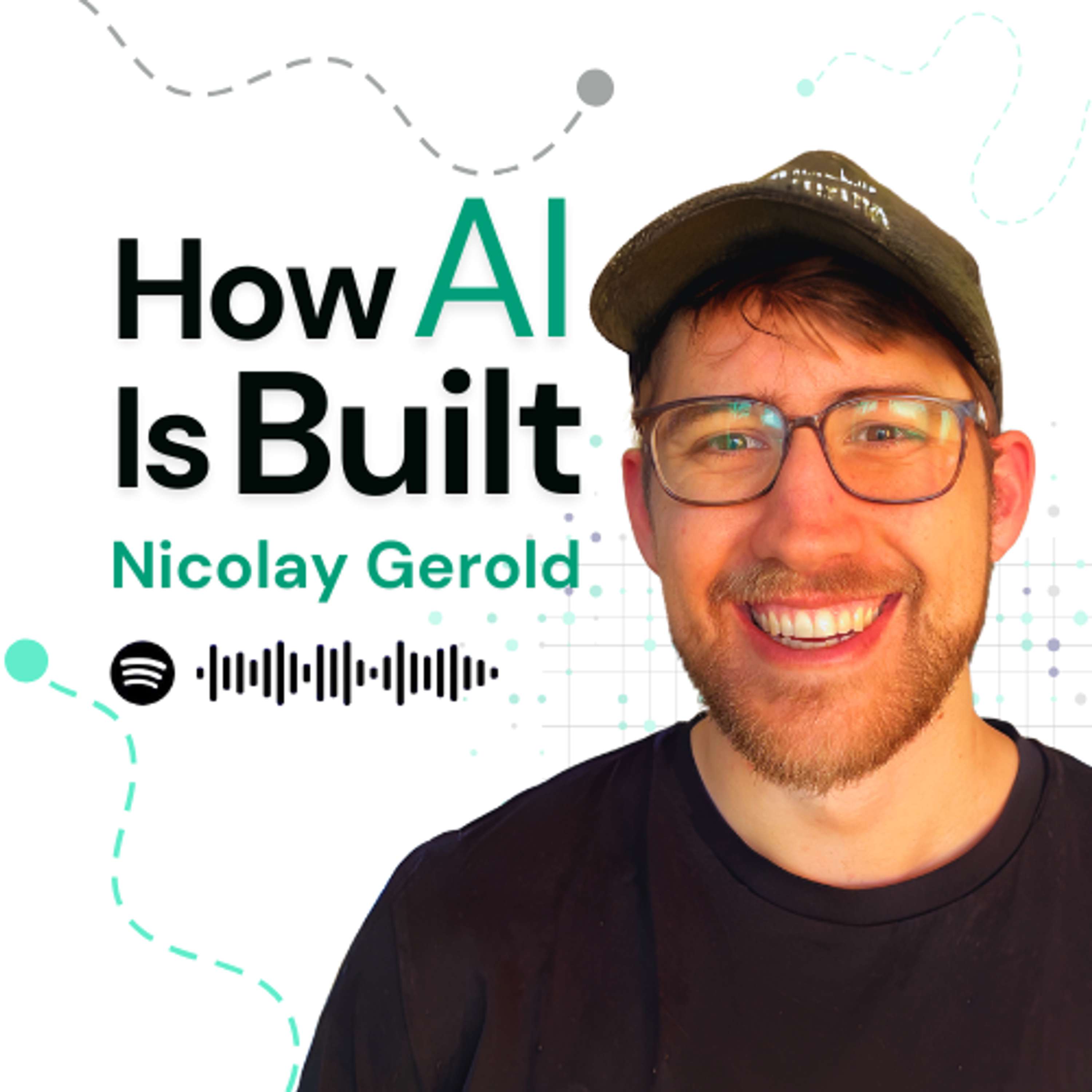
Nicolay Gerold
How AI Is Built
Real engineers. Real deployments. Zero hype. We interview the top engineers who actually put AI in production. Learn what the best engineers have figured out through years of experience. Hosted by Nicolay Gerold, CEO of Aisbach and CTO at Proxdeal and Multiply Content.
Author
Nicolay Gerold
Category
Podcast website
Latest episode
Sep 11, 2025
Where to listen?
Podcasts in the app Replaio Radio Coming soonPodcasts are coming to the app soon. Install now and be the first to see a whole new take on podcasts
 Install for free
Android 5M+ downloads · 4.8 rating
iOS soon
Install for free
Android 5M+ downloads · 4.8 rating
iOS soon
Episodes
#056 Building Solo: How One Engineer Uses AI Agents to Ship Production Code 11.09.2025 1:12:24
Nicolay here, Most AI coding conversations focus on which model to use. This one focuses on workflow - the specific commands, git strategies, and review processes that let one engineer ship production code with AI agents doing 80% of the work. Today I have the chance to talk to Kieran Klaassen, who built Cora (an AI email management tool) almost entirely solo using AI agents. His approach: treat A...
#055 Embedding Intelligence: AI's Move to the Edge 13.08.2025 1:05:35
Nicolay here, while everyone races to cloud-scale LLMs, Pete Warden is solving AI problems by going completely offline. No network connectivity required. Today I have the chance to talk to Pete Warden, CEO of Useful Sensors and author of the TinyML book. His philosophy: if you can't explain to users exactly what happens to their data, your privacy model is broken. Key Insight: The Real World Actio...
#054 Building Frankenstein Models with Model Merging and the Future of AI 29.07.2025 1:06:55
Nicolay here,most AI conversations focus on training bigger models with more compute. This one explores the counterintuitive world where averaging weights from different models creates better performance than expensive post-training. Today I have the chance to talk to Maxime Labonne, who's a researcher at Liquid AI and the architect of some of the most popular open source models on Hugging Face. H...
#053 AI in the Terminal: Enhancing Coding with Warp 23.07.2025 1:04:30
Nicolay here, Most AI coding tools obsess over automating everything. This conversation focuses on the right balance between human skill and AI assistance - where manual context beats web search every time. Today I have the chance to talk to Ben Holmes, a software engineer at Warp, where they're building the AI-first terminal. Manual context engineering trumps automated web search for getting accu...
#052 Don't Build Models, Build Systems That Build Models 01.07.2025 59:22
Nicolay here, Today I have the chance to talk to Charles from Modal, who went from doing a PhD on neural network optimization in the 2010s - when ML engineers could build models with a soldering iron and some sticks - to architecting serverless infrastructure for AI models. Modal is about removing barriers so anyone can spin up a hundred GPUs in seconds. The critical insight that stuck with me: "D...
#051 Build systems that can be debugged at 4am by tired humans with no context 17.06.2025 1:05:51
Nicolay here, Today I have the chance to talk to Charity Majors, CEO and co-founder of Honeycomb, who recently has been writing about the cost crisis in observability. "Your source of truth is production, not your IDE - and if you can't understand your code there, you're flying blind." The key insight is architecturally simple but operationally transformative: replace your 10-20 observability tool...
#050 Bringing LLMs to Production: Delete Frameworks, Avoid Finetuning, Ship Faster 27.05.2025 1:06:57
Nicolay here, Most AI developers are drowning in frameworks and hype. This conversation is about cutting through the noise and actually getting something into production. Today I have the chance to talk to Paul Iusztin, who's spent 8 years in AI - from writing CUDA kernels in C++ to building modern LLM applications. He currently writes about production AI systems and is building his own AI writing...
#050 TAKEAWAYS Bringing LLMs to Production: Delete Frameworks, Avoid Finetuning, Ship Faster 27.05.2025 11:00
Nicolay here, Most AI developers are drowning in frameworks and hype. This conversation is about cutting through the noise and actually getting something into production. Today I have the chance to talk to Paul Iusztin, who's spent 8 years in AI - from writing CUDA kernels in C++ to building modern LLM applications. He currently writes about production AI systems and is building his own AI writing...
#049 BAML: The Programming Language That Turns LLMs into Predictable Functions 20.05.2025 1:02:38
Nicolay here, I think by now we are done with marveling at the latest benchmark scores of the models. It doesn’t tell us much anymore that the latest generation outscores the previous by a few basis points. If you don’t know how the LLM performs on your task, you are just duct taping LLMs into your systems. If your LLM-powered app can’t survive a malformed emoji, you’re shipping liability, not sof...
#049 TAKEAWAYS BAML: The Programming Language That Turns LLMs into Predictable Functions 20.05.2025 1:12:34
Nicolay here, I think by now we are done with marveling at the latest benchmark scores of the models. It doesn’t tell us much anymore that the latest generation outscores the previous by a few basis points. If you don’t know how the LLM performs on your task, you are just duct taping LLMs into your systems. If your LLM-powered app can’t survive a malformed emoji, you’re shipping liability, not sof...
#048 TAKEAWAYS Why Your AI Agents Need Permission to Act, Not Just Read 13.05.2025 7:06
Nicolay here, most AI conversations obsess over capabilities. This one focuses on constraints - the right ones that make AI actually useful rather than just impressive demos. Today I have the chance to talk to Dexter Horthy, who recently put out a long piece called the “12-factor agents”. It’s like the 10 commandments, but for building agents. One of it is “Contact human with tool calls”: the LLM...
#048 Why Your AI Agents Need Permission to Act, Not Just Read 11.05.2025 57:02
Nicolay here, most AI conversations obsess over capabilities. This one focuses on constraints - the right ones that make AI actually useful rather than just impressive demos. Today I have the chance to talk to Dexter Horthy, who recently put out a long piece called the “12-factor agents”. It’s like the 10 commandments, but for building agents. One of it is “Contact human with tool calls”: the LLM...
#047 Architecting Information for Search, Humans, and Artificial Intelligence 27.03.2025 57:21
Today on How AI Is Built , Nicolay Gerold sits down with Jorge Arango, an expert in information architecture. Jorge emphasizes that aligning systems with users' mental models is more important than optimizing backend logic alone. He shares a clear framework with four practical steps: Key Points: Information architecture should bridge user mental models with system data models Information's purpose...
#046 Building a Search Database From First Principles 13.03.2025 53:28
Modern search is broken. There are too many pieces that are glued together. Vector databases for semantic search Text engines for keywords Rerankers to fix the results LLMs to understand queries Metadata filters for precision Each piece works well alone. Together, they often become a mess. When you glue these systems together, you create: Data Consistency Gaps Your vector store knows about documen...
#045 RAG As Two Things - Prompt Engineering and Search 06.03.2025 1:02:43
John Berryman moved from aerospace engineering to search, then to ML and LLMs. His path: Eventbrite search → GitHub code search → data science → GitHub Copilot. He was drawn to more math and ML throughout his career. RAG Explained "RAG is not a thing. RAG is two things." It breaks into: Search - finding relevant information Prompt engineering - presenting that information to the model These should...
#044 Graphs Aren't Just For Specialists Anymore 28.02.2025 1:03:34
Kuzu is an embedded graph database that implements Cypher as a library. It can be easily integrated into various environments—from scripts and Android apps to serverless platforms. Its design supports both ephemeral, in-memory graphs (ideal for temporary computations) and large-scale persistent graphs where traditional systems struggle with performance and scalability. Key Architectural Decisions:...
#043 Knowledge Graphs Won't Fix Bad Data 20.02.2025 1:10:58
Metadata is the foundation of any enterprise knowledge graph. By organizing both technical and business metadata, organizations create a “brain” that supports advanced applications like AI-driven data assistants. The goal is to achieve economies of scale—making data reusable, traceable, and ultimately more valuable. Juan Sequeda is a leading expert in enterprise knowledge graphs and metadata manag...
#042 Temporal RAG, Embracing Time for Smarter, Reliable Knowledge Graphs 13.02.2025 1:33:43
Daniel Davis is an expert on knowledge graphs. He has a background in risk assessment and complex systems—from aerospace to cybersecurity. Now he is working on “Temporal RAG” in TrustGraph. Time is a critical—but often ignored—dimension in data. Whether it’s threat intelligence, legal contracts, or API documentation, every data point has a temporal context that affects its reliability and usefulne...
#041 Context Engineering, How Knowledge Graphs Help LLMs Reason 06.02.2025 1:33:34
Robert Caulk runs Emergent Methods, a research lab building news knowledge graphs. With a Ph. D. in computational mechanics, he spent 12 years creating open-source tools for machine learning and data analysis. His work on projects like Flowdapt (model serving) and FreqAI (adaptive modeling) has earned over 1,000 academic citations. His team built AskNews, which he calls "the largest news knowledge...
#040 Vector Database Quantization, Product, Binary, and Scalar 31.01.2025 52:11
When you store vectors, each number takes up 32 bits. With 1000 numbers per vector and millions of vectors, costs explode. A simple chatbot can cost thousands per month just to store and search through vectors. The Fix: Quantization Think of it like image compression. JPEGs look almost as good as raw photos but take up far less space. Quantization does the same for vectors. Today we are back conti...
#039 Local-First Search, How to Push Search To End-Devices 23.01.2025 53:08
Alex Garcia is a developer focused on making vector search accessible and practical. As he puts it: "I'm a SQLite guy. I use SQLite for a lot of projects... I want an easier vector search thing that I don't have to install 10,000 dependencies to use.” Core Mantra: "Simple, Local, Scalable" Why SQLite Vec? "I didn't go along thinking, 'Oh, I want to build vector search, let me find a database for i...
#038 AI-Powered Search, Context Is King, But Your RAG System Ignores Two-Thirds of It 09.01.2025 1:14:23
Today, I (Nicolay Gerold) sit down with Trey Grainger, author of the book AI-Powered Search. We discuss the different techniques for search and recommendations and how to combine them. While RAG (Retrieval-Augmented Generation) has become a buzzword in AI, Trey argues that the current understanding of "RAG" is overly simplified – it's actually a bidirectional process he calls "GARRAG," where retri...
#037 Chunking for RAG: Stop Breaking Your Documents Into Meaningless Pieces 03.01.2025 49:12
Today we are back continuing our series on search. We are talking to Brandon Smith, about his work for Chroma. He led one of the largest studies in the field on different chunking techniques. So today we will look at how we can unfuck our RAG systems from badly chosen chunking hyperparameters. The biggest lie in RAG is that semantic search is simple. The reality is that it's easy to build, it's ea...
#036 How AI Can Start Teaching Itself - Synthetic Data Deep Dive 19.12.2024 48:10
Most LLMs you use today already use synthetic data. It’s not a thing of the future. The large labs use a large model (e.g. gpt-4o) to generate training data for a smaller one (gpt-4o-mini). This lets you build fast, cheap models that do one thing well. This is “distillation”. But the vision for synthetic data is much bigger. Enable people to train specialized AI systems without having a lot of tra...
#035 A Search System That Learns As You Use It (Agentic RAG) 13.12.2024 45:29
Modern RAG systems build on flexibility. At their core, they match each query with the best tool for the job. They know which tool fits each task. When you ask about sales numbers, they reach for SQL. When you need to company policies, they use vector search or BM25. The key is switching tools smoothly. A question about sales figures might need SQL, while a search through policy documents works be...
Similar podcasts







Listen to the How AI Is Built podcast in Replaio
Radio and podcasts in one app - free, with no sign-up. Install today and do not miss the launch
Replaio is not a podcast publisher; show names, artwork and audio belong to their authors and are distributed through public RSS feeds.