Shepler@Civics
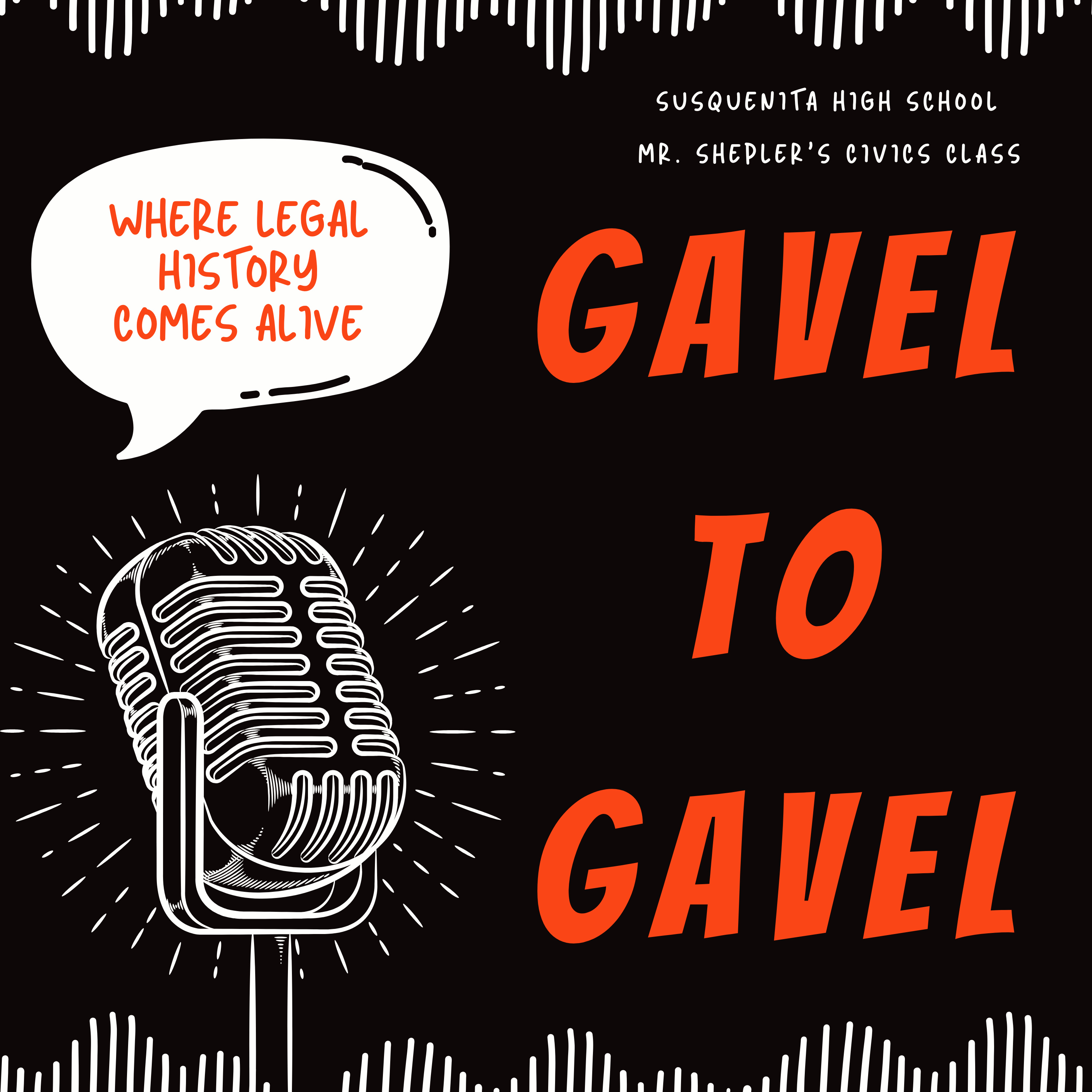
Gavel To Gavel: Student Perspectives on Supreme Court Landmarks
Gavel to Gavel dives into all kinds of court cases—from famous Supreme Court decisions to lesser-known legal battles—with student voices leading the way. We break down complex issues, explore different sides, and connect them to what’s happening today. It’s engaging, easy to follow, and designed to get you thinking about your rights, the law, and how it all impacts your everyday life.
Author
Shepler@Civics
Category
Podcast website
Latest episode
Mar 27, 2026
Where to listen?
Podcasts in the app Replaio Radio Coming soonPodcasts are coming to the app soon. Install now and be the first to see a whole new take on podcasts
 Install for free
Android 5M+ downloads · 4.8 rating
iOS soon
Install for free
Android 5M+ downloads · 4.8 rating
iOS soon
Episodes
Welcome to Gavel to Gavel (Season 2) 27.03.2026 2:19
In this episode, Federal Judge Jen Wilson introduces the season and explains the rights of the accused. Students learn why these rights are important and how they protect fairness in the justice system.
Your Right to Stay Silent (Miranda v. Arizona) 27.03.2026 5:12
In this episode, we learn why police must tell people their rights before questioning them. This helps students understand their rights and how they are protected.
Asking for a Lawyer (Escobedo v. Illinois) 27.03.2026 7:52
In this episode, we explore how the Court said people have the right to a lawyer during questioning. This helps students understand the importance of having help when facing serious situations.
Sharing Important Evidence (Brady v. Maryland) 27.03.2026 7:18
In this episode, we learn that prosecutors must share important evidence with the defense. This helps students understand that fairness means everyone gets the full story.
Waiting for Trial (Barker v. Wingo) 27.03.2026 6:23
In this episode, we discover how the Court decided what counts as a “speedy trial.” This helps students understand why it’s important not to wait too long for justice.
Choosing a Fair Jury (Batson v. Kentucky) 27.03.2026 4:33
In this episode, we learn how the Court said people cannot be excluded from juries because of race. This helps students understand fairness and why everyone deserves equal treatment.
Is the Death Penalty Fair? (Furman v. Georgia) 27.03.2026 4:42
In this episode, we learn how the Court stopped the death penalty for a time because it was not being used fairly. This helps students understand how laws can change when they are unfair.
Fair Rules for Punishment (McCleskey v. Kemp) 27.03.2026 3:41
In this episode, we explore how the Court looked at fairness in sentencing. This helps students think about why rules must be applied equally to everyone.
Kids and Big Decisions (Roper v. Simmons) 27.03.2026 5:10
In this episode, we discover why the Court ruled that people under 18 cannot receive the death penalty. This helps students understand that the law recognizes that kids and adults are different.
Tracking and Privacy (U.S. v. Jones) 27.03.2026 3:53
In this episode, we learn how tracking someone with a device raised questions about privacy. This case helps students understand how technology and rules about personal space connect.
Phones and Privacy (Riley v. California) 27.03.2026 4:33
In this episode, we explore how the Court ruled that police usually need a warrant to search a cell phone. This helps students see how personal information—like messages and photos—is protected.
Searching Your Car (Arizona v. Gant) 27.03.2026 5:16
In this episode, we learn how the Supreme Court decided when police can search a car after an arrest. This case helps students understand that rules exist to protect people’s privacy, even when someone is in trouble.
West Virginia State Board of Education v. Barnette 17.03.2026 5:50
West Virginia State Board of Education v. Barnette (1943) ruled that students cannot be forced to salute the flag or recite the Pledge of Allegiance. The Supreme Court held that compelled patriotic speech violates the First Amendment.
Engel v. Vitale 17.03.2026 6:48
Engel v. Vitale (1962) ruled that school-sponsored prayer in public schools violates the Establishment Clause. The Supreme Court held that even voluntary, nondenominational prayer is unconstitutional in a government-funded setting.
Wisconsin v. Yoder 17.03.2026 5:59
Wisconsin v. Yoder (1972) ruled that Amish families could not be forced to send their children to school past eighth grade. The Supreme Court held that compulsory education laws violated their First Amendment right to religious freedom.
Ingraham v. Wright 17.03.2026 10:30
Ingraham v. Wright (1977) upheld the use of corporal punishment in public schools, ruling it does not violate the Eighth Amendment. The Supreme Court found that school discipline is a local matter, leaving regulation to states and school districts.
Island Trees School District v. Pico 17.03.2026 4:49
Island Trees School District v. Pico (1982) ruled that schools cannot remove books from libraries simply because they dislike their content. The Supreme Court held that doing so violates students’ First Amendment rights.
Plyler v. Doe 17.03.2026 4:42
Plyler v. Doe (1982) ruled that states cannot deny free public education to undocumented children. The Supreme Court held that such policies violate the Equal Protection Clause of the Fourteenth Amendment.
New Jersey v. T.L.O 17.03.2026 4:51
New Jersey v. T.L.O. (1985) ruled that schools can search students without a warrant if they have reasonable suspicion. The Supreme Court held that the Fourth Amendment applies in schools but with a lower standard than probable cause.
Bethel School District No.43 v. Fraser 17.03.2026 4:27
Bethel v. Fraser (1986) ruled that schools can discipline students for lewd or inappropriate speech. The Supreme Court held that the First Amendment does not protect vulgar speech in a school setting.
Hazelwood School District v. Kuhlmeier 17.03.2026 11:45
Hazelwood v. Kuhlmeier (1988) ruled that schools can censor student newspapers if the content is inconsistent with educational goals. The Supreme Court held that school-sponsored publications are not fully protected under the First Amendment.
Vernonia School District 47J v. Acton 17.03.2026 6:38
Vernonia v. Acton (1995) upheld random drug testing for student-athletes, ruling it did not violate the Fourth Amendment. The Supreme Court found that schools have a legitimate interest in preventing drug use and ensuring student safety.
Santa Fe Independent School District v. Doe 17.03.2026 5:56
Board of Education v. Earls (2002) upheld school drug testing for students in extracurricular activities. The Supreme Court ruled it did not violate the Fourth Amendment, expanding schools’ authority to conduct suspicionless drug tests.
Board of Education v. Earls 17.03.2026 4:11
Board of Education v. Earls (2002) upheld school drug testing for students in extracurricular activities. The Supreme Court ruled it did not violate the Fourth Amendment, expanding schools’ authority to conduct suspicionless drug tests.
Morse v. Frederick 17.03.2026 4:21
Morse v. Frederick (2007) ruled that schools can restrict student speech promoting illegal drug use, even off-campus. The case set a precedent for limits on student free speech under the First Amendment.
Similar podcasts

Listen to the Gavel To Gavel: Student Perspectives on Supreme Court Landmarks podcast in Replaio
Radio and podcasts in one app - free, with no sign-up. Install today and do not miss the launch
Replaio is not a podcast publisher; show names, artwork and audio belong to their authors and are distributed through public RSS feeds.