Jason Edwards
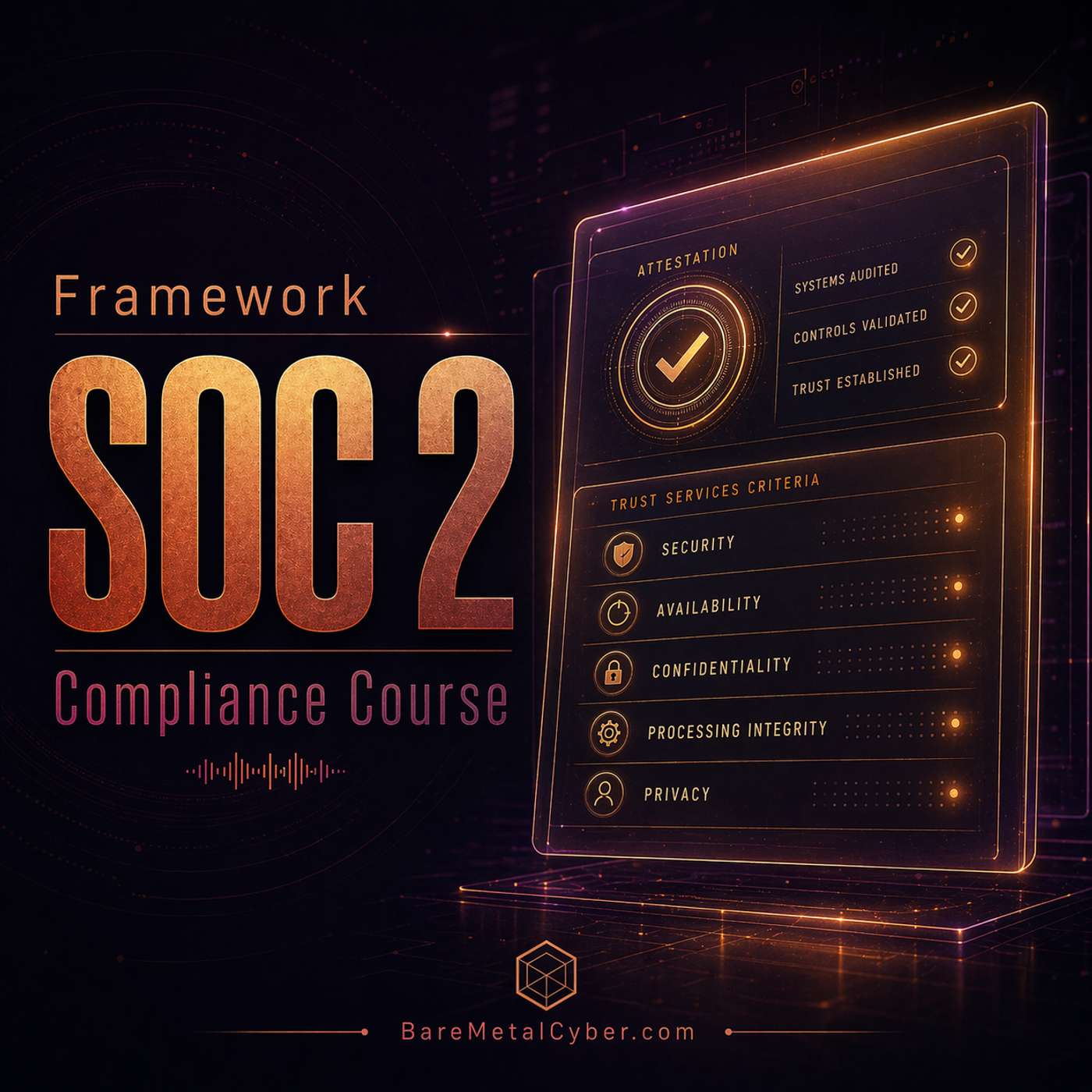
Framework - SOC 2 Compliance Course
The **SOC 2 Compliance Audio Course** is your comprehensive, audio-first guide to understanding and implementing the Service Organization Control (SOC) 2 framework from the ground up. Designed for cybersecurity professionals, auditors, and business leaders, this course breaks down the American Institute of Certified Public Accountants (AICPA) Trust Services Criteria into clear, practical lessons that connect compliance theory with daily operational reality. Each episode explores essential concepts such as governance, risk assessment, security controls, and audit preparation—helping you underst...
Be sure to visit the podcast's website and support the creator: baremetalcyber.com
Author
Jason Edwards
Category
Podcast website
Latest episode
Oct 14, 2025
Where to listen?
Podcasts in the app Replaio Radio Coming soonPodcasts are coming to the app soon. Install now and be the first to see a whole new take on podcasts
 Install for free
Android almost 10M downloads · 4.8 rating
iOS soon
Install for free
Android almost 10M downloads · 4.8 rating
iOS soon
Episodes
Episode 64 — Pre-Sales Enablement: Using SOC 2 to Accelerate Deals 14.10.2025 16:49
SOC 2 becomes a sales accelerator when its lessons and artifacts are packaged for fast, consistent buyer due diligence. The exam will expect you to explain how to translate control narratives and evidence into customer-ready answers: a concise overview of scope and criteria selected, a timeline of Type I and Type II coverage periods, and a mapping of common procurement questions to specific report...
Episode 63 — Pentest Scoping, Findings Lifecycle, Remediation Proof 14.10.2025 18:14
Penetration testing complements SOC 2 by validating the real-world effectiveness of defenses, but its value depends on disciplined scope and a complete findings lifecycle. The exam will expect you to distinguish between internal and external testing, application and network layers, authenticated and unauthenticated approaches, and rules of engagement that protect production stability. Scope should...
Episode 62 — IaC Guardrails & Policy-as-Code (OPA, conftest, SCPs) 14.10.2025 16:45
Infrastructure as Code accelerates delivery, but it can also scale misconfigurations, so SOC 2 programs enforce guardrails that codify security expectations and make them testable. For the exam, connect IaC to CC7 and CC8: baselines live in version control, changes flow through pull requests, and policy-as-code engines such as Open Policy Agent with conftest, cloud service control policies, and or...
Episode 61 — Mobile App SDLC & App-Store Release Governance 14.10.2025 19:15
Bringing mobile applications into SOC 2 scope requires aligning the software development lifecycle with platform-specific governance so releases remain predictable, auditable, and secure. The exam will expect you to articulate how requirements, design, coding, testing, and approval stages translate into control objectives for Apple App Store and Google Play deployments. Key risks include insecure...
Episode 60 — Multi-Cloud Specifics: AWS/Azure/GCP Control Patterns 14.10.2025 18:42
Operating across Amazon Web Services, Microsoft Azure, and Google Cloud Platform introduces divergent primitives that must still yield consistent control outcomes. The exam will expect you to articulate pattern-level equivalence: identity and access management, network segmentation, encryption and key custody, configuration baselines, and logging. Map roles and policies across providers so least p...
Episode 59 — Evidence Retention, Chain-of-Custody, Immutability 14.10.2025 15:55
SOC 2 programs live and die by the quality and integrity of their records. The exam will expect you to distinguish operational retention (keeping artifacts long enough to support the audit and legal obligations) from over-retention that increases exposure. Define retention schedules per artifact type—tickets, logs, access reviews, training attestations, vulnerability scans—and align them with cont...
Episode 58 — Customer Trust Portals & Controlled Evidence Sharing 14.10.2025 16:28
Trust portals convert audit artifacts into a curated, self-service experience for customers, reducing email churn and accelerating procurement reviews. For the exam, anchor your design in least privilege and purpose limitation: authenticate requestors, validate need-to-know, and gate sensitive materials behind nondisclosure agreements. Publish high-value documents such as the system description su...
Episode 57 — GenAI/ML Services in Scope: Risks, Controls, Evidence 14.10.2025 18:50
When generative artificial intelligence and machine learning enter scope, the risk profile expands to include data leakage through prompts, model inversion, training data provenance, and integrity of model outputs embedded in business processes. The exam will expect a structured approach: classify data permitted for prompts, enforce least-privilege access to models and vector stores, and implement...
Episode 56 — Designing a Metrics & KRIs Program for SOC 2 14.10.2025 18:40
A metrics and Key Risk Indicators program translates abstract control objectives into observable signals that management can act on throughout the audit period. For exam readiness, understand the progression from vision to measurement: define objectives tied to the Trust Services Criteria, identify the risks that threaten those objectives, and then select indicators that reveal changes in exposure...
Episode 55 — SRE for Availability: SLOs, Error Budgets, Incident Math 14.10.2025 18:28
Site Reliability Engineering provides quantitative tools to manage availability as a product feature rather than a vague aspiration. The exam will expect fluency in service level indicators, service level objectives, and error budgets that translate customer expectations into measurable targets. Define indicators such as request success rate, latency percentiles, and freshness of batch outputs; se...
Episode 54 — Backup, Restore, and DR Testing at Scale 14.10.2025 19:08
Backups provide recoverability; restores prove it. The exam emphasizes the difference between having copies and demonstrating business-level recovery within stated recovery time and recovery point objectives. At scale, design a tiered strategy: frequent, near-line snapshots for fast rollback; immutable, off-site copies for ransomware resilience; and cold archives for regulatory retention. Catalog...
Episode 53 — Remote Work Security: Home Offices, Travel, Contractors 14.10.2025 19:04
Remote work extends the security perimeter to living rooms, hotel networks, and partner sites, increasing variability and exposure. The exam will expect coverage of secure connectivity, user authentication, and environment controls. Standardize on strong multifactor authentication, device compliance checks, and least-privilege access to applications through secure gateways or zero-trust network ac...
Episode 52 — Endpoint & MDM Controls for Distributed Teams 14.10.2025 18:43
Endpoint security anchors the control environment when users operate outside traditional offices. The exam will expect you to describe a layered model: device enrollment, baseline configuration, patching, anti-malware, disk encryption, host firewalls, and telemetry. Mobile Device Management (MDM) and Enterprise Mobility Management platforms enforce these settings consistently across laptops, table...
Episode 51 — Secrets Management in Code and Pipelines (Deep Dive) 14.10.2025 18:22
Secrets management protects credentials, tokens, keys, and connection strings from exposure across source code, build systems, and runtime environments. For exam readiness, understand the lifecycle: creation, storage, retrieval, rotation, and revocation, with least-privilege access at every step. Hard-coding secrets in repositories is a critical anti-pattern; instead, use dedicated vaults or cloud...
Episode 50 — Key Management & BYOK/KMS Rotations 14.10.2025 18:22
Key management underpins encryption controls within the Confidentiality and Privacy criteria. The exam expects understanding of lifecycle governance—key generation, storage, distribution, rotation, and destruction. Bring Your Own Key (BYOK) models let customers retain control of cryptographic keys within cloud Key Management Services (KMS). Proper configuration ensures data remains encrypted even...
Episode 49 — Data Residency & Sovereignty in SOC 2 Scopes 14.10.2025 21:15
Data residency defines where data physically resides; sovereignty defines which jurisdiction’s laws apply. The exam tests understanding of how these concepts shape SOC 2 scope, particularly under the Availability, Confidentiality, and Privacy criteria. Multi-region hosting and cross-border replication introduce legal and operational complexity. Organizations must document storage locations, backup...
Episode 48 — Beyond the Stamp: Turning SOC 2 into Real Outcomes 14.10.2025 18:28
Achieving a SOC 2 report should mark the start of continuous improvement, not the end. The exam expects you to articulate how organizations convert audit results into measurable business outcomes: faster sales cycles, improved operational maturity, and stronger customer confidence. SOC 2 findings highlight where governance, automation, and monitoring can evolve. Post-audit retrospectives analyze e...
Episode 47 — Annual Maintenance: Calendars, KRIs, Maturity 14.10.2025 17:58
SOC 2 compliance is not a one-time milestone but a continuous program requiring annual maintenance. The exam emphasizes how recurring activities—control execution, evidence collection, and management reviews—are organized through compliance calendars. These calendars schedule control tasks, audits, policy updates, and risk reviews to maintain readiness year-round. Key Risk Indicators (KRIs) measur...
Episode 46 — Startup vs Enterprise Right-Sizing 14.10.2025 17:08
Implementing SOC 2 at a startup differs dramatically from doing so in a large enterprise. The exam expects you to recognize proportionality—controls must be effective and sustainable, not excessive for the organization’s size or risk profile. Startups should focus on policy clarity, automation, and minimal viable control coverage across the Trust Services Criteria. Enterprises, meanwhile, must man...
Episode 45 — Pairing with Pen Tests, Bug Bounties, SSDF/SLSA 14.10.2025 18:50
SOC 2 alone does not verify technical vulnerability depth, so many organizations augment it with penetration testing, bug bounty programs, or secure development frameworks such as SSDF (Secure Software Development Framework) and SLSA (Supply-chain Levels for Software Artifacts). The exam expects you to explain how these initiatives complement SOC 2 by addressing code-level and supply-chain assuran...
Episode 44 — Using SOC 2 to Answer SIG/CAIQ/Customer Questionnaires 14.10.2025 16:23
SOC 2 reports often serve as primary evidence when responding to security questionnaires like SIG (Standardized Information Gathering) or CAIQ (Consensus Assessments Initiative Questionnaire). The exam expects you to understand how SOC 2 streamlines assurance by providing verified, auditor-tested control information instead of ad hoc self-reports. Many SIG and CAIQ questions map directly to SOC 2...
Episode 43 — Crosswalks: SOC 2 ↔ NIST CSF / ISO 27001 / CIS 18 14.10.2025 20:49
Crosswalking frameworks allows organizations to reuse evidence across multiple compliance obligations. SOC 2 aligns conceptually with frameworks like NIST Cybersecurity Framework (CSF), ISO/IEC 27001, and CIS Critical Security Controls. The exam expects you to explain that each uses different terminology and structure but shares a common foundation: governance, risk management, and continuous impr...
Episode 42 — Final Report Reviews & Distribution Practices 14.10.2025 17:42
Once fieldwork concludes, the auditor issues a draft SOC 2 report for management review. The exam expects you to know how this stage validates accuracy and confidentiality before distribution. Management must verify that system descriptions, exceptions, and representations are correct and free of sensitive internal information not intended for customers. Distribution controls ensure only authorize...
Episode 41 — Handling Exceptions & Deviations 14.10.2025 16:41
Even mature SOC 2 environments experience exceptions—instances where a control did not operate as intended. The exam expects you to differentiate between design deficiencies, operational deviations, and isolated anomalies. Exceptions are not automatic failures; what matters is documentation, impact analysis, and remediation. Management must evaluate whether each exception materially affects the au...
Similar podcasts







Listen to the Framework - SOC 2 Compliance Course podcast in Replaio
Radio and podcasts in one app - free, with no sign-up. Install today and do not miss the launch
Replaio is not a podcast publisher; show names, artwork and audio belong to their authors and are distributed through public RSS feeds.