Jason Edwards
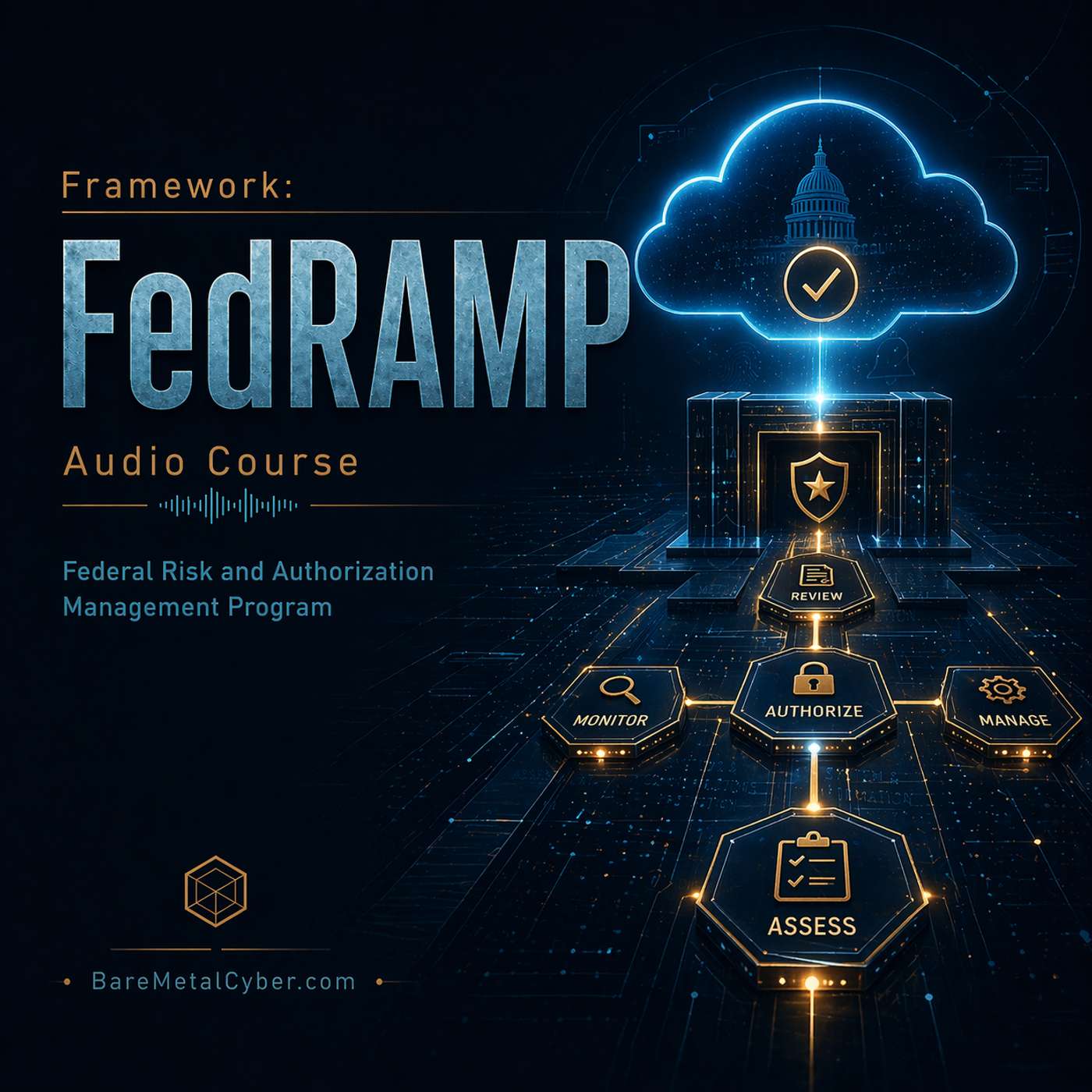
Framework: FedRAMP Audio Course
Step inside the FedRAMP world with an audio course built for real people, not policy wonks. In clear, story-driven language, each short episode unpacks the steps, roles, and secrets behind earning and keeping a federal cloud authorization. You’ll hear how the pieces fit together—documents, assessments, evidence, and continuous monitoring—without ever touching a slide or staring at a diagram. It’s designed for anyone who wants to get it: cloud providers chasing their first ATO, assessors sharpening their review skills, or agency staff looking to understand how it all connects. You’ll move from...
Author
Jason Edwards
Category
Podcast website
Latest episode
Nov 10, 2025
Where to listen?
Podcasts in the app Replaio Radio Coming soonPodcasts are coming to the app soon. Install now and be the first to see a whole new take on podcasts
 Install for free
Android 5M+ downloads · 4.8 rating
iOS soon
Install for free
Android 5M+ downloads · 4.8 rating
iOS soon
Episodes
Episode 70 — Final Review: From Package to ATO 10.11.2025 12:10
This concluding episode brings the entire FedRAMP journey together—from early readiness through authorization and continuous monitoring—showing how each artifact contributes to a single chain of assurance. We revisit the key milestones: readiness confirmation through the RAR, boundary and baseline definition in the SSP, objective verification via the SAP and SAR, disciplined risk management in the...
Episode 69 — Navigate Marketplace Listings and Reuse 10.11.2025 11:14
The FedRAMP Marketplace serves as the central repository of authorized cloud products, enabling agencies to discover, evaluate, and reuse existing authorizations. This episode explains how listings work, what information they display, and how service providers maintain them. We describe the listing types—In Process, Ready, and Authorized—along with the evidence and validation requirements for each...
Episode 68 — Evaluate Readiness With the RAR 10.11.2025 11:27
The Readiness Assessment Report (RAR) is the earliest formal evaluation in the FedRAMP process, confirming that a cloud service provider is prepared for a full security assessment. This episode clarifies its purpose, structure, and common pitfalls. We explain the main sections—system overview, boundary and data flow description, implemented versus planned controls, vulnerability scan results, and...
Episode 67 — Automate Evidence Collection Workflows 10.11.2025 11:53
Automation is the key to sustaining continuous monitoring without drowning in manual reporting. This episode details how to design evidence collection workflows that produce consistent, auditable artifacts for FedRAMP submissions. We discuss integrating compliance tools with operational systems—ticketing, CI/CD, logging, and configuration management—to capture outputs like patch approvals, baselin...
Episode 66 — Adopt OSCAL for Submissions 10.11.2025 11:06
Open Security Controls Assessment Language (OSCAL) transforms static FedRAMP documentation into structured, machine-readable data that accelerates reviews and improves consistency. This episode explains what OSCAL is, why it matters, and how it fits into the broader ecosystem of compliance automation. We describe OSCAL’s layered architecture—metadata models for system security plans, assessment pl...
Episode 65 — Build a Strong 3PAO QMS 10.11.2025 9:45
A Quality Management System (QMS) is how a 3PAO ensures assessments are consistent, competent, and continuously improving. This episode describes essential QMS components as they appear in FedRAMP work: documented procedures for planning and executing assessments, training and qualification paths for team members, peer review and technical oversight of work papers, nonconformance handling, correct...
Episode 64 — Operate Under ISO 17020 10.11.2025 11:35
ISO/IEC 17020 defines competence and impartiality requirements for bodies performing inspection, and accredited 3PAOs operate under this standard to deliver consistent, defensible FedRAMP assessments. This episode translates 17020 principles into operational realities: documented methods that produce repeatable results, control over impartiality risks, competency management for assessors, and qual...
Episode 63 — Validate 3PAO Independence and Ethics 10.11.2025 10:22
A Third-Party Assessment Organization’s credibility rests on independence and professional ethics, and FedRAMP expects providers to understand and respect these boundaries. This episode explains what independence means in practice: the assessment team cannot design, implement, or operate the very controls it evaluates; commercial relationships must be disclosed; and potential conflicts—such as adv...
Episode 62 — Quick Recap: Continuous Monitoring 10.11.2025 8:46
Continuous monitoring ties assessment results to everyday operations so authorization stays credible between audits. This recap pulls together its essentials: authenticated monthly scans aligned to complete inventories, incident reporting within required timelines, disciplined POA&M management with clear milestones, targeted retests that verify closure, and annual reassessments that sample whe...
Episode 61 — Maintain Authorization Over Time 10.11.2025 11:05
Maintaining an Authorization to Operate is an operational discipline that proves your controls continue to function, your risks are actively managed, and your documentation reflects reality. This episode frames “maintenance” as a living cycle tied to defined cadences: monthly vulnerability scans with authenticated coverage, quarterly or event-driven updates to inventories and boundary artifacts, a...
Episode 60 — Report Incidents Promptly and Properly 10.11.2025 11:09
Incident reporting ties real-world response performance to FedRAMP compliance. This episode explains mandatory reporting timelines and formats, including immediate notification within one hour of confirmed incidents involving federal data. We describe the minimum information that must be conveyed—incident type, detection method, systems affected, data exposure scope, and containment actions—and ho...
Episode 59 — Harden Logging and SIEM Practices 10.11.2025 12:18
Logging and Security Information and Event Management (SIEM) form the detection layer that validates continuous monitoring effectiveness. This episode describes how FedRAMP evaluates logging coverage, content, and retention to ensure sufficient visibility into security events. We explain key expectations: collection of system, application, and network logs; time synchronization to a trusted source...
Episode 58 — Execute Annual Assessment Requirements 10.11.2025 9:59
Annual assessments revalidate system controls to ensure they still meet FedRAMP baseline requirements under live operational conditions. This episode outlines how to plan and execute these recurring assessments efficiently. We describe how to select representative controls across families, integrate recent vulnerability trends and configuration changes, and coordinate testing schedules with ongoin...
Episode 57 — Process Significant Changes Safely 10.11.2025 9:48
Significant changes—major system modifications, infrastructure migrations, or service integrations—must be managed and reported under FedRAMP continuous monitoring. This episode defines what constitutes a “significant change” and why timely communication to the authorizing official and FedRAMP PMO preserves authorization integrity. We explain how to categorize changes by impact: boundary-affecting...
Episode 56 — Deliver Penetration Test Reports 10.11.2025 11:22
Penetration test reports are the tangible outcome of controlled attack simulations, and FedRAMP requires them to be comprehensive, reproducible, and linked to subsequent remediation. This episode explains how to structure a professional report that balances technical depth with readability for agency reviewers. We describe key sections: objectives and scope, methodology and tools, environment deta...
Episode 55 — Run Required Penetration Vectors 10.11.2025 11:48
FedRAMP mandates annual penetration testing across specific vectors to validate defensive effectiveness and identify exploitable weaknesses before adversaries can. This episode defines those vectors—external network, internal network, web application, API, and privilege escalation—and explains how to scope each relative to system architecture and data sensitivity. You will learn how to pre-stage t...
Episode 54 — Configure Authenticated Scanning Safely 10.11.2025 10:27
Authenticated scanning provides deeper assurance by testing systems from an insider perspective, confirming patch levels, configuration states, and control operations. This episode explains how to configure and secure credentialed scanning without compromising production systems. We cover credential storage methods, access restrictions, network throttling, scan account privileges, and segmentation...
Episode 53 — Analyze and Report Scan Results 10.11.2025 10:47
Scanning only provides raw data; analysis transforms it into actionable insight. This episode outlines how to interpret vulnerability results, identify trends, and communicate remediation progress to both internal stakeholders and agencies. We explain the metrics FedRAMP reviewers expect: counts of open findings by severity, aging of unresolved vulnerabilities, percentage of hosts fully remediated...
Episode 52 — Manage Monthly Vulnerability Scans 10.11.2025 10:21
Monthly vulnerability scanning provides the quantitative heartbeat of continuous monitoring, revealing whether systems remain patched, configured securely, and within acceptable risk tolerance. This episode defines the requirements for scope, credentialing, frequency, and evidence format. We clarify that scans must cover all in-scope assets—including hosts, containers, and applications—using authe...
Episode 51 — Stand Up Continuous Monitoring 10.11.2025 11:23
Continuous Monitoring (ConMon) is the operational backbone that sustains a FedRAMP authorization after the initial ATO is granted. This episode explains its purpose: maintaining visibility into system security, tracking control effectiveness, and ensuring timely detection of new vulnerabilities or deviations. We describe the foundational requirements—monthly vulnerability scans, annual penetration...
Episode 50 — Quick Recap: Assessment to Authorization 10.11.2025 10:57
This recap ties together the path from planning to authorization, highlighting the artifacts and decisions that carry the most weight. We revisit building a testable Security Assessment Plan, choosing effective methods, executing fieldwork under clear Rules of Engagement, and producing a Security Assessment Report that is precise, neutral, and defensible. We underscore how findings flow into a dis...
Episode 49 — Submit for PMO Review 10.11.2025 11:22
A successful FedRAMP PMO submission depends on completeness, internal consistency, and reviewer-friendly organization of the entire package. This episode details how to assemble the SSP, SAP/SAR, POA&M, attachments, scan artifacts, interconnection documents, privacy materials, letters, and cover forms into a coherent set with stable filenames, versioning, and checksums. We explain how to prepa...
Episode 48 — Understand ATO Letters and Conditions 10.11.2025 10:29
Authorization to Operate (ATO) letters are formal risk decisions issued by an agency or, in the JAB context, paired with a Provisional ATO (P-ATO); they acknowledge residual risk and impose conditions the provider must meet to keep operating for federal missions. This episode explains the structure and implications of these letters: scope statements that define what system and boundary are authori...
Episode 47 — Package Parseable Scan Artifacts 10.11.2025 11:18
Scan artifacts are only useful if reviewers can trace what was scanned, when, with which policies, and how the results map to inventory. This episode explains how to produce machine-readable, submission-ready exports for vulnerability scanning, configuration compliance, web application testing, and container or image analysis. We cover the essentials: include tool names and versions, policy IDs, c...
Episode 46 — Manage Deviation Requests and Exceptions 10.11.2025 10:39
Deviation Requests and exceptions are the formal mechanisms FedRAMP uses to handle situations where a weakness cannot be remediated on the normal timeline, where an alternate control achieves equivalent protection, or where a scanner-reported issue is a verified false positive. This episode explains the difference between common categories—due-date extensions tied to POA&M items, risk adjustme...
Similar podcasts







Listen to the Framework: FedRAMP Audio Course podcast in Replaio
Radio and podcasts in one app - free, with no sign-up. Install today and do not miss the launch
Replaio is not a podcast publisher; show names, artwork and audio belong to their authors and are distributed through public RSS feeds.