R.J. Rushdoony
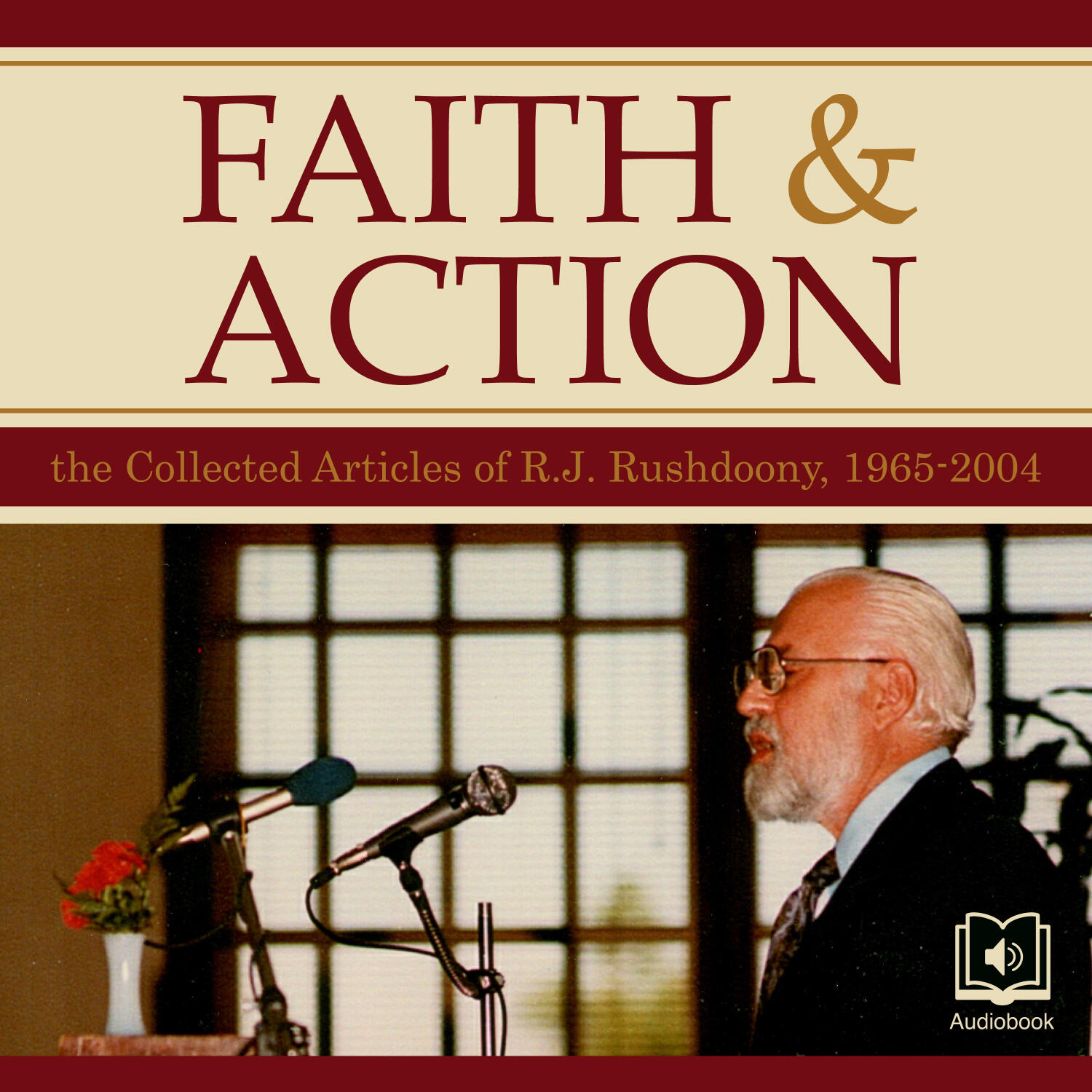
Faith and Action: The Collected Articles of R. J. Rushdoony, 1965-2004
Faith and Action is the complete collection of the essays of R. J. Rushdoony written for the Chalcedon Report between 1965 and 2001 along with several transcripts of his recorded talks. The large volume The Roots of Reconstruction only contained his Chalcedon Report essays up until 1985, so most of the essays included in Faith & Action were unavailable to readers for many years until now.
Be sure to visit the podcast's website and support the creator: cr101radio.com
Where to listen?
Podcasts in the app Replaio Radio Coming soonPodcasts are coming to the app soon. Install now and be the first to see a whole new take on podcasts
 Install for free
Android almost 10M downloads · 4.8 rating
iOS soon
Install for free
Android almost 10M downloads · 4.8 rating
iOS soon
Episodes
Innocent III 17.04.2026 8:37
In “Innocent III” (Chalcedon Report No. 151), Rushdoony examines how well-intentioned but misdirected efforts at moral renewal can deepen rather than cure civilizational decay. He portrays Pope Innocent III as an able and forceful leader who rightly recognized Europe’s spiritual indifference but disastrously sought renewal through dramatic, external action especially crusades rather than regenerat...
Science and Magic 15.04.2026 6:07
In “Science and Magic” (Chalcedon Report No. 370), Rushdoony argues that both science and magic, despite appearing opposed, share a common foundation: they treat the world as impersonal, amoral, and subject to manipulation for power. Both seek control rather than moral obedience, and both thrive where God is excluded as a personal, sovereign Lord. Biblical faith, by contrast, begins with a persona...
Total Meaning 10.04.2026 5:02
IThis passage describes a common problem with federally funded local projects: well-meaning federal grants can incentivize unnecessary construction, often at the expense of local residents. The anecdote of the hill-country homeowner illustrates how a simple bridge-widening need was expanded into a full road-widening project, costing land, money, and public resources unnecessarily. The author argue...
Experience 08.04.2026 7:45
In “Experience” (Chalcedon Report No. 107), Rushdoony critiques the modern elevation of personal experience and mass appeal over objective, God-ordained truth. He argues that since the late seventeenth century Western culture—and the church with it—has increasingly treated experience as the test of truth, displacing doctrine, law, and God’s purposes with individual feeling and subjective validatio...
The Myth of Neutrality 03.04.2026 8:59
This passage critiques the U.S. Court of Appeals for the Second Circuit granting the Communist Party special privileges in campaign reporting, exempting it from the disclosure rules required of Republicans and Democrats. The author questions the rationale, arguing that donors to the Communist Party rarely face persecution, while donors to mainstream causes like United Way sometimes do. He frames t...
The New Idolatry 01.04.2026 5:56
In “The New Idolatry” (Chalcedon Report No. 222), Rushdoony argues that modern theology has reproduced idolatry in subtler forms by relocating sovereignty, meaning, and truth from God to man. He identifies two dominant errors: first, the view of history as myth, which denies objective meaning and treats all truth as human interpretation—thereby demoting God to a symbolic construct and making man t...
Wolves 27.03.2026 5:57
This passage warns that excessive regulation even over seemingly minor matters like lawn maintenance can erode personal freedom and lead society toward tyranny. Using the example of a proposed 16-page building code in University Park, Texas, the author highlights how fines for weeds, cracks, or unsound chimneys, combined with inspectors’ authority to enter homes at will, could pave the way for eve...
Locale of Meaning 25.03.2026 6:36
In “Locale of Meaning” (Chalcedon Report No. 172), Rushdoony argues that the decisive shift of the modern age was the relocation of meaning from God to events themselves. Whereas biblical faith locates all meaning in the sovereign Creator—whose eternal decree gives purpose to every atom, moment, and event—modern thought claims that meaning arises from the relationships of events, human experience,...
Providence 20.03.2026 8:31
In “Providence” (Chalcedon Report No. 131), Rushdoony argues that Christianity is founded on God-ordained distinctions between good and evil, righteousness and sin, holy and profane while humanism destroys these distinctions by making autonomous man the sole standard. When man becomes god, all absolutes collapse, progress ceases, and meaning evaporates, because a self-deified humanity has no reaso...
Disposable Man 18.03.2026 7:14
In Disposable Man, Rushdoony argues that modern humanistic statism, by denying transcendent meaning and moral absolutes, inevitably treats human beings as expendable tools of the state. Drawing on testimonies from the Gulag, he shows how a worldview grounded in pragmatism, utility, and evolutionary meaninglessness produces a society where injustice is never a “mistake” because there is no higher l...
Post-Christian Era 13.03.2026 17:35
In Post-Christian Era, Rushdoony rejects the claim that the modern world has moved beyond Christianity, arguing instead that it is humanism not Christianity that is collapsing under its own contradictions. Tracing the Enlightenment’s militant rejection of biblical faith and its eventual descent through Darwin, Freud, and existential despair, he shows how humanism has stripped life of meaning, dign...
Genius 11.03.2026 20:09
This position paper argues that the modern idea of “genius” is a revived pagan concept rooted in animism and hero-worship, in which certain individuals are treated as semi-divine figures standing above law, morality, and ordinary humanity. Tracing the idea from ancient Rome through the Renaissance and Enlightenment to modern revolutionary movements, the paper shows how the “genius” shifted from a...
Nihilism 06.03.2026 17:06
In Nihilism, Rushdoony traces the destructive power of nihilism as both a philosophy and a pervasive mood that rejects all authority, meaning, and hope, replacing faith with cynicism and a lust for destruction. From pre-revolutionary Russia to the modern West, he shows how nihilism fuels violence, despair, and social collapse, whether directed against church, family, or state, and how even statist...
Psychopaths 04.03.2026 5:12
In Psychopaths, Rushdoony argues that modern society’s replacement of accountability to God with accountability only to man has produced a culture stripped of conscience, absolutes, and moral restraint. By excluding biblical faith and God’s law from public life while legalizing pornography, abortion, and sexual perversion the state has fostered the very conditions that give rise to psychopaths who...
From Ape Man to Christian Man 27.02.2026 4:22
In “Covenant Wealth,” Rushdoony reframes wealth not as income level or social class, but as covenantal faithfulness measured by service to God’s Kingdom rather than material display. From a biblical perspective, rich, middle-class, and poor alike can be righteous or corrupt depending on their obedience to God’s law and purpose, because true wealth begins with man’s original calling to exercise dom...
Everyday Romanticism 25.02.2026 7:43
In Everyday Romanticism, Rushdoony warns that popular Romanticism, far from being harmless sentiment, is a destructive mindset that replaces God’s reality with self-created dreams and demands instant fulfillment without responsibility, patience, or discipline. Whether expressed in distorted expectations of love, career, or revolution, Romanticism insists on life “on my terms,” erupting into rage,...
Our False Premises 20.02.2026 7:56
In Our False Premises, Rushdoony traces the collapse of modern thought to a fatal shift in starting points, from the triune God and His Word to the autonomous mind, reason, and emotions of man. Following thinkers from Descartes to Kant and Hegel, he shows how rationalism exalted human reason as final judge, while Romanticism divinized feelings, producing emotionalism, revival techniques, and a man...
Our False Premises 20.02.2026 7:56
In Our False Premises, Rushdoony traces the collapse of modern thought to a fatal shift in starting points, from the triune God and His Word to the autonomous mind, reason, and emotions of man. Following thinkers from Descartes to Kant and Hegel, he shows how rationalism exalted human reason as final judge, while Romanticism divinized feelings, producing emotionalism, revival techniques, and a man...
Existentialism 18.02.2026 8:32
In Existentialism, Rushdoony argues that modern law, politics, and education are increasingly governed by an existentialist worldview that denies the binding authority of God, history, and objective law, replacing them with the arbitrary demands of the present moment. By treating the past as irrelevant and truth as situational, existentialism dissolves law into power and planning into improvisatio...
Women 13.02.2026 6:54
In Women, Rushdoony argues that the Enlightenment’s exaltation of autonomous reason resulted in the social and legal downgrading of women by redefining man as reason incarnate and woman as emotion or unreason. This distortion fractured the complementary relationship between the sexes, weakened the family, and fostered both romanticized irresponsibility and modern feminism’s pursuit of the same law...
Women 13.02.2026 6:54
In Women, Rushdoony argues that the Enlightenment’s exaltation of autonomous reason resulted in the social and legal downgrading of women by redefining man as reason incarnate and woman as emotion or unreason. This distortion fractured the complementary relationship between the sexes, weakened the family, and fostered both romanticized irresponsibility and modern feminism’s pursuit of the same law...
Reason and Politics 11.02.2026 7:07
In Reason and Politics, Rushdoony argues that modern thought has distorted humanity by redefining man as an autonomous, rational, and political animal, replacing his identity as a creature made in God’s image and turning politics into a false means of salvation. This shift exalted reason as the supreme judge, politicized all of life, marginalized women and families, and reduced most men to “human...
Reason and Politics 11.02.2026 7:07
In Reason and Politics, Rushdoony argues that modern thought has distorted humanity by redefining man as an autonomous, rational, and political animal, replacing his identity as a creature made in God’s image and turning politics into a false means of salvation. This shift exalted reason as the supreme judge, politicized all of life, marginalized women and families, and reduced most men to “human...
Diderot: The Gardener and the Worm 06.02.2026 8:39
In Diderot: The Gardener and the Worm, Rushdoony exposes how humanism, by abolishing God and absolute law, inevitably replaces divine sovereignty with rule by an elite who exercise power over men reduced to expendable “worms.” Drawing on Diderot, Nietzsche, and the French Revolution, he shows that declaring all men equal apart from God does not elevate humanity but strips life of meaning, leaving...
Similar podcasts






Listen to the Faith and Action: The Collected Articles of R. J. Rushdoony, 1965-2004 podcast in Replaio
Radio and podcasts in one app - free, with no sign-up. Install today and do not miss the launch
Replaio is not a podcast publisher; show names, artwork and audio belong to their authors and are distributed through public RSS feeds.