R.J. Rushdoony
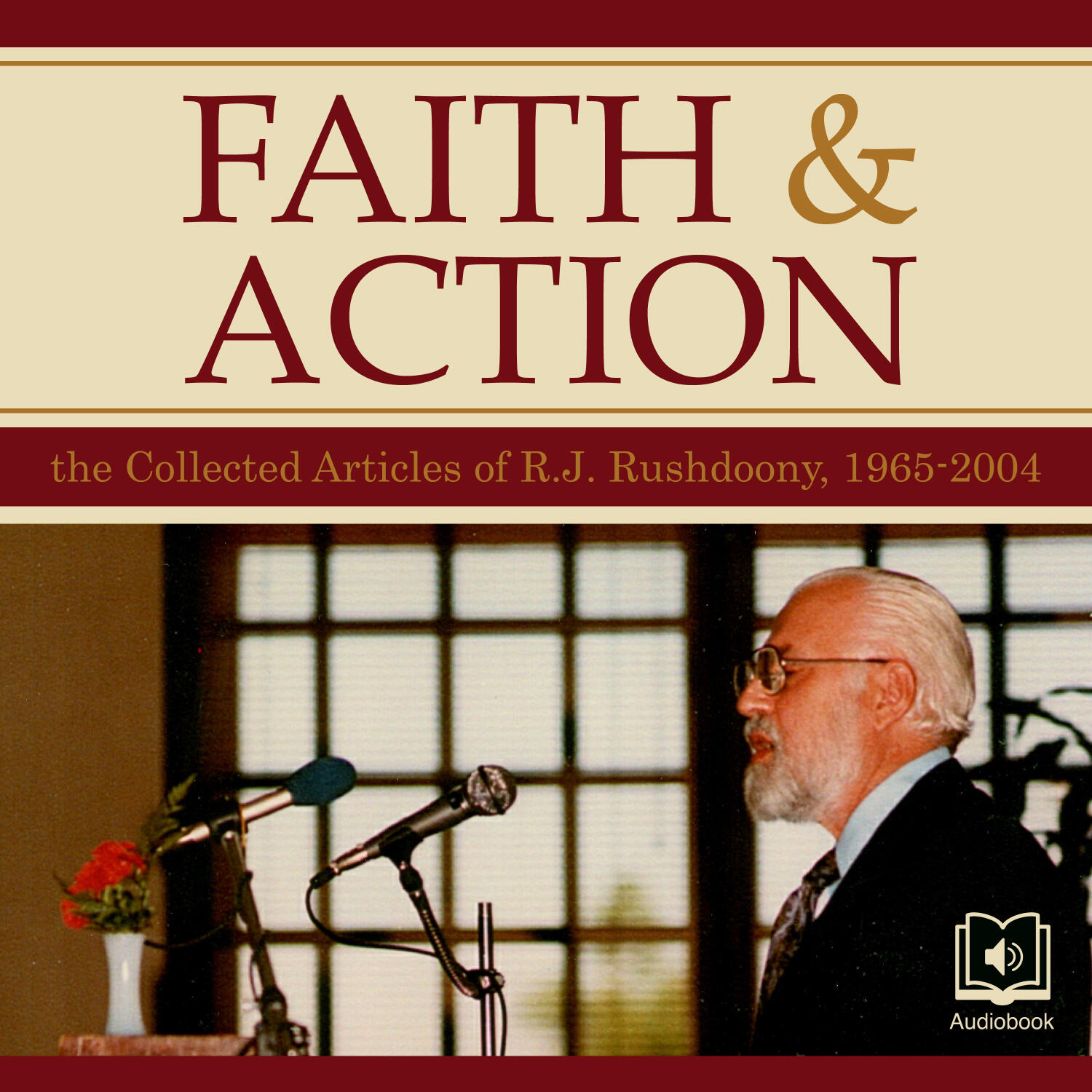
Faith and Action: The Collected Articles of R. J. Rushdoony, 1965-2004
Faith and Action is the complete collection of the essays of R. J. Rushdoony written for the Chalcedon Report between 1965 and 2001 along with several transcripts of his recorded talks. The large volume The Roots of Reconstruction only contained his Chalcedon Report essays up until 1985, so most of the essays included in Faith & Action were unavailable to readers for many years until now.
Where to listen?
Podcasts in the app Replaio Radio Coming soonPodcasts are coming to the app soon. Install now and be the first to see a whole new take on podcasts
 Install for free
Android 5M+ downloads · 4.8 rating
iOS soon
Install for free
Android 5M+ downloads · 4.8 rating
iOS soon
Episodes
The Van Til I Knew: An Interview With R.J. Rushdoony 10.07.2026 47:39
This passage argues that the United States does not have a permanent dynasty of wealth. While some inherited fortunes exist, the majority of the richest Americans earned their wealth independently, and new industries such as microelectronics and emerging energy technologies continuously create fresh fortunes. Economic change ensures that wealth shifts over time, discouraging stagnation. Historical...
Moral Paralysis 08.07.2026 15:33
In “Moral Paralysis,” Rushdoony argues that modern society is increasingly incapable of decisive moral action because it has abandoned belief in absolute truth and God’s sovereign law, replacing it with relativism and pragmatism. This results in people who may recognize evil but lack the authority, confidence, or will to oppose it, mistaking moral insight for moral strength and denunciation for ri...
Abortion 03.07.2026 17:31
This passage emphasizes that the primary caregivers for the poor in the U.S. are not government agencies, but private and voluntary institutions. The family remains the most effective welfare system, providing for sick members, elderly parents, and children’s education from kindergarten through college. Churches, both Protestant and Catholic, supplement this care by aiding the homeless and transie...
Moral Disarmament 01.07.2026 13:26
In “Moral Disarmament,” Rushdoony argues that before societies are conquered politically or militarily, they are first defeated morally, as distinctions between good and evil, truth and error, Christ and Antichrist are deliberately blurred. Through literature, theology, education, and popular culture, sympathy is shifted from righteousness to rebellion, from law to lawlessness, until betrayal, cri...
Epistemological Self-Consciousness 26.06.2026 13:45
In “Epistemological Self-Consciousness,” Rushdoony argues that every worldview must eventually face the implications of its own foundations, and that atheism, when consistently applied, leads to meaninglessness, lawlessness, and the collapse of authority. He contrasts figures like modern artists and scientists who deny God yet still borrow God’s order in practice, showing that unbelief cannot live...
Kwan-Yin Versus Christ 24.06.2026 6:56
In “Kwan-Yin Versus Christ,” Rushdoony contrasts Biblical Christianity with the relativistic, equalitarian impulse he traces to Eastern religions, arguing that modern socialism and progressive lawlessness flow from a worldview that denies absolute distinctions between good and evil. He presents Kwan-yin’s refusal to enter paradise until all are included as the logical symbol of total inclusivism,...
Relativism 19.06.2026 7:30
This passage argues that fears of overpopulation and overpollution are largely myths. Citing Dr. Julian L. Simon’s The Ultimate Resource, it emphasizes that food production, farmland availability, and natural resources are increasing, not diminishing. Pollution has been declining, population density does not inherently create social or biological problems, and immigration contributes positively to...
Moral Force 17.06.2026 19:00
In “Moral Force,” Rushdoony argues that all lasting authority rests not on brute power but on moral force rooted in faith, and that when societies abandon moral absolutes they inevitably replace persuasion, law, and justice with coercion, bribery, violence, and aestheticized destruction. He traces how relativism leads first to cynicism, then to the worship of power—whether through revolutionary vi...
The Smiling Face of Evil 12.06.2026 5:07
In “The Smiling Face of Evil,” Rushdoony warns that evil rarely appears brutal or grotesque but commonly presents itself as kind, helpful, idealistic, and morally concerned, masking its true nature behind pleasant words, good intentions, and public-relations charm. Drawing on personal anecdotes and biblical examples, he argues that Satan’s most effective strategy is not open hostility but deceptio...
Abominations 10.06.2026 6:07
In “Abominations”, Rushdoony explains that Scripture’s strong language about sin reflects God’s holiness and justice, not vulgarity or excess, and that the biblical term abomination consistently denotes what God finds utterly abhorrent because it is idolatrous, lawless, and spiritually corrupt. Drawing on Hebrew and Greek usage, he shows that abominations are actions and attitudes that despise God...
Blind Faith 05.06.2026 2:40
In “Blind Faith” (Chalcedon Report No. 419), Rushdoony argues that Darwinism functions not as proven science but as a massive act of blind faith, embraced because it promises liberation from the God of Christianity rather than truth. From its rapid acceptance in 1859 to its dominance in modern education, culture, and even churches, this faith in humanistic evolution has shaped a civilization that...
Humanism and Education 03.06.2026 16:16
In “Humanism and Education” (Chalcedon Report No. 54), Rushdoony argues that modern vandalism, campus unrest, and the collapse of public education are not random social failures but the visible signs of a dying religion—humanism—which once enthroned man as god and the state school as his church. He traces this faith to Horace Mann’s belief that public education could save society and usher in a ut...
Exaggeration and Denial 29.05.2026 3:03
This passage argues that the courts, rather than serving justice, have increasingly become instruments of relativism and majority rule, often harming victims more than criminals. It highlights Oliver Wendell Holmes Jr.’s philosophy that the law is a game to be played according to its rules rather than a pursuit of justice, suggesting that justice is no longer viewed as absolute but as subject to h...
The Disastrous War 27.05.2026 14:49
In “The Disastrous War” (Chalcedon Report No. 369), Rushdoony argues that the American Civil War was the greatest tragedy in U.S. history, not only because of its immense human cost but because it entrenched a worldview of irreconcilable conflict that still divides the nation. He contends that the war was driven less by Biblical moral reasoning than by Enlightenment humanism shared by influential...
Hostility to Christianity 22.05.2026 7:09
This passage critiques the uncritical glorification of science and technological enhancements, using the “bionic man” as a symbol of this trend. The author argues that while medical devices pacemakers, glasses, crutches are helpful, they are no replacement for God’s original design and natural human faculties. Scientific interventions, including test-tube babies, are portrayed as risky, morally co...
Depending on Evil 20.05.2026 7:22
In “Depending on Evil” (Chalcedon Report No. 112), Rushdoony argues that modern states consistently trust and support evil regimes because corruption is predictable, purchasable, and controllable, whereas righteousness and freedom are not. Using the long history of European and later global protection of the corrupt Turkish state as a central example, he shows how powers repeatedly defended tyrann...
Justice and Authority 15.05.2026 6:56
This passage explores the origin and meaning of the word nag, tracing it from its Scandinavian roots meaning “to gnaw, bite, or burrow” to its modern sense of persistent, irritating talk or complaint. The imagery comes from rats gnawing in thatched-roof houses during the Middle Ages, producing an unending, unwelcome noise hence the connection to human nagging. Solomon recognized the difficulty of...
History 13.05.2026 7:02
In “History” (Chalcedon Report No. 108), Rushdoony argues that history is not merely a record of past events but the remembered past shaped by faith, memory, and meaning, making it a fundamental obstacle to statist efforts to remake man. Because historical consciousness roots people in inherited loyalties, beliefs, and moral judgments, modern humanism seeks to erase history through statist educati...
Loss of the Past 08.05.2026 9:36
In “Loss of the Past” (Chalcedon Report No. 320), Rushdoony argues that modern society’s deliberate forgetting and moralizing distortion of history has severed us from reality, leaving us ignorant of both the past and present and therefore incapable of shaping a sound future. By erasing figures like Patrick Henry and Stephen Decatur, caricaturing European history, and indulging in shallow denuncia...
History 08.05.2026 7:02
In “History” (Chalcedon Report No. 108), Rushdoony argues that history is not merely a record of past events but the remembered past shaped by faith, memory, and meaning, making it a fundamental obstacle to statist efforts to remake man. Because historical consciousness roots people in inherited loyalties, beliefs, and moral judgments, modern humanism seeks to erase history through statist educati...
Anti-Christianity on the Rise 06.05.2026 4:15
In a 1993 Chalcedon Report, R.J. Rushdoony warned of rising anti-Christian hostility in America, tracing it to Supreme Court decisions eroding Biblical foundations of law since the 1950s, the rise of humanism as an unofficial established religion promoting moral relativism, media bias against Christians, and growing intolerance toward Biblical morality—while hypocritically accusing believers of ju...
Dream of Total Justice 01.05.2026 6:56
This passage examines how well-intentioned social and labor programs can be exploited, often favoring the wrong parties. The “Burglar Cops of Hollywood” case illustrates law enforcement officers who committed theft while on duty yet received overtime pay during interrogation and even claims for disability due to the stress of being caught. Similarly, in a sex-discrimination lawsuit, the plaintiff...
Doing Nothing 29.04.2026 6:57
In “Doing Nothing” (Chalcedon Report No. 159), Rushdoony argues that Western society’s failure to resist tyranny is not intellectual confusion but religious apostasy, rooted in a shared humanism that unites both democratic and communist systems. Solzhenitsyn’s critique unsettled the West because he exposed the uncomfortable truth that Marxism and Western statism spring from the same faith: the sov...
Crusading 24.04.2026 8:34
This passage critiques the modern legal system’s focus on technicalities over substantive justice. Minor procedural errors, once considered irrelevant, now frequently overturn convictions, regardless of overwhelming evidence of guilt. Charles Peters cites cases in New York where a convicted burglar and a guilty dentist were freed due to procedural quirks, despite strong evidence against them. The...
Children’s Crusade 22.04.2026 8:22
In “Children’s Crusade” (Chalcedon Report No. 152), Rushdoony argues that the belief in the natural innocence and saving power of children is a recurring humanistic heresy with catastrophic consequences. He traces this idea from medieval theology to the Children’s Crusade of 1212, where faith in childlike purity led nearly 100,000 children into death, slavery, disease, and disillusionment. The sam...
Similar podcasts






Listen to the Faith and Action: The Collected Articles of R. J. Rushdoony, 1965-2004 podcast in Replaio
Radio and podcasts in one app - free, with no sign-up. Install today and do not miss the launch
Replaio is not a podcast publisher; show names, artwork and audio belong to their authors and are distributed through public RSS feeds.