Jasmine Wolfe
Essays From A Strange Country
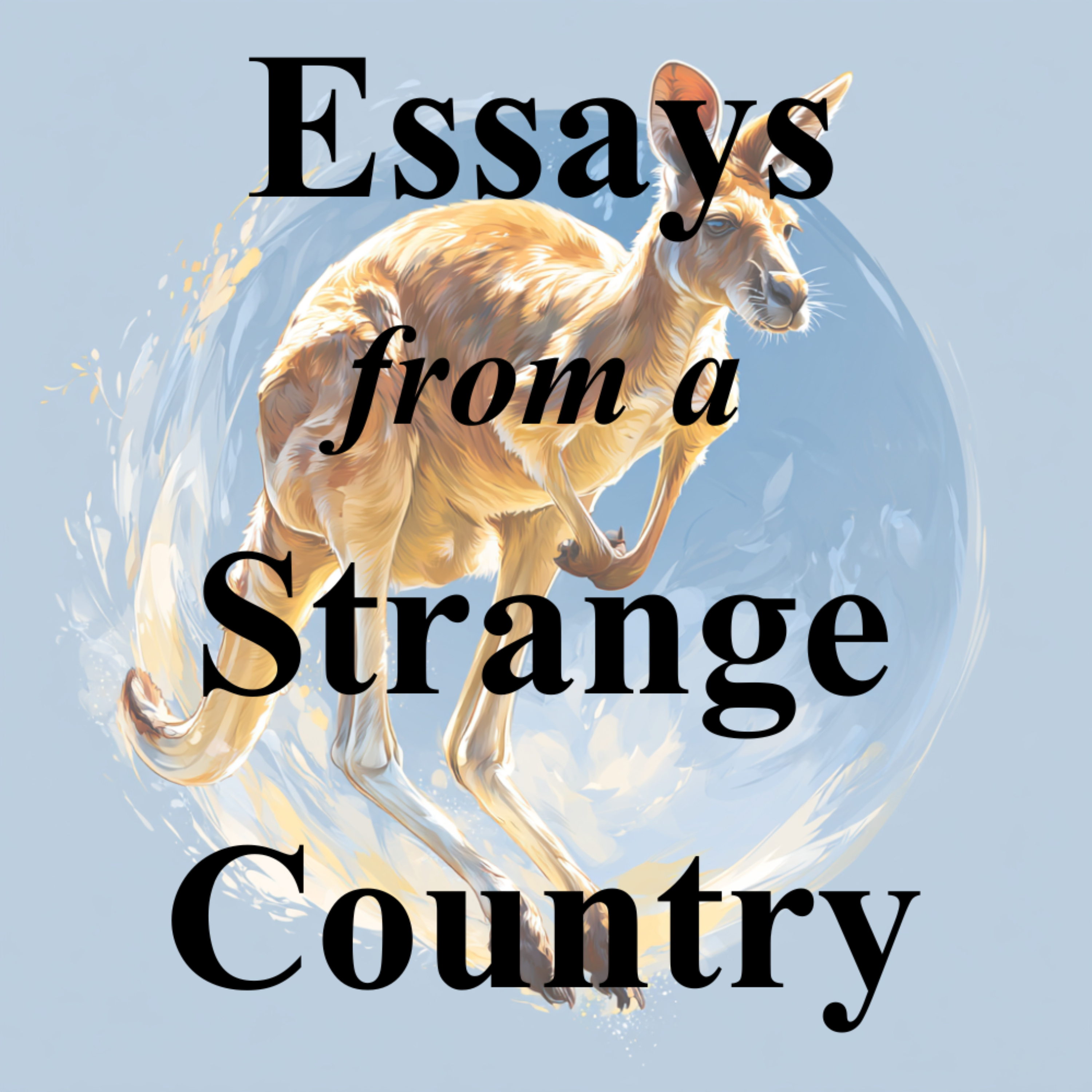
Welcome to Essays from a Strange Country, a podcast about Australian identity. I’m your host Jasmine Wolfe. Each episode, through the lens of what our culture has produced, such as an Australian film, literature, art, and music to ask how this country has imagined itself, and who has been conveniently left out of the portrait. This is not a search for one neat national identity. Mercifully, no such thing exists. Instead, we’ll read the mess: the stories, images, songs, and screen myths that make Australia feel familiar, strange, beautiful, brutal, and faintly ridiculous.
Author
Jasmine Wolfe
Category
Podcast website
Latest episode
Jul 5, 2026
Where to listen?
Podcasts in the app Replaio Radio Coming soonPodcasts are coming to the app soon. Install now and be the first to see a whole new take on podcasts
 Install for free
Android 5M+ downloads · 4.8 rating
iOS soon
Install for free
Android 5M+ downloads · 4.8 rating
iOS soon
Episodes
Stolen Spirit: The Gothic Reconstruction of Aboriginal Identity 05.07.2026 34:50
Aboriginal Gothic begins as a refusal of a convenient inheritance. The European Gothic arrived in Australia with its familiar machinery of haunted houses, ancestral crimes, spectral returns and threatened innocence, but on this continent those conventions could not remain merely decorative. Transplanted onto stolen land, the Gothic’s old anxieties about inheritance, legitimacy and buried violence...
Picnic At Hanging Rock: Literature, Landscape, and Cinema. 28.06.2026 36:53
Picnic at Hanging Rock endures because it gives elegant form to a less elegant national disturbance: the suspicion that European settlement in Australia has never quite settled anything. Joan Lindsay’s novel, Peter Weir’s film, and later theatrical reworkings return obsessively to the same scene of colonial confidence undone: white schoolgirls, dressed for discipline and display, enter an ancient...
Haunted Country, Convenient Ghosts: Settler Vulnerability and Indigenous Absence in Australian Gothic 21.06.2026 41:57
This essay argues that the Imperial Gothic lays a foundation for Australian culture by organising artistic representations of place around settler unease and white vulnerability. Its most durable mechanism is the "White Vanishing" trope, which transforms the colonial landscape into a scene of disappearance and mourning. In colonial art, this appears through the visual grammar of the lost...
"A Convict's Tour to Hell" Frank the Poet | Poem Recital 14.06.2026 10:16
A recital of the classic poem "A Convict's Tour to Hell," written by Frank the Poet in 1832. Australia.
Frank the Poet: The Bardic Weapon of Penal Resistance 13.06.2026 37:32
Francis MacNamara, famously known as Frank the Poet, was an Irish convict transported to Australia in 1832 whose intellectual defiance and improvised verse transformed the brutality of the penal system into a foundational Australian mythology. Despite enduring at least 14 floggings and over 650 lashes for his persistent refusal to submit to the "System," MacNamara weaponized his literacy and bardi...
The "Dungeon of the World": Trauma, Landscape, and the Contradictions of Convict Gothic. 07.06.2026 42:53
This essay reads Convict Gothic as one of Australian culture’s less flattering inheritance claims. It looks at the neat British rhetoric of reform and improvement, then sets it against the rather messier business of carceral violence. It argues that the penal system did not simply occupy the landscape; it made the landscape do some of the punishing. From there, it traces the afterlife of this logi...
Why Australian Stories Are Unlike Anything Else On Earth 31.05.2026 35:06
Discover why Australian storytelling is gloriously unruly: ancient Aboriginal knowledge systems, Country as living protagonist, Gothic reversals of colonisation, and the national talent for laughing while bleeding. This essay cuts through myths, cringe, Hollywood noise, and polite amnesia to show a literature shaped by memory, land, law, and bruised irony.
EfaSC Preview 30.05.2026 1:42
A short introduction to the spirit of Essays from a Strange Country.
Similar podcasts







Listen to the Essays From A Strange Country podcast in Replaio
Radio and podcasts in one app - free, with no sign-up. Install today and do not miss the launch
Replaio is not a podcast publisher; show names, artwork and audio belong to their authors and are distributed through public RSS feeds.