Paul Schmidtke
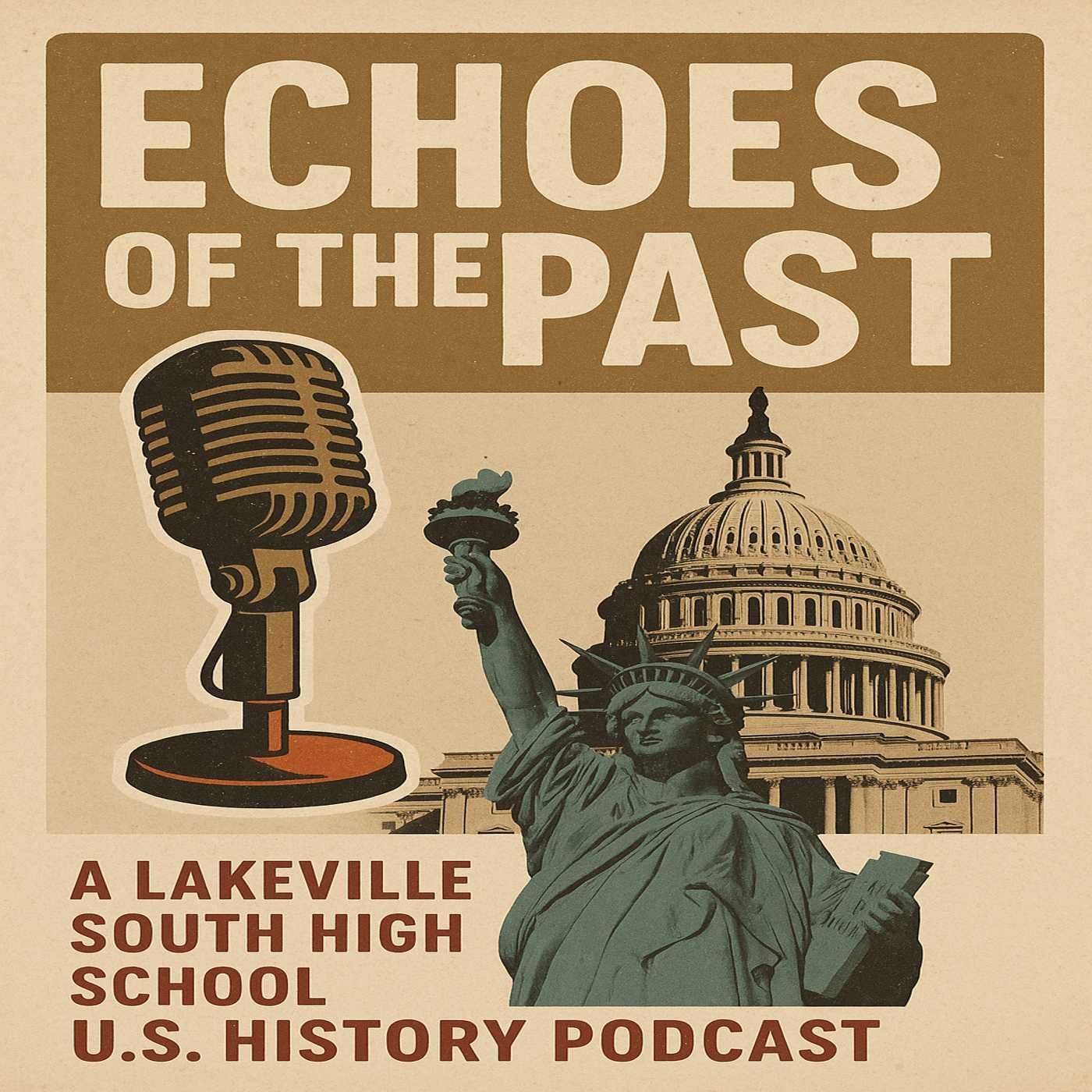
Echoes of the Past
Echoes of the Past: A Lakeville South High School U.S. History Podcast Journey through the pivotal moments, people, and movements that shaped the United States—one story at a time. Hosted by Lakeville South High School students, Echoes of the Past brings history to life through engaging episodes that explore the triumphs, struggles, and lessons of America's past. Whether you’re a student, teacher, or lifelong learner, this podcast offers thoughtful insights, vivid storytelling, and a fresh student perspective on the American experience.
Where to listen?
Podcasts in the app Replaio Radio Coming soonPodcasts are coming to the app soon. Install now and be the first to see a whole new take on podcasts
 Install for free
Android 5M+ downloads · 4.8 rating
iOS soon
Install for free
Android 5M+ downloads · 4.8 rating
iOS soon
Episodes
U S Ch 14.4 19.12.2025 6:47
Expansion: rewards and Costs: Populism
U S Ch 14.3 19.12.2025 5:54
Expansion: Rewards and Costs: Mining, Ranchinf and Farming
U S Ch 11.4 19.12.2025 6:31
The Civil War:Devestation and New Freedom
U S Ch 15.1 19.12.2025 5:40
Politics, Immigration, and Urban Life: Politics in the Gilded Age
U S Ch 15.2 19.12.2025 5:48
U S Ch 15.2 Politics, Immigration, and Urban Life. People On the move
U S Ch 8.5 17.12.2025 3:52
The Growth of the National Economy: The Age of Jackson
U S Ch 8.4 17.12.2025 3:51
Ch 8.4 The Growth of the National Economy: The groeth of Nationalism
U S Ch 11.3 03.11.2025 5:42
The Civil War battles were chaotic, characterized by the noise of cannons and rifle fire, where communication among troops relied heavily on drummer boys, often young adolescents who faced great danger on the battlefield. Notable events included the Battle of Fredericksburg, where Union General Burnside suffered heavy losses due to poor strategy, and the Battle of Chancellorsville, marked by Gener...
US Ch 13.1 28.10.2025 7:12
Wired for Change: America’s Industrial Spark
U S Ch 11.2 24.10.2025 5:53
11.2 By early 1862, the initial optimism of the war had faded, revealing the conflict would be prolonged and challenging, straining resources on both sides. The South faced a manpower crisis as Confederate soldiers neared the end of their enlistments, and many were reluctant to reenlist. The Confederate government, similar to the U.S. government but emphasizing states' rights and slavery, struggle...
U S Ch 11.1 24.10.2025 6:02
By early 1862, the initial optimism of the war had faded, revealing the conflict would be prolonged and challenging, straining resources on both sides. The South faced a manpower crisis as Confederate soldiers neared the end of their enlistments, and many were reluctant to reenlist. The Confederate government, similar to the U.S. government but emphasizing states' rights and slavery, struggled wit...
U S Ch. 10.5 20.10.2025 5:15
10.5 In 1860, the United States faced a deepening national crisis as the presidential election approached, revealing irreconcilable divisions between the North and South over slavery. The Democratic Party split into Northern and Southern factions, nominating Stephen Douglas and John C. Breckinridge, respectively, while moderate Southerners formed the Constitutional Union Party with John Bell as th...
U S Ch 10.4 20.10.2025 6:11
10.4 After the passage of the Kansas-Nebraska Act in 1854, the Kansas Territory became a battleground over whether it would enter the Union as a free or slave state, sparking intense conflict between proslavery and antislavery settlers. Proslavery forces, supported by illegal voting from Missouri settlers, established a rival government to the antislavery faction. Violence erupted in 1856, notably...
U S Ch 10.3 20.10.2025 5:40
10.3 The political conflicts of the 1850s, driven largely by the unresolved issue of slavery, set the stage for the American Civil War. The expansion of U.S. territory west of the Mississippi, especially after the Mexican War, reignited debates over whether new states and territories would permit slavery, threatening the balance of power in Congress. Efforts like the Missouri Compromise of 1820 te...
U S Ch 10.2 20.10.2025 5:21
10.2 In the 1830s and 1840s, a surge of migration into western territories inspired many Americans to believe in "manifest destiny," the idea that the United States was destined to expand across the continent. This belief fueled support for annexing Texas after its independence from Mexico in 1836, despite fears of war and political division over adding slave states. President Polk, a strong expan...
U S Ch 10.1 20.10.2025 5:19
10.1 chapter of U.S. history covers the deepening divide between the North and South leading up to the Civil War, highlighting cultural, economic, and political differences centered primarily around slavery. Northern opposition to slavery grew, fueled by religious and moral arguments, as well as influential works like Harriet Beecher Stowe’s Uncle Tom’s Cabin , which exposed slavery’s cruelties an...
U S Ch 9.4 20.10.2025 5:03
Chapter 9.4, the early 1800s reform movements in the United States, including revivalism, temperance, abolition, and women’s rights, often caused societal divisions rather than unity due to the nation's increasing cultural diversity and regional differences. Immigration from Ireland and Germany surged, especially in northern cities, bringing new cultures, religions, and political influences but al...
U S Ch 7.3 15.10.2025 4:44
7.3 Here’s a brief summary of U.S. History Chapter 7.3: In the 1840s, westward-moving American settlers largely avoided the Great Plains, viewing it as a dry, unsuitable “Great American Desert,” though Native American Plains tribes thrived there with diverse lifestyles, especially after acquiring horses. Spanish colonization in northern Mexico was limited but impactful, especially in California mi...
U S Ch 7.2 15.10.2025 5:09
7.2 In the early 1800s, Americans moved westward seeking land and prosperity, using routes like the Wilderness Road and National Road to settle territories such as Kentucky and Ohio. Native Americans were forced west to Indian Territory through unfair treaties, facing population decline from disease and settler pressure. The U.S. expanded into Florida via the Adams-Onís Treaty, while the idea of M...
U S Ch 8.1 15.10.2025 5:54
In the summer of 1844, Nathaniel Hawthorne reflected on the disruptive sound of a locomotive while noting the contrasting excitement it brought to many Americans, symbolizing progress during the Industrial Revolution. This era marked a shift from handcrafting to machine-based production, influenced by British inventions like the spinning jenny and the steam engine, which led to the rise of the tex...
U S Ch 8.2 15.10.2025 3:47
8.2 The early 1800s saw significant regional differences between the North and South of the United States, particularly in economy, culture, and urbanization. The North, comprising the Northeast and the Old Northwest, developed a mixed economy characterized by agricultural innovation and burgeoning industry. The fertile lands of the Old Northwest allowed for efficient farming of crops like corn an...
U S Ch 8.3 15.10.2025 4:57
8.3 In the first half of the 1800s, the economy of the South was dominated by cotton production, famously referred to as "King Cotton." This phrase, popularized by David Christy in his 1855 book, highlighted the increasing reliance on cotton, which became a significant driver of wealth and economic dependency, despite moral critiques of slavery. By 1860, cotton comprised two-thirds of American exp...
U S Ch 9.1 15.10.2025 2:55
9.1 In the early 1800s, urban areas in America faced significant social issues such as poverty, alcoholism, and illiteracy, prompting a reform movement largely rooted in Protestant beliefs. Influential figures like Charles Grandison Finney and Lyman Beecher emerged as key revivalists, advocating for social change, while transcendentalists like Ralph Waldo Emerson and Henry David Thoreau emphasized...
U S Ch 9.2 15.10.2025 4:03
9.2 David Walker, a free Black man, actively opposed slavery by placing his antislavery pamphlet, "Appeal to the Colored Citizens of the World," in the pockets of clothes he sold, aiming to spread his message of equality and freedom. In response, southern states banned antislavery publications and made it illegal to educate slaves. Despite these measures, the abolitionist movement gained momentum,...
U S Ch 9.3 15.10.2025 3:23
9.3 Catharine Beecher, influenced by her reformist family, dedicated her life to education and advocacy for women's roles within the home during a time of industrialization. While some women sought rights and freedoms, Beecher emphasized the importance of women's contributions as mothers and teachers, believing their influence was crucial for a strong democratic society. She founded the Hartford F...
Similar podcasts







Listen to the Echoes of the Past podcast in Replaio
Radio and podcasts in one app - free, with no sign-up. Install today and do not miss the launch
Replaio is not a podcast publisher; show names, artwork and audio belong to their authors and are distributed through public RSS feeds.