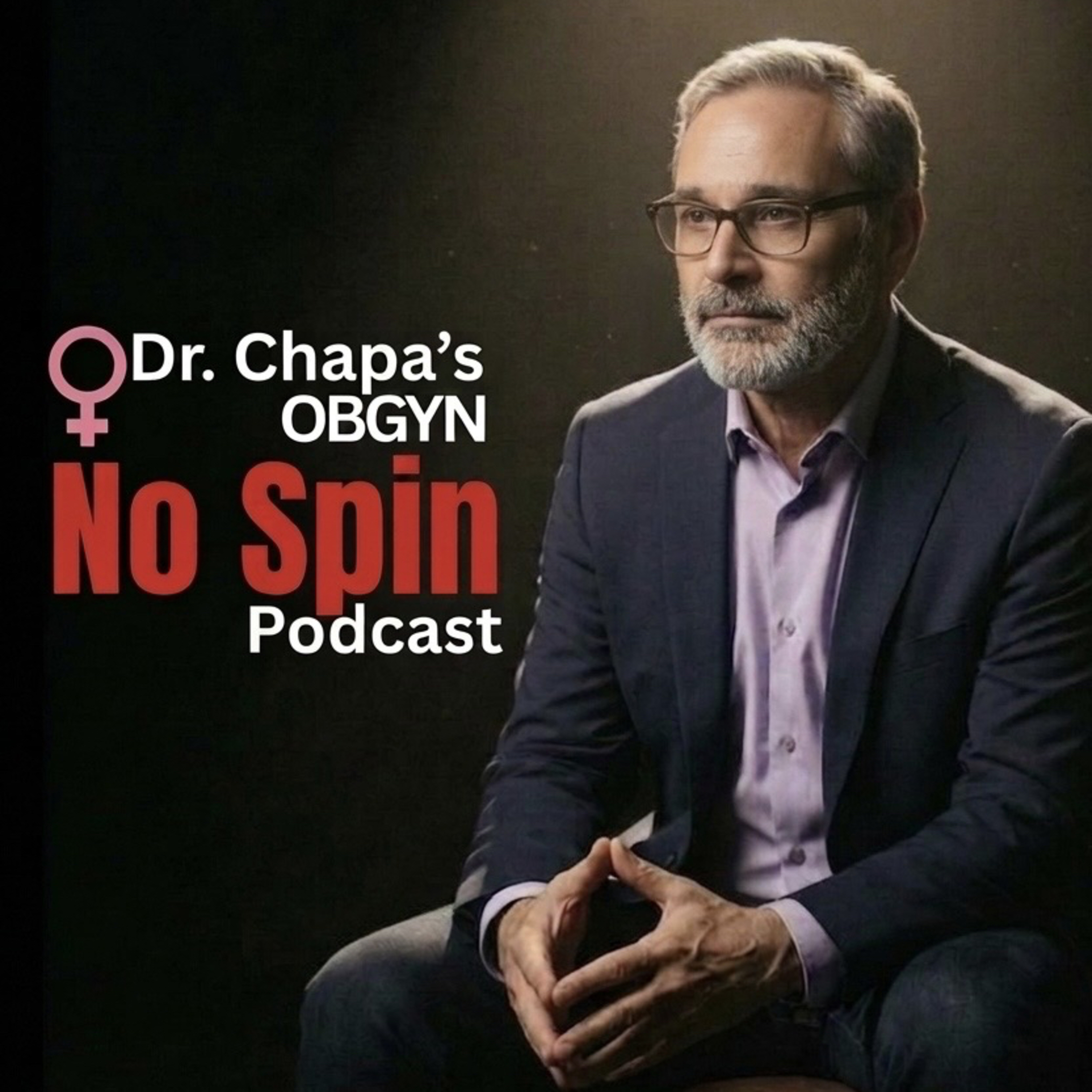
Dr. Chapa’s Clinical Pearls
Dr. Chapa’s OBGYN Clinical Pearls
Relevant, evidence based, and practical information for medical students, residents, and practicing healthcare providers regarding all things women’s healthcare! This podcast is intended to be clinically relevant, engaging, and FUN, because medical education should NOT be boring! Welcome...to Clinical Pearls.
Be sure to visit the podcast's website and support the creator: podcasters.spotify.com
Author
Dr. Chapa’s Clinical Pearls
Category
Podcast website
Latest episode
Nov 25, 2026
Where to listen?
Podcasts in the app Replaio Radio Coming soonPodcasts are coming to the app soon. Install now and be the first to see a whole new take on podcasts
 Install for free
Android 10M+ downloads · 4.7+ rating
iOS soon
Episodes
Scopolamine for Labor Progress? 25.11.2026 15:19
Picture this: It’s 2:00 AM on the labor and delivery floor. The pitocin is dripping, the epidural is humming, and the cervix has been sitting at six centimeters since the Clinton administration. Ah, yes. Arrest of labor. The ultimate plot twist of obstetrics- except instead of a thrilling cliffhanger, everybody just gets tired, frustrated, and eventually wheeled toward the OR. And for decades, res...
Barbed Suture for CS Hysterotomy Closure? 23.11.2026 24:19
Today we're focusing on a crucial step in one of the most common operations in the world: closing the uterus at caesarean delivery. Specifically, we're asking whether the suture we choose, barbed or conventional, affects what happens to a woman years later, when she tries to conceive again and in her next pregnancy. The idea of a barbed suture goes back decades. Barbs were described for te...
OB “WEEKEND” Effect For Adverse Outcomes? 20.11.2026 24:32
Today we’re tackling a topic that routinely sparks dismay in patient forums and dramatic media write-ups: the so-called "weekend effect" in obstetrics. You’ve likely seen the articles or heard the claims- that deliveries occurring on Saturdays and Sundays carry a higher risk of adverse maternal and neonatal outcomes compared to a standard workday. It sounds terrifying. But before we let ominous he...
Avocados Prevent Cesarean? Not So Fast. 18.11.2026 17:42
If you’ve scrolled through your feed lately, you might havecaught a buzzworthy new study suggesting that eating avocados during pregnancy could lower your odds of having a C-section by more than a quarter. On the surface, it sounds like an easy, delicious prescription—grab some guacamole and avoid major surgery. Today, we’re going to put that study under the microscope. We’re dissecting the Novemb...
Beware “The Dolphin Sign” at Second Stage 15.11.2026 19:43
Welcome back to the show. Let’s take a quick step back in time. Think about how far we’ve come: we went from pressing a classic OB fetoscope up against a pregnant belly just to catch a faint, muffled thumping, to relying on advanced, continuous electronic monitoring. We live in an era of high-tech obstetrics. But even with all these modern advancements, room for error still exists, especially duri...
Severe BP Intrapartum, Non-severe on Repeat: PreE with Severe Nuances 12.11.2026 24:21
Now, if you’ve been in OB care for more than a month, you know that preeclampsia is one of those topics we talk about constantly. We have endless guidelines, algorithms, and diagnostic criteria plastered all over our unit walls. But here’s the truth: despite all the literature out there, the real world doesn't always read the textbook. The clinical nuances… The gray areas…That’s where things g...
Latest HPV Cervical Guidelines: ACOG and HPV 56/59/66 09.11.2026 18:34
Yes, we have covered cervical cancer screening many, many times on this show. It is truly a testament to science and research just how far we have come from using slide-based cytology for cervical cancer screening. Primary high-risk HPV, as a screening modality, has been favored for many years and is now officially part of the age-based, ACOG cervical cancer screening guideline (July 2026). We wil...
ACOG POI Update (Oct 2026) 06.11.2026 19:18
If you work in women’s health, you already know the golden rule: just when you think you’ve got a guideline memorized, the ink dries, and the updates drop. Medicine moves fast, and this month is no exception. Today, we are diving straight into the fresh-off-the-press October 2026 ACOG Practice Advisory on Premature Ovarian Insufficiency. Now, if you’re thinking, 'Wait, didn’t ACOG just reaffir...
Myfembree as BC? ASRM Data 03.11.2026 18:03
Back in 2021, we discussed the FDA approval of a combination GNRH antagonist (relagolix) with estradiol and norethindrone. This was originally approved to treat uterine fibroid related heavy menstrual bleeding. It is also now approved for endometriosis care. In theory, this should also be an effective contraceptive agent. However, the FDA label strictly cautions against its use for birth control....
Maternal Fragile X Carrier: NEXT STEPS 31.10.2026 20:53
Today, we’re diving into a topic that has completely transformed prenatal care over the past decade—non-invasive prenatal testing, or NIPT. Thanks to recent technological leaps, cfDNA, cell-free fetal DNA, is giving us unprecedented visibility through just a simple maternal blood draw. Take Fetal Focus by Natera, for example, or the UNITY Reflex Screen from BillionToOne. These options offer single...
Choline in Pregnancy: New Oct 2026 RCT 28.10.2026 19:37
Choline is not a nutrient that the human body can synthesize in sufficient quantities; it must be obtained from dietary sources (eggs, meat, fish, dairy products, grains, and nuts). Its a water-soluble amine that serves as a precursor for phospholipids, which are vital components of cell membranes. Plus, it’s a vital component of acetylcholine, a neurotransmitter involved in numerous brain functio...
A DCC Conundrum 25.10.2026 17:40
Delayed cord clamp is standard of care. On today’s episode, we are stepping into a high-pressure dilemma in the labor and delivery room. Imagine this (which doesn’t need a lot of imagination, because it is a real event which occurred to one of our podcast family members): A mother has carefully drafted a birth plan. One of her non-negotiable requests is delayed cord clamping for two full minutes....
ASH New Ferritin Recs for Women (Sept 2026) 22.10.2026 20:09
Here is a sobering fact: Iron deficiency is one of the most common health conditions in the world. Iron deficiency affects an estimated one in three people, yet many go undiagnosed and untreated despite widespread treatment options. Iron deficiency can progress to iron deficiency anemia. If you’ve been listening for a while, you know we have banged the drum on this podcast time and time again abou...
Innie v Outie Labia: Listener Question 19.10.2026 18:48
Innie vs Outies: no, we are not referring to bellybuttons. In this episode, we’re talking about the labia of the Volva! Does it actually matter? Which one is more common? Now, this episode was actually sparked by a brilliant listener who sent us her question to our IG inbox (as a non-clinician): “Can having an innie labia actually cause me to have recurrent bacterial vaginosis?” Such a good questi...
Marfan Syndrome in Pregnancy 15.10.2026 22:12
Marfan syndrome is an autosomal dominant, connective tissue disorder. Because it’s autosomal dominant, an affected parent has a 50% chance of passing the genetic mutation to their offspring in every pregnancy. Approximately 25% of cases actually stem from spontaneous, de novo mutations with no prior family history. In the United States, the prevalence of Marfan syndrome is estimated at roughly 1 i...
Is Mag Always Needed for PP Readmission for PreE? 12.10.2026 18:14
If you’ve ever managed postpartum preeclampsia, you know the clinical gray zone: after an initial intrapartum course of magnesium sulfate, when do you actually restart it for a postpartum, readmission exacerbation? Always? There’s no standard national guidance on this. Every unit seems to do something a little different. In this episode, we’re summarizing a new study looking at practice patterns a...
The LT-O Whole Blood CONTROVERSY 08.10.2026 23:55
If you’ve been listening for a while, you might remember an episode we ran about two years ago where we dove deep into the use of low-titer O-positive whole blood in emergency resuscitation. At the time, the consensus in trauma care was leaning heavily "pro"—advocating for getting O-positive blood into bleeding patients fast, especially given the persistent and severe shortages of O-nega...
ASRM RPL “UPDATE” 2026 05.10.2026 23:48
In June 2026, the ASRM released its updated guidance on recurrent pregnancy loss. This is the most updated guidance in over a decade and includes a decision tree algorithm that starts with a pivotal test. In this episode we will review this “first pass” triage test and provide clinical implications. 1. ASRM CO: https://www.asrm.org/practice-guidance/practice-committee-documents/recurrent-pregnancy...
New Data on CHC with MwA 02.10.2026 24:34
Currently, the CDC U.S. Medical Eligibility Criteria (USMEC) rate CHCs as category 4 (unacceptable health risk) for migraine with aura, versus category 2 for migraine without aura; ACOG similarly recommends avoiding estrogen-containing contraception in migraine with aura. But, recent data published in August 2026 from the UK seems to show no increased risk with “modern”/low-dose combination birth...
Neg Trich on VP3 but Positive NAAT? Why? 29.09.2026 11:12
A growing body of research reveals the link between STIs andthe pathogens that cause most cases of vaginitis. Over 90% of vaginitis cases result from BV, yeast, or trich- alone or in combination. But, a recent 2024 study from Schwebke et al., in the J Clinical Microbiology, found that about 1 in 5 women who presented with symptoms of vaginitis also had at least one STI…a good reminder to not just...
cfDNA Reflex Testing for Autosomal Recessive Fetal Conditions 26.09.2026 26:04
An important clinical advantage of cfDNA screening for autosomal recessive conditions is its ability to provide meaningful fetal risk assessment in general-risk pregnancies at an early gestational age, even when partner carrier testing is unavailable. But is this reflex cell-free DNA approach reliable. In this episode, we will review NEW DATA (Oct 2026) from a prospective, multi-site study whose g...
ENTG New Removal Guidance (SGP Article in Press) 23.09.2026 27:29
Welcome back to the show, everyone! Today,we are diving deep into one of the most effective, set-it-and-forget-it contraceptive options available: the Nexplanon implant. With a failure rate of about 0.05%, it is apowerhouse of birth control. You pop it just under the skin of the inner upper arm, and for up to five years, you are covered. Standard removal is usually a quick, straightforward, in-off...
Retest GDM Late 3rd Tri for LGA or Poly? (OCT 2026 Data) 20.09.2026 28:11
Picture this common, late-gestation conundrum: You’re reviewing a 34-week sono. The mid-pregnancy 24-to-28-week glucose screen was completely normal. But now, the sonogram pops up with an estimated fetal weight of over 90%, or maybe a MVP (or AFI) that’s overtly elevated. The classic clinical dilemma hits: Do you order a repeat OGTT this late in the game? Is it actually worth poking the patient ag...
Routine pp Hgb? 17.09.2026 13:06
Today we’re diving into a lab order that almost every ob-gyn, midwife, and labor-and-delivery nurse were traditionally trained to do: the routine Postpartum Day 1 Hemoglobin and hematocrit. For decades, checking a patient’s H&H after delivery was automatic. Didn’t matter if it was a smooth, uncomplicated vaginal birth with minimal blood loss or a complex emergency C-section- come 6:00 AM the n...
General Anesthesia and PP Mood Disorders 15.09.2026 25:01
If you’ve been following health and medical headlines over the past few weeks, you’ve likely seen a renewed and urgent conversation around postpartum depression—a condition that affects millions of new mothers worldwide, often with devastating consequences. While we’ve long understood that postpartum depression is deeply multifactorial—shaped by a complex web of hormonal shifts, psychological stre...
Similar podcasts







Listen to the Dr. Chapa’s OBGYN Clinical Pearls podcast in Replaio
Radio and podcasts in one app - free, with no sign-up. Install today and do not miss the launch
Replaio is not a podcast publisher; show names, artwork and audio belong to their authors and are distributed through public RSS feeds.