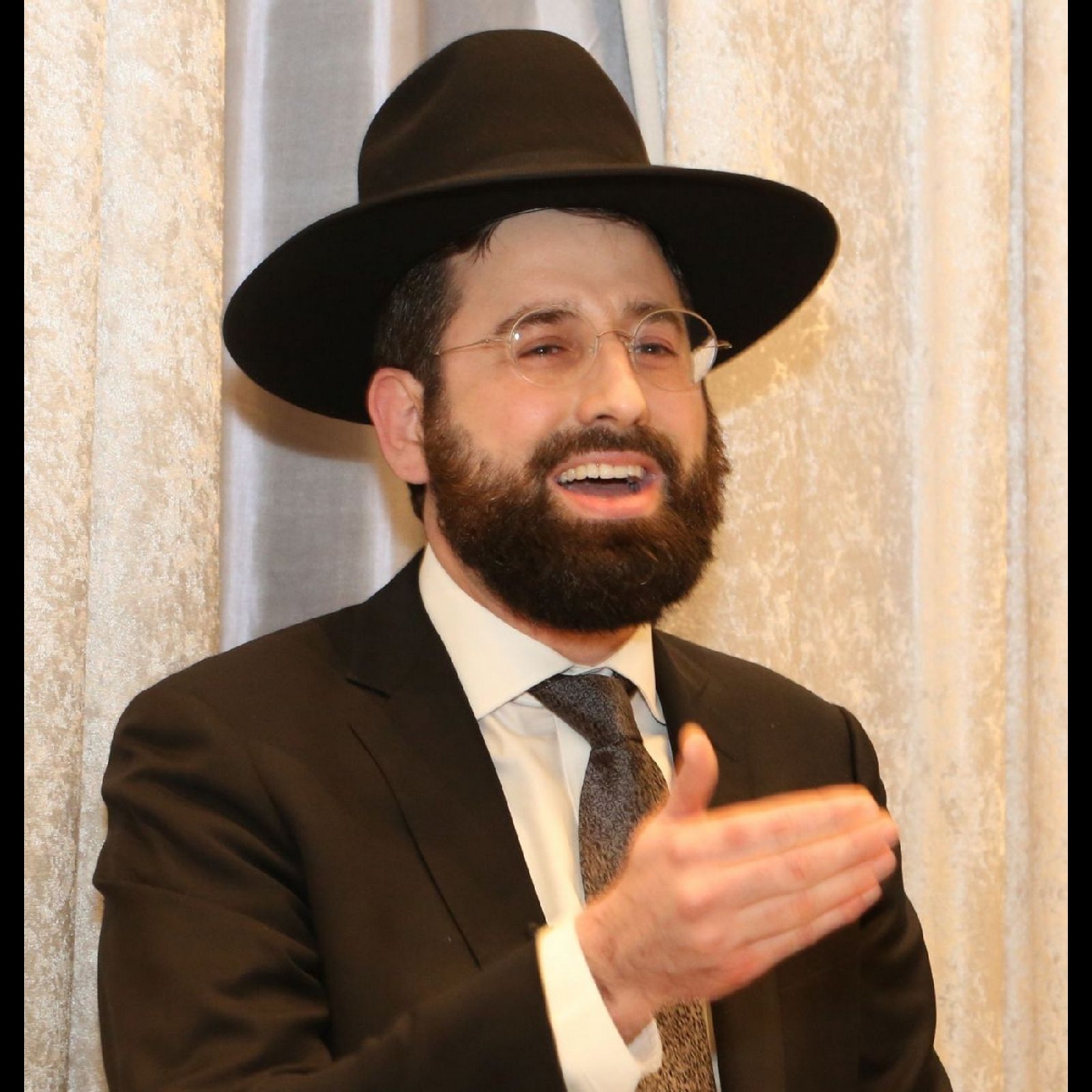
Mrs. Tsyrl Turen
Daily Tanya
Daily Tanya recordings by Master Tanya Teacher, Mrs. Tsyrl Turen. Spiritual growth through mindful meditations and G-dly awareness. Tap into your G-dly soul every day and emerge as a transformed person. This is L'iluy Nishmas Chana Tzivia Bas YBLT Yosef Yitzchak, a dear friend who was consistent with Chitas all of her short life. May this bring her soul much needed comfort and a great Aliyah.
Where to listen?
Podcasts in the app Replaio Radio Coming soonPodcasts are coming to the app soon. Install now and be the first to see a whole new take on podcasts
 Install for free
Android 5M+ downloads · 4.8 rating
iOS soon
Install for free
Android 5M+ downloads · 4.8 rating
iOS soon
Episodes
Tanya for the 17th of Shevat 07.02.2023 9:29
In this chapter, the Alter Rebbe concludes the discussion begun in ch. 18. There, he began to explain the verse, “For this thing is very near to you, in your mouth and in your heart, that you may do it,” meaning that to serve G-d out of a feeling of love and awe for Him is a very easy matter for everyone.
Tanya for the 16th of Shvat 07.02.2023 6:00
The differences between the various sins apply only after the sin has been committed. During the act, however, every sin tears one away from G-d.
Tanya for the 15th of Shevat 07.02.2023 9:32
A Jew has a natural soul repulsion to idolatry because he can't bear to be separated from G-d. However, when a Jew sins, causing a temporary disconnect to G-d, which is akin to idolatry, Tanya then explains this to be the cause of "temporary insanity".
Tanya for the 14th of Shevat י''ד שבט 29.01.2023 7:06
In this chapter, he explains that a transgression has exactly the opposite effect of a mitzvah. Whereas a mitzvah joins one to G-d, a transgression severs one from Him; whereas a mitzvah attests to G-d’s unity, a transgression implies idolatry.
Tanya for the 13th of Shevat י''ג שבט 29.01.2023 3:16
The performance of G-d’s commandments would seem to be a result of one’s fear of Him and not vice versa . The Alter Rebbe explains that this is a higher level of awe than that which is a prerequisite for performing the commandments. This level can only be attained as a result of one’s observance of the commandments. Now if the commandments lead one to a higher level in the fear of G-d, surely the...
Tanya for the 12th of Shevat י''ב שבט 29.01.2023 3:29
The Alter Rebbe has thus far discussed two levels of union with the Divine will, one analogous to the chariot and its rider and the second to the unity of body and soul. Both these levels of unity are achieved by performing the mitzvot . He now goes on to describe a third and higher level of unity that is achieved through the study of the Torah.
Tanya for the 11th of Shevat י''א שבט 29.01.2023 5:15
In this chapter, the Alter Rebbe demonstrates how one can unite with G-d’s will and wisdom, and thereby with G-d Himself, through study of the Torah and observance of the mitzvot .
Tanya for the 10th of Shevat י' שבט 29.01.2023 6:02
Through many and varied tzimtzumim , the Divine Word brought into being the kelipot and the sitra achara , who perceive themselves to be entities separate from G-d. For this reason, G-d’s Word is described in the Torah as speech, for the element of separation found in human speech (where the spoken word becomes separated from the speaker) is also present in the Divine “speech” of Creation. However...
Tanya for the 9th of Shevat ט' שבט 29.01.2023 4:17
In this chapter, the Alter Rebbe goes on to say that since, after all, the Torah does use the term “speech” with regard to Divine revelation, we must say that Divine speech contains, to some extent at least, the second characteristic of human speech as well (i.e., that it becomes separated from the speaker). He explains that this is in fact so but only with respect to the beings created by Divine...
Tanya for the 8th of Shevat ח' שבט 29.01.2023 1:26
Since G-d is not affected by the tzimtzumim which make it possible for a created being to feel separate from Him, He perceives all the creations brought into being by His Word as being still within their source—Himself. There they are in a state of absolute nullification. From His perspective, they are still nonentities, and the fact of their creation in no way detracts from His absolute unity—He...
Tanya for the 7th of Shevat ז' שבט 29.01.2023 3:55
the Alter Rebbe states that speech is distinguished by two characteristics: (a) it reveals that which was previously hidden in the speaker’s thoughts; (b) it becomes separated from its source. Only the former characteristic of human speech is analogous to Divine “speech,” which reveals to Creation that which was hitherto hidden within G-dliness.
Tanya for the 6th of Shevat 29.01.2023 2:41
A spoken word is utterly without value in comparison with the soul’s intellectual and emotional powers (which are described here, for our purposes, as the essence of the soul). Surely, then, the Divine “Word” by which G-d creates and animates all the worlds has no value at all next to G-d, Who is truly and absolutely infinite. Thus, all the worlds created and sustained by the Divine Word are as if...
Thanya for the 5th of Shevat 22.01.2023 8:10
This same power of self-sacrifice, says the Alter Rebbe, can enable a Jew to refrain from every transgression and to fulfill all the commandments. But if, in fact, only a clear challenge to one’s faith—such as idolatry—arouses and activates one’s hidden love, how can this love serve to motivate one’s observance of all the commandments?
Tanya for the 4th of Shevat 22.01.2023 4:03
The kelipah can obstruct only those matters that do not directly affect the G-dly soul’s level of chochmah . Therefore, in such matters as faith—a derivative of chochmah — kelipah can neither penetrate nor obstruct. Consequently, in such matters, the Jew is aware that to succumb to sin would mean being torn away from G-d, and therefore, he will readily lay down his life rather than sin.
Tanya for the 3rd of Shevat 22.01.2023 3:42
If a Jew felt how each sinful act tore him away from G-d, he would never sin, for after all, every Jew’s love of G-d is so strong that he is prepared to sacrifice his very life for G-d
Tanya for the 2nd of Shevat 22.01.2023 3:52
Two questions remain: (1) What is the nature of this love (i.e., what does it strive for)? (2) How is fear of G-d incorporated in it? They will be dealt with in this chapter.
Tanya for the 1st of Shevat 22.01.2023 4:02
Every Jew has a soul which stems from the holy sefirot. Ultimately each soul is animated by the light of the Ein Sof by way of the soul’s faculty of wisdom ( chochmah .. The Alter Rebbe now goes on to explain why it is chochmah that is the original recipient of the light of the Ein Sof . The explanation is based on a discussion of the nature of the soul’s faculty of wisdom
Tanya for the 29th of Tevet 22.01.2023 4:52
The Alter Rebbe will now explain an alternative method of attaining the love and awe of G-d, a method that may be used even by one with spiritual shortcomings. It consists of arousing the natural love of G-d that lies hidden in the heart of every Jew, a love that is his birthright, his inheritance from our Patriarchs. No meditation is needed to arouse it; all that is required of him is to recall a...
Tanya for the 28th of Tevet 22.01.2023 3:42
The Rasha, it says, is ruled by his heart. The rule of mind over heart won't work when one is ruled by their heart. The way in then is through a broken heart. The recognition that they have veered off the path of G-d and the bitterness over this can help bring the person to Teshuvah and a return to their true selves.
Tanya for the 27th of Tevet 22.01.2023 4:37
The verse "The ... (Torah) is very ...(attainable) to you in thought, speech, and action" is implying that everyone is capable of creating a love for G-d. The key to this is creating intellectual emotions, helping us to fulfill the Mitzvot with constant love for Hashem, being that "The mind rules the heart", this reality makes the ability to create an emotional reaction to the contemplation of G-d...
Tanya for the 26th of Tevet 22.01.2023 4:16
When the feelings of love and awe of Hashem don't seem to generate, these are times when it is possible to generate these emotions cognitively, through contemplation. Although these premeditated emotional responses may be less passionate or feel less natural, they are considered valuable and can even enhance your Torah and Mitzvot. This can be another way that one may fulfill the Mitzvah of love f...
Tanya for the 25th of Tevet כ''ה טבת 17.01.2023 3:30
To enable him to master his desires, the beinoni requires (in addition to the natural ability of one’s mind to govern his heart) the help of the Divine light which illuminates his mind1 upon contemplating G-d’s greatness.
Tanya for the 24th of Tevet כ''ד טבת 17.01.2023 2:07
The verse mentioned yesterday is part of a talmudical discussion. Hillel defines "one who worships G-d" as one who goes the extra measure to study 1 extra time beyond the norm, then 100 times. The extra effort it takes to stretch outside of habit or natural ability is what defines the Beinoni as either "One who worships G-d" and one who does not, meaning, one who "does not worship" is one who is a...
Tanya for the 23rd of Tevet כ''ג טבת 16.01.2023 3:11
There is a difference between the righteous who work on themselves and those who have no inner struggle. There are those who by nature or habit are not drawn to physical pleasures. Even if in action and behavior the two may be identical, one who does the inner work is called an "Oved Elokim" one who worships G-d.
Tanya for the 22nd of Tevet כ''ב טבת 16.01.2023 4:12
What is the point of the oath that we must be a Tzaddik, if this is not something every soul is destined or able to become? However, this does not absolve us of our obligation. Everyone must try their best.
Similar podcasts







Listen to the Daily Tanya podcast in Replaio
Radio and podcasts in one app - free, with no sign-up. Install today and do not miss the launch
Replaio is not a podcast publisher; show names, artwork and audio belong to their authors and are distributed through public RSS feeds.