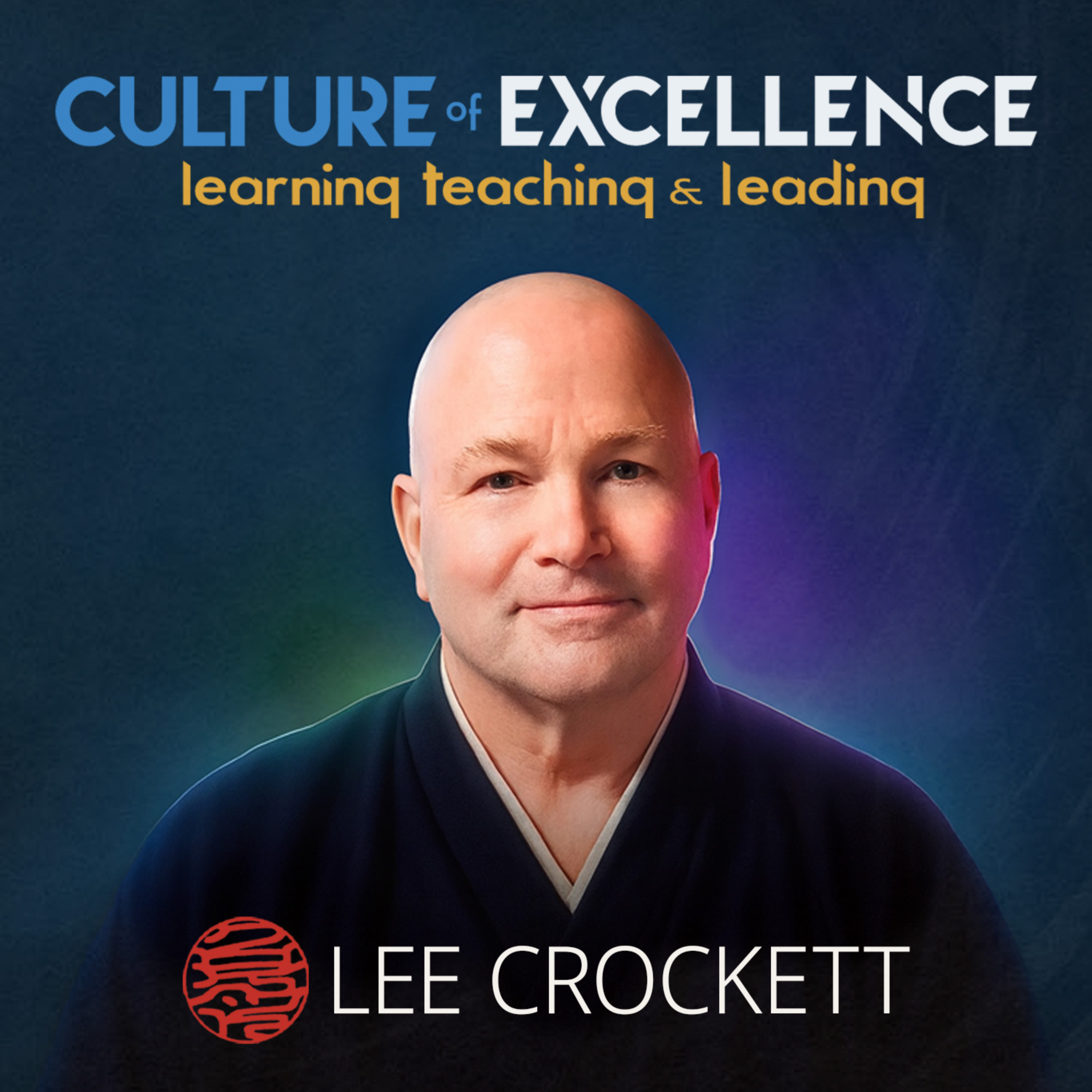
Lee Crockett
Culture of Excellence
Join Lee Crockett, author and global education consultant, as he explores how exceptional leaders build thriving, human-centred schools. Short, insightful episodes on leadership, culture, and professional wellness.
Author
Lee Crockett
Category
Podcast website
Latest episode
Jul 6, 2026
Where to listen?
Podcasts in the app Replaio Radio Coming soonPodcasts are coming to the app soon. Install now and be the first to see a whole new take on podcasts
 Install for free
Android 5M+ downloads · 4.8 rating
iOS soon
Install for free
Android 5M+ downloads · 4.8 rating
iOS soon
Episodes
When Important Starts Sounding Urgent 06.07.2026 13:49
In this episode of the Culture of Excellence podcast, Lee Crockett explores why the pressure many school leaders feel may not be initiative overload alone, but urgency overload: the accumulation of legitimate priorities that all arrive as if they require immediate attention. This reflective episode considers urgency as a claim on finite leadership attention, why every important thing cannot be a...
2.1 When Leadership Gets Heavier 02.07.2026 13:23
Why does leadership feel harder even when experienced leaders become more capable? In this episode of the Culture of Excellence podcast, Lee Crockett explores the Sustainability Myth: the idea that leadership sustainability is often framed as a workload problem, when it may also be a professional judgement problem. Drawing from the Week 1 article and the full Leadership Paper, Lee reflects on wh...
1.14 What Pressure Reveals About the Way You Lead Together 26.06.2026 18:16
In this final episode of the Leadership Archetypes season, Lee Crockett explores what pressure reveals about the way leadership teams actually lead together. School leadership does more than test endurance. Over time, pressure can train a team’s interpretation, behaviour, and collective identity. Capable teams may keep the school moving while becoming narrower than their values, more dependent on...
1.13 The Confidence a Team Earns — How Shared Effort Becomes Evidence a Team Can Trust 19.06.2026 15:55
Collective efficacy is often discussed as belief, confidence, positivity, or shared purpose. But in leadership teams, those words are not strong enough on their own. Collective efficacy is not optimism. It is confidence with evidence. In this episode, I explore why leadership teams build collective efficacy when shared effort repeatedly produces something durable: decisions that travel, conversati...
1.12 What Insight Requires — Why Leadership Teams Need Agreements They Can Return To 12.06.2026 17:14
Leadership insight can feel like progress. A team finally names the pattern, recognises what pressure has been doing, and finds language for something it has been carrying without fully naming. But insight has to become shared practice. In this episode, I explore why awareness alone is often not enough for leadership teams under pressure. Familiar patterns become available again when urgency, ambi...
1.11 When Leadership Teams Can’t See What’s Shaping Them 02.06.2026 8:17
Leadership teams often feel it when something isn’t fully aligned. Decisions don’t hold. Responsibility shifts. Conversations repeat. In this episode, Lee explores how these patterns emerge through differences in interpretation—and why teams can be working hard while still becoming misaligned. This is an episode about visibility . About how leadership teams move from fragmented understanding to sh...
1.10 When Leadership Teams Compensate Instead of Coordinate 25.05.2026 8:26
You can have a leadership team that looks highly functional—and still find that the work doesn’t quite hold. Decisions need reinforcing. Conversations return. A small number of people carry clarity, tension, and continuity across the system. Nothing appears broken, but the same effort is being applied more than once. In this episode, I explore the difference between coordination and compensation i...
1.9 Why Strong Leadership Teams Still Struggle 22.05.2026 10:02
Strong Leaders, Fragile Teams You can have a room full of capable, experienced leaders—and still have a leadership team that doesn’t quite hold. Decisions don’t travel. Conversations return. A few people carry clarity, while others contribute less over time. Nothing looks broken, but something isn’t working the way it should. In this episode, I explore a shift that changes how we understand leader...
1.8 When Your Strengths Start Working Against You 08.05.2026 8:43
Most leadership problems are diagnosed in the wrong way. We look for what is missing — more clarity, more decisiveness, more empathy, more strategy. But in many leadership teams, that is not the real issue. The issue is not missing strengths. It is strengths that have narrowed under pressure . In this episode, I explore one of the more difficult truths in leadership: your strengths do not disappea...
1.7 Stop Describing Leaders. Start Watching Them. 05.05.2026 14:43
Why leadership is revealed in behaviour, not identity Most leadership models begin by trying to explain who a leader is . Strategic. Relational. Visionary. Decisive. But that’s rarely where leadership becomes most visible. It becomes visible when pressure enters the room — in what people actually do when meetings tighten, decisions stall, ambiguity rises, and the emotional cost of the work begins...
1.6 Hidden Patterns: Why Leadership Teams Compensate Instead of Align 28.04.2026 10:43
Most leadership teams do not first struggle because of obvious dysfunction. They struggle because quiet patterns become normal. A conversation always feels slightly heavier than it should. A decision never quite settles. A meeting ends in agreement, but not in movement. One person keeps restoring clarity. Another keeps absorbing what others leave unsaid. Nothing looks dramatic. And that is precise...
1.5 Effort Leakage: Why Hardworking Leadership Teams Still Lose Traction 26.04.2026 11:04
Some leadership teams are not underperforming. They are leaking effort. In this episode, I explore one of the most frustrating and least understood realities in school leadership: why teams can work incredibly hard, stay highly active, and still feel as though too little of that effort is turning into durable traction. Drawing on the work of Lazarus and Folkman, Daniel Kahneman, Karl Weick, Chris...
1.4 Invisible Drift — How Good Leadership Teams Slowly Lose Coherence 17.04.2026 11:28
Strong leadership teams rarely drift because they stop caring. More often, they drift because they are highly adaptive, deeply committed, and very good at carrying pressure without fully seeing what that coping is costing the way they lead together. In this episode, I explore why drift often hides inside competence, why what feels like dedication can quietly become compensation, and how over-funct...
1.3 How Pressure Reshapes Leadership Behaviour 10.04.2026 9:10
Some pressures arrive loudly. Others slip quietly into the rhythm of a leadership team, reshaping behaviour long before anyone names what is happening. In this episode, I explore one of the most important truths in leadership: pressure does not simply add weight to the work. It changes the way the work is carried. Drawing on the work of Lazarus and Folkman, Daniel Kahneman, Karl Weick, and Albert...
1.2 The Initiative Graveyard 02.02.2026 10:37
Every school has one — that quiet space where good ideas go to die. In this episode, Lee Crockett explores The Initiative Graveyard : why promising programs fade, what it costs our culture, and how school leaders can design systems that make change last. Drawing on research from Fixsen, Durlak, DuPre, Fullan, Hattie, and more, Lee unpacks the real causes of initiative fatigue — and shares five po...
1.1 Reactive Rhythms 05.01.2026 12:16
Reactive Rhythms explores how urgency becomes identity and how leaders can restore coherence through awareness, design, and presence. Key Takeaways Reactive rhythm is a design issue, not a personal failing. Urgency feels productive but erodes empathy and foresight. Neuroscience (Porges 2011; Rock & Ringleb 2013) shows that constant reactivity narrows the social brain. Awareness restores agenc...
Similar podcasts







Listen to the Culture of Excellence podcast in Replaio
Radio and podcasts in one app - free, with no sign-up. Install today and do not miss the launch
Replaio is not a podcast publisher; show names, artwork and audio belong to their authors and are distributed through public RSS feeds.