Cohere Technologies
Cohere Technologies AI Podcast
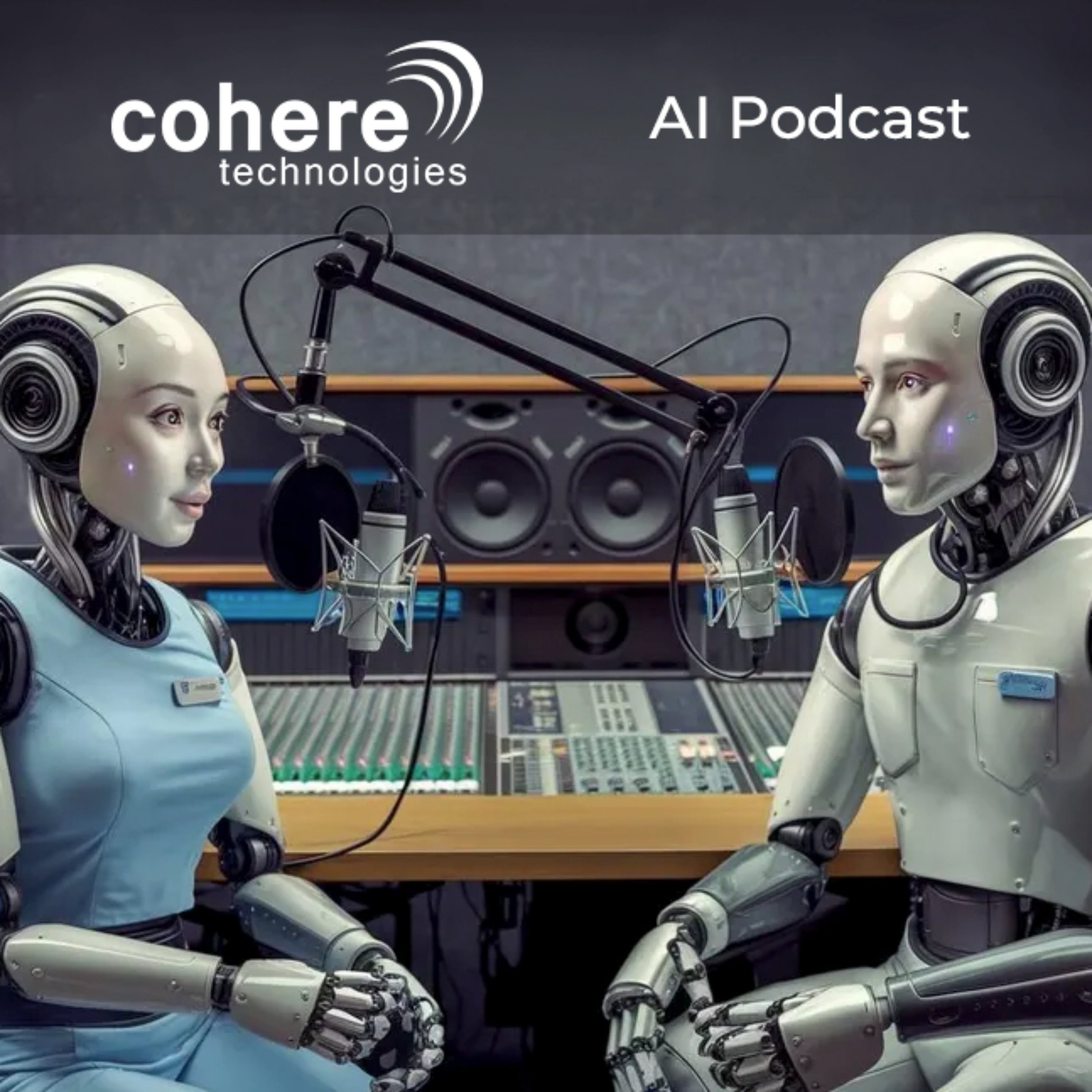
Our AI podcasts, hosted by Echo & Ether, are designed to take extremely complex PHY layer mathematics concepts, and academic materials developed by Cohere Technologies and other researchers, into an understandable and readily available conversational format.
Be sure to visit the podcast's website and support the creator: podcasters.spotify.com
Author
Cohere Technologies
Category
Podcast website
Latest episode
Jun 25, 2026
Where to listen?
Podcasts in the app Replaio Radio Coming soonPodcasts are coming to the app soon. Install now and be the first to see a whole new take on podcasts
 Install for free
Android almost 10M downloads · 4.8 rating
iOS soon
Install for free
Android almost 10M downloads · 4.8 rating
iOS soon
Episodes
The Economic Benefits of New, Radar-based Communications Platform 25.06.2026 20:52
The Universal Spectrum Multiplier and it’s ECHO dataset significantly increase the value of 5G assets by delivering 6G-grade capabilities, such as mission-first Integrated Sensing (ISAC) and AI-native optimization, on existing infrastructure now.
Significantly Improving Performance of Zak-OTFS based ISAC 17.06.2026 22:42
The researchers designed a Zak-OTFS based radar waveform that significantly improves target resolution in both delay and Doppler domains which minimize image blurriness and feature reduced signal processing complexity. Additionally, this discrete approach demonstrates a 100 dB reduction in sidelobes compared to traditional Zadoff-Chu sequences that are proposed for 5G.
Multi-G – The Mathematical Unification of 5G and 6G Candidate Modulations 17.06.2026 22:14
Mathematically, 5G’s OFDM and 6G contenders like Zak-OTFS are actually specific versions of a single family called complex Hadamard-modulated pulse trains. This theoretical unification allows for a true Multi-G transceiver architecture capable of supporting multiple waveforms simultaneously. By multiplexing these different schemes, operators can better serve diverse user needs within a single 6G n...
The Implications of Holographic Channel Insights 17.06.2026 22:12
This deep dive covers our collaboration with Bell, from the early integration of the Universal Spectrum Multiplier (USM) into a live OEM 5G base station to the groundbreaking Enhanced Channel Insight with Holographic Observability ( ECHO ) add-on. ECHO empowers millions of deployed 5G base stations globally to participate in AI-RAN without a forklift upgrade.
Multi-G Innovation for ISAC: Making the case for Orthogonal Time Frequency Space 17.06.2026 18:35
International standards, 6G practicalities, Integrated Sensing, and OTFS come together in this conversation.
How will “Learning in the Delay-Doppler Domain” transform our handling of the wireless channel? 17.06.2026 17:32
This deep-dive exposes a transformational approach proposed by Dr. Rob Calderbank of Duke University to using OTFS’ Delay-Doppler capabilities to operate “model free” while sending traffic over wireless channels. This adaptive and self-optimizing notion has positive implications to future use of higher frequency and doubly spread channels proposed for 6G spectrum.
What is Integrated Sensing and Communications (ISAC) and how does OTFS implement it? 17.06.2026 13:50
In this podcast OTFS is examined for its capabilities to implement both data transmission and sensing in same transmissions. Additionally, applications use cases for ISAC and simulation results will be discussed.
How do OFDM and OTFS stack up to each other? 17.06.2026 15:39
With 6G on the horizon and waveform innovation front and center, let’s discuss one of the candidates, Orthogonal Time Frequency Space (OTFS), and how it stacks up to the legacy Orthogonal Frequency Division Multiplexing (OFDM) used in 4G and 5G systems today.
What is Orthogonal Time Frequency Space (OTFS “primer”)? 17.06.2026 10:17
This short conversational podcast introduces OTFS and its concepts. First developed in 2011 and studied globally by academic researchers in over 1200+ papers since, OTFS has unique properties that solve for some of the gaps that today’s OFDM waveform experiences.
How do mobile operators benefit economically from adding USM to existing networks? 17.06.2026 20:18
Under financial pressure? Want to defer major capex while still making investments to expand spectral capacity? If you answered “yes”, this podcast is for you. The podcasters discuss a white paper by Appledore Research that breaks down the positive business and economic impacts of the Universal Spectrum Multiplier.
What is the Universal Spectrum Multiplier (USM) and how does it fit with 5G? 17.06.2026 15:16
This in-depth podcast gets into the origins of the Universal Spectrum Multiplier, the Delay-Doppler channel model it’s based upon, breakthrough spectral efficiency enabled by bringing MU-MIMO into FDD spectrum and the integration of it into Open RAN and traditional base stations.
Multi-G – Universal Neural Receiver enables receipt of multiple waveforms 17.06.2026 19:39
Deep-dive on a universal neural receiver designed for 6G and Multi-G wireless networks, which addresses the limitations of traditional model-based signal processing. An AI-native physical layer utilizes reservoir computing to perform real-time deconvolution, allowing the system to adapt at the sub-millisecond speed of wireless interference. The system avoids the need for extensive offline training...
Similar podcasts







Listen to the Cohere Technologies AI Podcast podcast in Replaio
Radio and podcasts in one app - free, with no sign-up. Install today and do not miss the launch
Replaio is not a podcast publisher; show names, artwork and audio belong to their authors and are distributed through public RSS feeds.