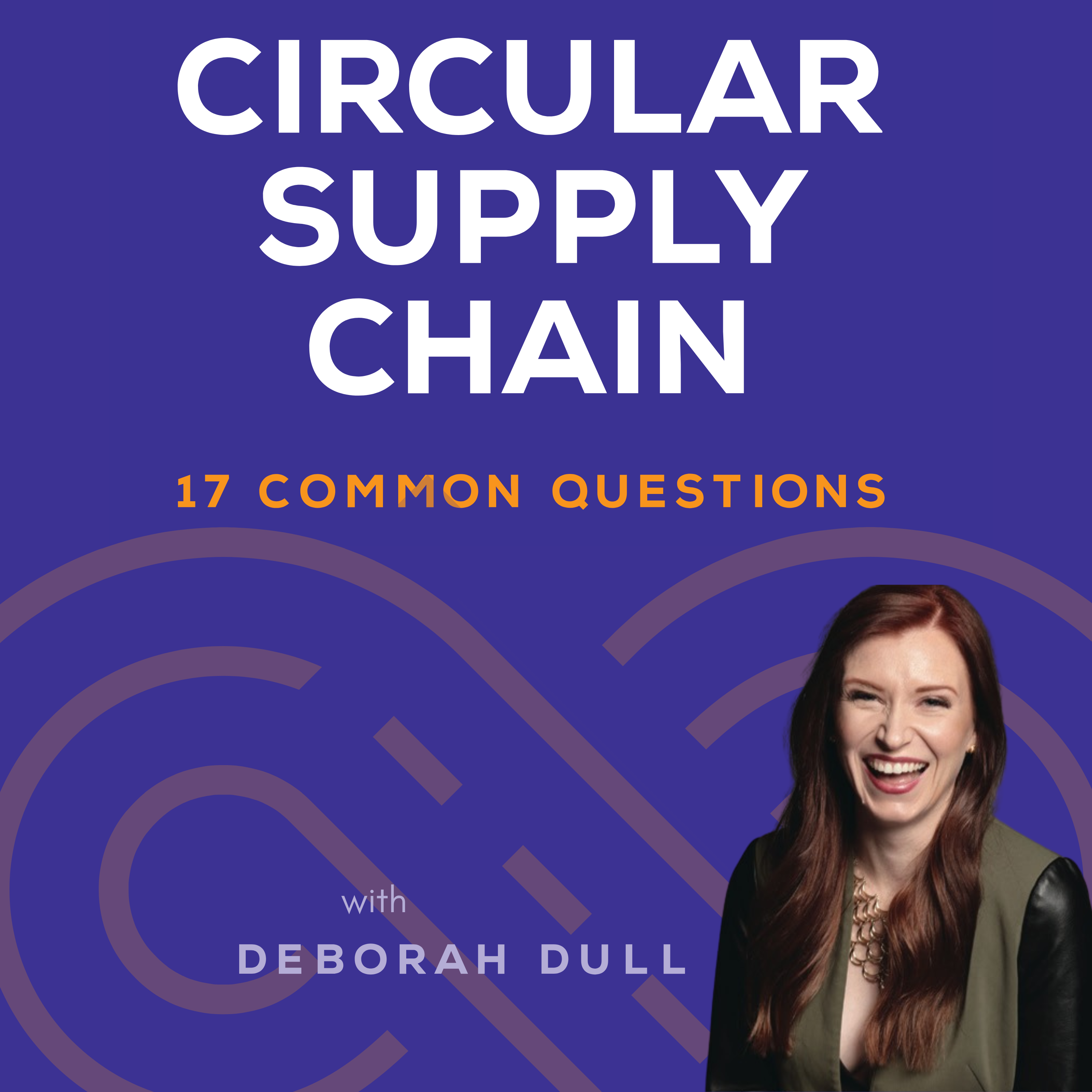
Deborah Dull
Circular Supply Chain: 17 Common Questions
Exploring the untapped opportunity of Circular Supply Chains. This podcast, based on the book by Deborah Dull, answers the 17 common questions supply chain professionals are asking. Discover how to give materials another life, leverage technology, and take the next step to build resilient, sustainable operations that save the planet. A must-listen for anyone moving beyond the linear economy.
Where to listen?
Podcasts in the app Replaio Radio Coming soonPodcasts are coming to the app soon. Install now and be the first to see a whole new take on podcasts
 Install for free
Android 5M+ downloads · 4.8 rating
iOS soon
Install for free
Android 5M+ downloads · 4.8 rating
iOS soon
Episodes
17. How do I take the next step? 08.10.2025 11:58
This final episode cuts through the complexity with five essential questions every supply chain team needs to answer now. We map the journey from identifying your most-traveled product and your largest waste stream, to pinpointing your single biggest vulnerability and confronting your carbon footprint.
16. How do linear supply chains become circular? 08.10.2025 12:43
This episode breaks down the seven-phase transition framework used by professionals worldwide. We move from mapping your hidden "fugitive value" and intensifying asset use, to predicting waste streams and deliberately slowing down your inventory's life cycle.
15. What is the future of supply chains? 08.10.2025 12:54
This episode moves beyond theory to tackle five real-world crises with circular solutions. Discover how to handle budget cuts by turning waste into revenue, bypass port closures with regional sourcing, and hit aggressive emissions targets by shortening your supply chain.
14. What about technology? 08.10.2025 16:49
This episode cuts through the hype of the fourth and fifth industrial revolutions to spotlight five practical technologies that actually matter. We explore the "digital bill of materials" that gives every product a unique life story, the modular connections that make partnerships snap together like LEGO, and the automated marketplace that could turn your waste into someone else's raw material over...
13. What does it mean to interconnected? 08.10.2025 15:48
This episode dives into the three critical touchpoints—physical, financial, and informational—that separate a simple network from a true circular ecosystem. Discover why money flows reveal more truths than your inventory data, how blockchain might finally solve the "new supplier" problem, and why your most creative (and chaotic) information workarounds are about to meet their match.
12. Aren't supply chains already systems? 08.10.2025 13:50
This episode argues that to build a truly circular supply chain, we need to rebuild the very systems they run on. Discover why "agile" and "cost" aren't enough, how a 20-year-old "turnkey" concept is making a comeback, and what it will take to measure circularity as a strategy, not just a goal.
11. Isn't zero waste impossible? 08.10.2025 12:58
This episode makes the case that it's not only possible but already happening inside forward-thinking companies. We break down the three-step playbook for achieving zero waste, from the radical efficiency of a pen with its own labeled spot, to a whiskey maker feeding cows with its leftovers, and a multi-billion dollar CPG giant that stopped throwing away its cardboard boxes. Discover why the ultim...
10. How can another supply chain use my waste? 08.10.2025 14:14
This episode dives into the surprising new revenue streams hidden in your supply chain's waste. Discover how "industrial symbiosis" is turning bean water into vegan mayo, why Ford is buying ketchup scraps from Heinz, and the three simple models for finding a buyer for your byproducts.
9. Can we make our supply chains shorter? 08.10.2025 14:18
How do we turn a dirty diaper into a business opportunity? This episode challenges the four fundamental assumptions that keep our global supply chains long, fragile, and wasteful. Discover why "centralized" doesn't always mean "optimized," how the very idea of "away" is a fantasy, and why the future of supply chain resilience might depend on partnering with an unexpected ally: your own garbage.
8. I've already leaned out my supply chain. How is this different? 06.10.2025 16:00
Is circularity just the next "Lean"? This episode uncovers the critical similarities and surprising differences. Discover why circularity shifts the core goal from inventory turns to asset utilization , how it turns waste streams into new revenue, and why it might be time to add a new type of "waste" to your vocabulary.
7. What do smaller circles mean for my supply chain? 06.10.2025 12:36
Moving to a circular model means shifting from a one-time sale to an ongoing relationship with products. This episode explores four key operational changes: the point of sale becomes just the beginning, repair overtakes building new, the crucial metric shifts from inventory turns to asset utilization, and wait times shrink dramatically. Discover how smaller, tighter loops create faster, more effic...
6. Where can I get circular materials? 06.10.2025 22:02
Sourcing circular materials isn't a distant dream—it's happening now. This episode uncovers six practical sources, from harvesting waste in your own operations and trading with neighboring supply chains, to tapping into commodity markets and even mining landfills. Discover how to find the materials that will build your resilient, circular supply chain.
5. What is a circular material? 06.10.2025 16:00
This episode breaks down the five lifecycle stages—from simple reuse to complex recycling—that determine how materials circulate through our supply chains. Discover why keeping materials in the smallest, most valuable loop is the key to building truly circular operations and how to think about the inputs that power them.
4. Why should we use circular supply chains? 06.10.2025 18:03
This episode dissects the five powerful advantages of circular supply chains, exploring how it's about more than just sustainability and has the potential to be a superior operational model.
3. How is this different from today? 06.10.2025 18:03
This episode explores the four fundamental shifts from linear to circular supply chains: from inventory turns to asset utilization, virgin materials to reused inputs, waste streams to value streams, and siloed operations to interconnected ecosystems. This is a complete operational redesign for lasting value.
2. What does supply chain have to do with a circular economy? 06.10.2025 23:37
The circular economy goes beyond recycling. This episode breaks it into six key parts—Materials, Business Models, Operations, Markets, Strategies, and Circular Supply Chains—and shows how they connect to create a value-driven system.
1: Why are we talking about this? 06.10.2025 12:54
Our first episode breaks down why the linear economy is a dead end and why a circular model is the necessary evolution for resilient, profitable, and sustainable supply chains.
A Welcome Message from Deborah 06.10.2025 3:48
Deborah welcomes you to the podcast adaptation of her book Circular Supply Chain: 17 Common Questions.
Similar podcasts





Listen to the Circular Supply Chain: 17 Common Questions podcast in Replaio
Radio and podcasts in one app - free, with no sign-up. Install today and do not miss the launch
Replaio is not a podcast publisher; show names, artwork and audio belong to their authors and are distributed through public RSS feeds.