Jason Edwards
Certified: The CompTIA Linux+ Audio Course
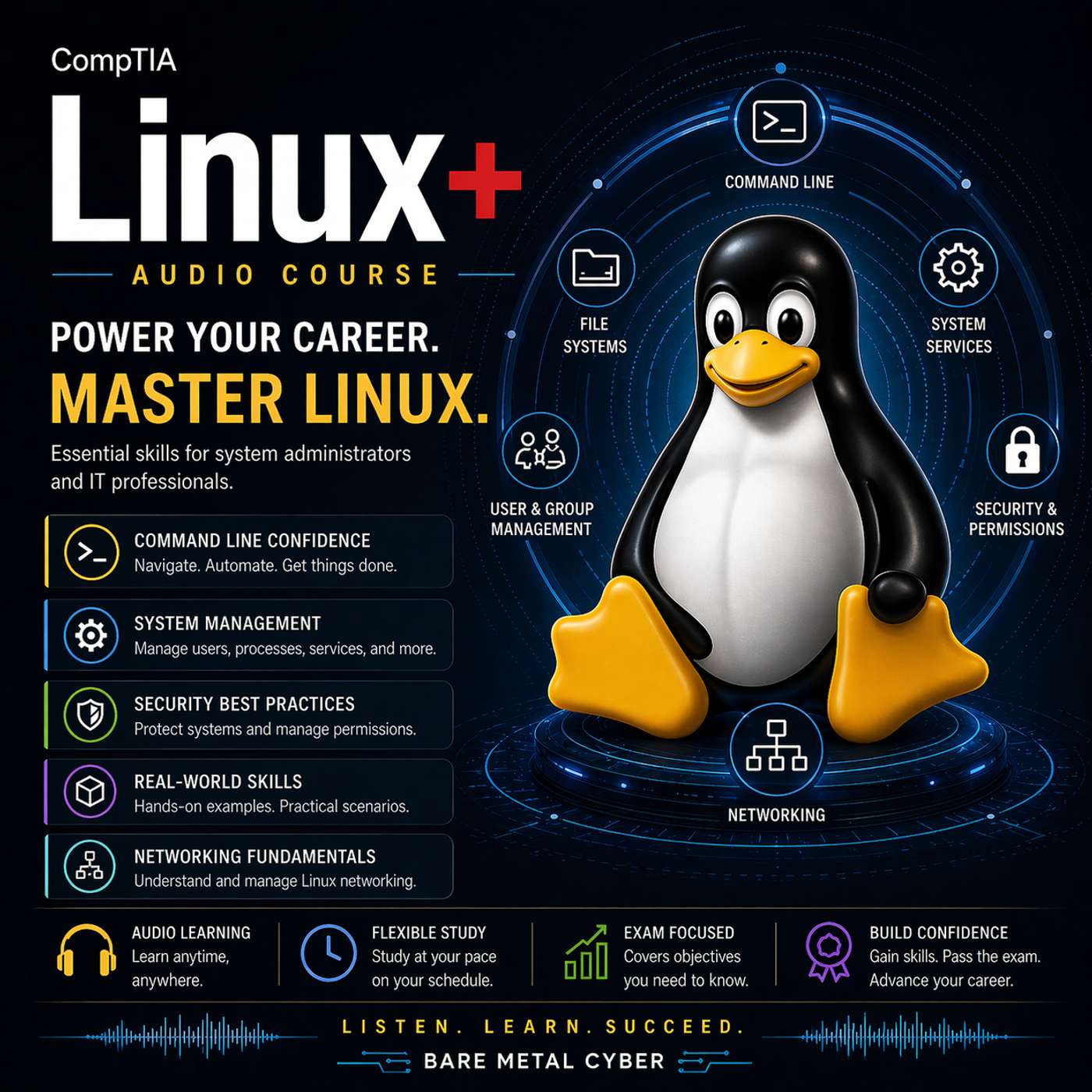
Linux+ for People With Jobs is a practical, audio-first course that teaches you to think and work like a real Linux administrator—without burying you in theory or trivia. You’ll learn the commands, concepts, and workflows the exam expects, but more importantly, you’ll build the habits that keep systems stable in production: verifying assumptions, making safe changes, and troubleshooting with a calm, repeatable process. Every episode is designed to help you study efficiently, retain what matters, and walk into the exam with confidence that actually transfers to the job.
Where to listen?
Podcasts in the app Replaio Radio Coming soonPodcasts are coming to the app soon. Install now and be the first to see a whole new take on podcasts
 Install for free
Android 5M+ downloads · 4.8 rating
iOS soon
Install for free
Android 5M+ downloads · 4.8 rating
iOS soon
Episodes
Episode 56 — firewalld mental model: zones, services vs ports, runtime vs permanent 07.02.2026 14:53
Linux+ tests firewalld because it represents policy-driven firewall management where intent matters more than individual rule syntax. This episode builds a mental model around zones as trust boundaries applied to interfaces and sources, defining which traffic is allowed by default and which must be explicitly permitted. You’ll learn the difference between allowing a named service versus opening a...
Episode 55 — Directory-backed auth: LDAP vs Kerberos vs Samba, in exam language 07.02.2026 17:18
Linux+ tests directory-backed authentication because understanding the roles of LDAP, Kerberos, and Samba prevents you from confusing “where identities are stored” with “how authentication happens.” This episode explains LDAP as a directory protocol used to query and store identity attributes, Kerberos as a ticket-based authentication system that proves identity without repeatedly sending password...
Episode 54 — Identity integration concepts: SSSD, Winbind, realm basics, and where they fit 07.02.2026 19:56
Identity integration appears on Linux+ because enterprise Linux rarely lives alone; it often consumes identities and policies from a central directory. This episode explains SSSD, Winbind, and realm concepts as ways Linux systems join or integrate with external identity providers, enabling centralized authentication, group membership, and policy enforcement. You’ll learn where these pieces fit: SS...
Episode 53 — Linux auth story: PAM, polkit, and what controls what 07.02.2026 15:48
Linux+ includes authentication and authorization because access control in Linux is a layered system, and questions often test whether you can identify which layer is responsible for a decision. This episode tells the Linux auth story using two key components: PAM as the pluggable framework that handles authentication and account policy checks for many login and privilege pathways, and polkit as t...
Episode 52 — Container networking: port mapping, network types, privileged vs unprivileged tradeoffs 07.02.2026 19:09
Container networking is on Linux+ because it tests whether you understand isolation boundaries and how services are exposed safely. This episode explains port mapping as the mechanism that connects a container’s internal service port to a host-accessible port, and it frames network types as different connectivity models that determine what can reach what by default. You’ll learn why the exam cares...
Episode 51 — Volumes and storage: persistence, mapping, overlay concepts, SELinux context awareness 07.02.2026 18:34
Linux+ tests container storage because persistence is where many real container deployments go wrong. This episode explains how containers use a layered filesystem model: an image provides read-only layers, a container adds a writable layer, and volumes or bind mounts provide persistent storage outside the container’s ephemeral write layer. You’ll learn why this matters on the exam: if data must s...
Episode 50 — Running containers: env vars, logs, exec, inspect, and what each is for 07.02.2026 12:43
Running containers is tested on Linux+ because day-to-day container administration is mostly about using the right runtime action for the right question. This episode organizes key runtime interactions by intent: environment variables shape application behavior without rebuilding images, logs reveal application and startup errors, exec lets you run commands inside a running container for targeted...
Episode 49 — Image operations: pull, build, tag, layers, and Dockerfile directive behavior 07.02.2026 12:32
Linux+ tests image operations because container usage depends on repeatable builds and predictable artifact management. This episode explains pull, build, and tag as lifecycle actions that determine where an image comes from, how it is constructed, and how it is referenced in deployments. You’ll learn why layers matter: images are assembled from cached build steps, and the order of those steps aff...
Episode 48 — Container fundamentals: runtimes and the image/container boundary 07.02.2026 11:15
Containers are on Linux+ because they represent a mainstream way to package and run workloads, and they require you to think clearly about what is immutable versus what changes at runtime. This episode defines the image/container boundary: images are built artifacts that define filesystem layers and metadata, while containers are running instances that add writable state and runtime configuration...
Episode 47 — systemctl troubleshooting mindset: status, logs, daemon-reload, enable, mask patterns 07.02.2026 12:44
Linux+ expects you to troubleshoot services using evidence, and systemctl is the primary interface for understanding systemd-managed state. This episode teaches a troubleshooting mindset centered on intent: confirm whether the unit is running, whether it is enabled to start at boot, what the last failure reason was, and what logs explain the behavior. You’ll learn why questions often hinge on smal...
Episode 46 — systemd units and targets: services, timers, mounts, targets, dependencies 07.02.2026 13:57
systemd is a major Linux+ topic because it defines how modern Linux systems start, stop, and coordinate services with predictable dependency behavior. This episode introduces unit types as building blocks: services represent long-running processes, timers schedule work, mounts define filesystem attachment behavior, and targets group units into higher-level system states similar to runlevels. You’l...
Episode 45 — Basic service configs at exam level: DNS, NTP, DHCP, HTTP, mail, what breaks 07.02.2026 16:13
Linux+ tests basic service configuration because administrators must recognize what “healthy” looks like and identify the most likely break points when a service fails. This episode frames DNS, NTP, DHCP, HTTP, and mail as service categories with predictable dependencies: network reachability, correct binding, correct configuration, and correct permissions. You’ll learn how exam questions describe...
Episode 44 — Language ecosystems: pip vs cargo vs npm, and how they fail differently 07.02.2026 14:16
Linux+ touches language ecosystems because modern systems often run software that is installed and updated outside the OS package manager. This episode compares pip, cargo, and npm as ecosystem-specific dependency managers that pull libraries, resolve versions, and install artifacts in ways that can differ dramatically from distribution packages. You’ll learn why the exam cares about “how they fai...
Episode 43 — Repositories and trust: enabling/disabling, third-party risk, signatures, exclusions 07.02.2026 14:14
Repositories are a Linux+ topic because they combine software supply chain trust with practical update management. This episode explains repositories as curated sources of packages and metadata, and it highlights why trust matters: the repository you enable determines what code can be installed and updated on your systems. You’ll learn how exam questions test repository management at a conceptual...
Episode 42 — Packages vs source: dependencies, conflicts, and clean rollback thinking 07.02.2026 14:26
Linux+ includes “packages versus source” because the choice affects maintainability, security updates, and incident response. This episode compares installing from distribution packages to building from source as two different operational models: packages provide managed dependencies, signature trust, and predictable upgrades, while source builds offer flexibility at the cost of manual dependency...
Episode 41 — Scheduling: cron vs anacron vs at, and choosing the right one 07.02.2026 14:22
Scheduling is tested on Linux+ because automation is only reliable when you pick the right scheduler for the job’s timing and execution guarantees. This episode differentiates cron, anacron, and at by intent: cron runs tasks on a fixed schedule, anacron ensures periodic jobs run even if the system was powered off at the exact scheduled time, and at runs a task once at a specific time. You’ll learn...
Episode 40 — Signals and job control: stop, continue, kill, foreground/background decisions 07.02.2026 15:45
Linux+ tests signals and job control because administrators must manage running work safely, especially when a process is misbehaving but data integrity still matters. This episode explains signals as messages delivered to processes, with different intents such as requesting a clean shutdown, pausing execution, or forcing termination. You’ll learn how job control works in a shell session: foregrou...
Episode 39 — Reading process reality: ps/top/htop/proc and what to look for first 07.02.2026 18:17
Processes are central to Linux+ because nearly every troubleshooting scenario eventually becomes “what is running, under what identity, consuming what resources, and why.” This episode teaches you to read process reality using multiple viewpoints: ps for snapshot listings, top/htop for live behavior, and /proc as the authoritative source of per-process details like command line, open files, and ru...
Episode 38 — Password aging and lockouts: expiration, chage concepts, and common gotchas 07.02.2026 18:18
Linux+ includes password aging and lockout behavior because access control is not just “set a password,” it is policy enforcement over time. This episode explains expiration, minimum and maximum password age, and warning periods as controls that shape how credentials are maintained and when users are forced to rotate. You’ll learn how tools like chage represent these controls conceptually: they do...
Episode 37 — Account lifecycle: add, modify, delete, shells, and least-privilege habits 07.02.2026 18:47
Account lifecycle management appears on Linux+ because administrators must create access cleanly, adjust it safely, and retire it without leaving security debt behind. This episode frames user and group changes as controlled operations: provisioning accounts with the right defaults, modifying attributes like group membership and shells to match job role, and deprovisioning in a way that protects d...
Episode 36 — Users, groups, and identity: UID, GID, EUID, EGID explained simply 07.02.2026 18:17
Linux+ tests identity concepts because permissions, auditing, and service behavior all depend on which identity the system believes is acting. This episode explains UID and GID as the core numeric identities for users and groups, then clarifies the “effective” identities—EUID and EGID—that determine what access checks actually use at runtime. You’ll learn why the exam emphasizes numbers, not names...
Episode 35 — Links and metadata: hard vs symbolic, stat thinking, and why it matters 07.02.2026 16:18
Links are a Linux+ staple because they reveal how Linux represents files and how administrators can design flexible paths without duplicating data. This episode explains hard links and symbolic links as two distinct mechanisms: hard links are additional directory entries pointing to the same inode, while symbolic links are special files that point to a path name. You’ll learn why the exam cares: l...
Episode 34 — Finding things fast: locate vs find, and which tool fits decisions 07.02.2026 16:44
Linux+ questions often compress a troubleshooting scenario into “you need to identify the file quickly,” and the correct tool depends on speed versus accuracy. This episode contrasts locate and find as two different approaches: locate searches an index for fast results, while find walks the filesystem in real time for authoritative results. You’ll learn why this distinction matters on the exam: lo...
Episode 33 — File operations you’re tested on: create, move, copy, remove safely 07.02.2026 21:08
Linux+ tests file operations because they are the foundation of administration and because small mistakes can cause real outages. This episode focuses on safe creation, movement, copying, and removal of files and directories, emphasizing how the exam expects you to reason about outcomes like overwriting, preserving attributes, and handling directories recursively. You’ll learn to interpret questio...
Episode 32 — libvirt and virsh mental model: what these tools manage and how questions frame them 07.02.2026 17:58
Linux+ expects you to recognize common virtualization management layers, and libvirt is a key abstraction that standardizes how VMs are defined and controlled. This episode builds a mental model: libvirt provides a management API and service that stores VM definitions and coordinates actions, while virsh is a command-line interface used to query and control that state. You’ll learn how exam questi...
Similar podcasts







Listen to the Certified: The CompTIA Linux+ Audio Course podcast in Replaio
Radio and podcasts in one app - free, with no sign-up. Install today and do not miss the launch
Replaio is not a podcast publisher; show names, artwork and audio belong to their authors and are distributed through public RSS feeds.