Dr. Jason Edwards
Certified - CompTIA Project+ Audio Course
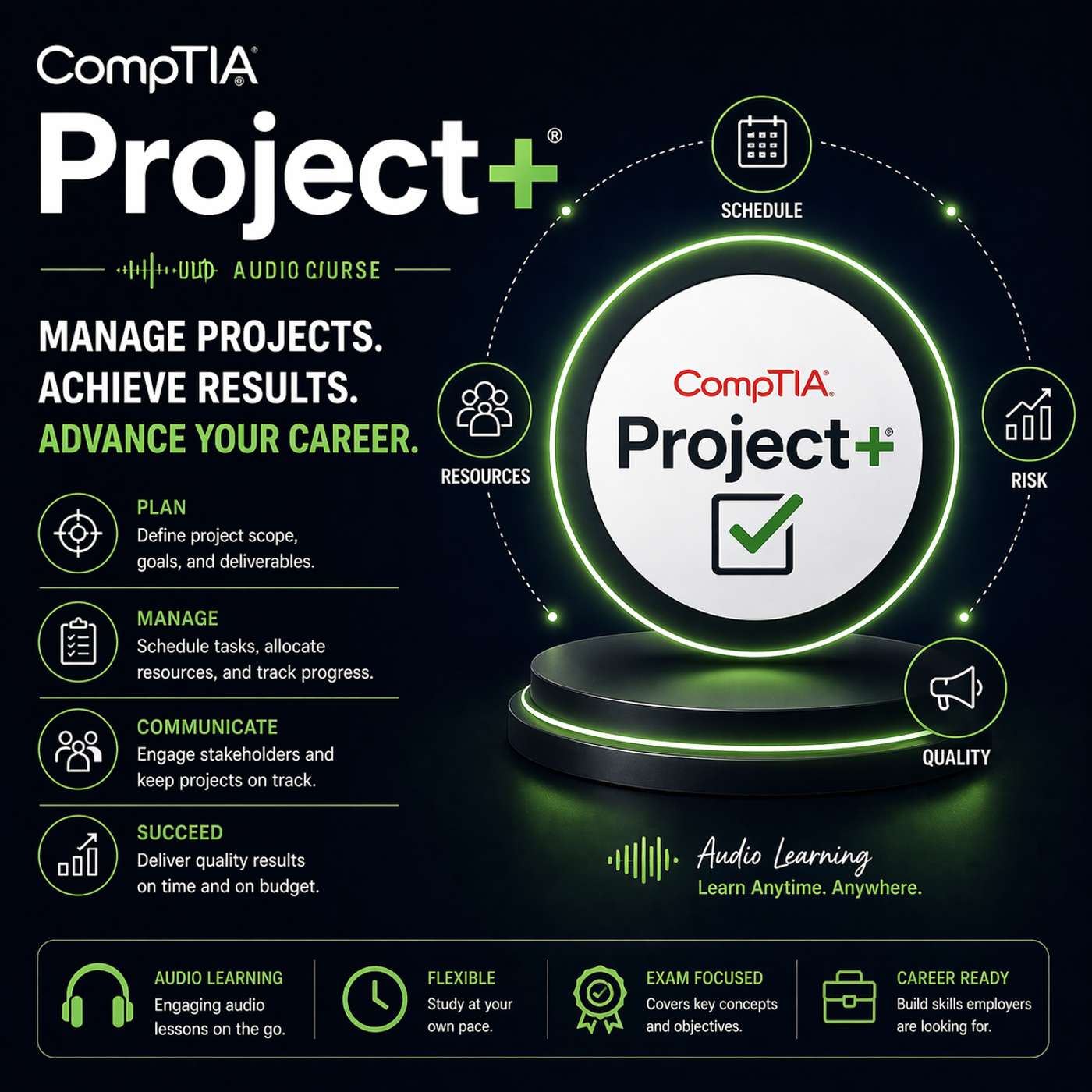
The Project+ Audio Course is a complete, on-demand learning series built around the CompTIA Project+ (PK0-005) certification exam objectives. Each episode transforms key project management concepts into clear, practical, and easy-to-follow lessons you can absorb anytime, anywhere. Covering topics such as project life cycles, scheduling, budgeting, communication, risk management, and IT governance, this Audio Course helps you develop the knowledge and confidence to lead and support projects effectively. Whether you’re an IT professional managing technical initiatives or a newcomer learning form...
Author
Dr. Jason Edwards
Category
Podcast website
Latest episode
Oct 14, 2025
Where to listen?
Podcasts in the app Replaio Radio Coming soonPodcasts are coming to the app soon. Install now and be the first to see a whole new take on podcasts
 Install for free
Android 5M+ downloads · 4.8 rating
iOS soon
Install for free
Android 5M+ downloads · 4.8 rating
iOS soon
Episodes
Episode 87: CI/CD, Beta Environments, and Tiered Architecture 17.08.2025 13:59
In this episode, we explore modern deployment practices and infrastructure structures. Continuous Integration/Continuous Deployment (CI/CD) processes are explained as automated workflows that speed up delivery while maintaining quality through frequent testing and integration. We then examine beta or staging environments, which allow changes to be tested in realistic conditions before production r...
Episode 86: Change Control: Downtime, Rollback, Validation, and Notifications 17.08.2025 16:11
This episode examines change control processes specific to IT infrastructure and software projects. We explain how to plan for downtime or maintenance windows to minimize business disruption, including scheduling during off-peak hours and securing necessary approvals. Rollback plans are covered as critical safety nets, allowing systems to be restored to a known stable state if a change fails. We a...
Episode 85: Software Platforms: ERP, CRM, CMS, and Records Systems 17.08.2025 15:25
This episode reviews major categories of enterprise software platforms and their roles in project environments. We cover Enterprise Resource Planning (ERP) systems for integrated business processes, Customer Relationship Management (CRM) tools for managing client interactions, Content Management Systems (CMS) for organizing and publishing digital assets, and Electronic Document and Records Managem...
Episode 84: Cloud Models: SaaS, PaaS, IaaS, and XaaS for PMs 17.08.2025 14:56
In this episode, we explain the primary cloud service models—Software as a Service (SaaS), Platform as a Service (PaaS), Infrastructure as a Service (IaaS)—and the broader category of Anything as a Service (XaaS). We define each model, its responsibilities, and typical use cases, with a focus on how they influence project cost, scalability, and maintenance responsibilities. We also compare benefit...
Episode 83: IT Infrastructure Fundamentals: Architecture, Networking, Storage 17.08.2025 14:14
This episode introduces core IT infrastructure concepts relevant to project management. We explain the components of computing architectures, including servers, clients, and multitiered structures. Networking fundamentals such as connectivity types, bandwidth considerations, and redundancy are discussed alongside storage solutions, from local drives to network-attached storage and cloud-based syst...
Episode 82: Global Privacy Laws: Country, State, and Industry Requirements 17.08.2025 14:50
In this episode, we focus on privacy laws that vary across jurisdictions and industries. We explain the implications of regulations such as the EU’s General Data Protection Regulation (GDPR), the California Consumer Privacy Act (CCPA), and health-sector requirements like HIPAA. You’ll learn how these rules govern the collection, storage, and processing of personal data in projects. We also discuss...
Episode 81: Compliance and Confidentiality: Regulatory and Legal Impacts 17.08.2025 14:12
This episode explores how compliance requirements and confidentiality obligations influence project planning and execution. We discuss key regulatory frameworks and legal standards that may apply, such as data protection laws, industry-specific compliance rules, and intellectual property protections. Confidentiality requirements are explained in terms of contractual obligations, non-disclosure agr...
Episode 80: Corporate IT Policies: Branding, Access, and Behavior 17.08.2025 7:36
This episode examines how corporate IT policies shape project work by defining rules for branding, access control, and acceptable use. Branding policies ensure consistent visual identity in deliverables, while access policies control who can use corporate systems and data. Acceptable use policies set behavioral standards for technology use, reducing the risk of misuse or security incidents. We als...
Episode 79: Data Classification: IP, PII, PHI, and National Security Data 17.08.2025 14:22
In this episode, we focus on classifying data according to sensitivity and regulatory requirements. We define categories including intellectual property (IP), personally identifiable information (PII), personal health information (PHI), and national security-related data. Each classification type is linked to specific handling, storage, and transmission requirements. We also explain how proper cla...
Episode 78: Digital Access: Remote Access, Permissions, and MFA 17.08.2025 14:49
This episode covers the digital access controls used to secure systems and data in projects. We explain how to manage permissions through role-based access, enforce least-privilege principles, and set up approval workflows for elevated permissions. Remote access policies are discussed, including VPN requirements, device compliance, and monitoring. We also examine multifactor authentication (MFA) a...
Episode 77: Operational Security: Screenings, Clearances, and Role Restrictions 17.08.2025 15:24
In this episode, we focus on operational security measures designed to protect projects from insider threats and ensure only authorized personnel have access to sensitive functions. We explain pre-employment background screenings, security clearances for classified work, and role-based restrictions that limit access according to project needs. We also discuss integrating these measures into hiring...
Episode 76: Physical Security: Devices, Media, and Facilities 17.08.2025 17:26
This episode examines the physical security measures that protect project assets, covering devices, removable media, and facilities. For devices, we discuss safeguards such as cable locks, secure storage, and inventory tracking. For removable media, controls include encryption, restricted access, and proper disposal methods to prevent data leakage. Facility security covers elements like badge acce...
Episode 75: Governance, Values, and Brand Alignment in Projects 17.08.2025 13:32
This episode focuses on the governance aspect of ESG, explaining how adherence to corporate policies, ethical guidelines, and regulatory frameworks shapes project execution. We discuss how aligning project objectives with organizational mission and values supports brand integrity and stakeholder trust. Examples show how governance practices, such as regular audits, transparent reporting, and compl...
Episode 74: Environmental and Social Impacts of Project Decisions 17.08.2025 15:05
In this episode, we dive deeper into the environmental and social components of ESG. Environmental impacts may include energy use, waste generation, and effects on local ecosystems. Social impacts can involve job creation, community engagement, and cultural considerations. We provide examples of how project decisions—such as supplier selection or facility location—can influence these outcomes. You...
Episode 73: Understanding ESG: What It Means for Project Managers 17.08.2025 15:23
This episode opens Domain 4 by defining Environmental, Social, and Governance (ESG) factors and their relevance to project management. Environmental aspects involve the project’s impact on resources, emissions, and sustainability. Social factors consider how projects affect communities, employees, and customers. Governance focuses on ethical practices, compliance, and organizational transparency....
Episode 72: Analyzing Charts: Pareto, Burnup, Velocity, and Decision Trees 17.08.2025 11:21
In this episode, we examine data visualization tools that guide decision-making and performance assessment. Pareto charts identify the most significant issues by showing frequency or impact, helping prioritize corrective actions. Burnup charts track progress toward scope completion, while velocity charts measure Agile team delivery rates over iterations. Decision trees visualize possible outcomes...
Episode 71: Case Management and Ticketing Tools in Support-Heavy Projects 17.08.2025 11:43
This episode focuses on case management and ticketing systems, which are essential in projects involving significant customer or user support. Case management tools track issues from initial report through resolution, maintaining detailed histories for accountability and improvement. Ticketing systems manage service requests, defects, and incidents in an organized queue, enabling prioritization an...
Episode 70: Scheduling Tools: Cloud vs. On-Premise and Local Installations 17.08.2025 12:12
This episode examines the different deployment models for project scheduling tools. Cloud-based solutions offer accessibility, scalability, and easier collaboration, while on-premise tools may provide greater control, customization, and security for sensitive projects. Local installations can be suitable for smaller teams or projects with limited connectivity. We compare the advantages and trade-o...
Episode 69: Office Productivity: Word Processors, Spreadsheets, and Diagrams 17.08.2025 13:19
In this episode, we review core productivity software that supports project documentation, planning, and reporting. Word processors create formal documents such as charters, contracts, and status reports. Spreadsheets handle calculations, schedules, and data analysis, while diagramming tools visually represent workflows, processes, and organizational structures. These tools are foundational to dai...
Episode 68: Meeting Tools: Calendars, Polling, Print Media, and Conferencing 17.08.2025 13:34
This episode explores meeting-focused tools that support planning, engagement, and participation. Calendaring tools coordinate availability and send reminders, ensuring maximum attendance. Polling tools gather participant input in real time, aiding decision-making during sessions. Print media, while less common in digital environments, can still be valuable for in-person workshops or stakeholder b...
Episode 67: Workflow and E-Signature Platforms in the Project Environment 17.08.2025 10:51
In this episode, we focus on workflow automation and e-signature platforms, both of which streamline project processes. Workflow platforms coordinate task assignments, enforce approval paths, and provide visibility into process status, reducing manual tracking. E-signature platforms accelerate contract approvals, change request sign-offs, and other document authorizations while maintaining securit...
Episode 66: Collaboration Tools: Real-Time Editors, File Sharing, Wikis, and Whiteboards 17.08.2025 11:11
This episode examines collaboration platforms that enable teams to work together efficiently, regardless of location. Real-time editors allow multiple contributors to work on documents or code simultaneously, improving speed and reducing version conflicts. File sharing platforms centralize storage and access, ensuring stakeholders can retrieve the latest materials. Wikis provide an evolving knowle...
Episode 65: Communication Tools: Email, SMS, Video, and Enterprise Social 17.08.2025 10:59
This episode focuses on communication platforms and their roles in project management. We compare email for formal correspondence, SMS and chat for rapid updates, video conferencing for rich, synchronous discussions, and enterprise social networks for collaborative knowledge sharing. The PK0-005 exam tests your ability to select the appropriate tool based on audience, urgency, and context. We also...
Episode 64: Version Control, Time Tracking, and Requirements Traceability Matrix 17.08.2025 11:24
In this episode, we cover three distinct but interconnected tools. Version control systems manage document and file changes over time, ensuring accuracy and enabling rollback when needed. Time tracking tools monitor labor hours and support budget control. The Requirements Traceability Matrix (RTM) links project requirements to deliverables, ensuring nothing is overlooked during execution. We explo...
Similar podcasts







Listen to the Certified - CompTIA Project+ Audio Course podcast in Replaio
Radio and podcasts in one app - free, with no sign-up. Install today and do not miss the launch
Replaio is not a podcast publisher; show names, artwork and audio belong to their authors and are distributed through public RSS feeds.